


Turning a completed dissertation into a journal article is one of the most valuable steps an academic researcher can take toward building a publication record. However, converting a dissertation to a journal article involves considerably more than shortening chapters or removing appendices. A dissertation is designed to demonstrate comprehensive research competence, whereas a journal manuscript must communicate a focused scholarly contribution within strict editorial and word-count limits.
Many doctoral graduates encounter the same challenges: deciding which chapter offers the strongest publication potential, reducing a 20,000-word chapter to a 6,000-word manuscript, restructuring the literature review, and maintaining methodological transparency while eliminating unnecessary detail. Citation inconsistencies, overlapping publications, and journal-specific formatting requirements introduce further complications.
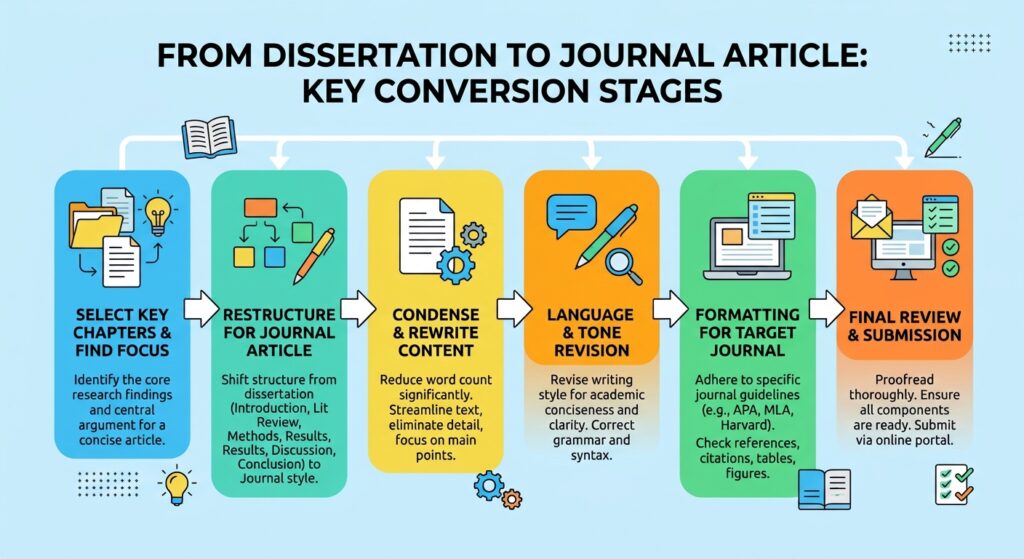
Converting a dissertation to a journal article is the process of selecting a coherent research contribution from a thesis, restructuring its content around a focused research question, and adapting its presentation to meet a target journal's editorial and submission requirements.
A successful conversion preserves the integrity of the original research while making its findings accessible, relevant, and compelling to a journal readership. This guide explains how to select a dissertation chapter, determine what to retain or remove, restructure the manuscript, address publication ethics, and prepare the final submission.
💡 Ready to polish your research paper for publication?
Transform your manuscript with PaperEdit's professional editing and proofreading services.
1. Understand the Difference Between a Dissertation and a Journal Article
Before adapting a thesis chapter for publication, understand that these two academic documents serve different purposes. A dissertation establishes the researcher's ability to conduct independent scholarly investigation. A journal article communicates a specific contribution to an established academic conversation.
Consequently, simply condensing dissertation chapters rarely produces a publication-ready manuscript.
Key structural and editorial differences
| Feature | Dissertation | Journal Article |
| Primary purpose | Demonstrate research competence | Present an original scholarly contribution |
| Length | Often 40,000–100,000+ words | Commonly 3,000–8,000 words, depending on journal |
| Literature review | Comprehensive and extensive | Selective and argument-driven |
| Methodology | Detailed procedural documentation | Relevant methodological information |
| Results | May include extensive supplementary findings | Focused on findings answering the research question |
| Discussion | Broad interpretation and implications | Direct interpretation of the principal findings |
| References | Extensive bibliography | Relevant, carefully selected references |
| Audience | Supervisory committee and examiners | Specialist academic readership |
Note: These word counts are illustrative, not universal requirements. Journal article limits vary by discipline, article type, and publisher.
Why does this distinction matter?
Journal editors and reviewers evaluate manuscripts according to originality, methodological rigor, relevance, clarity, and contribution to the field. A dissertation may satisfy examination requirements without presenting its findings in the concise, argument-driven format expected by a journal.
For example, a doctoral thesis might devote 8,000 words to reviewing theoretical developments. A journal article based on the same research may need only 1,000-1,500 words of literature review to establish the research gap and justify its objectives.
Common submission pitfall: Treating the dissertation as a manuscript that requires only deletion. Successful adaptation requires restructuring, rewriting, and prioritization not simply condensation.
2. Select the Right Dissertation Chapter for Publication
Not every dissertation chapter is suitable for independent publication. The strongest candidate is usually the chapter that contains a clearly defined research problem, a defensible methodology, substantial findings, and an identifiable contribution to existing literature.
Step 1: Evaluate the publication potential of each chapter
Begin by auditing your dissertation and identifying chapters or sections with independent scholarly value.
Consider the following possibilities:
- Empirical research chapter: Often suitable for an original research article because it contains a research question, methodology, results, and interpretation.
- Literature review chapter: May support a narrative review, scoping review, or systematic review if its methodology and coverage meet the relevant standards.
- Theoretical framework chapter: May be developed into a conceptual or theoretical article if it advances a meaningful argument.
- Methodology chapter: May support a methods paper when it introduces or validates a novel research technique.
- Discussion chapter: May provide the foundation for a scholarly commentary or synthesis, provided it offers a sufficiently original contribution.
Step 2: Apply a publication-readiness test
Assess each potential chapter against five criteria:
- Originality: Does it offer findings, arguments, or methodological insights beyond established knowledge?
- Research focus: Can its central question be communicated in one or two sentences?
- Evidence: Does it contain sufficient data or scholarly support?
- Journal relevance: Does its subject fit an identifiable journal's scope?
- Standalone completeness: Can readers understand the research without consulting the entire dissertation?
A chapter that performs well across these criteria is a stronger publication candidate.
Step 3: Identify the central contribution
Write a one-sentence statement explaining what the article contributes to the discipline.
For example:
"This study demonstrates how institutional support influences postgraduate research productivity among early-career academics in public universities."
Use this statement to guide every subsequent editorial decision. If a paragraph does not help establish the research problem, explain the methods, present the evidence, or interpret the contribution, consider removing it.
Common submission pitfall: Attempting to publish several unrelated dissertation chapters as one article. Combining disconnected research objectives often produces an unfocused manuscript that lacks a coherent central argument.
Also read: Language Errors in Manuscripts: How to Avoid Rejection
3. Decide How Much to Shorten and Rewrite
One of the most common questions researchers ask is: How much do you need to shorten a thesis chapter for publication?
There is no universal reduction percentage. The appropriate length depends on the target journal's article category, methodological requirements, disciplinary conventions, and word limit.
A 12,000 word dissertation chapter might become a 5,000-word article, while another chapter may require extensive rewriting to become publishable at all.
Condensation versus rewriting: Which approach works best?
Condensation removes redundant or nonessential material while preserving the original structure. Rewriting reorganizes the argument, changes the emphasis, and develops the content around the expectations of a journal audience.
| Editorial approach | What it involves | Best application |
| Condensation | Removing repetition and excessive background | Chapters with an already focused argument |
| Structural rewriting | Reorganizing sections and arguments | Chapters designed primarily for examination |
| Literature refinement | Retaining only relevant and influential studies | Extensive dissertation literature reviews |
| Results consolidation | Combining secondary findings and removing repetition | Data-heavy empirical chapters |
| Language editing | Improving clarity, grammar, precision, and academic tone | All manuscripts |
| Journal formatting | Applying journal-specific presentation requirements | Final submission preparation |
Recommended word-count allocation
For a hypothetical 6,000-word original research article, the following distribution can provide a useful starting point:
| Section | Suggested word count | Approximate share |
| Abstract | 200-250 | 3–4% |
| Introduction | 700-900 | 12–15% |
| Literature review/background | 900-1,100 | 15–18% |
| Methodology | 900-1,100 | 15–18% |
| Results | 1,000-1,200 | 17-20% |
| Discussion | 1,000-1,200 | 1720% |
| Conclusion | 200-300 | 3-5% |
| Remaining space | As required | References, captions, and other journal-dependent material |
These allocations are illustrative. Some journals integrate the literature review into the introduction, while others impose separate limits for abstracts, tables, or figures.
Common submission pitfall: Cutting the methodology and results excessively to meet a word limit. Preserve enough information for readers and reviewers to evaluate the research design, reproducibility, statistical procedures, and validity of the conclusions.
4. Restructure the Dissertation Chapter into a Journal Manuscript
A journal article needs a logical progression that takes readers from the research problem to the evidence and its implications. Avoid retaining dissertation chapter headings simply because they appeared in the original document.
A. Rewrite the introduction
The introduction should establish the research problem, identify the knowledge gap, explain its significance, and present the study's objectives or hypotheses.
Retain:
- Relevant background information.
- The most important theoretical context.
- Recent and foundational studies.
- A clearly articulated research gap.
- Research objectives, questions, or hypotheses.
Remove lengthy historical discussions, broad textbook explanations, and background material unrelated to the article's central argument.
B. Refine the literature review
A dissertation literature review demonstrates comprehensive knowledge. A journal literature review establishes why the current study matters.
Organize the discussion around scholarly debates, unresolved questions, methodological limitations, and conflicting findings.
Do not simply list previous studies. Synthesize their contributions and demonstrate how your research extends, challenges, or refines existing knowledge.
C. Rebuild the methodology
The methodology must remain sufficiently detailed for critical evaluation and, where applicable, replication.
Retain relevant information about:
- Research design and setting.
- Sampling procedures and participant characteristics.
- Data collection instruments.
- Experimental or analytical procedures.
- Statistical methods and software.
- Ethical approval and informed consent, where applicable.
Remove procedural details that do not affect interpretation or reproducibility. Transfer appropriate supporting information to supplementary materials when the journal permits.
D. Prioritize the results
Present findings according to the research questions rather than reproducing every dissertation table.
Select the most important results and ensure that each table or figure communicates a distinct piece of evidence.
For quantitative research, report relevant statistical information, such as effect sizes, confidence intervals, test statistics, and exact p-values where appropriate. For qualitative research, present representative evidence and explain how it supports the identified themes.
E. Develop a focused discussion and conclusion
Interpret the findings rather than repeating them. Explain how they relate to previous research, why differences or similarities matter, and what theoretical or practical implications follow.
A strong conclusion should answer the research question, acknowledge important limitations, and identify appropriate future research directions.
Also read: Properly Paraphrasing Complex Technical Passages Without Patchwriting
5. Address Publication Ethics and Dissertation Ownership
Converting a dissertation to a journal article introduces important questions about originality, prior dissemination, authorship, and copyright. Researchers must resolve these issues before submitting their manuscripts.
Can you publish a dissertation chapter as a standalone research article?
In many cases, yes. However, eligibility depends on the journal's prior-publication policy, the dissertation's publication history, copyright arrangements, and the extent to which the manuscript constitutes an original scholarly contribution.
A dissertation deposited in an institutional repository is not automatically equivalent to a previously published peer-reviewed journal article. Nevertheless, individual publishers and journals apply different policies.
Before submission:
- Check whether your university requires an embargo or imposes repository-related conditions.
- Review the target journal's policy on theses, dissertations, preprints, and prior dissemination.
- Disclose the dissertation's availability in the cover letter when required.
- Cite the dissertation where appropriate.
- Confirm that you retain the necessary rights to reuse figures, tables, and other copyrighted material.
Maintain accurate authorship attribution
Include all individuals who meet the target journal's authorship criteria. Supervisors should not automatically be included merely because they supervised the dissertation, nor should qualifying contributors be omitted.
Discuss authorship order and responsibilities before submission. Follow the journal's requirements for acknowledgments, funding statements, conflicts of interest, and author contributions.
Avoid duplicate publication and text recycling
Reusing your own dissertation material is not automatically misconduct. However, presenting previously published work as entirely new, submitting substantially overlapping manuscripts without disclosure, or reproducing copyrighted content without permission can create serious publication-ethics concerns.
Disclose relevant overlap and follow the journal's requirements for transparent reporting.
For additional guidance, consult the ICMJE Recommendations and the COPE Core Practices.
6. Choose the Right Journal Before Finalizing the Article
Do not complete the manuscript first and search for a journal afterward. Selecting a suitable target early helps determine the article's structure, length, terminology, reporting requirements, and citation style.
Evaluate journal suitability
Assess potential journals according to:
- Scope: Does the journal regularly publish research in your specific subject area?
- Audience: Are its readers likely to benefit from your findings?
- Article types: Does it accept original research, reviews, methods papers, or theoretical contributions?
- Editorial standards: Are its peer-review and research-integrity policies transparent?
- Indexing: Is its indexing status relevant and verifiable?
- Publication fees: Are article processing charges and other costs clearly disclosed?
- Turnaround information: Does the journal provide credible information about editorial and peer-review timelines?
Avoid selecting a journal solely because it advertises rapid acceptance. Verify its legitimacy and examine recently published articles to assess thematic and methodological compatibility.
Match the manuscript to the journal's guidelines
Once you identify a target journal, download its current author instructions and create a compliance checklist.
Pay particular attention to:
- Maximum word count.
- Abstract structure and length.
- Required keywords.
- Heading hierarchy.
- Citation and reference style.
- Table and figure specifications.
- Supplementary-material requirements.
- Double-blind review and anonymization.
- Ethical declarations and reporting checklists.
Official style resources include the APA Style website, the IEEE Author Center, and Purdue OWL.
Common submission pitfall: Applying APA 7th, IEEE, Vancouver, Harvard, or Chicago formatting based on the dissertation's original requirements instead of the target journal's instructions. The journal's specified reference and manuscript conventions take priority.
7. Format Figures, Tables, References, and Supporting Materials
Formatting is not merely a presentation exercise. It improves readability, supports accurate interpretation, and demonstrates compliance with editorial requirements.
Standardize visual elements
Review every figure and table individually.
- Number figures and tables consistently.
- Use descriptive titles and informative captions.
- Define abbreviations and explain symbols.
- Ensure all visual elements are cited in the manuscript.
- Check that numerical values match the results section.
- Follow the journal's accepted file formats and image specifications.
For raster images, 300 DPI is a common minimum for photographic-quality figures, while line art may require 600 DPI or higher. Always follow the journal's actual technical specifications rather than treating these values as universal requirements.
Audit citations and references
Use a reference manager such as Zotero, EndNote, or Mendeley to standardize citations and reduce manual formatting errors.
Check that:
- Every in-text citation appears in the reference list.
- Every reference-list entry is cited in the manuscript.
- Author names and publication years are accurate.
- DOI links and article details are correct.
- Citation punctuation and ordering follow the required style.
- Reused tables, figures, and instruments have appropriate permissions and attribution.
Consider professional academic editing and proofreading if language inconsistencies or formatting errors are affecting the manuscript's presentation.
Common submission pitfall: Updating citations in the main text without updating the reference list. Such inconsistencies can create avoidable editorial queries and undermine the manuscript's professionalism.
Also read: Understanding Turnitin Similarity Index Scores vs. Plagiarism
8. Conduct a Final Manuscript Review Before Submission
The final review should evaluate the manuscript as a complete journal submission rather than as an isolated dissertation chapter.
Pre-submission editing checklist
Research content and structure
- The manuscript presents one clearly defined research contribution.
- The research question and objectives are explicit.
- The literature review establishes a meaningful knowledge gap.
- The methodology provides sufficient detail.
- Results directly address the research objectives.
- The discussion interprets rather than repeats findings.
- Limitations and implications are appropriately explained.
Academic language and editing
- Grammar, spelling, punctuation, and sentence structure are accurate.
- Academic tone and terminology remain consistent.
- Unnecessary repetition and wordiness have been eliminated.
- Tense, voice, and abbreviations are standardized.
- ESL-related language issues have been addressed.
- Tracked changes and editorial comments have been resolved.
Formatting and publication compliance
- The manuscript follows the target journal's author guidelines.
- Abstract, keywords, and word count meet requirements.
- Citations and references are consistent.
- Figures and tables meet technical specifications.
- Ethical approvals and disclosures are included.
- The manuscript is anonymized if double-blind review requires it.
- Copyright permissions have been obtained where necessary.
- The cover letter accurately describes the manuscript's contribution.
- The dissertation's publication history and relevant overlap have been disclosed.
A final independent proofreading review can help identify inconsistencies that authors often overlook after working extensively with the same document.
Conclusion: Turn Your Dissertation into a Publishable Contribution
Converting a dissertation to a journal article requires strategic selection, structural rewriting, focused literature synthesis, methodological precision, and careful compliance with journal requirements. The objective is not to reproduce the entire thesis in a shorter format. It is to extract its strongest scholarly contribution and present it in a form that journal editors, peer reviewers, and specialist readers can evaluate efficiently.
Start by identifying the chapter with the clearest independent contribution. Select a suitable journal early, rebuild the manuscript around its central research question, preserve essential methodological detail, and address publication ethics before submission. Finish with a thorough review of academic language, citations, figures, and formatting.
Give your research the professional presentation it deserves. PaperEdit's expert manuscript editing, academic proofreading, and formatting support can help transform a promising dissertation chapter into a polished, journal-ready research article. Visit PaperEdit to prepare your manuscript for its next academic milestone.