


A research manuscript may contain more valuable information than a journal's word count, figure allowance, or formatting requirements can accommodate. Detailed statistical analyses, extended methodology descriptions, additional figures, raw datasets, and research instruments often exceed the space available in the main article. Removing these materials entirely, however, can weaken research transparency and make it difficult for readers to evaluate the study's findings.
Supplementary materials are additional research files published or made available alongside a journal article to provide supporting information that is relevant to the study but not essential to understanding its central argument. They allow researchers to preserve methodological detail, demonstrate analytical rigor, and improve reproducibility without overwhelming the main manuscript.
Understanding what to include in supplementary materials, what to move out of the main text, and how to cite supplementary tables and figures correctly is essential for journal submission readiness. Poorly organized supplementary files can create inconsistencies, complicate peer review, and even delay publication.
This guide explains how to select, organize, label, format, and reference supplementary information while complying with journal requirements and maintaining academic integrity.
💡 Ready to polish your research paper for publication?
 Transform your manuscript with PaperEdit's professional editing and proofreading services. Ensure consistent academic language, accurate formatting, and submission-ready supplementary documents.
1. What Are Supplementary Materials in a Research Paper?
Supplementary materials are supporting documents, datasets, figures, tables, multimedia files, or extended methodological information submitted separately from the main manuscript.
Journals commonly publish these materials online alongside the accepted article. Depending on the publisher, they may appear under headings such as Supplementary Information, Online Supplement, Supporting Information, or Additional Files.
Why Are Supplementary Materials Important?
Supplementary information serves several academic purposes:
- Research transparency: Provides additional evidence supporting the reported findings.
- Methodological reproducibility: Documents experimental procedures, analytical decisions, and research instruments.
- Data accessibility: Makes relevant datasets, coding frameworks, and statistical outputs available to readers.
- Manuscript readability: Prevents lengthy technical explanations from interrupting the central narrative.
- Peer-review support: Allows reviewers to examine additional evidence without expanding the main article unnecessarily.
What Do Journals Typically Expect?
Although requirements vary, supplementary files should be:
- Directly relevant to the research question.
- Clearly identified and organized.
- Referenced at appropriate points in the main manuscript.
- Consistent with the information presented in the article.
- Submitted in publisher-approved file formats.
- Complete enough to be understood independently.
Importantly, supplementary materials are not an opportunity to hide inconvenient results or present information that should have appeared in the main article.
2. What Types of Data and Analyses Belong in Supplementary Materials?
Selecting appropriate supplementary content requires distinguishing between information necessary to understand the study and information that provides additional technical detail.
A. Extended Methodology and Research Protocols
Move detailed methodological information into supplementary files when the main Methods section already provides sufficient information to understand and evaluate the research design.
Examples include:
- Full experimental protocols.
- Detailed laboratory procedures.
- Extended survey questionnaires.
- Interview guides and coding frameworks.
- Additional equipment specifications.
- Detailed descriptions of computational models.
- Expanded descriptions of statistical procedures.
Industry-standard criterion: Retain enough methodological information in the main manuscript for readers to understand what was done, why it was done, and how the findings were generated. Supplementary methods should provide additional operational detail rather than replace essential methodological reporting.
B. Supplementary Tables and Figures
Supplementary tables and figures are appropriate when they provide additional evidence without being essential to the central argument.
Common examples include:
- Additional subgroup analyses.
- Extended descriptive statistics.
- Sensitivity and robustness analyses.
- Additional regression models.
- Secondary outcome comparisons.
- Detailed demographic distributions.
- Additional experimental images.
- Expanded graphical representations of results.
For example, a clinical research article may present its primary outcome in Figure 2 while providing additional subgroup comparisons in Supplementary Figure S1.
Common pitfall: Moving a critical result into supplementary information simply to meet a journal's figure limit. The principal findings must remain visible in the main article.
C. Raw Data, Datasets, and Statistical Outputs
Research datasets may be included as supplementary files when permitted by the journal and when ethical, privacy, and data-sharing requirements are satisfied.
Potential materials include:
- De-identified participant-level datasets.
- Additional descriptive statistics.
- Statistical analysis outputs.
- Data dictionaries.
- Variable definitions.
- Extended model diagnostics.
- Supporting computational results.
For large datasets, a recognized repository may be more appropriate than direct journal submission.
Always check consent restrictions, institutional policies, confidentiality requirements, and applicable data protection regulations before sharing research data.
D. Software, Code, and Computational Materials
Computational research often requires additional documentation to support reproducibility.
Consider including:
- Statistical analysis scripts.
- R or Python code.
- Software configuration details.
- Algorithm descriptions.
- Model parameters.
- Simulation procedures.
- Computational notebooks.
- Version information and software dependencies.
Provide instructions explaining how the files relate to the published analysis. Include relevant software versions and dependencies, and avoid submitting code that cannot be interpreted or executed without undocumented resources.
E. Audio, Video, and Other Multimedia
Some research questions benefit from multimedia evidence that cannot be adequately represented through conventional tables and figures.
Examples include:
- Recorded experimental demonstrations.
- Clinical procedure videos.
- Audio recordings or sound samples.
- Animation of computational models.
- Time-lapse experimental observations.
- Multimedia demonstrations of research instruments.
Ensure that multimedia files meet the journal's technical specifications and accessibility requirements.
3. What Should Be Moved Out of the Main Text?
One of the most common manuscript preparation challenges is deciding which information deserves space in the article and which belongs in supplementary files.
The decision should be based on relevance, interpretability, and the journal's publication requirements not simply document length.
A Practical Content Allocation Framework
| Content | Recommended location | Reason |
| Primary research findings | Main text | Essential to the central argument |
| Principal figures and tables | Main text | Communicate the major results |
| Extended statistical analyses | Supplementary files | Provide additional analytical evidence |
| Detailed research protocols | Supplementary methods | Preserve methodological detail |
| Additional subgroup results | Supplementary tables | Support secondary interpretations |
| Full survey instruments | Supplementary files | Allow examination of research instruments |
| Large datasets | Repository or approved supplementary file | Improve accessibility and reproducibility |
| Essential limitations | Main text | Necessary for interpreting findings |
| Supporting computational code | Repository or supplementary files | Facilitate reproducibility |
How Do Journal Word Limits Influence What Gets Moved to Appendices?
Journal word limits encourage authors to prioritize the most important information.
For example, a journal may impose a 4,000-word limit on an original research article. An author with extensive methodological details and multiple secondary analyses may need to reorganize the manuscript to maintain compliance.
Use the following approach:
- Preserve the research question, rationale, and principal findings.
- Retain essential methodological information.
- Present the most important results in the main Results section.
- Move extended statistical tables and secondary analyses into supplementary files where permitted.
- Condense repetitive explanations without removing scientifically necessary information.
- Check whether appendices count toward the journal's word limit.
Important distinction: An appendix and an online supplementary file are not always interchangeable. Appendices may form part of the manuscript itself, whereas supplementary files are often uploaded separately and published online. Their treatment depends on the journal's submission policy.
Do not assume that moving content into an appendix automatically excludes it from the official word count.
Also read: How to Report P-Values, Effect Sizes, and Confidence Intervals in a Research Paper
4. How to Label and Organize Supplementary Files Correctly
Clear supplementary file labeling makes the submission easier to evaluate and reduces the risk of editorial confusion.
A. Use Consistent File Names
Adopt descriptive, sequential file names that identify the manuscript and the file's contents.
Recommended examples:
- Supplementary_Material_Manuscript.docx
- Supplementary_Table_S1.xlsx
- Supplementary_Figure_S1.tif
- Supplementary_Methods.docx
- Supplementary_Data_S1.csv
- Supplementary_Code_S1.zip
Follow the journal's preferred naming convention if one is provided.
B. Apply Sequential Numbering
Number supplementary elements according to their first appearance in the main manuscript.
A practical labeling system includes:
- Supplementary Table S1
- Supplementary Table S2
- Supplementary Figure S1
- Supplementary Figure S2
- Supplementary Method S1
- Supplementary Dataset S1
Some publishers use alternative conventions, such as eTable 1, eFigure 1, or Online Resource 1. Never impose an alternative numbering system when the journal specifies its own.
C. Include Descriptive Titles and Captions
Every supplementary table and figure should have a clear, informative title.
Weak title: Supplementary Table S1: Results
Improved title: Supplementary Table S1: Multivariable Logistic Regression Analysis of Factors Associated With Treatment Response
Figure legends should explain the displayed information, relevant abbreviations, statistical symbols, sample sizes, and other details necessary for interpretation.
D. Create a Supplementary File Index
When multiple supplementary files are submitted, include an index or contents page where appropriate.
For example:
| File identifier | Description | Format |
| Table S1 | Participant demographic characteristics | XLSX |
| Table S2 | Additional regression analyses | XLSX |
| Figure S1 | Subgroup analysis results | TIFF |
| Methods S1 | Detailed experimental protocol | DOCX |
| Dataset S1 | De-identified supporting dataset | CSV |
This structure makes supplementary information easier for reviewers and readers to navigate.
5. How Do You Correctly Cite Supplementary Tables and Figures In-Text?
Supplementary information must be connected explicitly to the main manuscript. Uploading additional files without referring to them in the article makes their purpose unclear.
A. Use Direct, Consistent In-Text References
Introduce each supplementary item at the relevant point in the manuscript.
Examples:
Supplementary table citation:
"Additional demographic characteristics of the study participants are presented in Supplementary Table S1."
Supplementary figure citation:
"The subgroup analysis demonstrated a consistent trend across the evaluated populations (see Supplementary Figure S1)."
Supplementary methods citation:
"The complete experimental protocol and instrument specifications are provided in Supplementary Method S1."
Supplementary dataset citation:
"The supporting dataset is available in Supplementary Dataset S1."
These examples illustrate a general approach. Use the exact terminology and citation format required by the target journal.
B. How to Reference Supplementary Tables in Text APA
APA 7th edition distinguishes between appendices included in a manuscript and supplementary materials published online by a journal.
For an appendix within an APA-formatted paper, use the appropriate appendix label and refer to it by name.
Example:
"Additional details of the survey instrument are provided in Appendix A."
When an appendix contains multiple tables, use appendix-based numbering, such as Table A1 and Table A2, following the applicable APA rules.
For journal-published supplementary files, follow the journal's specific instructions. Do not automatically apply APA appendix numbering to online-only supplementary materials.
The official APA Style tables and figures guidance provides additional formatting principles.
C. Avoid Common Supplementary Citation Errors
Watch for these frequent problems:
- Citing Supplementary Table S2 when the uploaded file is labeled S1.
- Mentioning supplementary figures without explaining their relevance.
- Uploading files that are never referenced in the manuscript.
- Referring to an appendix as supplementary information when the journal distinguishes between the two.
- Using inconsistent numbering between the manuscript and supplementary document.
- Omitting references cited exclusively in supplementary methods or other supplementary text.
Editorial rule: Every supplementary element should have a clear connection to the main manuscript, and every in-text reference should correspond to an actual submitted file.
Also read: Top 10 APA 7th Formatting Errors That Cause Journal Rejections and How to Fix Them
6. Formatting Supplementary Methods and Code Appendices
Supplementary files should be treated as formal scholarly components, not informal attachments.
A. Supplementary Document Formatting
Unless the journal specifies otherwise, apply a consistent, readable document structure.
Recommended practices include:
- Use descriptive section headings.
- Maintain consistent terminology and abbreviations.
- Number supplementary tables and figures sequentially.
- Include explanatory notes beneath tables.
- Define statistical symbols and abbreviations.
- Use consistent units of measurement.
- Ensure tables remain readable when viewed electronically.
- Include references for sources cited within supplementary text.
Do not assume that standard manuscript formatting rules automatically apply to supplementary documents.
B. Figure Resolution and File Formats
Figure specifications depend on the journal and the type of visual material.
As a general technical reference:
- Photographic and raster images are commonly prepared at 300 DPI or higher.
- Line drawings may require 600–1200 DPI, depending on publisher specifications.
- Vector graphics are preferable for diagrams and plots when accepted.
- TIFF, EPS, PDF, and high-quality PNG may be accepted, depending on the journal.
Check the publisher's requirements for dimensions, color mode, compression, embedded fonts, and maximum file size.
C. Code and Computational Appendices
Code submissions should contain:
- A descriptive file name.
- Programming language and version.
- Software dependencies.
- Execution instructions.
- Relevant input and output descriptions.
- Licensing information where applicable.
Remove passwords, API keys, personal information, and other confidential material before submission.
Common pitfall: Uploading code without explaining which analyses it reproduces. A code file should be understandable and sufficiently documented to support the stated research objectives.
Also read: From Thesis to Journal Article: Converting a Dissertation into a Publishable Research Paper
7. Supplementary Materials vs. Main-Text Content: Editing Priorities
The following comparison provides a practical framework for deciding where information belongs.
| Editing consideration | Main manuscript | Supplementary materials |
| Scientific importance | Essential findings | Supporting detail |
| Methodology | Core research design | Extended protocols |
| Statistical analysis | Primary outcomes | Secondary and sensitivity analyses |
| Figures | Principal visual evidence | Additional supporting figures |
| Tables | Key results | Extended datasets and analyses |
| Word-count impact | Usually subject to limits | Depends on journal policy |
| Accessibility | Part of the article | Often online-only |
| Citation | Standard in-text citations | Explicit supplementary references |
The objective is not to make the main manuscript shorter at any cost. It is to create a logical hierarchy in which the article communicates the research efficiently and supplementary files provide the evidence needed for deeper examination.
8. Supplementary Materials Submission Checklist
Before uploading supplementary files to a journal portal, complete the following quality-control checks.
Content and Scientific Accuracy
- All supplementary content directly supports the manuscript.
- Primary findings remain in the main article.
- Essential methodological information has not been removed.
- Statistical results agree with the main manuscript.
- Dataset values and sample sizes are consistent across files.
- Confidential and identifiable participant information has been protected.
Formatting and Organization
- Every file has a descriptive name.
- Tables and figures follow the journal's numbering convention.
- All supplementary items have informative titles and captions.
- Abbreviations and statistical symbols are explained.
- Figure resolution and file formats meet publisher requirements.
- Supplementary methods and code are adequately documented.
- The supplementary file index is accurate, where required.
Citation and Submission Readiness
- Every supplementary item is cited in the main manuscript.
- In-text references match the uploaded file labels.
- References cited within supplementary documents are included appropriately.
- Journal-specific supplementary file requirements have been checked.
- Word-count and appendix restrictions have been verified.
- All uploaded files open correctly and contain the final versions.
- No tracked changes, hidden comments, or unintended metadata remain.
Supplementary Materials Editing Workflow
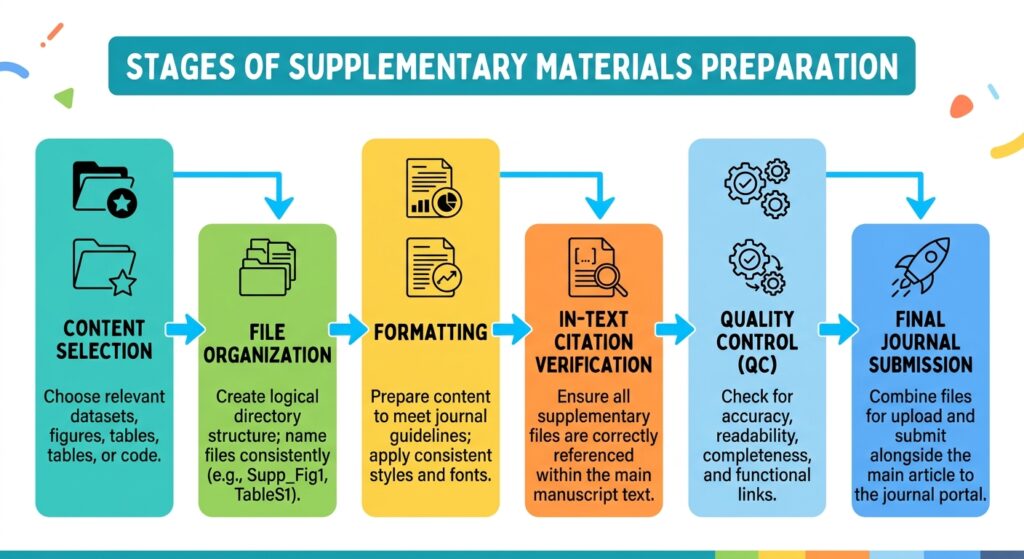
9. Common Mistakes to Avoid When Preparing Supplementary Materials
Even well-designed research can encounter avoidable submission problems when supplementary files are poorly prepared. Inconsistent labeling, incomplete documentation, and incorrect in-text references can make it difficult for reviewers to verify supporting evidence. Before submission, identify and eliminate the following common mistakes.
A. Moving Essential Findings Out of the Main Manuscript
One of the most serious mistakes is transferring important research findings into supplementary files simply to satisfy journal word or figure limits.
The main manuscript must communicate the study's principal findings, essential methodology, and major conclusions without requiring readers to consult multiple external files.
How to avoid it: Keep primary outcomes, critical comparisons, and evidence supporting the central argument in the main text. Move secondary analyses, extended results, and additional supporting information into supplementary materials.
B. Inconsistent Supplementary File Numbering
Incorrect numbering creates confusion for editors, reviewers, and readers. For example, the manuscript may refer to Supplementary Figure S2 while the uploaded file identifies the same figure as Figure S3.
How to avoid it: Create a master supplementary file index before submission. Cross-check every table, figure, dataset, and supplementary method against its corresponding in-text citation.
C. Submitting Supplementary Files Without In-Text Citations
Uploading supplementary documents without referring to them in the main manuscript makes their relevance unclear. Reviewers may overlook important supporting evidence if the manuscript does not direct them to the appropriate file.
How to avoid it: Introduce each supplementary item at the relevant point in the Results, Methods, or other appropriate section. Use consistent references such as "Supplementary Table S1" and "Supplementary Figure S1."
D. Providing Incomplete Figure Legends and Table Notes
Supplementary figures and tables should be understandable without requiring readers to repeatedly search the main manuscript for definitions or explanations.
How to avoid it: Include descriptive titles, define abbreviations, identify sample sizes, explain statistical symbols, and specify units of measurement. Ensure that captions accurately describe the displayed information.
E. Ignoring Journal-Specific File Requirements
Different publishers impose different requirements for file formats, image resolution, naming conventions, file size, and supplementary document structure.
How to avoid it: Review the target journal's instructions for authors before preparing the final files. Confirm accepted formats, maximum upload sizes, figure specifications, and whether supplementary information must be submitted as one consolidated document or separate files.
F. Failing to Check Data Consistency
Supplementary statistical tables and datasets must agree with the results reported in the main manuscript. Differences in sample sizes, percentages, confidence intervals, or p-values can undermine research credibility.
How to avoid it: Conduct a final numerical audit. Compare supplementary results against the manuscript, verify calculations, and ensure that all reported values correspond to the final version of the analysis.
G. Overlooking Confidentiality and Research Ethics
Supplementary files sometimes contain identifiable participant information, confidential research records, or unpublished material that should not be publicly accessible.
How to avoid it: Remove personal identifiers, review participant consent restrictions, and confirm that data-sharing practices comply with institutional ethics approval and applicable privacy regulations.
H. Submitting Unedited Supplementary Documents
Researchers often spend considerable time polishing the main manuscript but overlook spelling errors, inconsistent terminology, unclear captions, and formatting problems in supplementary files.
How to avoid it: Apply the same academic editing, copyediting, and proofreading standards to supplementary materials as to the main article. Check grammar, terminology, abbreviations, cross-references, and formatting consistency.
A final editorial review should treat the manuscript and its supplementary files as one integrated scholarly submission. This ensures that every supporting document reinforces the research rather than creating additional questions during peer review.
Conclusion: Make Supplementary Materials an Extension of Research Quality
Well-prepared supplementary materials strengthen a research manuscript by providing additional methodological detail, supporting statistical evidence, and resources that improve transparency and reproducibility. The key is to distinguish essential findings from supporting information, organize supplementary files consistently, and cite every item accurately within the main text.
Before submission, audit your supplementary tables, figures, datasets, methods, and code against the target journal's requirements. Check file names, numbering, formatting, data consistency, and citation accuracy. These editorial checks help prevent avoidable submission problems and make your research easier for reviewers and readers to evaluate.
Prepare your manuscript for a more professional submission with PaperEdit. Explore PaperEdit's academic editing and proofreading services for expert support with academic language, manuscript formatting, supplementary document consistency, and final submission readiness.