


A research paper can contain rigorous methodology, compelling findings, and original contributions yet still encounter unnecessary publication delays because of inconsistent citations and incorrectly formatted references. For researchers preparing manuscripts for journal submission, choosing the appropriate referencing system is therefore more than a formatting exercise.
A citation style guide for disciplines explains how academic sources must be acknowledged, cited within the manuscript, and documented in the reference list according to the conventions of a particular scholarly field. Five widely encountered systems are Vancouver, IEEE, Harvard, AMA, and ACS. Although all five establish source attribution, they differ in citation numbering, author-date conventions, punctuation, reference ordering, and bibliographic formatting.
Choosing the wrong style can create avoidable editorial corrections, undermine manuscript consistency, and signal insufficient attention to journal submission guidelines. This guide examines the differences between these five systems, provides practical formatting examples, and explains how to select and implement the correct citation style for your discipline.
Ready to Make Your Manuscript Publication-Ready?
💡 Ready to polish your research paper for publication? Transform your manuscript with PaperEdit's professional editing and proofreading services!
1. Understanding Discipline-Specific Academic Citation Styles
Citation styles are standardized systems for acknowledging the intellectual contributions of other researchers. They establish how authors identify sources in the manuscript and how readers locate the corresponding publications in the reference list.
Why Do Different Disciplines Use Different Citation Systems?
Academic disciplines prioritize different kinds of information.
- Medicine and clinical sciences: Emphasize efficient source identification and compact numerical citations.
- Engineering and computer science: Favor concise numbered references that minimize interruptions in technical discussions.
- Humanities and social sciences: Often prioritize author identity and publication date to establish intellectual context.
- Chemistry: Uses flexible numerical and author-date conventions, with detailed bibliographic requirements.
These preferences explain why discipline-specific academic citation styles have evolved rather than adopting one universal referencing format.
The Two Main Citation Systems
Most referencing conventions fall into two broad categories:
Author-date systems: Identify sources using the author's surname and publication year. Harvard is a prominent example.
Example: (Smith, 2024)
Numbered systems: Assign a number to each source according to its first appearance in the manuscript. Vancouver, IEEE, and AMA use numbered systems, although their presentation and bibliographic rules differ.
Example: [1] or superscript ¹
ACS supports multiple citation approaches, including numerical and author-date systems.
The essential distinction is that author-date citations immediately communicate authorship and publication chronology, whereas numbered citations reduce the visual footprint of references within technical and scientific prose.
2. Vancouver Citation Style: The Standard for Medical Research
Vancouver referencing is widely used in biomedical research and medical journal publishing. It follows a numbered citation system in which references are assigned numbers according to their first appearance in the manuscript.
What Are the Vancouver Citation Rules?
In-text citations
Vancouver citations generally use Arabic numerals in parentheses or superscript, depending on the journal's implementation.
Examples:
- Parenthetical: Previous research established this association (1).
- Superscript: Previous research established this association.¹
Once a source receives a number, the same number is reused whenever that source appears again.
Reference list
References appear in numerical order rather than alphabetical order. Journal titles are generally abbreviated according to MEDLINE conventions.
A simplified journal article example:
- Smith AB, Jones CD. Advances in clinical research methodology. J Med Res. 2024;12(3):145-152. doi:10.xxxx/example
Industry Standard Criteria
The International Committee of Medical Journal Editors (ICMJE) provides recommendations for preparing medical manuscripts, including numbered references and standardized journal title abbreviations.
Authors should consult the target journal's instructions because individual publications may specify different punctuation, placement, or numbering requirements.
Common Submission Pitfalls
- Mixing superscript and parenthetical numbering.
- Renumbering previously cited sources incorrectly.
- Using full journal titles instead of required abbreviations.
- Omitting DOI information when required.
- Failing to number references cited exclusively in figures or tables according to their first appearance.
Best suited for: Clinical medicine, biomedical research, public health, nursing, and related medical sciences.
3. IEEE Citation Style: Precision for Engineering and Technology
The Institute of Electrical and Electronics Engineers (IEEE) uses a numbered citation system designed for technical and scientific publications.
IEEE is especially common in electrical engineering, computer science, telecommunications, robotics, and information technology.
What Are the IEEE Square Bracket Citation Rules?
IEEE uses Arabic numerals enclosed in square brackets for in-text citations.
Examples:
- The proposed algorithm improves processing efficiency [1].
- Previous investigations support this approach [2], [3].
- Several researchers have examined this phenomenon [4]–[6].
Each source receives a number based on its first appearance. Subsequent citations retain the original number.
Reference list example:
[1] A. B. Smith and C. D. Jones, "Advances in computational modeling," IEEE Transactions on Engineering, vol. 12, no. 3, pp. 145–152, 2024.
IEEE reference entries typically use initials before surnames, quotation marks around article titles, abbreviated journal names where applicable, and publication details arranged according to the source type.
Industry Standard Criteria
IEEE publications follow the IEEE Editorial Style Manual and the IEEE Reference Guide.
Technical manuscripts should maintain consistent numbering, accurate publication metadata, and standardized formatting for journal articles, conference papers, books, and online resources.
Common Submission Pitfalls
- Using parentheses instead of square brackets.
- Arranging references alphabetically rather than by citation order.
- Incorrectly formatting conference proceedings.
- Omitting volume, issue, page range, or DOI details.
- Applying inconsistent capitalization to article titles.
Best suited for: Electrical engineering, computer science, electronics, telecommunications, and technical research.
Also read: From Thesis to Journal Article: Converting a Dissertation into a Publishable Research Paper
4. Harvard Citation Style: Author-Date Referencing Across Disciplines
Harvard referencing uses an author-date system that identifies sources through the author's surname and publication year.
Unlike numbered systems, Harvard allows readers to identify the researcher and publication chronology without consulting the reference list immediately.
What Is the Main Difference Between Harvard Author-Date and Vancouver Numbered Styles?
Consider the following comparison:
- Harvard: (Smith, 2024)
- Vancouver: (1)
In Harvard, the in-text citation communicates the author's identity and publication year. In Vancouver, the number points to a corresponding entry in the numbered reference list.
Harvard In-Text Citation and Reference List Format
In-text examples:
- One author: (Smith, 2024)
- Two authors: (Smith and Jones, 2024)
- Three or more authors: (Smith et al., 2024)
Page numbers are generally included when quoting directly or referring to specific passages:
(Smith, 2024, p. 45)
Reference list example:
Smith, A.B. and Jones, C.D. (2024) 'Advances in research methodology', Journal of Academic Studies, 12(3), pp. 145–152.
References are usually arranged alphabetically by the first author's surname.
Industry Standard Criteria
Harvard is widely used in social sciences, business, education, and interdisciplinary research. However, Harvard is not one universally controlled style manual.
Universities and publishers often maintain their own Harvard variants. Authors must therefore follow the precise institutional or journal-specific guide rather than assuming that every Harvard implementation uses identical punctuation and ordering.
Common Submission Pitfalls
- Confusing Harvard with APA.
- Using inconsistent punctuation between in-text citations and references.
- Omitting page numbers from direct quotations.
- Incorrectly alphabetizing multiple publications by the same author.
- Mixing different institutional Harvard conventions.
Best suited for: Social sciences, business studies, education, management, and interdisciplinary research.
5. AMA Citation Style: Referencing in Medical and Health Sciences
The American Medical Association (AMA) style is a major referencing convention in medical publishing. Its 11th edition provides detailed guidance on manuscript preparation, scientific writing, and reference formatting.
AMA uses superscript Arabic numerals in the manuscript and a numbered reference list.
AMA 11th Edition Reference List Format
In-text example:
Clinical evidence supports the effectiveness of the intervention.¹
The superscript number corresponds to the reference entry assigned when the source first appears. Repeated citations retain that original number.
Reference list example:
- Smith AB, Jones CD. Advances in clinical research methodology. J Med Res. 2024;12(3):145-152. doi:10.xxxx/example
AMA references generally follow these conventions:
- Arrange entries numerically by first appearance.
- Use abbreviated journal titles.
- Include author surnames followed by initials.
- Provide publication year, volume, issue, and page range as applicable.
- Include DOI information where available and required.
How Does AMA Differ from Vancouver?
Both styles use numbered references and are common in medical publishing. However, they are not interchangeable.
AMA generally uses superscript citations, whereas Vancouver journals may use superscript or parenthetical numbers. Their detailed reference punctuation, author-list conventions, and formatting requirements can also differ.
Common Submission Pitfalls
- Using regular bracketed numbers instead of required superscripts.
- Incorrectly positioning superscript citations around punctuation.
- Formatting journal titles incorrectly.
- Applying outdated AMA conventions instead of the 11th edition.
- Failing to reuse the original number when citing a source repeatedly.
Best suited for: Medicine, clinical research, medical education, healthcare, and health sciences.
6. ACS Citation Style: Specialized Referencing for Chemistry
The American Chemical Society (ACS) style is designed for chemistry and related scientific disciplines. It provides detailed conventions for referencing scientific articles, books, patents, datasets, and other research materials.
One distinctive feature is its flexibility: ACS supports several in-text citation systems.
What Is the Difference Between ACS Superscript and Italic Number Citations?
ACS commonly accommodates three citation approaches:
- Superscript Arabic numerals.
- Italicized Arabic numerals in parentheses.
- Author-date citations.
Examples:
- Superscript: The reaction proceeds through an intermediate.¹
- Italicized number: The reaction proceeds through an intermediate (1).
- Author-date: The reaction proceeds through an intermediate (Smith, 2024).
The appropriate system depends on the journal's instructions. Authors must not combine these approaches within one manuscript unless explicitly instructed.
ACS Reference List Format
For numerical citation systems, references are generally numbered in order of appearance.
A simplified journal article example:
- Smith, A. B.; Jones, C. D. Advances in Catalytic Reaction Mechanisms. J. Chem. Res. 2024, 12 (3), 145–152. https://doi.org/10.xxxx/example.
For author-date referencing, references are generally arranged alphabetically by author.
Industry Standard Criteria
ACS journals follow the applicable ACS reference and manuscript preparation guidelines. Journal abbreviations should be checked against recognized chemistry indexing resources, such as the Chemical Abstracts Service Source Index (CASSI), where appropriate.
Common Submission Pitfalls
- Mixing superscript and parenthetical numerical citations.
- Confusing italicized numbers with ordinary parenthetical numbers.
- Incorrectly formatting chemical journal abbreviations.
- Omitting required DOI or publication information.
- Applying an ACS format without checking the target journal's preferred variant.
Best suited for: Chemistry, analytical chemistry, organic chemistry, materials science, and chemical engineering.
Also read: Supplementary Materials in Research Papers: What to Include, What to Move Out of the Main Text, and How to Cite Them
7. Vancouver vs IEEE vs Harvard vs AMA vs ACS: Complete Comparison
The following table summarizes the most important distinctions when choosing a citation style for a research paper.
| Feature | Vancouver | IEEE | Harvard | AMA | ACS |
| Citation system | Numbered | Numbered | Author-date | Numbered | Multiple options |
| In-text format | (1) or superscript | [1] | (Smith, 2024) | Superscript ¹ | Superscript, italicized number, or author-date |
| Reference ordering | Citation order | Citation order | Alphabetical | Citation order | Depends on system |
| Main disciplines | Medicine | Engineering | Social sciences | Medical sciences | Chemistry |
| Journal abbreviation | Commonly used | Commonly used | Depends on guide | Commonly used | Commonly used |
| Author names | Surname and initials | Initials and surname | Surname and initials | Surname and initials | Depends on source format |
Which Citation Style Should I Use for Medicine, Engineering, or Chemistry?
Use the following practical decision guide:
- Medicine: Vancouver or AMA, depending on the journal.
- Engineering: IEEE for IEEE publications and other engineering journals that require it.
- Chemistry: ACS for ACS publications and journals specifying ACS conventions.
- Social sciences: Harvard where required by the university or journal.
- Interdisciplinary research: Follow the target journal's explicit instructions rather than selecting a style solely by subject.
Remember that a discipline's common referencing practice does not override a journal's official submission requirements.
8. How to Choose and Apply the Correct Citation Style
Selecting the appropriate citation style is only the first step. Authors must also implement it consistently across the entire manuscript.
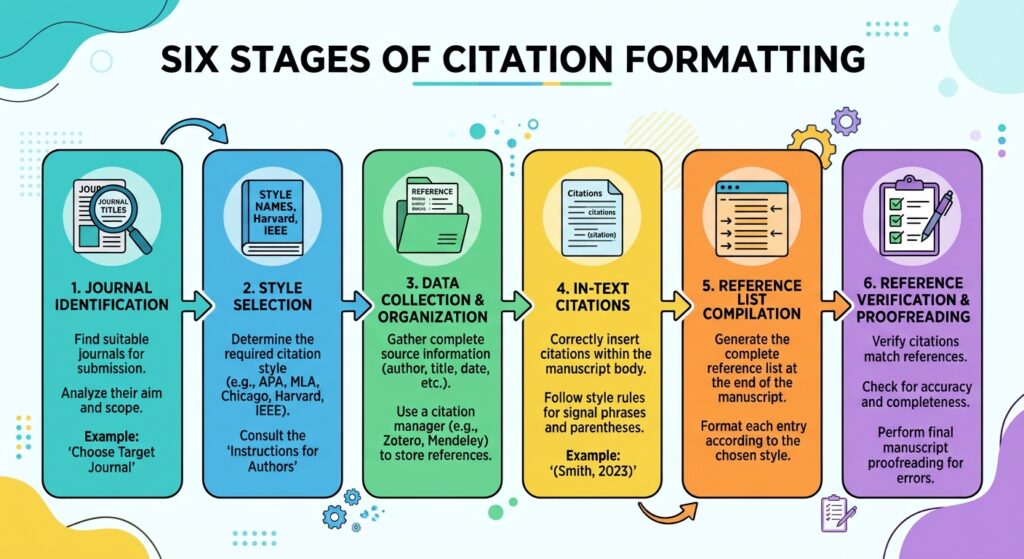
Step 1: Identify the Target Journal
Before formatting references, review the journal's author instructions. Check whether it specifies Vancouver, IEEE, AMA, ACS, Harvard, or a journal-specific variation.
Step 2: Review the Official Style Requirements
Consult the appropriate style manual or official publishing guidance. Do not rely exclusively on examples from unrelated journals or previously published manuscripts.
Step 3: Configure Reference Management Software
Tools such as Zotero, EndNote, and Mendeley can automate citation insertion and reference formatting.
Select the correct style file, import bibliographic metadata, and verify each reference against the original publication.
Step 4: Audit In-Text Citations
Check that every citation corresponds to the correct source. Confirm numbering, author names, publication dates, punctuation, and citation placement.
Step 5: Verify the Reference List
Check author order, article titles, journal abbreviations, publication details, page ranges, and DOI accuracy.
Step 6: Perform a Final Consistency Review
Inspect citations in the main text, tables, figures, supplementary materials, and appendices. Confirm that the journal's formatting requirements are satisfied throughout.
9. Common Citation Formatting Errors That Affect Journal Submission
Citation inconsistencies may seem minor, but they can generate editorial queries and additional revision work.
Inconsistent Citation Numbering
Numbered systems require references to follow the order of first appearance. Manual editing can accidentally disconnect in-text numbers from reference entries.
Incorrect Bibliographic Information
Incorrect author names, article titles, publication dates, page ranges, and DOI identifiers reduce reference accuracy. Always verify bibliographic information against the original publication.
Inconsistent Journal Abbreviations
Vancouver, AMA, IEEE, and ACS may require abbreviated journal titles. Authors should use the appropriate recognized abbreviation rather than inventing shortened forms.
Mixing Citation Systems
Combining Harvard author-date citations with IEEE square brackets or AMA superscripts creates inconsistency and can violate journal requirements.
Outdated Style Editions
Always check the applicable edition or current journal instructions. For example, authors using AMA should verify requirements against the 11th edition rather than relying on older formatting templates.
Also read: Top 10 APA 7th Formatting Errors That Cause Journal Rejections and How to Fix Them
For additional support, consider PaperEdit Academic Proofreading Services to identify citation inconsistencies, grammatical errors, and manuscript presentation issues before submission.
10. Final Pre-Submission Citation and Editing Checklist
Before uploading your manuscript to a journal submission portal, complete the following checks:
Citation Style Compliance
- Confirm that the selected style matches the journal's author guidelines.
- Verify the correct citation system: author-date, square brackets, or superscript.
- Check citation numbering and reuse of previously assigned numbers.
- Standardize punctuation and capitalization.
Reference List Accuracy
- Confirm that every in-text citation has a corresponding reference entry.
- Remove uncited references unless specifically permitted.
- Verify author names, publication years, titles, and page ranges.
- Check journal abbreviations against recognized databases.
- Validate DOI identifiers and URLs.
- Confirm reference ordering and hanging indentation where required.
Manuscript Quality
- Complete academic copyediting and proofreading.
- Standardize terminology, abbreviations, and academic tone.
- Check table and figure citations.
- Verify supplementary material references.
- Review journal-specific formatting and submission requirements.
- Ensure that tracked changes and editorial comments are handled appropriately.
Conclusion: Make Citation Accuracy Part of Your Publication Strategy
Selecting the correct referencing system is essential for producing a credible, consistent, and publication-ready research manuscript. Vancouver and AMA serve medical publishing, IEEE supports technical and engineering research, Harvard provides an author-date approach across many disciplines, and ACS offers specialized referencing conventions for chemistry.
However, the most appropriate citation style is ultimately the one required by your target journal. Identify the correct guidelines, configure your reference management software, verify every bibliographic entry, and conduct a final manuscript-wide consistency audit.
Prepare your research for publication with confidence. PaperEdit provides professional academic editing, proofreading, reference formatting, and manuscript refinement to help researchers submit clear, consistent, and professionally presented scholarly work. Explore PaperEdit's professional editing services and take the next step toward a publication-ready manuscript.