


Paraphrasing complex technical passages without patchwriting is one of the most challenging aspects of academic writing, particularly when researchers work with dense scientific literature, specialized terminology, statistical descriptions, and established methodological frameworks. Simply replacing a few words with synonyms or rearranging clauses does not produce an original paraphrase. It can result in patchwriting, a form of writing that retains too much of the original source's language or sentence structure.
Effective technical paraphrasing involves understanding the source material, identifying its essential meaning, reconstructing the explanation in an independent linguistic structure, and maintaining the accuracy of discipline-specific terminology. This distinction matters because patchwriting can raise plagiarism concerns, undermine academic credibility, and create difficulties during journal submission and editorial screening.
For researchers, doctoral candidates, and ESL authors, the objective is not to make technical language unnecessarily complicated or replace every specialized term. It is to communicate established scientific information accurately through genuinely independent expression while providing appropriate citations.
This guide explains what patchwriting is, why similarity checkers flag it, how to paraphrase dense research articles, and which practical techniques help preserve scientific meaning without compromising originality.
💡 Ready to polish your research paper for publication?
Transform your manuscript with PaperEdit's professional editing and proofreading services!
1. What Is Patchwriting and Why Do Similarity Checkers Flag It?
Patchwriting occurs when a writer reproduces the language, sentence structure, or organizational patterns of a source while making limited changes to individual words or phrases.
It commonly happens when researchers understand the general meaning of a passage but struggle to express its technical content independently. Instead of reconstructing the information, they retain the original sentence framework and substitute synonyms.
For example:
Original passage:
"Chronic inflammation contributes to the development of insulin resistance by disrupting intracellular signaling pathways involved in glucose metabolism."
Patchwritten version:
"Persistent inflammation contributes to the progression of insulin resistance by interfering with cellular signaling pathways associated with glucose metabolism."
Although several words have changed, the sentence retains nearly identical organization, grammatical relationships, and progression of ideas.
Why is this problematic?
- The sentence structure remains substantially dependent on the original.
- Synonym substitution does not demonstrate independent expression.
- The paraphrase may retain distinctive phrasing from the source.
- A citation does not automatically make close copying acceptable.
- The resulting passage may raise concerns during editorial assessment.
Why similarity checkers identify patchwriting
Similarity detection software compares submitted manuscripts against available published and indexed content. Depending on the software, it may identify overlapping phrases, matching word sequences, and similarities in sentence construction.
However, a similarity score is not a definitive plagiarism determination. Technical terminology, standard methodological expressions, properly quoted material, and commonly used scientific descriptions can generate legitimate matches.
Editors must evaluate the context, source attribution, originality of expression, and extent of textual dependence rather than relying exclusively on a numerical score.
Industry-standard criteria: An acceptable paraphrase should communicate the source's meaning accurately, use independently constructed prose, and acknowledge the original source through appropriate citation.
Common submission pitfall: Assuming that changing 30–40% of the original vocabulary automatically produces an acceptable paraphrase. There is no universal synonym-replacement threshold that establishes originality.
2. How to Paraphrase Dense Research Articles Without Losing Meaning
Technical passages frequently contain several interconnected concepts within a single sentence. These may include causal relationships, experimental conditions, statistical outcomes, theoretical assumptions, and discipline-specific terminology.
The challenge is to simplify the linguistic structure without simplifying the scientific meaning.
Apply the following techniques.
Technique 1: Identify the central scientific claim
Before rewriting a passage, determine what the author is actually communicating.
Identify:
- The primary subject or research variable.
- The principal action, relationship, or finding.
- The conditions under which the finding applies.
- Any limitations or qualifications.
- The relationship between the evidence and the conclusion.
For example, a passage discussing the relationship between temperature, enzyme activity, and reaction rates contains several scientific components. A paraphrase must preserve the relationship among all three rather than merely replace the terminology.
Technique 2: Separate technical terminology from sentence structure
Not every word in a technical passage can or should be changed.
Terms such as polymerase chain reaction (PCR), standard deviation, randomized controlled trial, and heteroscedasticity have established meanings. Replacing them with approximate synonyms may introduce scientific inaccuracies.
Instead, preserve essential technical vocabulary while independently reconstructing the surrounding explanation.
Technique 3: Reorganize the information logically
A technically accurate paraphrase may use a different grammatical structure or order of explanation.
For example, a source may introduce an experimental procedure before describing its purpose. Your paraphrase might explain the purpose first and then describe the procedure, provided the logical relationship and meaning remain unchanged.
Technique 4: Verify the rewritten passage against the original
Compare both passages to ensure that:
- No important scientific qualification has disappeared.
- The causal relationship remains accurate.
- Numerical values and statistical interpretations are unchanged.
- Technical terminology is used correctly.
- The rewritten sentence does not reproduce distinctive source phrasing unnecessarily.
Industry-standard criteria: Independent expression, factual fidelity, correct terminology, and appropriate attribution are essential elements of responsible academic paraphrasing.
Common submission pitfall: Simplifying a dense scientific sentence so aggressively that the rewritten version changes the original researcher's interpretation.
Also read: Understanding Turnitin Similarity Index Scores vs. Plagiarism
3. A Four-Step Technical Paraphrasing Framework
A systematic paraphrasing framework reduces dependence on source wording and makes academic writing more consistent.
Step 1: Read and understand the complete passage
Read the entire paragraph rather than isolating a single sentence. Technical arguments often depend on information introduced earlier or explained later.
Identify the research question, scientific mechanism, experimental context, and intended conclusion.
If the passage is difficult to understand, consult relevant background literature before attempting to rewrite it.
Step 2: Extract the essential information
Close or temporarily move away from the source text and write brief conceptual notes.
For example:
- Research variable: chronic inflammation.
- Outcome: insulin resistance.
- Proposed mechanism: altered intracellular signaling.
- Functional consequence: impaired glucose metabolism.
These notes represent the scientific content rather than the original sentence structure.
Step 3: Reconstruct the passage independently
Use your notes to create a new explanation.
Consider changing:
- The sentence opening.
- The grammatical subject.
- The order of supporting information.
- The relationship between clauses.
- The distribution of information across sentences.
Do not deliberately make the writing complicated to appear original. Clarity and technical accuracy should remain the priorities.
Step 4: Compare, cite, and refine
Return to the original passage and check whether your paraphrase accurately reflects its meaning.
Insert the appropriate in-text citation and ensure that the full reference appears in your reference list.
Finally, revise the sentence for academic tone, grammatical accuracy, and consistency with the surrounding manuscript.
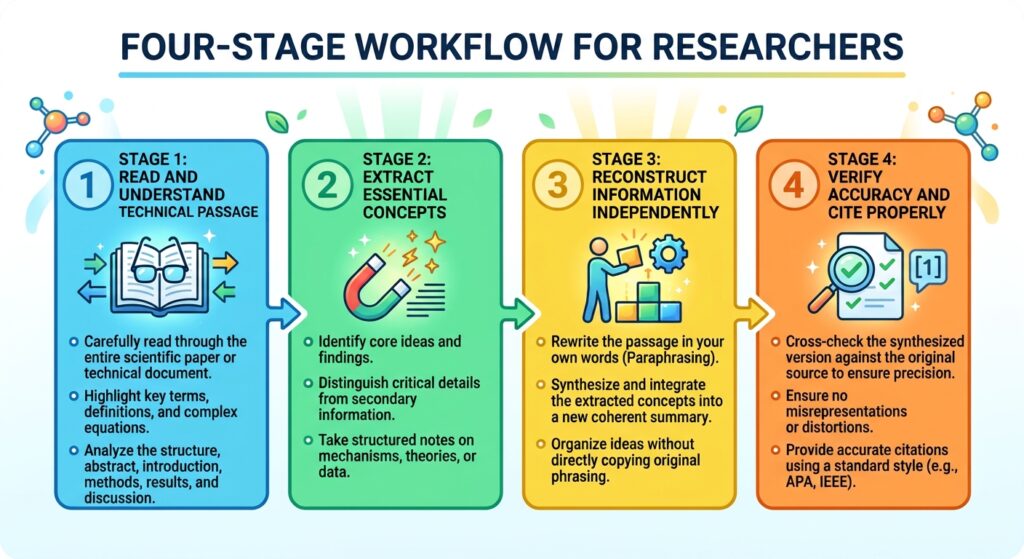
Industry-standard criteria: A strong paraphrasing workflow demonstrates independent expression while preserving the original author's intellectual contribution and acknowledging the source.
Common submission pitfall: Rewriting individual sentences immediately after reading them without first understanding the complete scientific argument.
4. Patchwriting vs. Effective Paraphrasing: Examples and Differences
Understanding the difference between patchwriting and effective paraphrasing is particularly important when working with highly technical research material.
Consider the following example.
Original passage:
"The administration of broad-spectrum antibiotics alters the composition of the intestinal microbiota, potentially reducing microbial diversity and affecting metabolic functions."
Example of patchwriting:
"Giving broad-spectrum antibiotics changes the composition of intestinal microorganisms, possibly decreasing microbial diversity and influencing metabolic activities."
This version changes several words but preserves the original sentence's structure and sequence of ideas.
Example of effective paraphrasing:
"Broad-spectrum antibiotic treatment can disrupt the diversity of microorganisms residing in the intestine, with potential consequences for microbiota-associated metabolic activity (Author, Year)."
The revised version reconstructs the sentence while retaining its central scientific meaning and appropriately attributing the underlying information.
Key differences
| Evaluation criterion | Patchwriting | Effective paraphrasing |
| Vocabulary | Minor synonym substitutions | Independent word choices where appropriate |
| Sentence structure | Closely follows the source | Independently reconstructed |
| Idea organization | Retains original sequence | Reorganizes information logically |
| Technical terminology | May retain or replace terms inaccurately | Preserves essential discipline-specific terms |
| Source attribution | May be missing or insufficient | Appropriate citation included |
| Scientific accuracy | Can introduce distortions | Preserves original meaning |
| Academic originality | Excessively dependent on source expression | Demonstrates independent communication |
Industry-standard criteria: Effective paraphrasing should demonstrate a meaningful transformation of expression, not merely a superficial change in vocabulary.
Common submission pitfall: Believing that a passage is sufficiently original because a similarity checker reports a low percentage. Similarity scores should be interpreted alongside human evaluation of source dependence and attribution.
5. How to Paraphrase Complex Jargon Without Altering Technical Meaning
Scientific jargon presents a particular challenge because many specialized terms have precise definitions that cannot be replaced without changing the meaning.
For example, sensitivity and specificity are not interchangeable in diagnostic research. Similarly, correlation does not establish causation, and statistical significance does not necessarily indicate clinical importance.
Researchers must distinguish between terminology that requires preservation and sentence structures that can be independently reconstructed.
Non-paraphrasable terminology vs. adaptable language
| Language category | Examples | Recommended approach |
| Established technical terms | PCR, DNA sequencing, regression coefficient | Preserve exact terminology |
| Statistical terminology | p-value, confidence interval, standard error | Retain established definitions |
| Scientific classifications | Gram-positive bacteria, Type 2 diabetes | Preserve accepted nomenclature |
| Standard methodological phrases | Random sampling, control group | Retain when technically necessary |
| Explanatory sentence frames | "The findings suggest that..." | Reconstruct independently |
| Descriptive transitions | "In addition to this..." | Replace or restructure naturally |
| Interpretive explanations | Mechanistic or theoretical descriptions | Express independently while preserving meaning |
Practical techniques for handling scientific jargon
Preserve terminology but change the explanation. Retain the recognized technical term and rewrite the surrounding sentence to communicate its meaning independently.
Use accepted abbreviations consistently. Introduce the full term at first mention and use the abbreviation consistently afterward, following the relevant journal guidelines.
Consult authoritative disciplinary references. Use recognized glossaries, methodological textbooks, and discipline-specific reporting standards when uncertain about terminology.
Avoid artificial synonym substitution. Replacing a precise scientific term with a loosely related expression can compromise accuracy.
For additional manuscript language support, explore PaperEdit Academic Editing and Proofreading Services.
Industry-standard criteria: Scientific nomenclature, measurement terminology, mathematical notation, and established methodological labels should remain accurate and consistent throughout the manuscript.
Common submission pitfall: Replacing standardized technical terms with informal alternatives merely to reduce textual similarity.
Also read: Language Errors in Manuscripts: How to Avoid Rejection
6. Paraphrasing Methodology and Statistical Descriptions
Methodology and statistical reporting require particular care because even minor wording changes can affect how readers interpret an experiment.
Researchers should distinguish between rewriting explanatory prose and changing the actual description of experimental procedures.
Paraphrasing methodological passages
Consider a hypothetical original description:
"Participants were randomly assigned to two groups, and each group received a different intervention over a 12-week period."
An independent explanation might be:
"The study used random allocation to distribute participants between two intervention groups, with both treatment conditions maintained for 12 weeks."
The revised passage changes the sentence construction while preserving the study design and duration.
However, researchers must not alter procedural details such as:
- Sample size.
- Participant eligibility criteria.
- Experimental duration.
- Instrument specifications.
- Intervention dosage.
- Randomization procedures.
- Laboratory conditions.
Paraphrasing statistical descriptions
Statistical language must preserve the exact analytical meaning.
For example, consider the statement:
"The intervention group demonstrated a statistically significant reduction in blood pressure compared with the control group (p = 0.03)."
A suitable paraphrase could be:
"Blood pressure decreased significantly in the intervention group relative to the control condition (p = 0.03)."
The numerical result and comparison remain unchanged.
However, researchers should not rewrite this finding as evidence that the intervention produced a clinically meaningful improvement unless the study actually establishes that conclusion.
Statistical elements that must remain unchanged
- p-values and significance thresholds.
- Confidence intervals.
- Regression coefficients.
- Effect sizes.
- Standard deviations and standard errors.
- Sample sizes and degrees of freedom.
- Statistical test names.
- Adjusted and unadjusted estimates.
Industry-standard criteria: Statistical reporting should remain reproducible, transparent, and consistent with the study's analytical methods.
Researchers should consult the ICMJE Recommendations for guidance on scholarly reporting and manuscript preparation.
Common submission pitfall: Replacing statistical expressions with general statements that exaggerate the strength, significance, or clinical implications of a finding.
7. Advanced Strategies for Avoiding Patchwriting in Technical Writing
Once researchers understand the basic paraphrasing process, several advanced techniques can improve the originality and readability of complex academic passages.
Use synthesis rather than sentence-by-sentence rewriting
Instead of paraphrasing every sentence independently, identify relationships among multiple sources.
For example, three studies may examine the effects of sleep deprivation on cognitive performance. Rather than presenting three closely modeled descriptions, synthesize their findings around shared outcomes, methodological differences, and conflicting evidence.
Synthesis demonstrates analytical engagement with the literature rather than simple reproduction of published descriptions.
Vary sentence architecture naturally
Use a combination of:
- Active and passive constructions where appropriate.
- Simple and compound sentences.
- Subordinate clauses.
- Cause-and-effect structures.
- Comparison-based explanations.
- Concise sentences for complex findings.
Sentence variation should improve readability, not serve as an artificial technique for manipulating similarity scores.
Maintain an accurate citation trail
Record the source immediately when taking research notes. This prevents accidental loss of attribution when information is transferred between documents.
Reference management software such as Zotero, EndNote, and Mendeley can help organize sources and standardize bibliographic information.
Separate your interpretation from the original findings
Clearly distinguish between what the original researchers reported and what you infer from their findings.
For example:
- Reported finding: The treatment group showed a reduction in inflammatory markers.
- Author interpretation: This reduction may indicate a potential therapeutic effect.
- Limitation: The study's sample size restricts the generalizability of the results.
This separation strengthens academic credibility and prevents unsupported conclusions.
Also read: Avoiding Accidental Plagiarism in Research Papers
Industry-standard criteria: Literature synthesis should integrate evidence, maintain traceable citations, and distinguish established findings from the manuscript author's interpretation.
Common submission pitfall: Combining several sources into a paragraph without making it clear which claims are supported by which references.
8. Recommended Academic Standards and Referencing Practices
Paraphrasing is not only a language exercise. It is also an important component of research integrity and responsible scholarly communication.
Different journals and disciplines follow different citation and manuscript preparation requirements.
Researchers should identify the appropriate style before completing the final editing stage.
Common referencing requirements
| Citation style | Common application | Important considerations |
| APA 7th | Psychology, education, social sciences | Author-date citations and reference formatting |
| IEEE | Engineering and computer science | Numbered citations in order of appearance |
| Vancouver | Medicine and biomedical sciences | Sequential numerical referencing |
| Harvard | Various academic disciplines | Author-date referencing with institution-specific variations |
| Chicago | Humanities and selected social sciences | Notes-bibliography or author-date systems |
Consult the official APA Style website, IEEE Author Center, and Purdue OWL for relevant citation and academic writing guidance.
Understand the difference between paraphrasing and quotation
Paraphrasing communicates an author's idea using independently constructed language while retaining appropriate attribution.
Direct quotation reproduces the source's exact wording and requires quotation formatting and citation according to the applicable style guide.
Some technical passages, particularly established definitions, may be better quoted when exact wording is essential. However, excessive quotation can interrupt the manuscript's flow and reduce the visibility of the researcher's own analysis.
Industry-standard criteria: Citation placement, reference completeness, quotation formatting, and consistency must comply with the target journal's requirements.
Common submission pitfall: Assuming that paraphrased information does not require a citation because the original wording has been changed.
9. Pre-Submission Checklist: Eliminating Patchwriting Before Journal Submission
Before uploading a manuscript, conduct a dedicated paraphrasing and originality audit.
Use the following checklist to identify potential problems.
Technical paraphrasing checklist
- Every paraphrased passage communicates the source's original meaning accurately.
- Sentence structures have been independently reconstructed.
- Synonym substitution has not been used as the primary rewriting technique.
- Established scientific terminology remains accurate.
- Statistical values and methodological details are unchanged.
- Causal relationships and research qualifications are preserved.
- All borrowed ideas are supported by appropriate citations.
- Multiple sources have been synthesized rather than mechanically combined.
- Direct quotations are clearly identified and referenced.
- Reference entries match their corresponding in-text citations.
Language and formatting checklist
- Academic tone is consistent throughout the manuscript.
- Grammar, punctuation, and sentence transitions have been reviewed.
- Abbreviations are introduced and used consistently.
- Tense and voice follow disciplinary conventions.
- The target journal's referencing style is applied consistently.
- Similarity reports have been reviewed in context.
- Figures, tables, and supplementary materials have appropriate attribution.
- The manuscript complies with the journal's submission instructions.
For a final language and originality review, consider professional academic proofreading and manuscript editing.
Conclusion
Properly paraphrasing complex technical passages without patchwriting requires more than changing vocabulary or rearranging sentences. Researchers must understand the original scientific argument, identify essential technical information, reconstruct the explanation independently, and preserve the accuracy of terminology, methodology, and statistical findings.
The four-step framework—understand, extract, reconstruct, and verify—provides a practical foundation for producing original, accurate, and publication-ready academic prose.
Most importantly, remember that originality does not require replacing established scientific terminology or avoiding references to previous research. It requires communicating scholarly ideas responsibly, demonstrating independent expression, and acknowledging the researchers whose work informs your manuscript.
Prepare your manuscript for publication with confidence. PaperEdit's professional academic editing and proofreading services can help identify patchwriting concerns, refine technical language, improve sentence structure, and strengthen overall manuscript clarity before journal submission.