


A research manuscript may contain rigorous methodology, statistically significant findings, and carefully formatted references, yet still encounter submission delays because its data availability statement is incomplete, unclear, or missing. As academic journals increasingly prioritize research transparency, reproducibility, and responsible data sharing, authors must explain precisely where their supporting research data can be accessed and under what conditions.
A data availability statement (DAS) is a formal declaration within a research article that describes the availability, location, and accessibility of the datasets, materials, or other research outputs supporting the published findings. Depending on journal policy, it may also explain why certain data cannot be shared publicly.
Getting this statement right is essential for demonstrating research integrity, satisfying funder requirements, supporting independent verification, and reducing avoidable manuscript revisions. Requirements vary across publishers, disciplines, and funding organizations, particularly when research involves confidential human data, proprietary datasets, or third-party information.
This guide explains what journals expect in 2026, how to write a data availability statement, which examples to use for different research scenarios, and how to avoid common submission mistakes.
💡 Ready to polish your research paper for publication?
Transform your manuscript with PaperEdit's professional editing and proofreading services. Ensure your academic writing meets journal expectations for clarity, consistency, and submission readiness.
1. What Is a Data Availability Statement in a Research Article?
A data availability statement is a dedicated section of a scholarly manuscript that tells readers whether the data supporting a study's conclusions are publicly accessible, available through controlled access, obtainable upon request, or restricted for specific reasons.
Its primary purpose is to make research findings more transparent and verifiable.
Why Do Journals Require Data Availability Statements?
Academic publishers increasingly recognize that published findings should be supported by accessible research materials wherever legally and ethically possible.
A well-written DAS serves four important functions:
- Research reproducibility: Allows other researchers to examine the underlying datasets and evaluate whether the reported results can be reproduced.
- Research transparency: Clarifies which materials support the findings and whether access restrictions exist.
- Research accountability: Demonstrates compliance with institutional, funder, and publisher data-sharing policies.
- Future research: Enables secondary analysis, systematic reviews, meta-analyses, and further scientific investigation.
What Information Should a DAS Contain?
Although requirements differ between journals, an effective statement generally identifies:
- The datasets or research materials associated with the article.
- The repository or organization holding the data.
- A permanent identifier, such as a Digital Object Identifier (DOI) or accession number, where applicable.
- The conditions under which the data can be accessed.
- Any ethical, legal, licensing, or confidentiality restrictions.
A statement should provide enough information for an independent researcher to understand how to locate the relevant materials without contacting the authors for basic clarification.
2. What Do Journals Require in a Data Availability Statement in 2026?
Journal data-sharing policies are not universal. Some publishers require unrestricted public access to the minimum dataset supporting the findings, while others permit controlled access when confidentiality, consent, intellectual property, or legal restrictions apply.
Authors should consult the target journal's instructions for authors before finalizing the manuscript.
Major Journal and Funder Requirements
PLOS journals
PLOS requires authors to make the data necessary to replicate the study's findings publicly available without restriction, subject to recognized legal and ethical exceptions. Authors must provide a DAS explaining how the data can be accessed.
PLOS also expects authors to share the minimum dataset necessary to support the reported findings, including relevant metadata and methodological information.
NIH (National Institutes of Health)
The NIH Data Management and Sharing (DMS) Policy became effective on January 25, 2023. It requires applicable NIH-funded or conducted research to submit and comply with an approved Data Management and Sharing Plan.
Importantly, an NIH Data Management and Sharing Plan is not identical to a journal's data availability statement. Authors should address both the applicable funder requirements and the publication venue's disclosure requirements.
The NIH expects researchers to maximize appropriate data sharing while recognizing justified ethical, legal, and technical limitations.
UK Research and Innovation (UKRI)
UKRI's open-access requirements call for a data access statement in applicable research publications, including situations where no associated data exist or the data cannot be accessed.
The statement should explain where underlying research materials are available and how readers can access them. UKRI also emphasizes the FAIR principles and responsible data sharing.
Common Requirements Compared
| Organization or publisher | Main expectation | Important consideration |
| PLOS | Public availability of supporting data | Exceptions require explanation |
| NIH | Approved data management and sharing plan | Sharing limitations must be justified |
| UKRI | Data access statement in applicable publications | Include a persistent identifier where relevant |
| NIHR Open Research | Detailed data availability statement | Explain access conditions and restrictions |
Important: Do not assume that satisfying a funder's data-sharing policy automatically satisfies a journal's submission requirements. Check both independently.
3. How to Write a Data Availability Statement: Step-by-Step Guide
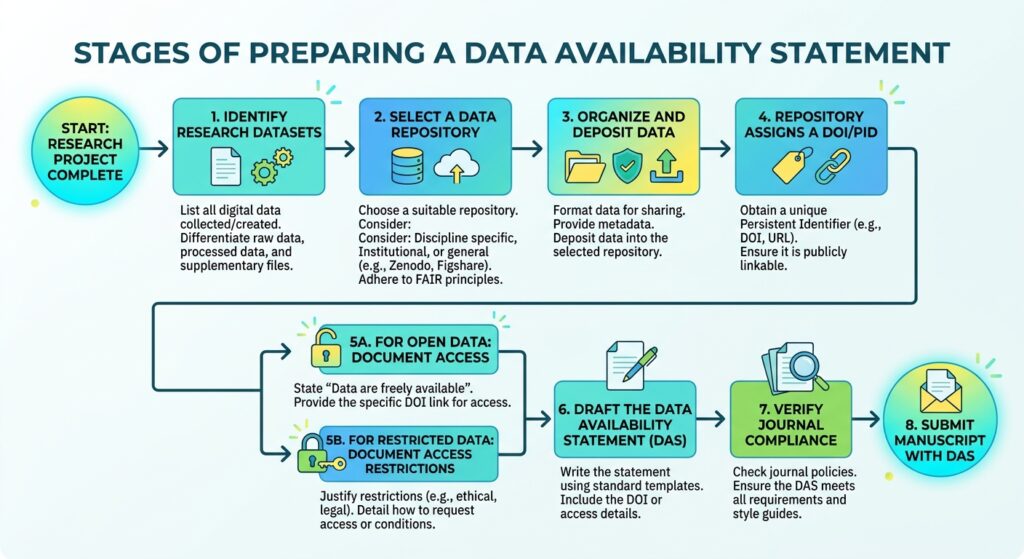
Writing an effective DAS begins with identifying the data associated with the manuscript and determining whether they can be shared responsibly.
Follow these steps before submission.
Step 1: Identify the Research Data Supporting Your Findings
Start by identifying the materials necessary to understand, verify, or reproduce the reported results.
Depending on the discipline, these may include:
- Raw or processed experimental datasets.
- Survey responses and questionnaire results.
- Statistical analysis files.
- Clinical or observational research datasets.
- Laboratory measurements.
- Interview transcripts or qualitative research materials.
- Research code, algorithms, and computational models.
- Supplementary datasets and supporting documentation.
Not every project requires unrestricted publication of its complete raw dataset. The appropriate level of sharing depends on the research methodology, discipline-specific standards, and applicable ethical requirements.
Step 2: Select an Appropriate Data Repository
If the data can be shared publicly, deposit them in a suitable repository before submitting the manuscript.
Common repository options include:
| Repository | Typical application | Useful feature |
| Zenodo | Multidisciplinary research | DOI generation and versioning |
| Figshare | Research datasets and supplementary files | Persistent identifiers |
| Dryad | Research datasets | Structured data publication |
| OSF | Open science projects | Project management and sharing |
Choose a repository that supports your discipline, file formats, preservation requirements, and intended access conditions.
Before depositing data, verify that the repository provides appropriate metadata, persistent identifiers, and licensing options.
Step 3: Generate a Persistent Identifier
A permanent identifier helps readers locate the exact dataset associated with the publication.
A DOI is particularly useful because it provides a stable reference even if the repository changes its website structure.
For example:
https://doi.org/10.5281/zenodo.1234567
Use the actual DOI assigned to your dataset. Never insert a placeholder DOI into a final submission.
If a repository provides a reserved DOI before publication, check whether it can be cited or resolved during the journal's review process.
Step 4: Explain Access Conditions Clearly
Identify whether the data are:
- Publicly available without restrictions.
- Available through a controlled-access application.
- Available from the corresponding author upon reasonable request.
- Restricted because of ethical or legal obligations.
- Owned by a third party and subject to licensing conditions.
- Not generated or analyzed during the study.
Avoid vague descriptions. Readers should understand exactly what they need to do to access the data.
Step 5: Draft and Verify the Statement
Write the statement in direct, formal academic language.
Check that the repository name, dataset title, DOI, accession number, and access conditions are accurate.
Finally, compare the statement against the journal's author guidelines and the approved data management plan, where applicable.
Also read: The Role of Articles (“a,” “an,” “the”) in Research Writing
4. Data Availability Statement Examples for Different Research Scenarios
The most effective way to understand how to write a data availability statement is to examine examples for different research situations.
The following templates can be adapted to individual manuscripts. Replace all bracketed information with verified project-specific details.
Example 1: Data Publicly Available in a Repository
Use this format when the complete supporting dataset can be shared publicly.
Template:
"The datasets generated and analyzed during this study are publicly available in [Repository Name] at [DOI or permanent URL]. The dataset includes [brief description of the research materials] and is available under the [license name] license."
Example:
"The datasets generated during this study are available in Zenodo at https://doi.org/[actual DOI]. The repository contains the processed survey dataset and accompanying documentation used in the statistical analysis."
This approach is appropriate when the repository provides unrestricted or clearly defined public access.
Example 2: Data Available Upon Reasonable Request
Some journals accept author-mediated access, particularly when public deposition is impractical.
Template:
"The data supporting the findings of this study are available from the corresponding author upon reasonable request. Access is subject to [applicable conditions, if any]."
However, is "data available upon reasonable request" still accepted by journals?
The answer depends on the publisher and discipline. Some journals permit this arrangement, while others require public deposition or a more specific controlled-access mechanism.
Avoid using this wording as a default. Explain why the data are not publicly deposited and identify any conditions governing access.
Example 3: Confidential Human Participant Data
Research involving patients, survey respondents, interviewees, or other human participants requires particular attention to privacy and informed consent.
Template:
"The data supporting this study contain potentially identifiable information relating to human participants and cannot be made publicly available due to confidentiality and ethical restrictions. De-identified data may be available from the corresponding author upon reasonable request, subject to approval by the relevant institutional ethics committee and applicable data protection requirements."
Do not promise access if participant consent, ethics approval, or applicable law prohibits further sharing.
Where appropriate, consider controlled-access repositories or trusted research environments instead of unrestricted public deposition.
Example 4: Data Obtained From a Third Party
Researchers frequently use commercial databases, institutional records, government datasets, or licensed research materials.
Template:
"The data analyzed in this study were obtained from [Third-Party Organization or Database Name]. Access to the original dataset is subject to the provider's licensing and usage restrictions. Qualified researchers may request access directly from [Provider Name] in accordance with its applicable terms and conditions."
Where possible, provide the original database citation, accession details, or public access link.
Example 5: No New Data Generated or Analyzed
Some articles rely exclusively on published literature, theoretical analysis, or previously available materials.
Template:
"No new datasets were generated or analyzed during this study. Data sharing is not applicable to this article."
Always check whether the journal prescribes a specific statement. For example, NIHR Open Research provides the wording: "No data are associated with this article."
Example 6: Data Available Through Controlled Access
Some clinical, genetic, and population-based studies require additional safeguards.
Template:
"The datasets supporting the findings of this study are available through [Controlled-Access Repository Name] under accession number [Accession Number]. Access is restricted to qualified researchers who obtain approval from the relevant data access committee and agree to the applicable data-use conditions."
This statement should explain the application process and identify the organization responsible for reviewing access requests.
5. How to Write a Data Availability Statement for Confidential Human Data
Confidentiality is one of the most challenging aspects of research data sharing, particularly in clinical medicine, psychology, public health, and social sciences.
Researchers must balance transparency with their responsibility to protect participants.
What Makes Human Research Data Sensitive?
Sensitive information may include:
- Personal identification details.
- Medical histories and clinical records.
- Genetic and genomic information.
- Audio recordings and interview transcripts.
- Geographic information that could identify participants.
- Information relating to vulnerable populations.
Removing names alone does not necessarily anonymize a dataset. Combinations of demographic variables, dates, locations, and other attributes may allow individuals to be reidentified.
Best Practices for Ethical Data Sharing
Before preparing the DAS:
- Review the original informed consent documentation.
- Consult the Institutional Review Board (IRB) or relevant research ethics committee.
- Determine whether de-identification adequately protects participants.
- Assess whether controlled access is more appropriate than public deposition.
- Document the procedure for requesting access.
- Explain any legal, ethical, or contractual restrictions.
The NIH recognizes that informed consent, privacy, safety, and legal obligations can justify limitations on data sharing.
The guiding principle is to make data as open as possible and as closed as necessary.
6. Applying FAIR Data Sharing Principles to Your Research Paper
The FAIR data sharing principles provide an internationally recognized framework for improving research data management.
FAIR stands for Findable, Accessible, Interoperable, and Reusable.
These principles help authors prepare datasets that are easier for other researchers to discover, understand, and use.
Understanding the Four FAIR Principles
Findable: Assign datasets persistent identifiers and provide descriptive metadata so researchers and indexing systems can locate them.
Accessible: Explain how the data can be retrieved, including any authentication, approval, or controlled-access requirements.
Interoperable: Use standardized, machine-readable formats that support integration with other datasets and research tools.
Reusable: Provide sufficient documentation, provenance information, and licensing details to clarify how the data can be reused.
For example, a spreadsheet containing experimental measurements may be easier to reuse when accompanied by a data dictionary, variable descriptions, methodological documentation, and a clear usage license.
FAIR does not mean that every dataset must be publicly downloadable. Sensitive data can still follow FAIR principles through accessible metadata and transparent controlled-access procedures.
Also read: Top 10 APA 7th Formatting Errors That Cause Journal Rejections and How to Fix Them
7. Where Should the Data Availability Statement Be Placed in the Manuscript?
Placement depends on the journal's submission guidelines and manuscript structure.
Common locations include:
- After the Methods section.
- Before the Acknowledgments section.
- Within a dedicated Declarations section.
- Before the References section.
- In a separate submission-system field.
Many journals group the DAS with other declarations, such as funding information, conflicts of interest, ethical approval, and author contributions.
Manuscript Formatting Considerations
When preparing the document:
- Use the exact heading requested by the journal, such as "Data Availability Statement" or "Data Availability."
- Follow the prescribed heading hierarchy.
- Maintain consistent font, spacing, and paragraph formatting.
- Ensure DOI links and repository URLs are functional.
- Include dataset citations in the reference list when required.
- Check whether the journal requires the statement in both the manuscript and online submission portal.
Do not assume that a data availability statement should always appear in the same location across publishers.
Also read: Weak Arguments in Academic Papers (And How to Fix Them)
8. Common Data Availability Statement Mistakes That Authors Should Avoid
Even experienced researchers can make avoidable errors when preparing data-sharing declarations.
| Common mistake | Why it creates problems | Recommended correction |
| Using a broken repository link | Readers cannot locate the dataset | Test every URL and DOI |
| Writing only "available upon request" | Access conditions remain unclear | Explain the request procedure and restrictions |
| Ignoring participant confidentiality | May violate consent or ethical requirements | Consult the ethics committee and use appropriate safeguards |
| Omitting third-party restrictions | Misrepresents data accessibility | Identify the data owner and licensing conditions |
| Failing to cite the dataset | Reduces traceability and recognition | Include a persistent identifier and data citation |
| Using inconsistent dataset descriptions | Creates confusion about supporting materials | Match the statement to the actual deposited files |
| Omitting the DAS entirely | May violate journal or funder requirements | Check the submission checklist |
One particularly important mistake is treating a data availability statement as a formality. It is a substantive research disclosure and should be reviewed as carefully as the Methods and References sections.
Also read: Professional Academic Proofreading Services
9. Pre-Submission Data Availability Statement Checklist
Before uploading your manuscript to a journal portal, audit the following items.
Research Data and Repository
- All datasets supporting the reported findings have been identified.
- The selected repository is appropriate for the research discipline.
- Dataset titles and descriptions are accurate.
- Persistent identifiers, such as DOIs or accession numbers, have been verified.
- Supporting documentation and metadata are included where necessary.
Ethical and Legal Compliance
- Participant consent permits the proposed level of data sharing.
- Sensitive information has been appropriately protected.
- Institutional ethics requirements have been reviewed.
- Third-party licensing and ownership restrictions have been addressed.
- Controlled-access procedures are explained where applicable.
Writing and Formatting
- The statement uses clear, formal academic language.
- Repository links are functional.
- Access conditions are described precisely.
- The manuscript follows the journal's required heading and placement.
- Data citations are included where required.
- The statement is consistent with the applicable funder requirements and data management plan.
Final Submission Review
- The DAS has been checked against the journal's current author guidelines.
- The corresponding author has verified all access information.
- The final manuscript contains the correct statement.
- Any required declarations have been completed in the submission portal.
Conclusion: Make Your Research Data Transparent, Accessible, and Publication-Ready
A well-prepared data availability statement strengthens research transparency, supports reproducibility, and demonstrates compliance with journal and funding requirements. Whether your dataset is publicly available, restricted for ethical reasons, licensed by a third party, or unavailable because no new data were generated, your statement must explain the situation accurately and transparently.
Prioritize repository selection, persistent identifiers, appropriate access conditions, and compliance with the target journal's guidelines. Most importantly, treat the DAS as an essential component of scholarly reporting rather than an administrative afterthought.
Before submission, refine the statement alongside your manuscript's language, formatting, references, and declarations.
Need expert help preparing your manuscript for journal submission?