


After completing the results section, many researchers face a deceptively difficult question: What do these findings actually mean for theory and for practice? The distinction between implications for theory and implications for practice is central to a strong Discussion chapter, thesis, dissertation, or journal manuscript because it demonstrates how empirical evidence contributes beyond the immediate study.
Theoretical implications explain how your findings confirm, extend, refine, challenge, or complicate existing theoretical frameworks. Practical implications translate supported findings into appropriate actions for professionals, organizations, educators, clinicians, policymakers, or other stakeholders.
A strong implications section does not simply repeat the results or list generic recommendations. It builds a defensible chain from evidence → interpretation → contribution → action while remaining within the boundaries of the study design.
💡 Ready to polish your research paper for publication?
Transform your manuscript with PaperEdit's professional editing and proofreading services!
What Is the Difference Between Implications for Theory and Implications for Practice?
The simplest distinction is the audience and purpose of each type of implication.
Theoretical implications speak primarily to researchers and scholars. They answer questions such as:
- Does the evidence support the theoretical framework?
- Does the finding reveal a boundary condition for an existing theory?
- Does it explain a previously unresolved relationship?
- Does the study suggest that a construct should be defined or measured differently?
- Does the evidence justify extending or modifying an established model?
Practical implications address what relevant stakeholders can reasonably do with the findings. They answer questions such as:
- What should practitioners change?
- Which organizational process could be improved?
- What intervention, policy, or professional practice might be informed by the evidence?
- Which stakeholders need to respond?
- What should decision-makers consider before implementing a recommendation?
The two categories are connected but not interchangeable.
For example, suppose a study finds that structured feedback improves postgraduate students' academic writing performance.
A theoretical implication might be that the finding provides additional support for a model of formative learning in which timely feedback mediates the relationship between instructional intervention and learning outcomes.
A practical implication might be that universities could incorporate structured, criterion-based feedback into postgraduate writing support programs.
The first statement advances scholarly understanding. The second translates evidence into potential action.
Why the distinction matters
Confusing these categories can weaken a Discussion chapter. A paragraph that says a finding "proves the theory and means universities should immediately change their policies" combines two very different claims and may overstate the evidence.
Instead, separate them:
Theoretical contribution: What does the finding add to knowledge?
Practical contribution: What could a relevant stakeholder reasonably do because of the finding?
Evidence boundary: What does the study not establish?
This separation is particularly important in dissertations, where Chapter 5 often contains explicit subsections for theoretical contribution, practical implications, recommendations, limitations, and future research.
How Do I Connect My Empirical Results Back to Existing Theoretical Frameworks?
Connecting empirical results to theory requires more than mentioning a theory in the Discussion. Your task is to demonstrate what the evidence does to the theoretical argument.
Use a four-step process.
1. Identify the theoretical proposition
Return to the conceptual framework, hypotheses, research questions, or propositions established in the Introduction and literature review.
Ask:
What relationship, mechanism, assumption, or proposition did the theory lead me to expect?
For example:
The theoretical framework predicts that perceived organizational support increases employee engagement because employees interpret institutional support as an indication that their contributions are valued.
This gives you a theoretical proposition to evaluate.
2. Compare the empirical finding with the proposition
Do not write only:
"The findings support social exchange theory."
Explain which finding supports it and why.
A stronger formulation is:
"The positive association between perceived organizational support and employee engagement is consistent with the reciprocal-exchange mechanism proposed by social exchange theory, suggesting that employees may respond to organizational investment with greater psychological and behavioral engagement."
The second version identifies the finding, connects it to a mechanism, and explains the theoretical relationship.
3. Determine the type of theoretical contribution
Your findings may:
- Support an existing theoretical relationship.
- Extend a theory into a new population, context, or setting.
- Refine a theoretical explanation by identifying conditions under which it operates.
- Challenge an established assumption.
- Integrate previously separate theoretical perspectives.
- Reveal a boundary condition that limits where a theory applies.
- Generate a new conceptual proposition requiring further investigation.
Do not automatically describe every statistically significant result as a theoretical contribution. A result becomes theoretically meaningful when it changes, strengthens, clarifies, or contextualizes our understanding of a theoretical explanation.
Also read: How to Articulate Study Limitations Without Weakening Your Research
4. Explain the contribution without overstating causality
This is where academic precision matters.
If your study is cross-sectional and correlational, avoid:
"The findings demonstrate that organizational support causes employee engagement."
Prefer:
"The findings indicate an association between organizational support and employee engagement, consistent with the mechanism proposed by social exchange theory."
The second statement respects the study design.
For quantitative research, interpret effect sizes, confidence intervals, model estimates, and theoretical consistency rather than relying exclusively on statistical significance. In biomedical publishing, the ICMJE similarly emphasizes presenting quantitative findings with appropriate measures of uncertainty and distinguishing exploratory from prespecified analyses.
For qualitative research, theoretical implications may emerge through themes, categories, mechanisms, conceptual relationships, or process explanations rather than statistical relationships.
Examples of theoretical implications in qualitative research
Imagine a qualitative study examining how early-career academics experience institutional mentoring.
The findings identify three recurring processes:
- Mentoring provides technical knowledge.
- Mentoring provides professional identity validation.
- Mentoring creates access to informal academic networks.
A weak theoretical implication would be:
"The study contributes to mentoring theory."
A stronger version would explain the conceptual contribution:
"The findings extend existing mentoring perspectives by indicating that professional identity validation and network access operate alongside knowledge transfer, suggesting that mentoring may function as both a developmental and identity-forming process."
That is a theoretical implication because it modifies how the phenomenon can be conceptualized.
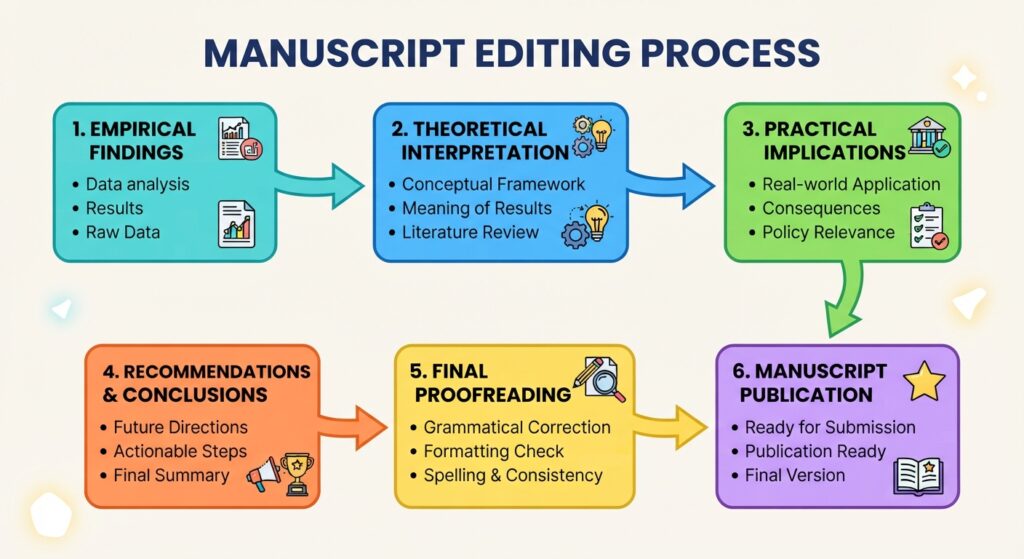
How Do I Frame Practical Recommendations Without Overstretching My Findings?
Practical recommendations should be proportionate to the strength, scope, and design of your evidence.
A common mistake is moving directly from one empirical result to a broad policy recommendation.
For example:
"Because participants reported difficulties with online learning, universities should replace traditional classroom teaching with online instruction."
This recommendation is probably unsupported unless the study directly compared instructional modes and established that online learning produces better outcomes.
A defensible practical implication would be:
"The reported barriers suggest that universities implementing online learning should strengthen technical support, instructor communication, and student orientation."
The second statement is narrower and more closely connected to the evidence.
Use the evidence-to-action ladder
A useful way to frame practical recommendations is:
Finding → Interpretation → Stakeholder → Action → Boundary
For example:
Finding: Participants reported inconsistent access to research databases.
Interpretation: Limited access may constrain students' ability to identify and evaluate current literature.
Stakeholder: University libraries and graduate research programs.
Action: Institutions could evaluate database access, off-campus authentication, and researcher training.
Boundary: The study does not establish that database access alone determines research productivity.
This structure prevents practical implications from becoming unsupported prescriptions.
Distinguish implications from recommendations
The terms are related but should not be treated as synonyms.
An implication explains what the finding means for practice.
A recommendation proposes what someone should do.
For example:
Practical implication: The findings indicate that inconsistent supervisor feedback may create uncertainty about doctoral writing expectations.
Recommendation: Graduate programs could establish clearer feedback protocols and provide supervisors with shared guidance on feedback frequency and scope.
The implication interprets the evidence. The recommendation proposes a response.
Theoretical vs. Practical Implications: A Direct Comparison
| Dimension | Implications for Theory | Implications for Practice |
| Primary audience | Researchers and scholars | Practitioners, organizations, policymakers, professionals |
| Core question | What does this finding contribute to knowledge or theory? | What could stakeholders do differently? |
| Evidence focus | Constructs, mechanisms, relationships, assumptions | Processes, interventions, decisions, policies |
| Typical verbs | Supports, extends, refines, challenges, contextualizes | Inform, improve, implement, evaluate, consider |
| Main risk | Claiming a major theoretical contribution from a narrow finding | Recommending action beyond the evidence |
| Best location | Discussion/theoretical contribution section | Discussion/practical implications section |
| Key limitation | Theoretical claims must remain connected to the conceptual framework | Recommendations must reflect study scope and design |
A well-written Discussion often moves between these two perspectives rather than treating them as competing forms of contribution.
How to Structure Implications in a Thesis or Dissertation
If you are writing Chapter 5, use clear subsections so readers can identify the contribution quickly.
A practical structure is:
5.1 Summary of Key Findings
Briefly synthesize the most important findings without repeating the entire Results chapter.
5.2 Contributions to Theory
Explain how the findings relate to each theoretical framework.
For each major contribution, use this sequence:
Prior theoretical position → empirical finding → interpretation → theoretical contribution
5.3 Implications for Practice
Organize implications by stakeholder where appropriate.
For example:
- Implications for clinicians
- Implications for educators
- Implications for managers
- Implications for organizations
- Implications for policymakers
Avoid creating a separate subsection for every minor stakeholder unless the evidence warrants it.
5.4 Recommendations
Convert the strongest practical implications into specific, feasible actions.
5.5 Limitations
Identify methodological and contextual constraints that affect interpretation.
5.6 Future Research
Explain which unanswered questions should be investigated next and why.
This structure helps distinguish what your study contributes from what future researchers should do.
Also read: Top 10 APA 7th Formatting Errors That Cause Journal Rejections and How to Fix Them
How to Write Strong Theoretical Implications
Use the following sentence architecture when drafting:
"The finding that [specific result] extends/refines/challenges [theory] by demonstrating [specific theoretical insight], particularly in [population/context]."
For example:
"The finding that supervisor accessibility was associated with doctoral persistence extends existing models of doctoral completion by indicating that relational availability may represent an important contextual dimension of academic support."
Then ask three questions:
What was already known?
Establish the existing theoretical position.
What does your study add?
Identify the specific difference created by your evidence.
Why does that difference matter?
Explain the conceptual significance.
Avoid vague statements such as:
- "This study adds to the literature."
- "The findings have important theoretical implications."
- "This research contributes to theory."
These sentences may be true, but they do not demonstrate contribution.
Replace them with precise claims describing what changed in the scholarly understanding of the phenomenon.
For additional guidance on research reporting and manuscript structure, consult the ICMJE Recommendations, particularly when preparing biomedical or health-related manuscripts. The current recommendations were updated in January 2026 and emphasize clear reporting, appropriate interpretation, and conclusions supported by the data.
Also read: How to Write Thesis Discussion Chapter: Chapter 5 Structure & Future Research Directions 2026 Guide
How to Write Strong Practical Implications
Practical implications should answer five questions:
- Who can use this evidence?
- What does the finding mean for that stakeholder?
- What action could reasonably follow?
- Under what conditions would that action apply?
- What remains uncertain?
Consider a study finding that structured peer review improves students' revision quality.
Instead of writing:
"Universities should mandate peer review in all courses."
Write:
"The findings suggest that structured peer-review activities may strengthen students' revision practices. Writing-intensive programs could consider integrating criterion-based peer review where instructors can provide sufficient orientation and oversight."
This version identifies the potential application without assuming that every educational setting will produce the same outcome.
Practical implications for stakeholders and policymakers
For policy audiences, be particularly cautious.
A single institutional study rarely justifies a universal policy change. Frame implications according to the evidence's population, setting, timeframe, and methodological strength.
Use language such as:
- "may inform"
- "suggests that"
- "could support"
- "provides evidence for considering"
- "warrants further evaluation"
- "may be particularly relevant in contexts where..."
Use stronger language only when the research design supports it.
Randomized controlled trials, systematic reviews, longitudinal studies, and robust multi-site investigations may justify stronger practical conclusions than small convenience samples or exploratory qualitative studies. The appropriate strength of language should always follow the evidence rather than the desired impact statement.
Common Submission Pitfalls
Pitfall 1: Repeating the Results
The Discussion should interpret results rather than reproduce every statistic.
Fix: Select the findings that materially affect your research questions and contribution.
Pitfall 2: Introducing a New Theory Too Late
Do not introduce an entirely new theoretical framework in the implications section without establishing it in the literature review.
Fix: Build the conceptual foundation earlier and use the Discussion to show how your findings interact with it.
Pitfall 3: Treating Statistical Significance as Theoretical Contribution
A statistically significant association is not automatically a theoretical advance.
Fix: Explain the mechanism, construct relationship, boundary condition, or conceptual insight that makes the finding theoretically relevant.
Pitfall 4: Turning Correlation Into Causation
Words such as "causes," "leads to," and "results in" imply causal evidence.
Fix: Match causal language to your research design.
Pitfall 5: Making Generic Recommendations
Statements such as "organizations should provide more training" are weak when disconnected from the findings.
Fix: Identify the finding, stakeholder, action, and rationale.
Pitfall 6: Ignoring Limitations
A recommendation that ignores sampling limitations, measurement constraints, or contextual factors may appear overstated.
Fix: Integrate limitations into the interpretation of implications.
Pitfall 7: Confusing Future Research With Practical Action
"More research is needed" is not a practical implication.
Fix: State what researchers should investigate next and separately explain what practitioners can reasonably do now.
Editing Standards for an Implications Section
Before submission, audit the section at three levels: argument, language, and formatting.
Structural editing
Check whether every implication connects to a research question, finding, or theoretical proposition.
Ask:
- Is the contribution explicit?
- Does each paragraph have one central claim?
- Are theory and practice clearly separated?
- Are recommendations supported by evidence?
- Are limitations acknowledged?
Line editing and academic tone
Eliminate vague or inflated language.
Replace:
"This extremely important finding clearly proves..."
With:
"This finding provides evidence consistent with..."
Use precise verbs and avoid promotional claims such as "revolutionizes," "definitively proves," or "completely changes" unless the evidence genuinely supports them.
Copyediting and consistency
Standardize:
- Terminology for theoretical constructs
- Abbreviations
- Statistical notation
- Capitalization of theories and models
- Citation format
- Heading hierarchy
- Cross-references to tables and figures
If the journal requires APA 7th, IEEE, Vancouver, Chicago, Harvard, or another style, apply the selected style consistently rather than mixing conventions. Purdue OWL provides current APA 7th guidance for headings, citations, references, and manuscript formatting.
For journal submission, the journal's own author instructions take precedence over generic formatting advice. ICMJE likewise advises authors to follow relevant journal instructions alongside broader reporting recommendations.
Also read: PaperEdit Academic Proofreading Services for professional manuscript-level language, consistency, and submission-readiness support.
A Practical Editing Workflow for Chapter 5
Use this sequence when revising your implications section:
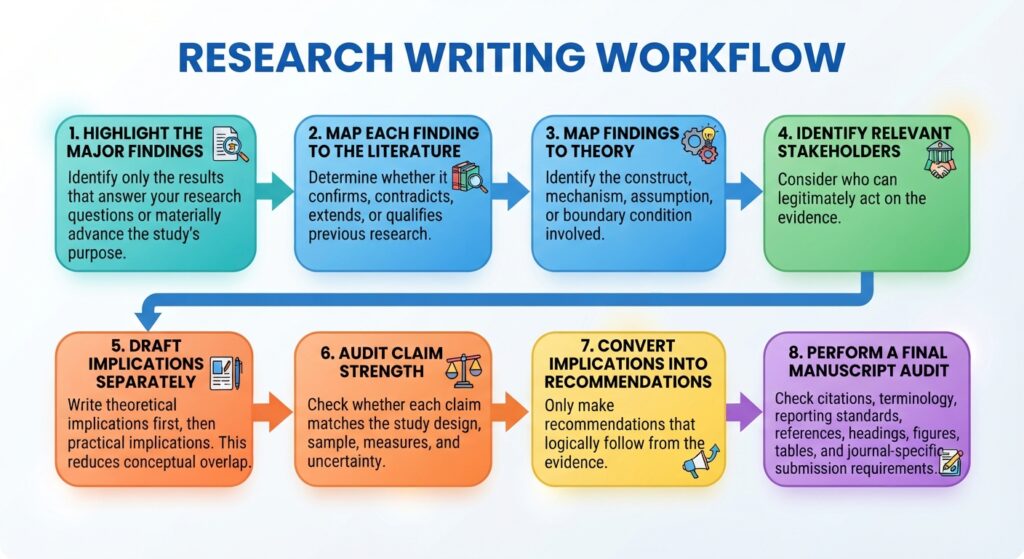
Step 1: Highlight the major findings.
Identify only the results that answer your research questions or materially advance the study's purpose.
Step 2: Map each finding to the literature.
Determine whether it confirms, contradicts, extends, or qualifies previous research.
Step 3: Map findings to theory.
Identify the construct, mechanism, assumption, or boundary condition involved.
Step 4: Identify relevant stakeholders.
Consider who can legitimately act on the evidence.
Step 5: Draft implications separately.
Write theoretical implications first, then practical implications. This reduces conceptual overlap.
Step 6: Audit claim strength.
Check whether each claim matches the study design, sample, measures, and uncertainty.
Step 7: Convert implications into recommendations.
Only make recommendations that logically follow from the evidence.
Step 8: Perform a final manuscript audit.
Check citations, terminology, reporting standards, references, headings, figures, tables, and journal-specific submission requirements.
Pre-Submission Checklist
Before uploading your thesis, dissertation, or manuscript, verify the following:
- Each major finding is connected to the relevant research question.
- Theoretical implications are explicitly distinguished from practical implications.
- Each theoretical claim identifies a specific contribution to existing theory.
- Practical implications identify an appropriate stakeholder.
- Recommendations do not exceed the strength of the evidence.
- Correlational findings are not described as causal.
- Qualitative findings are connected to concepts, processes, or theoretical interpretations where appropriate.
- Limitations are reflected in the wording of implications.
- Future research is separated from immediate practical recommendations.
- All theoretical frameworks discussed in the implications section were adequately established earlier in the manuscript.
- Citations support major interpretive claims.
- APA 7th, IEEE, Vancouver, Chicago, Harvard, or the required journal style is applied consistently.
- Headings follow the required hierarchy.
- Tables and figures are numbered and referenced correctly.
- Figure files meet the target journal's technical specifications; where raster images are required, 300 DPI is a common publication benchmark, but journal-specific requirements should always take precedence.
- References are complete and correspond exactly with in-text citations.
- The conclusion answers the research objectives without introducing unsupported claims.
- The final manuscript has undergone line-by-line proofreading for grammar, terminology, punctuation, and formatting consistency.
Conclusion: Make the Contribution Explicit
A strong implications section demonstrates that your research does more than produce findings: it explains why those findings matter.
Theoretical implications answer the scholarly question: How does this evidence affect what we know, assume, or theorize about the phenomenon?
Practical implications answer the applied question: What can relevant stakeholders reasonably learn or do because of these findings?
The strongest manuscripts connect the two without collapsing them. They show how empirical results relate to existing theoretical frameworks, identify a specific contribution to academic literature, and translate defensible findings into appropriately cautious recommendations for professional practice.
When writing Chapter 5 or preparing a journal Discussion section, remember the central rule: make the contribution specific, make the recommendation evidence-based, and make every claim proportional to the study's design and limitations.
For final submission, consider an expert review that examines not only grammar and spelling but also academic tone, logical flow, terminology, citation consistency, and journal formatting. PaperEdit's academic editing and proofreading services can help refine a manuscript from substantive clarity through final proofreading and submission readiness.