


A strong limitations section does not undermine a dissertation, thesis, or journal article. It demonstrates methodological awareness, intellectual honesty, and control over the scope of your claims. The challenge is to acknowledge constraints such as sample size, study design, measurement limitations, or restricted generalizability without making your findings sound unreliable.
Academic authors often struggle with questions such as: How do I write study limitations without sounding defensive? Where should limitations be placed in Chapter 5? How can I frame methodological constraints as opportunities for future research? The answer is not to conceal weaknesses, but to contextualize them precisely and show how they affect interpretation.
This guide explains how to articulate study limitations professionally, where to place them in a dissertation, how to phrase methodological weaknesses, and how to turn legitimate research constraints into directions for future scholarship.
💡 Ready to polish your research paper for publication?
Transform your manuscript with PaperEdit's professional editing and proofreading services!
What Are Study Limitations?
Study limitations are methodological, practical, theoretical, or contextual constraints that may affect how research findings should be interpreted or generalized.
A limitation does not necessarily mean that a study is flawed. For example, a qualitative study based on 20 interviews may provide rich contextual insights while not supporting statistical generalization to an entire population. Similarly, a cross-sectional survey may identify associations without establishing temporal or causal relationships.
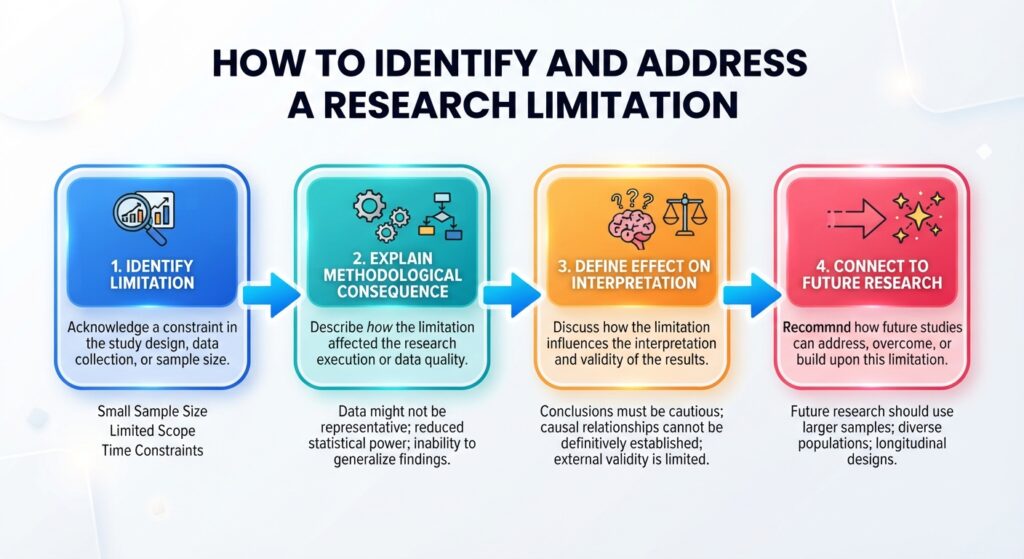
The objective is therefore not to produce a long list of everything that could have been done differently. Instead, a high-quality limitations section should answer four questions:
- What is the constraint?
- Why does it exist?
- How does it affect interpretation?
- What can future researchers do differently?
What reviewers expect
Industry and scholarly publishing standards generally favor limitations that are:
- Specific, rather than vague
- Relevant, rather than exhaustive
- Evidence-based, rather than apologetic
- Proportionate, rather than exaggerated
- Connected to interpretation, rather than detached from the findings
- Linked to future research, where appropriate
Avoid statements such as “This study has many weaknesses” or “Unfortunately, the research was not perfect.” Such language sounds defensive and provides little methodological information.
Instead, identify the exact boundary of the evidence.
Weak:
The sample size was unfortunately too small, which is a major weakness of this study.
Stronger:
The relatively small sample size limits the statistical power of the analysis and warrants caution when generalizing the findings to larger populations.
The second version acknowledges the same constraint while maintaining an appropriately measured scholarly tone.
How Do You Write Study Limitations Without Sounding Defensive?
The most effective strategy is to describe limitations analytically rather than emotionally.
A useful structure is:
Constraint → methodological consequence → interpretive boundary → future direction
For example:
The study relied on self-reported measures, which may be susceptible to recall and social-desirability biases. Consequently, the findings should be interpreted as reflecting participants’ reported experiences rather than independently verified behaviors. Future studies could strengthen the evidence base by incorporating longitudinal observations or objective behavioral measures.
This formulation does three things:
- It acknowledges a legitimate methodological constraint.
- It prevents readers from overinterpreting the findings.
- It identifies a constructive path for subsequent research.
Use calibrated scholarly language
When addressing methodological weaknesses academically, choose language that is accurate without being unnecessarily self-critical.
| Defensive or overly negative | More appropriate academic phrasing |
| “This study failed to…” | “This study did not examine…” |
| “The sample was too small.” | “The relatively small sample limits statistical power and generalizability.” |
| “The methodology was weak.” | “The selected methodology was appropriate to the research objective but imposes limitations on…” |
| “Unfortunately, we could not…” | “The study was unable to…” |
| “This is a major flaw.” | “This constraint should be considered when interpreting…” |
| “The results cannot be trusted.” | “The findings should be interpreted within the methodological boundaries of…” |
| “More research is desperately needed.” | “Further research could examine…” |
The goal is precision, not self-defense.
Also read: Top 10 APA 7th Formatting Errors That Cause Journal Rejections and How to Fix Them
Where Should Limitations Be Placed in Chapter 5?
For dissertations and theses, limitations are commonly discussed in Chapter 5, particularly within the discussion, interpretation, implications, or conclusion chapter. However, the exact location depends on your institution, discipline, and approved dissertation structure.
A common Chapter 5 sequence is:
- Introduction to the chapter
- Summary of major findings
- Interpretation/discussion of findings
- Relationship to existing literature
- Study limitations
- Implications
- Recommendations for future research
- Conclusion
Some disciplines integrate limitations directly into the discussion of individual findings rather than placing all limitations in one subsection.
How to present limitations in Chapter 5
Do not simply reproduce the methodological limitations from Chapter 3.
Chapter 3 typically explains how the study was designed and conducted.
Chapter 5 should explain what those methodological decisions mean for interpretation.
For example:
Chapter 3:
Participants were recruited using convenience sampling from three institutions.
Chapter 5:
The use of convenience sampling may have introduced selection bias because participants who volunteered for the study may differ systematically from individuals who did not participate. Accordingly, the findings may not be fully representative of the broader population.
This distinction makes the Chapter 5 discussion analytical rather than repetitive.
Dissertation limitations section best practices
A strong limitations subsection should generally:
- Introduce the limitations without apologizing for them.
- Prioritize the limitations that materially affect interpretation.
- Explain their methodological implications.
- Distinguish limitations from delimitations.
- Avoid introducing major limitations for the first time.
- Connect meaningful constraints to future research.
- Ensure that the limitations are consistent with the methodology described earlier.
Also read: How to Write Thesis Discussion Chapter: Chapter 5 Structure & Future Research Directions
How to Frame Methodological Constraints as Opportunities for Future Research
One of the most effective approaches to writing limitations is to treat them as boundaries that define the next research question.
This does not mean artificially portraying every limitation as a benefit. A limitation remains a limitation. The constructive move is to explain how subsequent studies could address it.
Example 1: Sample size
Suppose your study included 75 participants.
Instead of:
The sample size was too small, so the findings may not be valid.
Use:
The sample size of 75 participants limited the statistical power available for detecting smaller effects and restricts the extent to which the findings can be generalized. Future research involving larger, more diverse samples could test whether the observed relationships remain consistent across population subgroups.
The limitation remains explicit, but the statement does not invalidate the existing analysis.
Example 2: Cross-sectional design
Because the study employed a cross-sectional design, relationships among variables were examined at a single point in time. This design limits conclusions regarding temporal ordering and causality. Longitudinal research could therefore determine whether the observed associations persist over time and clarify potential causal pathways.
Example 3: Single-site research
Data were collected from a single institution, which provided a contextually focused examination of the research problem but may limit transferability to institutions with different organizational or demographic characteristics. Multi-site studies could assess whether these findings are replicated across comparable settings.
Example 4: Self-reported data
Reliance on self-reported measures may have introduced recall or social-desirability bias. Future studies could triangulate self-reports with behavioral observations, administrative records, or independently validated measures.
This is the essence of turning research weaknesses into future strengths: identify what the present design could not establish and specify how a future design could address that boundary.
Also read: Complete Master’s & PhD Dissertation Defense & Formatting Checklist
Framing Research Limitations Without Weakening Findings
A limitation should modify the scope of your claim, not automatically invalidate the claim.
Consider the difference between these statements:
The study proves that intervention X causes improved performance.
and:
The findings indicate an association between intervention X and improved performance within the study population.
If your design cannot establish causality, the appropriate response is not necessarily to weaken the entire study. Instead, calibrate the claim to the evidence.
This is particularly important for:
- observational studies,
- cross-sectional studies,
- qualitative research,
- convenience samples,
- small samples,
- single-site studies,
- self-reported measures,
- exploratory analyses,
- studies with substantial missing data.
Match the limitation to the affected inference
Ask:
What exactly does this limitation prevent me from claiming?
For example:
- Small sample → limits precision and potentially generalizability.
- Convenience sampling → limits representativeness.
- Cross-sectional design → limits causal or temporal inference.
- Self-reported measures → may introduce reporting bias.
- Single institution → limits transferability.
- Short follow-up → limits conclusions about long-term effects.
- Measurement instrument → may constrain construct validity.
This approach prevents the common mistake of presenting one methodological limitation as if it invalidates every finding.
Scholarly Phrasing for Research Constraints
Strong limitations writing depends heavily on calibrated academic language.
Useful phrases include:
- “The findings should be interpreted within the context of…”
- “This constraint limits the extent to which…”
- “The study design does not permit conclusions regarding…”
- “Caution is warranted when generalizing…”
- “The findings may not fully capture…”
- “This methodological decision may have influenced…”
- “The use of [method] introduces the possibility of…”
- “Future research could address this limitation by…”
- “Subsequent studies may benefit from…”
- “Further investigation is warranted to determine whether…”
Avoid excessive hedging. Repeated use of may, might, could, and possibly can make an otherwise strong discussion sound uncertain.
Instead, distinguish between established methodological consequences and possible effects.
Over-hedged:
The relatively small sample may perhaps have potentially affected the findings in some ways.
Precise:
The relatively small sample reduced statistical power and limits the precision of estimates.
Precision communicates confidence without overstating the evidence.
Examples of Academic Study Limitations by Research Design
Different research designs produce different limitations. Your discussion should reflect the actual methodological architecture of your study.
Quantitative research
Common limitations include:
- limited sample size,
- non-probability sampling,
- measurement error,
- missing data,
- self-reported variables,
- cross-sectional design,
- limited statistical power,
- residual confounding,
- restricted geographic coverage.
Qualitative research
Common limitations include:
- limited participant diversity,
- researcher positionality,
- context-specific findings,
- reliance on participant accounts,
- limited transferability,
- interpretation-dependent coding.
A qualitative limitation should not be framed as a failure to achieve statistical generalizability when statistical generalization was never the objective.
For example:
The study's context-specific sample limits transferability to settings with substantially different institutional or cultural characteristics. Future comparative qualitative research could examine whether the identified themes emerge across contrasting contexts.
Mixed-methods research
Potential limitations include:
- unequal integration of qualitative and quantitative components,
- differences in sample composition,
- limited resources for simultaneous data collection,
- challenges in reconciling divergent findings,
- sequencing effects.
Explain how the limitation affects integration, rather than merely listing the separate weaknesses of each method.
How to Frame Sample Size Limitations Professionally
Sample size is one of the most frequently mishandled limitations.
Never simply write:
“The sample was small.”
Explain why the sample size matters.
Depending on the research design, sample size may affect:
- statistical power,
- confidence interval precision,
- subgroup analysis,
- model complexity,
- representativeness,
- saturation,
- transferability.
For quantitative research, report the actual sample and connect it to the relevant statistical consequence.
The final sample comprised 82 participants, which limited the power available for detecting small effects and prevented reliable subgroup analyses. The findings therefore provide preliminary evidence regarding the observed relationships, while larger samples would be valuable for testing their stability across demographic and contextual subgroups.
For qualitative research, avoid mechanically applying quantitative concepts such as statistical power. Discuss depth, diversity, saturation, transferability, and contextual scope as appropriate.
Limitations vs. Delimitations: Do Not Confuse Them
A limitation is a constraint that affects the study but is not necessarily fully under the researcher's control.
A delimitation is a deliberate boundary established by the researcher.
For example:
The study included undergraduate students rather than postgraduate students.
If this was intentionally specified in the research design, it may be a delimitation.
By contrast:
The final sample contained fewer participants than anticipated because of recruitment difficulties.
This is more appropriately treated as a limitation.
The distinction matters because describing every research boundary as a “limitation” can make a carefully designed study appear unnecessarily weak.
Copyediting the Limitations Section: What Editors Check
After the conceptual content is correct, perform a dedicated academic copyediting and proofreading pass.
Editors should check:
1. Consistency of terminology
Use the same terms throughout the dissertation.
If Chapter 3 calls the design a “cross-sectional survey,” do not alternate unnecessarily among “cross-sectional study,” “survey research,” and “one-time observational research.”
2. Consistency with methodology
The limitations section must accurately reflect the methods actually used.
Do not claim that your study has a “small sample” without considering the discipline, research design, statistical approach, or qualitative methodology.
3. Claim calibration
Check whether your conclusion makes claims that exceed the limitations.
A useful editorial test is:
Does the strength of the claim match the strength of the evidence?
4. Academic tone
Eliminate emotional or apologetic language such as:
- unfortunately,
- sadly,
- regrettably,
- failed to,
- inadequate,
- terrible,
- serious weakness.
Replace subjective judgments with methodological descriptions.
5. Logical progression
Each limitation should move logically from:
constraint → consequence → interpretation → future research
This makes the section easier for examiners and peer reviewers to evaluate.
Editing Tiers for a Dissertation Limitations Section
Different levels of editorial intervention address different problems.
| Editing level | Primary focus | Typical limitation-section issues |
| Structural editing | Argument and organization | Limitations are repetitive, misplaced, or disconnected from findings |
| Line editing | Clarity and academic expression | Defensive tone, weak transitions, excessive wordiness |
| Copyediting | Grammar and consistency | Terminology, tense, punctuation, capitalization |
| Proofreading | Final surface accuracy | Typos, formatting errors, citation inconsistencies |
For authors preparing a dissertation or manuscript for submission, the strongest workflow is usually structural review → academic language editing → copyediting → final proofreading.
You can also use PaperEdit Academic Proofreading Services for a final language and consistency review before submission.
Also read: Academic Editing and Proofreading Services
Reporting and Style Standards to Check
Your limitations section should also comply with the reporting framework appropriate to your study.
Depending on the research design, relevant standards may include:
- PRISMA for systematic reviews and meta-analyses
- CONSORT for randomized trials
- STROBE for observational studies
- COREQ for qualitative interviews and focus groups
Researchers should also consult the requirements of their target journal or university rather than assuming that one reporting framework applies universally.
For citation and manuscript-style questions, consult the official APA Style guidance where APA 7th edition applies. Researchers working in biomedical publishing should also review the ICMJE Recommendations. For technical and engineering manuscripts, the IEEE Author Center provides journal and submission guidance.
Pre-Submission Study Limitations Checklist
Before submitting your dissertation, thesis, or manuscript, audit the limitations section against this checklist:
- Have you identified the most consequential limitations rather than listing every possible imperfection?
- Does each limitation have a clear methodological basis?
- Have you explained how each limitation affects interpretation?
- Have you avoided apologetic or defensive language?
- Does the section distinguish limitations from deliberate delimitations?
- Is the sample-size limitation explained in terms appropriate to your research design?
- Are claims about causality consistent with the study design?
- Have you addressed generalizability or transferability appropriately?
- Are recommendations for future research specific and realistic?
- Does Chapter 5 interpret limitations rather than merely repeat Chapter 3?
- Are terminology and methodological descriptions consistent throughout the dissertation?
- Have you checked your institution's dissertation requirements?
- Have you checked the target journal's author guidelines?
- Have you completed a final academic proofreading pass?
- Are citations, headings, tables, and references formatted consistently?
Conclusion
A well-written limitations section does not weaken research; it establishes the boundaries within which the findings can be interpreted confidently. The strongest dissertations and journal manuscripts neither conceal methodological constraints nor exaggerate them. Instead, they identify the constraint, explain its consequence, calibrate the interpretation, and show how future research can extend the evidence.
When writing limitations in Chapter 5, focus on methodological precision rather than apology. Replace “this study was flawed because…” with a structured explanation of what the study could establish, what it could not establish, and what the next study should investigate.
If you are preparing a dissertation, thesis, or manuscript for examination or journal submission, PaperEdit can help you refine academic language, improve argument clarity, standardize formatting, and complete a final manuscript proofreading review before submission.