


A systematic literature review (SLR) requires more than collecting relevant articles and summarizing their findings. Researchers must define a focused research question, develop a reproducible search strategy, apply transparent inclusion and exclusion criteria, critically appraise the evidence, and synthesize results using methods appropriate to the research question. Without these safeguards, even a well-written review can suffer from selection bias, incomplete evidence coverage, and weak methodological transparency.
Understanding systematic literature review methodology is therefore essential for doctoral candidates, academic researchers, and scholars preparing manuscripts for peer-reviewed journals. A rigorous review allows readers to evaluate how evidence was identified, why particular studies were included, and whether the conclusions are justified by the available research.
This guide explains how to conduct and write a systematic literature review in 2026, covering protocol development, database searching, PRISMA reporting, screening, data extraction, critical appraisal, evidence synthesis, and journal submission readiness.
💡 Ready to polish your research paper for publication?
Transform your manuscript with PaperEdit's professional editing and proofreading services!
1. Understand What a Systematic Literature Review Involves
A systematic literature review is a structured research method that identifies, evaluates, and synthesizes relevant studies according to predefined, explicit procedures. Unlike an informal literature overview, an SLR aims to minimize avoidable bias and make the review process transparent and reproducible.
Systematic review vs. traditional literature review
A traditional literature review may prioritize influential publications, conceptual developments, or a broad discussion of a research field. A systematic review follows a documented methodology for searching, selecting, appraising, and synthesizing evidence.
| Criterion | Traditional literature review | Systematic literature review |
| Research question | Often broad or exploratory | Focused and explicitly defined |
| Search strategy | May be selective or narrative | Documented and reproducible |
| Study selection | Often based on author judgment | Governed by predefined criteria |
| Quality appraisal | Variable or informal | Uses appropriate, explicit appraisal methods |
| Synthesis | Primarily narrative or conceptual | Structured qualitative, quantitative, or mixed synthesis |
| Reporting | Flexible structure | Follows relevant reporting guidance |
| Main limitation | Greater risk of selection bias | Resource-intensive; still vulnerable to methodological bias |
Why this distinction matters: Journal editors and reviewers need to determine whether the conclusions reflect the available evidence or the authors' selective interpretation of it.
A systematic review is not automatically superior for every research question. A scoping review may be more appropriate when mapping a broad field, identifying evidence gaps, or clarifying concepts. Select the review design that fits your objective rather than forcing every research problem into an SLR.
2. Define a Focused Research Question
The research question determines the scope of the review, the search strategy, the eligibility criteria, and the synthesis method.
Start by identifying the research problem, the population or context of interest, the intervention or phenomenon being investigated, and the outcomes or concepts that matter.
Select an appropriate question framework
Different disciplines require different question structures.
- PICO: Population, Intervention, Comparison, Outcome. Common in clinical and intervention research.
- PICo: Population, Interest, Context. Useful for qualitative evidence synthesis.
- SPIDER: Sample, Phenomenon of Interest, Design, Evaluation, Research type. Often useful for qualitative and mixed-methods research.
- PEO: Population, Exposure, Outcome. Useful for exposure-related questions.
- Population–Concept–Context: Frequently used in scoping reviews.
For example, a broad question such as "How does artificial intelligence affect education?" may be difficult to investigate systematically. A more focused question is: "What effects do AI-supported tutoring systems have on undergraduate students' learning outcomes compared with conventional instruction?"
The revised question identifies the intervention, population, comparison, and outcome, making it easier to determine which studies qualify for inclusion.
Establish the scope before searching
Specify the publication period, languages, eligible study designs, settings, and relevant outcomes where justified. Explain the rationale for each restriction.
Common pitfall: Defining eligibility criteria after reviewing the search results can introduce confirmation bias. Establish the criteria before screening and document any justified amendments.
3. Develop and Register a Review Protocol
A review protocol specifies how the review will be conducted before the main screening and synthesis activities begin. It functions as a methodological blueprint, supporting consistency across reviewers and reducing the risk of decisions being influenced by emerging findings.
What should a systematic review protocol include?
At minimum, document:
- The review title, rationale, and objectives.
- The primary and secondary research questions.
- Eligibility and exclusion criteria.
- Databases and supplementary search sources.
- Search strings and planned search dates.
- Screening procedures and reviewer responsibilities.
- The data extraction template and variables.
- Critical appraisal or risk-of-bias assessment methods.
- The planned synthesis approach.
- Procedures for handling disagreements, missing data, and protocol amendments.
Where should you register a systematic review protocol?
Choose a repository appropriate to your discipline and review type.
- PROSPERO is a prospective international register for eligible systematic reviews, particularly in health and related fields. Check its current eligibility requirements before submission.
- Open Science Framework (OSF) supports registration and sharing of protocols across many research disciplines.
- Some journals accept or publish review protocols directly.
Registration is not universally mandatory, and registering a protocol does not guarantee methodological quality. Its primary value is to establish a transparent record of planned methods and subsequent changes.
Common pitfall: Treating the protocol as a document that can be silently revised. If the research question, eligibility criteria, or synthesis plan changes, record what changed, when it changed, and why.
4. Build a Reproducible Search Strategy
A comprehensive search strategy is one of the most important components of a rigorous SLR. Searching only Google Scholar or a single database can miss relevant studies, especially when terminology differs across disciplines.
Step 1: Identify suitable databases
Select databases based on the subject area and the types of evidence required. Depending on the review, these may include PubMed/MEDLINE, Embase, Scopus, Web of Science, ERIC, PsycINFO, IEEE Xplore, or the Cochrane Library.
Use discipline-specific databases alongside multidisciplinary sources when appropriate. Consider citation searching, reference-list checking, trial registries, dissertations, preprints, and grey literature when these sources are relevant to the review question.
Step 2: Build search strings using Boolean operators
Combine synonyms and controlled vocabulary where supported.
- OR retrieves records containing alternative terms.
- AND combines distinct concepts.
- NOT excludes terms but should be used cautiously because it can remove relevant studies.
- Quotation marks may identify exact phrases.
- Truncation and wildcard symbols vary by database.
For a review of AI-supported tutoring in higher education, an illustrative search structure might be:
("artificial intelligence" OR "intelligent tutoring" OR "AI-supported learning") AND ("higher education" OR universit* OR undergraduate*) AND (achievement OR "learning outcomes" OR performance)
This is a starting point, not a validated search string. Adapt field tags, controlled vocabulary, proximity operators, and syntax to each database. Test the strategy against known relevant studies and revise it when necessary.
Step 3: Document every search
Record the database and platform, complete search string, search date, applied filters, and number of records retrieved. Preserve exported records and deduplicate them using reference management software or a documented workflow.
For a reproducible search, another researcher should be able to reconstruct the search process from your methods and supplementary files.
Common pitfall: Reporting only that "multiple databases were searched." Without the complete search strings and dates, readers cannot adequately evaluate search coverage or reproduce the process.
5. Define Inclusion and Exclusion Criteria
Eligibility criteria determine which studies can answer the research question. Apply them consistently, ideally through independent screening by two reviewers or another justified quality-control procedure.
| Criterion | Example inclusion rule | Example exclusion rule |
| Population | Undergraduate students | Primary or secondary school students |
| Intervention or concept | AI-supported tutoring | Unrelated digital learning tools |
| Outcomes | Measured learning performance | No relevant learning outcome |
| Study design | Eligible controlled or observational studies | Editorials and opinion pieces |
| Publication period | 2016–2026, if justified | Publications outside the specified period |
| Language | Languages the review can reliably assess | Languages outside the stated scope |
These examples are illustrative. The actual criteria must reflect the research question and protocol.
Screen titles, abstracts, and full texts
Use a staged screening process:
- Deduplication: Remove duplicate records while preserving the record counts.
- Title and abstract screening: Exclude clearly ineligible records using the predefined criteria.
- Full-text screening: Assess potentially relevant reports against all eligibility criteria.
- Exclusion documentation: Record a specific reason for each full-text exclusion.
- Conflict resolution: Use discussion, a third reviewer, or another prespecified procedure to resolve disagreements.
Pilot the criteria on a sample of records before full screening. Clarify ambiguous rules and assess reviewer agreement where appropriate.
Common pitfall: Excluding studies because their findings contradict the expected hypothesis. Eligibility must depend on the protocol, not whether a result supports the review authors' assumptions.
6. Apply the PRISMA Framework Correctly
The PRISMA framework for a literature review provides reporting guidance that helps authors explain how systematic review records were identified, screened, assessed, and included.
The PRISMA 2020 statement includes a 27-item reporting checklist and flow diagrams for documenting study selection. It improves transparency but does not replace a sound search strategy, appropriate risk-of-bias assessment, or a suitable synthesis method.
How do you use the PRISMA flow diagram?
Report the numbers of records identified from databases and registers, records removed before screening, records screened, reports sought and assessed for retrieval, full-text reports excluded, and studies included in the review. Where applicable, distinguish reports from studies because one study may have multiple publications.
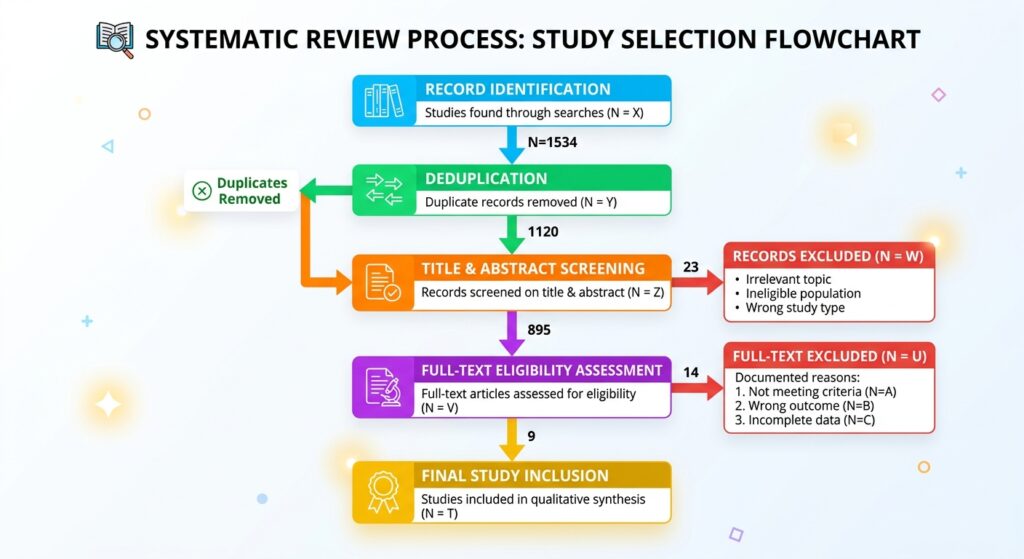
Replace this placeholder with a properly prepared PRISMA 2020 flow diagram populated with the review's actual counts.
Important: The diagram must reflect the work performed. Never estimate missing counts or adjust numbers merely to make the flow appear consistent. Reconcile every stage against your reference manager, screening log, and full-text exclusion records.
Common pitfall: Treating PRISMA compliance as proof that a review is rigorous. PRISMA is primarily a reporting guideline; methodological conduct must be evaluated separately.
Also read: 4 Types of Language Errors in Research Papers (With Examples)
7. Use a Structured Data Extraction Template
Data extraction transforms included studies into a consistent evidence dataset. A standardized data extraction template for a systematic review reduces transcription errors, helps reviewers compare studies, and supports transparent synthesis.
What should the extraction form capture?
Include fields relevant to the review question, such as:
- Author, publication year, and study identifier.
- Country, setting, and research context.
- Study design, sample size, and participant characteristics.
- Intervention, exposure, comparator, or phenomenon of interest.
- Outcomes, measurement instruments, and follow-up periods.
- Main findings and effect estimates, where applicable.
- Funding sources and declared conflicts of interest.
- Limitations, risk-of-bias judgments, and relevant notes.
A spreadsheet may be sufficient for a small review, while specialized systematic review software can support independent extraction, reconciliation, and audit trails in larger projects.
Pilot the template before full extraction
Test the form on several included studies. Confirm that each field is clearly defined, required data can be located, and reviewers interpret the categories consistently. Have a second reviewer verify critical data, particularly outcome values, sample sizes, confidence intervals, and effect estimates.
Do not confuse the extraction of study characteristics with critical appraisal. Collect descriptive information systematically, then evaluate methodological limitations using an appropriate assessment tool.
Common pitfall: Extracting only the headline findings. Without information about study design, sample characteristics, measurement methods, and limitations, the review may overstate the comparability of the evidence.
8. Conduct Critical Appraisal and Assess Risk of Bias
Critical appraisal evaluates whether the included studies provide credible evidence for the research question. A study can be relevant to a review yet have limitations that reduce confidence in its findings.
Choose the appraisal instrument according to the study design and review objective. Depending on the evidence base, relevant resources may include Cochrane risk-of-bias tools for randomized trials, ROBINS-I for nonrandomized intervention studies, and JBI critical appraisal tools for relevant designs.
Assess issues such as:
- Selection and confounding bias.
- Randomization and allocation concealment, where relevant.
- Missing outcome data and attrition.
- Measurement validity and outcome assessment.
- Selective reporting and deviations from intended interventions.
- Appropriateness of the analysis.
Report the tool used, the assessment domains, the reviewer process, and how judgments informed interpretation or synthesis.
Address publication bias
Publication bias occurs when the likelihood of research being published or available is related to its findings. Searching grey literature, trial registries, and relevant repositories may help identify evidence that conventional database searches miss.
For quantitative meta-analyses, funnel plots and statistical tests may help assess small-study effects when the number and characteristics of studies make these methods appropriate. They cannot establish publication bias conclusively, particularly when few studies are available or substantial heterogeneity exists.
Common pitfall: Assigning a single quality score without explaining the underlying methodological weaknesses. Transparent domain-level judgments are often more informative than an unexplained total score.
9. Synthesize the Evidence Appropriately
Evidence synthesis should answer the research question, not merely repeat the abstracts of included studies. The method depends on the type, quality, comparability, and volume of available evidence.
| Synthesis method | Appropriate use | Key consideration |
| Narrative synthesis | Heterogeneous findings or studies unsuitable for pooling | Use a structured, transparent approach rather than selective description |
| Meta-analysis | Quantitatively compatible outcome data | Justify effect measures, model assumptions, and heterogeneity assessment |
| Thematic synthesis | Qualitative findings and recurring concepts | Explain coding, theme development, and interpretation |
| Framework synthesis | Evidence organized around an established conceptual model | Define the framework and document how evidence is mapped |
| Mixed-methods synthesis | Reviews integrating qualitative and quantitative evidence | Explain how evidence types are integrated and how discrepancies are handled |
Quantitative synthesis
When a meta-analysis is appropriate, specify the effect measure, statistical model, approach to heterogeneity, and treatment of missing data. Depending on the outcome, measures may include risk ratios, odds ratios, mean differences, or standardized mean differences.
Report effect estimates with confidence intervals and explain the practical meaning of the results. Statistical significance alone does not establish clinical, educational, or policy importance.
Qualitative synthesis
For qualitative evidence, describe how findings were coded, grouped, compared, and interpreted. Distinguish participants' original accounts, the primary study authors' interpretations, and the systematic review authors' analytical conclusions.
Interpret heterogeneity carefully
Differences in study populations, interventions, outcome definitions, settings, and research designs may limit comparability. Statistical heterogeneity measures, including I², can help characterize variation in meta-analysis, but they should be interpreted alongside clinical and methodological differences.
If the evidence cannot support meaningful pooling, do not force a meta-analysis. A rigorous narrative synthesis is preferable to a statistically inappropriate combined estimate.
Common pitfall: Claiming that an intervention is effective because most included studies reported positive findings. Consider study quality, effect sizes, uncertainty, inconsistent results, and the possibility of missing evidence.
10. Write the Systematic Literature Review Manuscript
A well-conducted review still needs a clear, logically organized manuscript. The writing should allow readers to understand the research problem, reproduce the methods, evaluate the findings, and distinguish evidence from interpretation.
Recommended manuscript structure
Title and abstract: Identify the review as systematic where appropriate. Summarize the objective, information sources, eligibility criteria, synthesis methods, principal results, and conclusions.
Introduction: Establish the research problem, summarize the knowledge gap, justify the review, and state the research question or objective.
Methods: Describe the protocol, registration, eligibility criteria, databases, full search strategies, selection process, data extraction, risk-of-bias assessment, and synthesis methods. Include deviations from the original protocol.
Results: Present search and selection counts, study characteristics, risk-of-bias findings, and synthesis results. Use tables and figures to organize complex information.
Discussion: Interpret the findings in relation to previous research, explain heterogeneity and limitations, identify evidence gaps, and discuss implications for research and practice.
Conclusion: Answer the research question directly without making claims that exceed the evidence.
Supplementary materials: Provide full search strings, detailed extraction tables, appraisal judgments, and additional analyses when appropriate.
Maintain academic precision
Use consistent terminology, define abbreviations at first mention, and distinguish association from causation. Report numerical results accurately and align every statement with the underlying evidence.
Use citation management software to standardize references, but manually verify author names, publication years, DOIs, reference-list entries, and in-text citations. Follow the target journal's author instructions rather than assuming a universal formatting standard.
The ICMJE Recommendations provide relevant guidance for medical journal manuscripts, while Purdue OWL offers practical academic writing and citation resources.
Also read: Writing with Clarity: Avoiding Overly Complex Sentences
11. Prepare the Review for Journal Submission
Submission readiness involves more than grammatical accuracy. Editors may assess whether the review fits the journal's scope, addresses a meaningful evidence gap, follows appropriate reporting guidance, and demonstrates a defensible methodology.
Before submission:
- Select a journal that publishes your review type and subject area.
- Read its instructions for authors, including word limits and supplementary-file requirements.
- Complete the applicable reporting checklist and prepare the flow diagram.
- Verify protocol registration details and disclose amendments.
- Ensure the abstract, methods, results, tables, and supplementary materials agree.
- Check references, figure legends, abbreviations, and statistical notation.
- Confirm ethical declarations, funding statements, conflicts of interest, and author contributions as applicable.
- Prepare a concise cover letter explaining the review's contribution and relevance to the journal.
Use the appropriate reporting guideline for the review design. PRISMA 2020 is widely used for systematic reviews of intervention effects; other review types may require additional or different guidance.
Final Systematic Literature Review Checklist
Use this checklist before uploading your manuscript to a journal portal.
- The research question is focused and justified.
- The review protocol was developed and registration considered where appropriate.
- Inclusion and exclusion criteria were defined before screening.
- Relevant databases and supplementary sources were searched.
- Complete search strings, platforms, dates, and filters were recorded.
- Duplicate records were handled consistently.
- Screening decisions and full-text exclusion reasons were documented.
- PRISMA flow counts match the underlying records.
- The data extraction template was piloted and applied consistently.
- Critical appraisal used tools appropriate to the included study designs.
- The synthesis method matches the evidence and research question.
- Publication bias, heterogeneity, and evidence limitations were considered where relevant.
- Conclusions reflect the strength and uncertainty of the findings.
- Citations, references, tables, and figures are accurate and consistent.
- The manuscript complies with the target journal's reporting and formatting requirements.
- The final document has undergone academic language editing and proofreading.
Conclusion: Make Methodological Rigor Your Priority
A rigorous systematic literature review combines a focused research question, a transparent protocol, a reproducible search strategy, consistent screening, structured data extraction, appropriate critical appraisal, and a defensible evidence synthesis. Each stage contributes to the credibility of the final manuscript.
For researchers preparing an SLR for publication, methodological transparency and clear academic writing should work together. PaperEdit can help refine your manuscript's language, improve consistency, and strengthen submission readiness while preserving your scholarly meaning. Visit PaperEdit to explore professional academic editing and proofreading support before submitting your review.