


Academic writing is not considered publication-ready simply because the research is sound. Authors must also satisfy the documentation, citation, formatting, and presentation conventions expected in their discipline. Choosing the wrong style or mixing rules from different systems can create inconsistent citations, poorly formatted references, and avoidable revisions.
An academic style guide establishes standardized rules for documenting sources, presenting scholarly arguments, formatting manuscripts, and maintaining consistency. The three systems researchers and graduate students most commonly encounter are APA 7th edition, MLA 9th edition, and Chicago style, with Chicago offering both notes-and-bibliography and author-date systems. Official guidance confirms that APA is widely associated with the social sciences, MLA with the humanities, and Chicago with a broad range of disciplines, particularly humanities, history, arts, sciences, and social sciences depending on the system selected.
This comprehensive academic formatting standards guide explains when to use each style, how their citation systems differ, what formatting conventions matter most, and how to audit a manuscript before submission.
💡 Ready to polish your research paper for publication?
Transform your manuscript with PaperEdit's professional editing and proofreading services!
APA vs. MLA vs. Chicago: What Is the Right Style?
The first rule of academic formatting is simple: do not choose a citation style based only on personal preference. Your department, instructor, journal, publisher, or target discipline may prescribe the required style.
APA 7th edition
APA 7th is most strongly associated with psychology, education, sociology, communication, nursing, and other social and behavioral sciences. Its author-date citation system foregrounds the researcher and publication year:
(Garcia, 2025)
The publication date is particularly important because readers in empirical disciplines often need to assess how current the evidence is. APA also provides detailed conventions for headings, statistical reporting, tables, figures, numbers, inclusive language, and references. Purdue OWL's current APA 7 resources cover the style's in-text citation, reference-list, heading, table, figure, and formatting requirements.
MLA 9th edition
MLA is primarily associated with literature, languages, cultural studies, and other humanities disciplines. Rather than emphasizing publication date, MLA generally emphasizes the author's name and the location of the cited material.
A basic parenthetical citation may look like:
(Ahmed 127)
MLA 9 uses a flexible container model built around core bibliographic elements. The official MLA Style Center provides current examples based on the ninth edition.
Chicago style
Chicago is distinctive because it provides two citation systems:
- Notes and bibliography — citations appear in numbered footnotes or endnotes, generally accompanied by a bibliography.
- Author-date — citations appear in parentheses, usually with author and year, followed by a reference list.
Chicago notes and bibliography is particularly common in history, literature, and the arts, while author-date is widely used in sciences and social sciences. The Chicago Manual of Style's official guide emphasizes that authors should follow the system required by their field, instructor, or publisher.
Also read: Top Grammar Pitfalls in Academic Writing for ESL Students
Academic Style Guides Comparison: APA, MLA, and Chicago
| Feature | APA 7th | MLA 9th | Chicago |
| Typical disciplines | Social sciences, behavioral sciences, education | Humanities, literature, languages, cultural studies | Humanities, history, arts; author-date also common in sciences/social sciences |
| Primary citation system | Author-date | Author-page | Notes-bibliography or author-date |
| In-text example | (Lee, 2025) | (Lee 42) | (Lee 2025, 42) |
| Main end matter | References | Works Cited | Bibliography or Reference List |
| Publication date emphasis | High | Generally lower | Depends on system |
| Footnotes | Supplementary/limited uses | Optional/special purposes | Central to notes-bibliography |
| Heading system | Five hierarchical levels | Flexible; consistency required | Depends on project/publisher |
| Core strength | Research currency and empirical documentation | Author/work/location documentation | Flexibility and detailed source notes |
The central lesson is that citation style is an information architecture, not merely a punctuation preference. Each system determines what information readers see first and how easily they can trace your sources.
When Should I Use APA?
Use APA when your discipline or target publication expects an author-date documentation system with strong emphasis on publication year.
APA is particularly appropriate when your research depends on current empirical literature. A reader studying a rapidly developing research field benefits from immediately seeing when a source was published.
What APA 7 requires
A typical APA manuscript should be audited for:
- Consistent author-date in-text citations
- A corresponding References section
- Correct capitalization of article and book titles
- Correct DOI and URL presentation
- Appropriate use of italics
- Correct treatment of multiple authors
- Hierarchical APA headings
- Correct formatting of tables and figures
- Appropriate reporting of numbers and statistics
- Consistent page numbering and document layout
APA 7 also uses five heading levels, with formatting determined by the hierarchy of the section rather than arbitrary numbering.
For student papers, requirements can differ from professional manuscripts. Do not automatically apply an old APA template containing a traditional running head to a current student paper. Always verify the specific assignment, department, or journal instructions against current APA 7 guidance.
Common APA submission pitfalls
Mixing APA 6 and APA 7 rules is particularly common. Authors may retain outdated running-head conventions, obsolete reference formats, or incorrect treatment of electronic sources.
Another frequent problem is incomplete synchronization between citations and the reference list. Every source cited in the text should be checked against the final reference list, and every reference-list entry should be traceable to an in-text citation unless the publication specifically permits otherwise.
Also read: Top 10 APA 7th Formatting Errors That Cause Journal Rejections and How to Fix Them
MLA 9: Mastering the Humanities Citation System
MLA requires a different mindset from APA. Instead of making publication year the central identifying feature, MLA typically directs readers to the author and relevant page or other location.
What MLA 9 requires
A conventional MLA research paper generally uses:
- Double spacing
- One-inch margins
- A readable 12-point font such as Times New Roman
- A first-line paragraph indentation of 0.5 inch
- A last-name/page-number header
- A centered paper title
- A Works Cited page
- Hanging indents for Works Cited entries
Purdue OWL's current MLA guidance confirms these general paper-formatting conventions and recommends consulting the ninth edition of the MLA Handbook for authoritative rules.
MLA's Works Cited entries use a nine-element framework commonly described as a core-elements template. Authors should identify which elements apply to the source rather than forcing every source into an identical citation formula.
Example of MLA logic
Suppose you quote a passage from page 42 of a book by an author named Chen:
(Chen 42)
The Works Cited entry then provides the fuller publication information.
This creates an efficient relationship between the in-text reference and the detailed bibliographic record.
Common MLA submission pitfalls
One of the most frequent mistakes is importing APA conventions into an MLA manuscript for example, emphasizing publication dates in parenthetical citations or labeling the final page References instead of Works Cited.
Another is treating every web page as a simple URL. MLA 9's container model requires authors to evaluate the source carefully and determine which elements and containers actually apply.
Authors also frequently overlook the requirement that the Works Cited page correspond accurately with sources cited in the manuscript. Purdue OWL explicitly notes that Works Cited entries should correspond to works cited in the main text.
Also read: 4 Types of Language Errors in Research Papers (With Examples)
Chicago Style: Understanding Notes-Bibliography and Author-Date
Chicago requires an additional decision: which Chicago system does your project require?
Notes and bibliography
The notes-and-bibliography system uses superscript numbers linked to footnotes or endnotes:
...as demonstrated by recent archival research.¹
A corresponding note provides the source details. A bibliography is generally included at the end.
This system is especially useful when an author needs to provide explanatory comments alongside citations or document unusual source types. Chicago describes notes and bibliography as its oldest and most flexible citation system.
Author-date
Chicago's author-date system resembles APA structurally:
(Chen 2025, 42)
The reader then consults the reference list for complete bibliographic information.
This distinction is important when answering the question: What are the core differences between author-date and notes-bibliography systems?
Author-date puts a compact citation directly into the prose, emphasizing who produced the source and when. Notes-and-bibliography moves documentation into footnotes or endnotes, allowing the prose to remain visually cleaner while giving authors more room for source details and explanatory notes.
Common Chicago pitfalls
Do not combine the two systems casually.
For example, an author should not use Chicago footnotes for some sources and APA-style parenthetical citations for others simply because the resulting references appear readable. Select the system specified by the journal, instructor, publisher, or discipline and apply it consistently.
Also distinguish a bibliography from a reference list. Chicago explains that an author-date reference list contains the works cited, whereas a bibliography can encompass works consulted during research and may include material not directly cited.
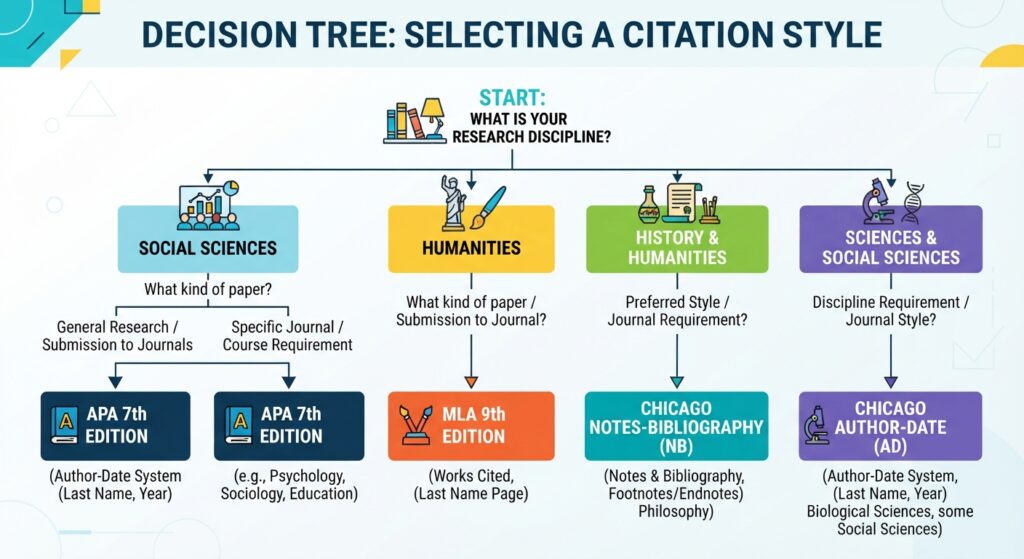
How Do I Format a Paper According to Major Academic Style Guidelines?
Start with the source of authority, not a generic template.
Use this sequence:
1. Identify the controlling guideline
For a university assignment, check the assignment brief and departmental instructions.
For a journal manuscript, prioritize the journal's Instructions for Authors. A journal may specify a particular citation style while also imposing its own requirements for manuscript structure, word count, tables, figures, supplementary files, references, and reporting standards.
2. Establish document formatting
Audit:
- Page size
- Margins
- Typeface and font size
- Line spacing
- Paragraph indentation
- Page numbering
- Heading hierarchy
- Title-page requirements
- Abstract requirements
- Table and figure placement
- Appendix formatting
Do not assume that a universal “academic format” exists. Style manuals provide conventions; publishers and journals may modify those conventions.
3. Standardize citations
Select one citation system and apply it consistently.
Check:
- Author names
- Publication years
- Page numbers
- Titles
- Journal names
- Volume and issue numbers
- Page ranges
- DOIs
- URLs
- Punctuation
- Capitalization
- Italicization
4. Synchronize references
Perform a two-way audit:
In-text citation → reference entry
and
Reference entry → in-text citation
Reference-management software such as Zotero, EndNote, or other bibliographic platforms can reduce repetitive work, but automated output still requires human review. Citation generators can reproduce incomplete metadata or apply inappropriate rules when source information is ambiguous.
5. Complete a visual consistency audit
Formatting errors are often easier to detect visually than during ordinary proofreading.
Check every page for:
- Inconsistent headings
- Uneven indentation
- Incorrect page breaks
- Orphaned headings
- Misaligned tables
- Figure-caption inconsistencies
- Incorrect numbering
- Extra spaces
- Mixed fonts
- Inconsistent italics
- Broken hyperlinks
Citation and Style Rules for Researchers: What Editors Audit
Professional academic editing goes beyond correcting commas.
A manuscript may require several editorial layers:
| Editing level | Primary objective | Typical intervention |
| Structural editing | Improve scholarly organization | Argument flow, section order, logic |
| Line editing | Improve readability and academic voice | Sentence construction, transitions, precision |
| Copyediting | Standardize language and style | Grammar, terminology, punctuation, consistency |
| Citation editing | Correct documentation | In-text citations, references, DOI/URL data |
| Proofreading | Eliminate final errors | Typographical, formatting, spacing, numbering errors |
The correct sequence matters. Do not spend hours correcting reference punctuation before resolving structural weaknesses.
A manuscript with a polished bibliography but an unclear research question still needs substantive revision.
Also read: PaperEdit Academic Proofreading Services
Building a Journal-Ready Formatting Workflow
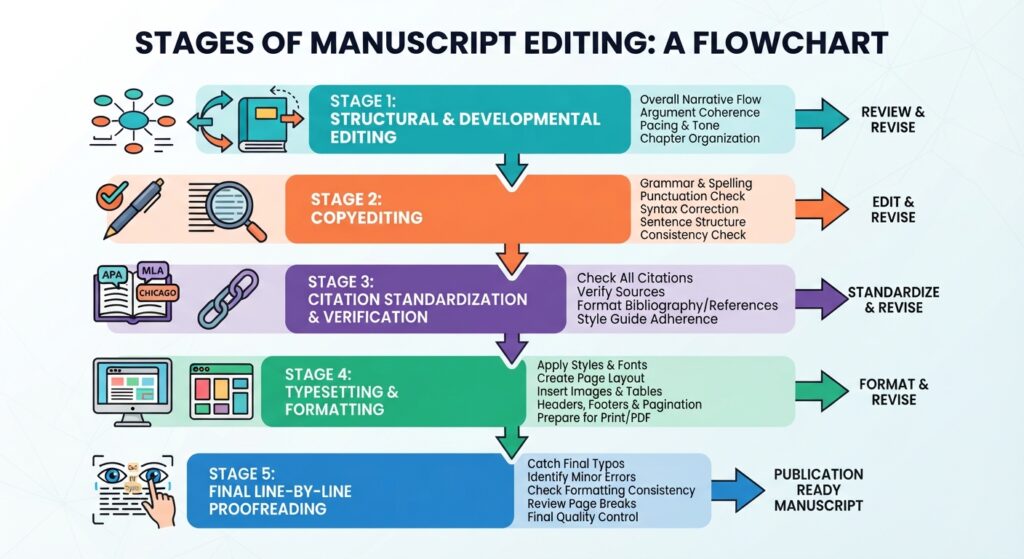
Use a staged workflow:
Research requirements → Journal/institution guidelines → Structural edit → Language edit → Citation audit → Formatting audit → Reference reconciliation → Proofreading → Submission-file check
This sequence minimizes rework.
Structural stage
Confirm that the manuscript's argument, research questions, methodology, results, discussion, and conclusion are logically connected. Where applicable, verify reporting frameworks such as PRISMA, CONSORT, or STROBE against the requirements of the target journal.
Language stage
Refine grammar, syntax, terminology, academic tone, and voice consistency. For ESL authors, this stage should focus not only on grammatical correctness but also on idiomatic academic expression, precision, cohesion, and avoidance of unintended ambiguity.
Citation stage
Run a systematic citation audit rather than correcting references opportunistically.
Formatting stage
Apply the selected style guide globally. Use Word styles for headings rather than manually changing individual lines. This makes hierarchical revisions faster and reduces inconsistent formatting.
Proofreading stage
Conduct a final line-by-line review after all substantive changes are complete. Track changes should be accepted or presented according to the journal's submission requirements.
Also read: The Difference Between Writing for Graduation vs Writing for Journals
Professional Citation and Referencing Guide: How to Avoid Style Mixing
Style mixing usually occurs when authors rely on multiple online examples without identifying which manual governs the manuscript.
For example:
- APA uses References.
- MLA uses Works Cited.
- Chicago may use a Bibliography or Reference List, depending on the system and project.
- APA commonly places the year immediately after the author in parenthetical documentation.
- MLA normally uses author and location information.
- Chicago notes-bibliography uses numbered notes.
These differences are intentional.
The solution is to create a style sheet before final editing. Record decisions for:
- Citation system
- Heading hierarchy
- British vs. American spelling
- Hyphenation
- Capitalization
- Abbreviations
- Numbers
- Statistical notation
- Table labels
- Figure labels
- Reference formatting
- DOI/URL treatment
- Preferred terminology
A style sheet is particularly valuable for dissertations and long manuscripts because consistency becomes harder to maintain as document length increases.
Choosing the Right Academic Citation Style
Use the following decision framework:
Are you writing in psychology, education, or another social/behavioral science?
→ Check whether APA 7th is required.
Are you writing about literature, languages, textual analysis, or cultural studies?
→ Check whether MLA 9th is required.
Are you writing history, literature, or humanities research that benefits from detailed notes?
→ Chicago notes-and-bibliography may be appropriate.
Are you writing a scientific or social-science project that requires Chicago?
→ Check whether Chicago author-date is specified.
Are you submitting to a journal?
→ The journal's author guidelines take priority over general disciplinary assumptions.
The official Chicago guidance likewise recommends checking the conventions used by the field or publisher when deciding between its two systems.
Final Academic Formatting Checklist
Before submitting your paper, dissertation chapter, or journal manuscript, complete this audit:
- Confirm the required citation style and edition.
- Read the target journal's or institution's formatting instructions.
- Verify page size, margins, font, and line spacing.
- Apply the correct heading hierarchy.
- Standardize title-page and abstract requirements.
- Check every in-text citation.
- Match every citation to the appropriate reference or Works Cited entry.
- Remove uncited references unless the selected system or publication permits them.
- Verify author names, dates, titles, page ranges, DOI information, and URLs.
- Check hanging indents and alphabetical order.
- Standardize tables, figures, legends, and captions.
- Check numbering of sections, tables, figures, equations, and appendices.
- Confirm that terminology and abbreviations are consistent.
- Run a final grammar, spelling, punctuation, and typographical review.
- Remove comments and unnecessary tracked changes before submission.
- Check that the correct manuscript version and supplementary files are uploaded.
- Confirm that the final PDF or Word file renders correctly.
Authoritative Resources for APA, MLA, and Chicago
For researchers who need to verify a rule rather than rely on a secondary citation guide, consult the relevant authority:
- APA: APA Style resources
- MLA: MLA Style Center
- Chicago: Chicago Manual of Style Citation Quick Guide
- Purdue OWL: Purdue OWL Research and Citation resources
Purdue OWL is especially useful for quick comparisons and practical examples, while the official style organizations remain the strongest sources when a rule is disputed or a publication requirement is unusually specific.
Conclusion
Mastering academic style guides means more than memorizing citation punctuation. APA 7th, MLA 9th, and Chicago each represent different approaches to scholarly documentation, shaped by disciplinary priorities and reader expectations. APA emphasizes author and publication year, MLA emphasizes authorship and source location, and Chicago provides both a flexible notes-and-bibliography system and an author-date alternative.
The most reliable approach is to identify the governing style, follow the latest applicable edition, prioritize journal or institutional instructions, and complete a systematic citation and formatting audit before submission.
When your research deserves publication, the final manuscript should demonstrate the same precision in presentation that it demonstrates in methodology and analysis. Use PaperEdit's professional academic editing and proofreading services to refine language, standardize formatting, audit citations, and prepare your manuscript for a professional submission.