


A literature review can include dozens of credible studies and still fail to demonstrate critical thinking. The problem often lies not in the quality of the sources but in how they are connected. When researchers summarize one study after another without identifying relationships, evaluating conflicting findings, or explaining what the evidence collectively reveals, their writing remains descriptive rather than analytical.
Synthesizing sources means integrating findings, arguments, and evidence from multiple scholarly publications to develop a coherent interpretation of a research problem. Unlike summarizing, which explains what individual authors have reported, synthesis examines how their contributions relate to one another, where they agree or disagree, and what their combined findings mean for the field.
For doctoral candidates, academic researchers, and ESL authors, learning how to synthesize literature is essential for producing persuasive literature reviews, establishing research gaps, and demonstrating scholarly independence. This guide explains how to move from summary to critical analysis, construct a synthesis matrix, integrate multiple citations into analytical paragraphs, evaluate contradictory findings, and identify gaps in existing research.
💡 Ready to polish your research paper for publication?
Transform your manuscript with PaperEdit's professional editing and proofreading services!
1. Synthesis vs. Summary: Understanding the Difference
Summary and synthesis are complementary academic writing skills, but they serve different purposes. Summary establishes what a source contributes; synthesis explains how that contribution relates to other evidence and advances your argument.
What is a descriptive summary?
A descriptive summary presents the principal objectives, methods, findings, or conclusions of an individual study. It is useful when introducing a foundational theory, defining a concept, or explaining a particularly relevant result.
However, a literature review dominated by sequential summaries can read like an annotated bibliography rather than a critical examination of the field.
What is critical synthesis?
Critical synthesis groups sources according to shared themes, competing explanations, methodological differences, or developments over time. It evaluates the strength of the evidence and establishes relationships between studies.
| Feature | Descriptive summary | Critical synthesis |
| Organization | One source at a time | Themes, debates, or research questions |
| Main question | What did the study report? | What does the combined evidence reveal? |
| Use of citations | Documents individual findings | Connects and compares multiple findings |
| Critical appraisal | Often limited | Evaluates methods, limitations, and assumptions |
| Research gaps | May remain implicit | Identifies unresolved questions and inconsistencies |
| Scholarly contribution | Demonstrates understanding | Develops an evidence-based interpretation |
Example of summary:
Smith (2022) found that online learning improved student engagement. Lee (2023) examined digital learning environments and reported higher student satisfaction. Ahmed (2024) investigated virtual classrooms and identified improved participation.
Example of synthesis:
Research suggests that digital learning environments can support student engagement and participation, although the outcomes vary across educational contexts. While Smith (2022) identified improvements in engagement and Lee (2023) reported higher student satisfaction, Ahmed (2024) highlighted participation as a distinct outcome. Taken together, these findings suggest that digital learning may influence several dimensions of student experience, but further research is needed to establish whether increased participation consistently translates into improved academic performance.
Note: These citations are illustrative examples, not verified research references.
The second paragraph does more than report findings. It establishes a relationship among outcomes, distinguishes related concepts, and identifies a question requiring further investigation.
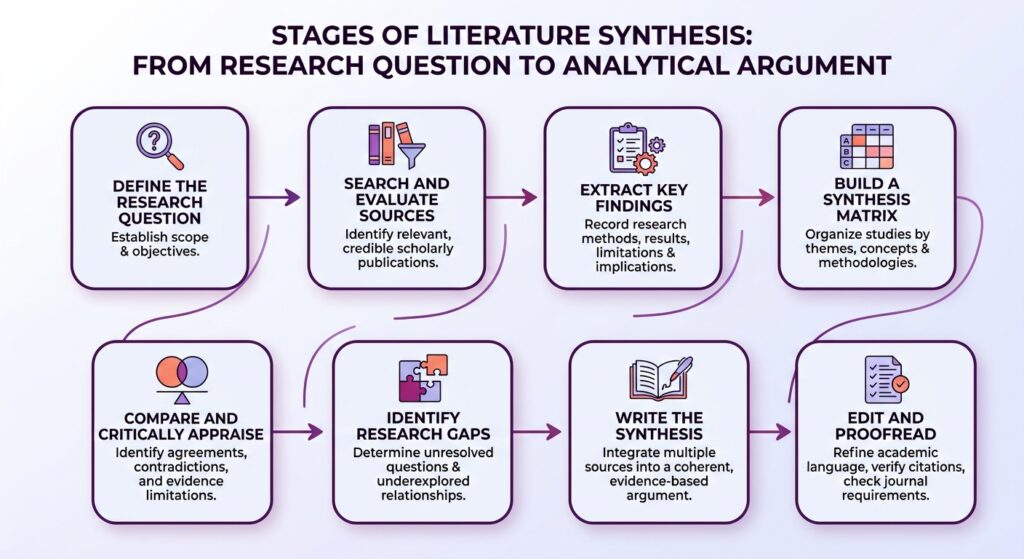
2. How to Synthesize Literature: A Step-by-Step Method
Effective synthesis begins before drafting. Researchers must extract comparable evidence, evaluate source quality, and organize findings around a defensible analytical framework.
Step 1: Define the central research question
Establish the question your literature review must answer. A focused question provides criteria for selecting relevant sources and determining which findings deserve comparison.
For example, a review examining the effectiveness of digital learning should specify the population, educational setting, intervention, and outcomes of interest wherever appropriate.
Avoid organizing the review around a topic as broad as “technology in education.” Instead, investigate a question such as how digital learning interventions affect student engagement and academic performance in undergraduate education.
Step 2: Extract comparable information
Read each source with a consistent set of questions:
- What research question or hypothesis did the study address?
- Which theoretical framework informed the investigation?
- What research design, sample, and measurement instruments were used?
- What were the principal findings?
- What limitations did the authors acknowledge?
- How does the study support, qualify, or challenge other evidence?
- What unanswered question emerges from the findings?
Record this information in a research spreadsheet or reference management system. Tools such as Zotero, EndNote, and Mendeley can help manage bibliographic records, but researchers must still evaluate the evidence and develop their own interpretations.
Step 3: Group studies by analytical themes
Organize the literature according to recurring concepts, mechanisms, outcomes, methodological approaches, or theoretical disagreements.
For example, a review of digital learning might use these themes:
- Student engagement and motivation.
- Academic performance and knowledge retention.
- Access, digital inequality, and institutional resources.
- Differences between synchronous and asynchronous learning.
- Methodological limitations in measuring learning outcomes.
A thematic structure enables meaningful comparison. Chronological organization can also be appropriate when the purpose is to trace theoretical development or changes in evidence over time.
Step 4: Compare findings and evaluate evidence quality
Do not assume that studies reporting similar outcomes provide equally strong evidence. Compare sample sizes, research designs, measurement validity, follow-up periods, and potential sources of bias.
For example, a randomized controlled trial may support a causal inference more strongly than a cross-sectional survey, depending on the research question and study execution. However, no design is automatically reliable: implementation quality, attrition, confounding, and measurement limitations also matter.
Distinguish between consistency of findings and strength of evidence. Several small studies with similar limitations may provide less confidence than a well-conducted, adequately powered investigation.
Step 5: Develop an interpretive claim
After identifying patterns and contradictions, formulate a claim that answers your review question.
A useful analytical claim explains not merely what studies report but why their combined findings matter. It may establish that evidence converges around a mechanism, that an effect depends on contextual conditions, or that apparently conflicting results arise from differences in research design.
Support the claim with relevant citations, acknowledge limitations, and explain the implications for theory, practice, or future research.
3. How to Construct a Synthesis Matrix for a Literature Review
A synthesis matrix is a structured table that places studies alongside one another to reveal relationships that may be difficult to recognize when reading articles individually.
What should a synthesis matrix include?
A practical matrix may contain the following columns:
| Study | Research design | Main findings | Limitations | Analytical theme |
| Study A | Cross-sectional survey | Higher reported engagement | Self-reported measures | Engagement |
| Study B | Controlled intervention | Improved short-term performance | Limited follow-up | Academic outcomes |
| Study C | Qualitative interviews | Access barriers affected participation | Single institutional setting | Digital inequality |
| Study D | Mixed-methods study | Outcomes varied by course design | Heterogeneous measures | Contextual factors |
The studies above are hypothetical and illustrate matrix construction only.
How to use the matrix effectively
First, identify convergence. Determine which studies support similar conclusions and whether the agreement persists across different methods and settings.
Second, identify divergence. Record conflicting results and investigate whether they reflect differences in populations, interventions, outcome measures, or theoretical assumptions.
Third, evaluate methodological patterns. Determine whether recurring limitations, such as small samples or short observation periods, restrict the conclusions that can be drawn.
Fourth, identify underexplored areas. Look for populations, settings, mechanisms, or outcomes that receive insufficient attention.
A synthesis matrix should guide interpretation rather than replace it. The final literature review must transform tabulated evidence into a coherent narrative that explains relationships and develops an argument.
Also read: PaperEdit Academic Editing and Proofreading Services
4. Writing Synthesis Paragraphs With Multiple Citations
An effective synthesis paragraph combines a clear analytical claim, evidence from multiple sources, comparison or evaluation, and an explanation of significance.
Use a claim evidence comparison interpretation structure
1. Claim: Begin with the central point of the paragraph.
2. Evidence: Introduce findings from two or more relevant studies.
3. Comparison: Explain how the studies converge, differ, or qualify one another.
4. Interpretation: State what the relationship reveals about the research question.
Consider this illustrative example:
“Although several studies associate digital learning with improved student engagement, the magnitude and consistency of these benefits appear to depend on instructional design. Smith (2022) reported increased participation in structured online activities, whereas Lee (2023) found that engagement varied according to the level of instructor interaction. Ahmed (2024) similarly identified course design as an important contextual factor. Collectively, these findings suggest that digital delivery alone may not explain improvements in engagement; the pedagogical conditions under which technology is implemented also warrant investigation.”
This paragraph integrates evidence around a shared argument rather than presenting three disconnected summaries.
Integrate citations without overloading the paragraph
Use citations to substantiate specific claims, not merely to demonstrate extensive reading. In APA 7th edition, multiple sources supporting a common claim are generally arranged alphabetically within the same parenthetical citation and separated by semicolons.
For example: (Ahmed, 2024; Lee, 2023; Smith, 2022).
When sources contribute different types of evidence, discuss their individual contributions explicitly. Do not group citations if doing so obscures meaningful differences in findings or methodology.
Also distinguish your interpretation from the authors' conclusions. Accurate attribution is essential to scholarly integrity, particularly when studies provide qualified or contradictory results.
5. Synthesizing Contradictory Research Findings
Conflicting findings are not necessarily a weakness in the literature. They may reveal contextual differences, competing theoretical explanations, measurement problems, or genuine uncertainty.
Investigate the source of disagreement
When studies reach different conclusions, examine five factors:
- Population: Were the participants comparable in age, expertise, socioeconomic background, or clinical characteristics?
- Research design: Did the studies use experimental, observational, qualitative, or mixed-methods approaches?
- Measurement: Were outcomes defined and measured consistently?
- Context: Did institutional conditions, geographic settings, or implementation practices differ?
- Time frame: Were short-term effects compared with long-term outcomes?
For instance, an intervention may improve immediate task performance without producing durable learning gains. These findings are not necessarily contradictory if the studies measure different outcomes or follow participants for different periods.
Avoid false equivalence
Do not give every finding equal weight simply because it appears in a published article. Evaluate sample adequacy, risk of bias, analytical transparency, and relevance to the review question.
Likewise, avoid dismissing inconvenient evidence solely because it challenges your preferred interpretation. A defensible synthesis explains the disagreement, assesses the strength of competing evidence, and identifies what additional research would resolve the uncertainty.
Also read: How to Conduct and Write a Rigorous Systematic Literature Review
6. How Can Critical Synthesis Highlight Gaps in Literature?
A research gap is an important unanswered question, insufficiently investigated relationship, methodological limitation, or underrepresented context in the existing evidence. Critical synthesis helps researchers identify these gaps by examining what the literature collectively establishes and what it cannot yet establish.
Distinguish meaningful gaps from simple absences
Not every topic that has received little attention constitutes a significant research gap. The gap should matter theoretically, methodologically, empirically, or practically.
Common types include:
- Empirical gaps: Insufficient evidence about a population, intervention, outcome, or context.
- Methodological gaps: Heavy reliance on a limited research design or inadequate measurement.
- Theoretical gaps: Competing explanations remain unresolved or an established framework fails to explain observed findings.
- Contextual gaps: Evidence from one geographic or institutional setting may not transfer to another.
- Longitudinal gaps: Existing studies cannot establish whether observed effects persist over time.
Build the gap from the evidence
A persuasive gap statement follows a logical progression: summarize the established evidence, identify its limitations, explain why those limitations matter, and specify the question that remains unresolved.
For example:
“Existing studies suggest that structured digital learning can support student engagement. However, much of the available evidence relies on self-reported outcomes collected over short periods. Consequently, the extent to which engagement gains predict sustained academic performance remains uncertain. Longitudinal studies using validated outcome measures could help clarify this relationship.”
This statement identifies a limitation, explains its significance, and proposes a research direction without claiming that no relevant studies exist.
Before asserting novelty, conduct an updated and transparent literature search. A defensible gap claim must reflect the scope and limitations of the search rather than an assumption that a topic has never been studied.
Also read: Top 10 APA 7th Formatting Errors That Cause Journal Rejections (and How to Fix Them)
7. Critical Appraisal vs. Descriptive Summary in Research Papers
Critical appraisal evaluates the credibility, relevance, and limitations of research evidence. Descriptive summary reports what the research contains. Strong literature reviews require both, but appraisal must inform the interpretation of findings.
Use an established appraisal framework appropriate to your evidence base. For systematic reviews, relevant resources include the Cochrane risk-of-bias tools for appropriate study designs and the Joanna Briggs Institute critical appraisal tools. For reporting completeness, consult the relevant EQUATOR Network guideline, such as PRISMA for systematic reviews, STROBE for observational studies, or CONSORT for randomized trials.
Remember that reporting guidelines and critical appraisal tools serve different purposes. A reporting checklist evaluates whether important information has been reported; it does not independently establish that a study is methodologically sound.
Researchers should also avoid treating statistical significance as a complete measure of importance. Consider effect sizes, confidence intervals, clinical or practical relevance, and the consistency of the evidence.
For further guidance on academic style and source integration, consult Purdue OWL's research and citation resources, the APA Style website, and the EQUATOR Network reporting guidelines.
8. Common Mistakes When Synthesizing Sources
Even well-researched literature reviews can lose analytical depth through avoidable writing errors.
Mistake 1: Organizing every paragraph around one author. Repeatedly introducing one study at a time creates a source-by-source narrative. Organize paragraphs around analytical claims and bring relevant studies together.
Mistake 2: Treating agreement as proof. Multiple studies reporting similar results do not automatically establish a strong conclusion. Assess study quality, independence, and contextual variation.
Mistake 3: Ignoring contradictory evidence. Selectively citing supportive findings weakens credibility. Address disagreement transparently and explain the evidence behind your interpretation.
Mistake 4: Making unsupported generalizations. Claims such as “research proves” or “all studies agree” require stronger evidence than a small or heterogeneous set of publications may provide. Calibrate language to the certainty of the findings.
Mistake 5: Using citations as substitutes for analysis. A paragraph with numerous references may still be descriptive. Explain how the sources relate to one another and why their relationship matters.
Mistake 6: Failing to distinguish correlation from causation. Observational evidence may establish an association without showing that one variable caused another. Match causal language to the research design and supporting evidence.
Mistake 7: Neglecting attribution and reference accuracy. Verify that every in-text citation corresponds to the correct reference entry, that paraphrases accurately represent the original source, and that direct quotations follow the applicable style requirements.
Also read: Structuring Technical and Research Reports for Maximum Impact
9. Editing and Formatting Your Synthesis for Journal Submission
Critical synthesis requires sound reasoning, but its presentation also influences how effectively readers can evaluate the argument. Structural editing, line editing, copyediting, and proofreading address different dimensions of manuscript quality.
| Editing stage | Primary focus | What to check |
| Structural editing | Argument and organization | Thematic progression, research gap, logical connections |
| Line editing | Clarity and academic style | Paragraph coherence, transitions, precision, concision |
| Copyediting | Language and consistency | Grammar, terminology, tense, citation and style consistency |
| Proofreading | Final presentation | Typographical errors, reference matching, headings, layout |
Apply the journal's requirements
Do not assume that every journal requires identical formatting. Follow the target journal's current author instructions for manuscript structure, headings, reference style, tables, figures, and supplementary files.
For example, APA 7th edition commonly uses double spacing throughout manuscripts unless specific instructions state otherwise. A 1-inch margin on each side and an approved, readable font are standard APA manuscript conventions, but the journal's submission requirements take precedence.
For figures, follow the journal's file-format, size, and resolution specifications. Raster images may require 300 dpi or higher, depending on the image type and publisher; vector graphics are often preferable for charts and line drawings.
Ensure that tables and figures communicate the same findings described in the text. Use descriptive titles, define abbreviations, provide appropriate figure legends, and verify that every item is cited in the manuscript.
Professional editing can improve clarity and presentation, but neither editing nor formatting guarantees journal acceptance. Editorial decisions also depend on originality, methodological rigor, scope, and contribution to the field.
Explore PaperEdit's academic editing and proofreading services to refine your manuscript before submission.
10. Final Pre-Submission Checklist for a Critical Literature Review
Before uploading your manuscript, review the following items:
- The literature review addresses a clearly defined research question.
- Sources are organized by themes, concepts, debates, or relevant methodological differences.
- Each major paragraph advances an analytical claim rather than simply summarizing a study.
- Multiple studies are compared where appropriate, with similarities and differences explained.
- Conflicting findings are evaluated rather than ignored.
- Methodological limitations and the strength of the evidence are considered.
- Research gaps follow logically from the reviewed evidence.
- Claims are appropriately qualified and supported by accurate citations.
- In-text citations and reference-list entries match.
- The required citation style is applied consistently.
- Grammar, academic tone, transitions, and terminology have been reviewed.
- Tables, figures, legends, and supplementary files meet journal specifications.
- The manuscript complies with the target journal's author guidelines and relevant reporting standards.
Conclusion: Turn Literature Into a Scholarly Argument
Moving from summary to synthesis is one of the most important steps in developing a strong academic literature review. By grouping studies around meaningful themes, comparing methods and findings, evaluating contradictory evidence, and identifying defensible research gaps, authors can transform individual publications into a coherent scholarly argument.
The objective is not simply to demonstrate that you have read widely. It is to show what the evidence means, where its limitations lie, and how your research contributes to the ongoing academic conversation.
Before submission, refine both the intellectual structure and the language of your manuscript. PaperEdit's professional academic editing and proofreading services can help you strengthen clarity, improve coherence, standardize citations, and prepare your research paper for journal submission.