


Tables and figures can make a research paper easier to interpret, but inconsistent titles, missing source notes, incorrect numbering, and incomplete permissions information can undermine an otherwise well-prepared manuscript. Formatting tables and figures according to the Chicago Manual of Style means presenting visual and tabular material consistently, labeling it clearly, documenting its sources, and following the journal’s submission requirements.
The Chicago Manual of Style (CMOS) provides guidance on tables, illustrations, captions, source acknowledgments, and citations. However, individual journals may adapt these conventions to suit their disciplines, publishing platforms, and production workflows. Authors must therefore distinguish between Chicago’s general editorial principles and a journal’s specific instructions.
This guide explains Chicago style table formatting rules, figure captions, numbering conventions, source notes, mathematical and statistical tables, credit lines, permissions, and in-text references. It also provides practical examples and a final checklist to help researchers prepare publication-ready manuscripts.
💡 Ready to polish your research paper for publication?
Transform your manuscript with PaperEdit’s professional editing and proofreading services!
1. Understand Chicago Manual of Style Guidelines for Tables and Figures
What counts as a table or figure?
A table organizes information into rows and columns, allowing readers to compare values, categories, measurements, or results efficiently. A figure is a visual element, such as a photograph, map, graph, chart, diagram, illustration, or schematic.
Both elements should support the manuscript’s argument rather than duplicate information already explained adequately in the text.
Why does consistent formatting matter?
Consistent presentation helps readers locate evidence, understand comparisons, and distinguish original findings from previously published material. It also helps editors and production teams process manuscripts without requesting avoidable corrections.
What are the standard Chicago criteria?
Chicago’s recommendations depend partly on the manuscript type and the publisher’s requirements. In general:
- Number tables and figures consistently when the publication uses numbered callouts.
- Give each table a clear title and each figure an appropriate caption.
- Identify borrowed, adapted, or reproduced material through source acknowledgments and citations.
- Explain abbreviations, symbols, and relevant methodological details.
- Refer to every numbered table and figure in the main text.
- Follow the journal’s specifications for placement, file formats, resolution, and accessibility.
Consult the Chicago Manual of Style for authoritative guidance, particularly its chapters on tables, illustrations, and source documentation.
Common submission pitfalls
Do not assume that Chicago requires every journal to use the same layout. A publisher may request figures as separate files, tables at the end of the manuscript, or captions in a dedicated document. Such production instructions take precedence over a generic template.
2. Apply Chicago Style Table Formatting Rules
Tables should communicate information efficiently, with a clear hierarchy and enough contextual detail for readers to interpret the data correctly.
Step 1: Number tables consistently
For a conventional manuscript, number tables consecutively in the order in which they are first mentioned:
- Table 1
- Table 2
- Table 3
Use the same numbering sequence throughout the document unless the journal requires chapter-based numbering, such as Table 2.1 and Table 2.2.
Avoid numbering tables according to the order in which you created them. Their sequence should follow the manuscript’s discussion.
Step 2: Position the table number and title
A common Chicago-style arrangement places the table number above the table, followed by its title. The title should be concise but descriptive enough to identify the information presented.
Example:
Table 1. Research Participants by Academic Discipline
| Academic discipline | Participants (n) | Percentage |
| Engineering | 48 | 32.0 |
| Social sciences | 52 | 34.7 |
| Natural sciences | 50 | 33.3 |
| Total | 150 | 100.0 |
Note: This is an illustrative example. Adapt the table’s styling to the journal’s specifications.
Step 3: Simplify the table structure
Use meaningful column headings, consistent units, logical row groupings, and appropriate alignment. Align numerical values by decimal point when doing so improves comparison. Avoid unnecessary vertical rules, decorative shading, and excessive gridlines; a clean structure is usually easier to read and easier to typeset.
For statistical tables, distinguish estimates from standard errors, confidence intervals, sample sizes, and significance indicators. Never rely on asterisks or abbreviations without explaining their meaning.
Step 4: Include only necessary information
Every column should serve a clear analytical purpose. Define specialized abbreviations in a table note, and state measurement units in column headings where practical. Use a consistent number of decimal places when the precision is comparable across observations.
Common pitfall: Do not compress a complex table until its meaning becomes ambiguous. If a table contains several unrelated comparisons, consider dividing it into smaller tables or moving supplementary results to an appendix.
3. Format Figure Captions According to Chicago Guidelines
Figures require captions that identify the visual, explain its relevance, and provide source information when necessary.
Where do figure captions go?
In many Chicago-style book and manuscript layouts, the figure number and caption appear below the image. However, journals may require captions in a separate list or manuscript section, particularly when figures are uploaded independently.
A practical example is:
Figure 1. Distribution of Research Publications by Year, 2020–2025
[Insert figure here]
Source: Illustrative data compiled by the author.
Use this as a layout example rather than a universal rule. Follow the target publisher’s instructions for caption placement.
What should a figure caption contain?
A useful caption typically identifies the figure, describes what it shows, and supplies essential context that is not obvious from the image itself.
Depending on the figure, include:
- A sequential figure number.
- A concise, informative caption.
- Explanations of symbols, abbreviations, or colors when needed.
- The source citation and applicable credit line.
- A permission acknowledgment when required by the rights holder.
Avoid captions that simply repeat a vague label such as “Results” or “Study Findings.” Instead, identify the variables, population, period, or relationship being illustrated when those details help interpretation.
Should figures be numbered or unnumbered?
Numbered figures are generally preferable when the text refers to specific visuals. Use “Figure 1,” “Figure 2,” and so forth consistently.
Unnumbered illustrations may be appropriate in some books, essays, or designed publications where visuals function decoratively and are not referenced individually. This is a publication-specific decision, not a universal Chicago requirement.
Common pitfall: Do not alternate between “Figure 2,” “Fig. 2,” and “the second image” without a clear house-style reason. Consistent labels make cross-referencing and copyediting easier.
Also read: PaperEdit academic editing and proofreading services for support with manuscript consistency, language accuracy, and submission readiness.
4. Distinguish Table Titles from Figure Captions
Although table titles and figure captions both identify visual material, they perform slightly different functions.
| Feature | Table title | Figure caption |
| Primary purpose | Identifies tabulated information | Identifies and may explain a visual |
| Typical placement | Above the table | Often below the figure; journal-dependent |
| Content | Concise description of the data | Description plus essential interpretive context |
| Source acknowledgment | Usually in a note below the table | Often in the caption or an accompanying credit line |
| Additional explanation | Table notes below the table | Caption text or separate source/credit information |
How should you write each one?
A table title should identify the data without turning into a paragraph. A figure caption may need more explanation because a graph, map, or photograph can require context that the title alone cannot provide.
For example:
- Table title: “Table 2. Mean Test Scores by Instructional Method”
- Figure caption: “Figure 2. Mean Test Scores by Instructional Method. Students receiving the blended intervention achieved higher mean scores than students in the comparison group.”
Use the second sentence only when the statement accurately reflects the findings and does not overstate causation.
Common pitfall: Do not place all methodological explanations in a lengthy title. Move detailed definitions, qualifications, and statistical information to notes or the main text when appropriate.
Also read: Chicago Manual of Style: Notes-Bibliography vs. Author-Date (2026 Guide)
5. Add Source Notes, Citations, and Credit Lines Correctly
Source notes help readers identify where table data or visual material originated. They also distinguish the author’s original work from material reproduced or adapted from other sources.
Where do table titles and source notes go in Chicago style?
A common arrangement is:
- Table number and title above the table.
- Table body beneath the title.
- General notes below the table.
- Source acknowledgment or source citation below the table, often after explanatory notes.
The exact order and presentation can vary by publisher. Some journals combine explanatory and source information in one note; others require separate notes.
How do you write a source note for a table?
If the table uses previously published data, cite the source using the documentation system required by the journal.
Illustrative example:
Source: Adapted from Jane Smith, “Research Participation in Higher Education,” Journal of Academic Studies 12, no. 2 (2024): 115.
This example demonstrates the information a source note may contain. It is not a verified publication citation. Replace it with the actual source details and format the citation according to the applicable Chicago notes-and-bibliography or author-date system.
How do you cite a table from a journal in Chicago style?
First, identify whether the source uses the notes-and-bibliography system or the author-date system.
In notes and bibliography, a footnote may identify the article, publication details, and relevant page or table. The bibliography then provides the complete reference when required.
In author-date style, the citation generally uses the author’s surname and publication year, with a page locator when appropriate. The reference list supplies the full publication details.
When citing a table from a journal article, cite the article as the source and identify the table number or page when that information is available and useful. Do not invent a page number or assume the table has a separate bibliographic entry.
Consult the official Chicago-Style Citation Quick Guide to select the correct documentation format.
How do you write a credit line for a figure?
A figure credit line should identify the original creator or source and, where applicable, acknowledge the copyright holder and permission.
A general template is:
Source: [Creator], [title or description], [publication or website details], [year]. Reproduced with permission of [rights holder].
For an adapted figure, use wording such as “Adapted from” when appropriate. For an original figure based entirely on the author’s own work, a credit line may be unnecessary unless the journal requests one.
Important: Attribution and permission are separate obligations. A citation acknowledges the source, but it does not automatically grant the right to reproduce copyrighted material. Check the applicable license and obtain permission when required.
What about adapted figures and republished data?
If you substantially redesign a previously published figure, cite the original source and describe the adaptation accurately. If you reuse a dataset, document its origin and explain any transformations that affect interpretation.
For republished material, confirm the rights holder’s requirements, permitted uses, required wording, and any restrictions on modification. Keep permission documentation available for the journal’s editorial office.
Common pitfall: Do not use “Source: Author” for a figure derived from an existing publication without acknowledging the underlying source. Similarly, do not label a figure “adapted” if it is actually reproduced unchanged.
6. Format Table Footnotes, Statistical Notes, and Mathematical Data
Table notes provide information needed to interpret a particular table. They are not interchangeable with the manuscript’s general text footnotes.
What is the difference between table notes and general text footnotes?
Table notes sit with the table and explain its contents. General text footnotes support statements in the manuscript body, provide references, or supply additional discussion.
A table note may explain a sample restriction, an abbreviation, a statistical test, or an exception in the data. A text footnote may explain a broader methodological decision or document a source discussed in a paragraph.
How should table-cell footnotes be formatted?
Use superscript letters, numerals, or symbols according to the journal’s requirements. Place the corresponding explanations directly below the table.
For example:
| Variable | Group A | Group B |
| Mean score | 82.4ᵃ | 76.1ᵇ |
| Sample size | 45 | 47 |
Note: ᵃAdjusted for baseline score. ᵇUnadjusted mean.
The superscripts here are illustrative. Avoid assigning the same symbol to different explanations within a table, and use a logical order for multiple notes.
What are the rules for statistical and mathematical tables?
For mathematical and statistical tables:
- Use consistent notation for variables, parameters, and statistical measures.
- Identify whether values represent means, medians, standard deviations, standard errors, or confidence intervals.
- Explain significance symbols and report exact p values when appropriate to the discipline and journal.
- Include sample sizes and relevant units.
- Preserve meaningful precision without implying unsupported accuracy.
- Ensure that equations, Greek letters, and special characters render correctly in the final file.
For example, a note might state: “Values are means with standard deviations in parentheses.” Include that statement only if it accurately describes the table.
Do not use statistical significance symbols as a substitute for reporting meaningful effect sizes or uncertainty.
Common pitfall: A table can be grammatically polished yet statistically misleading if its units, denominators, missing-data rules, or uncertainty measures are unclear. Have the numerical content checked alongside the formatting.
7. Refer to Tables and Figures in the Main Text
Every numbered table or figure should be introduced or discussed at an appropriate point in the narrative.
How should tables and figures be cited within the narrative text?
Use the label and number consistently:
- “Table 1 summarizes the demographic characteristics of the participants.”
- “As shown in Figure 2, publication output increased during the study period.”
- “The regression estimates are reported in Table 3.”
Capitalize “Table” and “Figure” when they form part of a numbered reference, subject to the journal’s house style.
Explain the finding that matters rather than simply directing readers to a visual. For instance, instead of writing “See Table 2,” identify the relevant comparison and explain its significance.
Where should tables and figures appear?
Placement depends on the journal’s submission instructions. Some publishers expect tables and figures close to their first mention; others require tables after the references and figures as separate uploads.
If a journal requests separate figure files, retain the corresponding captions in the location specified by its instructions. Include clear callouts in the manuscript when required.
Common cross-referencing errors
- Referring to the wrong table number after revisions.
- Mentioning a figure that does not appear in the submitted files.
- Including a table or figure that is never discussed.
- Using inconsistent capitalization or abbreviations.
- Referring to “the table below” when production may move the table elsewhere.
After any major revision, audit all cross-references to ensure that the labels still match the correct visual elements.
8. Prepare Tables and Figures for Journal Submission
Chicago style addresses editorial presentation, but technical submission requirements may come from the journal rather than the style manual.
Check the target journal’s author instructions for accepted file types, image resolution, dimensions, color requirements, accessibility expectations, and placement.
For example, some publishers request approximately 300 dpi for photographic images at final print size, while line art may require higher resolution. These are common production specifications, not universal Chicago rules. Vector formats may be preferable for some charts and diagrams.
Use a consistent workflow:
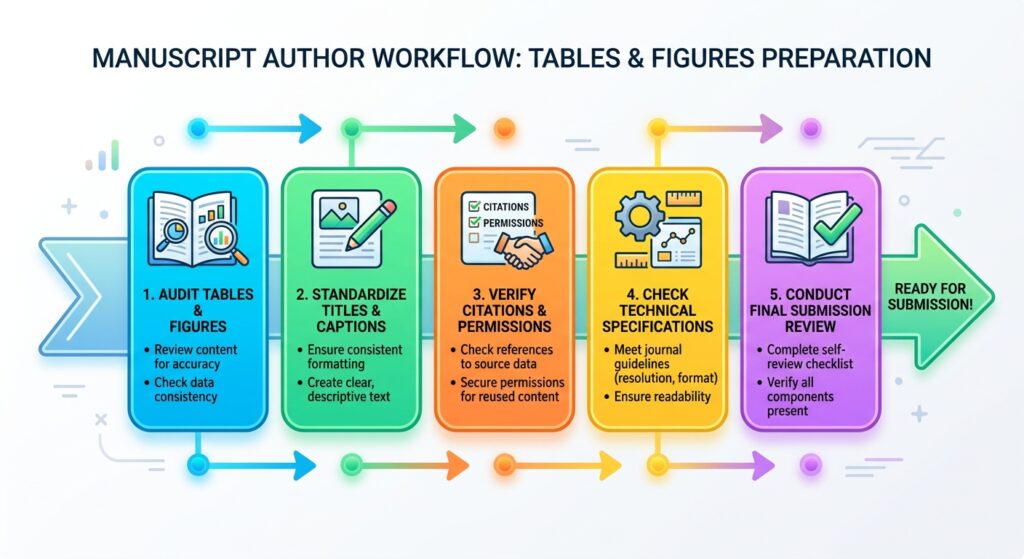
Recommended quality-control sequence
- Audit every table and figure against its first mention in the text.
- Standardize numbering, capitalization, titles, and captions.
- Verify data, units, abbreviations, symbols, and statistical notes.
- Check source citations and permission requirements.
- Confirm that the files meet the journal’s technical specifications.
- Proofread the manuscript and compare the final uploaded files with the approved version.
For research involving human participants, maps, clinical images, or sensitive datasets, also verify confidentiality, consent, anonymization, and any applicable institutional or publisher requirements.
Also read: When to Use Ibid. vs. Shortened Footnotes in Chicago Style: A Complete 2026 Guide
9. Final Pre-Submission Checklist
Before uploading your manuscript, confirm each item:
- Every table and figure follows the journal’s required numbering system.
- Table numbers and titles appear in the required position.
- Figure captions are complete and correctly placed.
- Every numbered visual is cited in the manuscript narrative.
- All abbreviations, units, symbols, and statistical measures are defined.
- Table notes are distinguished from general manuscript footnotes.
- Source notes identify borrowed or adapted data accurately.
- Figure credit lines include required attribution and permission wording.
- Copyright permissions and license conditions have been checked.
- References follow the required Chicago documentation system.
- Images meet the journal’s resolution, format, and size requirements.
- Tables and figures are legible, accessible where required, and consistent with the manuscript.
- All cross-references remain accurate after the final revision.
- The submission files match the journal’s author instructions.
Conclusion: Make Chicago-Style Tables and Figures Publication-Ready
Formatting tables and figures according to the Chicago Manual of Style requires more than placing titles above tables and captions below images. Authors must maintain consistent numbering, provide clear explanatory notes, cite original sources, verify reproduction rights, and ensure that every visual supports the manuscript’s argument. Because journal-specific requirements can differ, always consult the target publication’s instructions alongside the relevant Chicago guidance.
A systematic final review can eliminate avoidable formatting corrections and help editors, reviewers, and readers focus on the research itself. For additional support, explore PaperEdit’s academic editing and proofreading services to refine your manuscript before journal submission.