


Writing Chapter 5 is where many doctoral and master’s researchers struggle to move from reporting findings to explaining what those findings mean. A strong discussion chapter does not simply repeat the results presented in Chapter 4. It interprets the evidence, connects it with the literature, explains theoretical and practical implications, acknowledges limitations, and identifies defensible directions for future research.
In other words, Chapter 5 transforms research findings into a scholarly argument.
Although the exact dissertation Chapter 5 layout varies by discipline and university, the chapter commonly brings together discussion, conclusions, implications, limitations, recommendations, and future research. Your institutional thesis template and disciplinary conventions should take precedence over any generic structure. Purdue OWL similarly emphasizes following university templates alongside disciplinary conventions when formatting a thesis or dissertation.
This guide explains how to write a thesis discussion chapter, how to structure Chapter 5 relative to the literature review, how to synthesize results with existing research, how to frame theoretical contributions, and how to organize future research directions without making unsupported claims.
💡 Ready to polish your research paper for publication?
Transform your manuscript with PaperEdit's professional editing and proofreading services!
What Goes Into Chapter 5 of a Dissertation?
Before writing, determine what your institution and supervisor expect Chapter 5 to accomplish.
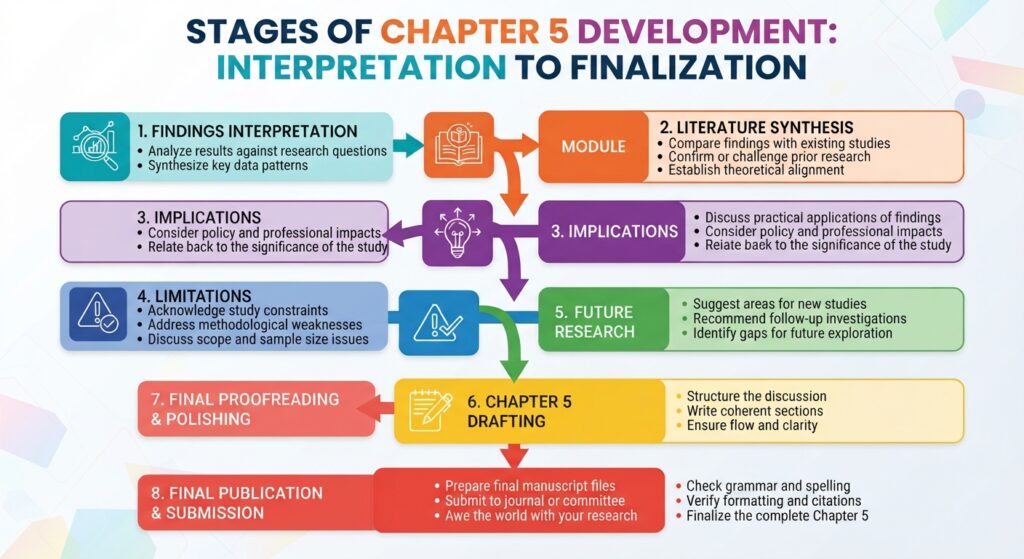
A common Chapter 5 structure is:
- Introduction to the chapter
- Summary of key findings
- Discussion of findings by research question or objective
- Comparison with previous literature
- Theoretical contributions
- Practical, professional, or policy implications
- Study limitations
- Recommendations for future research
- Conclusion
Not every dissertation requires all nine sections as separate headings. Some disciplines combine the conclusion with the discussion; others use separate chapters for conclusions and recommendations.
The key principle is functional separation. Your results chapter answers, “What did the analysis show?” Chapter 5 answers, “What do those findings mean, why do they matter, and what should researchers understand or do differently because of them?”
This distinction is consistent with publication guidance. The ICMJE recommends that a discussion briefly summarize the main findings, interpret possible explanations, place the findings within the relevant evidence, acknowledge limitations, and discuss implications for future research and practice or policy.
A practical Chapter 5 blueprint
| Section | Primary purpose | Common pitfall |
| Chapter introduction | Orient the reader | Repeating the entire methodology |
| Findings summary | Reconnect findings to research questions | Copying Chapter 4 |
| Discussion | Interpret findings | Describing statistics without interpretation |
| Literature synthesis | Explain agreement/disagreement | Listing citations one by one |
| Theoretical contribution | Explain conceptual significance | Claiming a theory was “proved” |
| Practical/policy implications | Explain application | Making recommendations beyond the evidence |
| Limitations | Establish boundaries | Presenting limitations as an apology |
| Future research | Identify evidence-based next steps | Giving generic suggestions |
| Conclusion | Deliver the final scholarly message | Introducing new evidence |
IEEE's author guidance likewise distinguishes the Discussion from the Results: the Discussion explains what results mean and why they constitute an important contribution, while the Conclusion can highlight broader implications and areas requiring further study.
How Do I Structure My Discussion Relative to My Literature Review?
Do not treat the literature review and discussion as mirror images.
The literature review establishes the scholarly landscape before your study. The discussion revisits that landscape after your findings are known.
A useful conceptual sequence is:
Literature Review → Research Gap → Research Questions → Findings → Interpretation → Comparison → Contribution
Your literature review may explain that previous studies produced inconsistent findings regarding a particular relationship. Chapter 5 should then determine whether your evidence supports, contradicts, qualifies, or extends those findings.
Use a synthesis structure
Instead of writing:
Smith (2022) found X. Jones (2023) found Y. Ahmed (2024) found Z. Your study found X.
Build an analytical paragraph:
Finding → Previous evidence → Agreement/disagreement → Explanation → Contribution
For example:
The present study found a positive association between X and Y. This finding is consistent with earlier research showing that X can influence Y under comparable conditions. However, the strength of the association was lower than that reported in previous studies. One possible explanation is the difference in sample characteristics and measurement procedures. The present findings therefore suggest that the relationship may be context-dependent rather than universally consistent.
That is discussion rather than literature review.
What is the industry-standard criterion?
A strong discussion should demonstrate:
- direct alignment with the research questions;
- accurate interpretation of findings;
- selective engagement with relevant literature;
- explanation of unexpected or contradictory results;
- explicit identification of contribution;
- appropriate qualification of claims.
Avoid turning Chapter 5 into a second literature review. The goal is not to demonstrate how many sources you have read. The goal is to show what your findings contribute to the existing body of knowledge.
Also read: Top 10 APA 7th Formatting Errors That Cause Journal Rejections and How to Fix Them
Step 1: Open Chapter 5 With a Clear Orientation
The opening section should tell readers what the chapter does.
A concise opening typically states:
- the purpose of the chapter;
- the research problem or objectives;
- how the discussion is organized;
- the major interpretive themes.
Do not begin by reproducing several pages of results.
A useful organizational principle is to structure the central discussion around research questions, hypotheses, objectives, or major themes.
For example:
5.1 Introduction
5.2 Summary of Principal Findings
5.3 Discussion of Research Question 1
5.4 Discussion of Research Question 2
5.5 Theoretical Contributions
5.6 Practical and Policy Implications
5.7 Study Limitations
5.8 Future Research Directions
5.9 Conclusion
This structure makes it easier for examiners to trace the relationship between the research questions and your conclusions.
Step 2: Interpret Findings Instead of Repeating Them
One of the most frequent Chapter 5 weaknesses is excessive repetition.
If Chapter 4 states:
The intervention group demonstrated a statistically significant increase in performance, p < .05.
Chapter 5 should not simply restate the same sentence.
Instead, explain:
- What does the increase indicate?
- Why might it have occurred?
- Does it support your hypothesis?
- Does it agree with previous research?
- Does it challenge an established assumption?
- What theoretical or practical meaning does it have?
- What can and cannot be inferred?
Follow the interpretation ladder
Finding → Meaning → Explanation → Evidence → Qualification → Contribution
This approach is particularly important when interpreting statistically significant results. Statistical significance does not automatically establish practical significance, causality, or broad generalizability.
For medical and biomedical manuscripts, ICMJE explicitly advises authors to avoid unqualified conclusions and claims that are not supported by the data.
Also read: Structuring Chapter 4: Results & Findings Explained 2026 Dissertation Guide
Step 3: Explain Unexpected or Contradictory Findings
Unexpected results are not necessarily weaknesses. A carefully interpreted unexpected finding can become one of the most valuable parts of Chapter 5.
Use a structured analysis:
- State the unexpected finding.
- Explain what you initially expected.
- Compare the result with relevant studies.
- Identify plausible methodological, theoretical, contextual, or sampling explanations.
- Distinguish evidence-based explanations from speculation.
- State what future research should test.
Use cautious language when evidence is incomplete:
- “One possible explanation is…”
- “This finding may reflect…”
- “A plausible interpretation is…”
- “The evidence does not permit a definitive conclusion…”
- “Future research should examine whether…”
Avoid:
- “This proves that…”
- “The only reason is…”
- “This definitively demonstrates…”
Strong academic writing distinguishes interpretation from speculation.
Step 4: Frame Your Theoretical Contributions
A dissertation should do more than report data. It should explain how the research contributes to knowledge.
Theoretical contribution may involve:
- extending an existing model;
- identifying a previously overlooked relationship;
- challenging an assumption;
- explaining contradictory evidence;
- refining a theoretical construct;
- identifying boundary conditions;
- applying a theory in a previously understudied context.
Use a contribution matrix
| Contribution type | Question to ask | Evidence required |
| Extension | What does the study add to existing theory? | Findings linked to theoretical propositions |
| Refinement | Which concept requires modification? | Consistent empirical pattern |
| Challenge | Which assumption is questioned? | Evidence inconsistent with expectation |
| Contextual contribution | Where does the theory operate differently? | Context-specific findings |
| Methodological contribution | What approach improves investigation? | Demonstrated methodological value |
Do not claim that your study “proves” a theory unless your research design genuinely supports such a conclusion. More commonly, a dissertation supports, challenges, extends, refines, or provides evidence relevant to a theoretical proposition.
Step 5: Write Practical and Policy Implications
Recommendations should follow logically from the evidence.
A strong implications section answers:
Who can use these findings? → What should they consider doing? → Why? → Under what conditions?
Potential audiences include:
- practitioners;
- educators;
- clinicians;
- organizational leaders;
- policymakers;
- researchers;
- professional bodies.
Separate evidence-based implications from personal preferences.
For example, rather than writing:
Universities should completely redesign their assessment systems.
write:
The findings suggest that universities may benefit from reviewing assessment practices in contexts where the observed pattern is consistently reproduced. Pilot implementation and longitudinal evaluation would be appropriate before broader policy adoption.
The second formulation recognizes the boundaries of the evidence.
Step 6: State Limitations Without Undermining the Dissertation
Limitations establish the boundaries within which your findings should be interpreted.
Common limitations include:
- sample size;
- sampling strategy;
- geographic or institutional scope;
- measurement limitations;
- self-reported data;
- cross-sectional design;
- potential response bias;
- limited follow-up duration;
- incomplete variables;
- generalizability constraints.
Use a three-part structure:
Limitation → Consequence → Mitigation/Future Research
For example:
Because the study used a cross-sectional design, temporal relationships between X and Y could not be established. Consequently, the findings should be interpreted as evidence of association rather than causation. Longitudinal research could test whether the observed relationship persists over time.
This is stronger than simply listing weaknesses.
Step 7: Organize Future Research Directions
Future research should not become a list of generic statements such as “more research is needed.”
Each recommendation should emerge from a specific limitation, unexpected result, theoretical gap, or unanswered question.
Use the evidence-gap-method framework
For every future research direction, identify:
- Gap: What remains unknown?
- Reason: Why does the current study not resolve it?
- Research direction: What should investigators examine?
- Method: How could they investigate it?
- Potential contribution: What knowledge could result?
For example:
The present study examined X using a cross-sectional design. Future longitudinal research could determine whether the observed relationship changes over time and whether the association remains after controlling for Z. Such evidence would help clarify the temporal mechanisms underlying the relationship.
Organize future research by priority
A useful hierarchy is:
Immediate research needs → Methodological improvements → New populations/settings → Long-term theoretical development
This produces a more credible research agenda than a random list of possibilities.
Also read: Complete Master’s & PhD Dissertation Defense & Formatting Checklist: 2026 Guide
How Should I Articulate Future Research Directions Effectively?
Use specific researchable questions.
Weak:
Future researchers should investigate this topic further.
Stronger:
Future studies should test whether the observed association persists across different institutional settings and whether socioeconomic context moderates the relationship.
Strongest:
A multi-site longitudinal study could test whether X predicts changes in Y over 12–24 months, while examining socioeconomic context as a moderator. This design would address the current study's cross-sectional limitation and determine whether the observed association is stable across settings.
Specificity demonstrates that you understand both the research gap and the methodological requirements for addressing it.
Dissertation Chapter 5 Layout Best Practices
Before finalizing your structure, audit the chapter against your university's thesis regulations.
Check:
- chapter numbering;
- heading hierarchy;
- font and paragraph requirements;
- line spacing;
- margins;
- page numbering;
- table and figure placement;
- caption format;
- citation style;
- reference-list consistency;
- appendices;
- front and back matter.
Do not automatically impose journal formatting on a dissertation. University requirements may specify different margins, typography, chapter layouts, or figure placement.
Purdue OWL notes that institutional formatting commonly governs elements such as margins, fonts, chapter numbering, and illustrations, while disciplinary conventions govern the scholarly style of the work.
For a publication-bound dissertation, perform a second audit against the target journal after the thesis has been approved. IEEE, for example, uses a conventional progression from Introduction and Methodology through Results, Discussion, Conclusion, and References, while specific journals may impose additional requirements.
How to Edit Chapter 5 Before Submission
Chapter 5 requires more than a final spellcheck. Conduct editing in layers.
1. Structural editing
Check whether every major section contributes directly to the research questions.
2. Line editing
Refine paragraph transitions, eliminate redundancy, improve sentence rhythm, and strengthen academic tone.
3. Copyediting
Standardize:
- terminology;
- capitalization;
- abbreviations;
- tense;
- headings;
- numbers;
- statistical notation;
- citations.
4. Reference audit
Check every in-text citation against the reference list. Verify author names, publication years, DOI information where required, and formatting according to the prescribed style.
5. Final proofreading
Inspect the final document for:
- typographical errors;
- duplicated words;
- missing citations;
- incorrect cross-references;
- inconsistent headings;
- figure/table numbering;
- page-break problems;
- tracked changes;
- comments left in the document.
PaperEdit Academic Proofreading Services can provide an additional editorial review when a final examiner- or journal-ready manuscript requires independent quality control.
Chapter 5 Pre-Submission Checklist
Before submitting your thesis or dissertation, confirm:
- Chapter 5 directly addresses every research question or objective.
- The findings are interpreted rather than merely repeated.
- Major findings are connected to the literature.
- Agreements and contradictions with previous studies are explained.
- Unexpected findings receive appropriate interpretation.
- Theoretical contributions are explicitly identified.
- Practical or policy implications remain within the evidence.
- Limitations explain the boundaries of interpretation.
- Future research recommendations emerge from identified gaps.
- No future research recommendation is purely generic.
- Claims are appropriately qualified.
- Statistical and substantive significance are not conflated.
- All citations are consistent with the required style.
- References cited in Chapter 5 appear in the reference list.
- Heading levels and numbering are consistent.
- Tables and figures are correctly cross-referenced.
- University formatting requirements have been checked.
- Journal requirements have been checked if publication is planned.
- Tracked changes and reviewer comments have been removed or resolved.
- The final document has undergone line-by-line proofreading.
For additional guidance on academic organization and revision, Purdue OWL's graduate writing resources provide resources covering revision, paragraph organization, academic writing, and thesis/dissertation preparation.
Researchers preparing manuscripts for biomedical journals should also consult the current ICMJE Recommendations, which were updated in January 2026.
Conclusion: Make Chapter 5 the Argument of Your Dissertation
A strong Chapter 5 does not simply tell readers what you discovered. It demonstrates what those discoveries mean within the existing body of knowledge.
The most effective structure moves logically from findings to interpretation, from interpretation to literature synthesis, from synthesis to contribution, and from limitations to targeted future research. Every recommendation should have an evidentiary or methodological rationale, and every major claim should remain proportional to the study design and available evidence.
When you finish drafting, read Chapter 5 as an examiner would: Can I clearly identify the answer to every research question? Can I see how the findings advance the literature? Are the claims appropriately supported? Do the proposed future studies follow logically from the limitations and unanswered questions?
If the answer is yes, your discussion chapter is doing its scholarly job.
For researchers who need an independent final review, PaperEdit's professional manuscript editing and proofreading support can help refine academic language, strengthen coherence, standardize citations, and prepare the manuscript for submission or examination.