


Contradictory reviewer comments can leave authors unsure which revisions to make, particularly when Reviewer 1 asks for a substantial change that Reviewer 2 explicitly discourages. Handling contradictory peer review feedback means evaluating conflicting recommendations against the manuscript’s research objectives, evidence, journal guidelines, and the editor’s decision not simply choosing the comment that seems easier to implement.
The key is to treat reviewer disagreement as an editorial problem that requires structured analysis. Authors should identify the underlying issue, distinguish essential revisions from preferences, document their reasoning, and communicate unresolved conflicts respectfully in the response letter.
This guide explains how to resolve conflicting reviewer comments, when you can choose which advice to follow, how to explain your decision to the editor, and how to revise a manuscript without compromising its scientific coherence.
💡 Ready to polish your research paper for publication?
Transform your manuscript with PaperEdit's professional editing and proofreading services!
Why Do Reviewer 1 and Reviewer 2 Give Conflicting Advice?
What contradictory feedback means
Contradictory feedback occurs when two or more reviewers recommend changes that cannot reasonably be implemented together.
For example:
- Reviewer 1: “Remove the secondary analysis because it distracts from the primary research question.”
- Reviewer 2: “Expand the secondary analysis because it provides important context.”
- Reviewer 1: “The Discussion is too speculative.”
- Reviewer 2: “The authors should discuss additional implications and possible explanations.”
These comments may appear directly incompatible, but they often reflect different interpretations of the manuscript rather than a fundamental disagreement about the research itself.
Why it matters
Following every reviewer recommendation literally can produce a fragmented manuscript. You might add material that contradicts the study design, expand an analysis beyond its evidentiary basis, or make the manuscript substantially longer than the journal permits.
The objective of revision is therefore not to satisfy every reviewer independently. It is to produce a scientifically sound manuscript while demonstrating to the editor that you have carefully considered all substantive feedback.
Industry-standard revision practice generally prioritizes:
- The editor's decision and explicit instructions.
- Methodological and ethical requirements.
- Journal-specific author guidelines.
- Comments identifying genuine errors or weaknesses.
- Suggestions that improve clarity, interpretation, or presentation.
- Individual reviewer preferences that do not materially affect validity.
Common submission pitfall
Do not write in your response letter:
“Reviewer 1 is wrong, and Reviewer 2 is correct.”
Even if one recommendation is demonstrably inconsistent with the study, confrontational language can distract from your scientific rationale. Instead, explain what you changed, why you changed it, and how the final revision addresses the underlying concern.
Also read: Why Academic Proofreading Services Are a Requirement, Not a Bonus
How Do I Resolve Conflicting Feedback from Reviewer 1 and Reviewer 2?
Use a structured decision process rather than responding to reviewer comments sequentially.
Step 1: Separate the comments into categories
Create a reviewer-response matrix before editing the manuscript.
| Feedback category | Example | Recommended author action |
| Factual/methodological error | “The sample size calculation is missing.” | Address directly and document the correction |
| Essential analysis | “A sensitivity analysis is needed to support this conclusion.” | Assess carefully against study design |
| Interpretation | “The conclusion overstates causality.” | Usually revise the claim |
| Clarity | “The methodology is difficult to follow.” | Revise structure and language |
| Optional suggestion | “Consider discussing another theory.” | Evaluate relevance and scope |
| Conflicting preference | “Shorten this section” vs. “Expand this section” | Identify the underlying concern and find a balanced solution |
This classification prevents minor stylistic preferences from receiving the same weight as methodological concerns.
Step 2: Identify the underlying issue
Conflicting comments frequently address the same problem from different directions.
Suppose Reviewer 1 says:
“The Discussion is unnecessarily long.”
Reviewer 2 says:
“The Discussion does not adequately explain the implications.”
The real issue may not be length. It may be inefficient organization.
You could therefore remove repetitive background material while expanding the interpretation of the principal findings.
That is often more effective than following either recommendation literally.
Step 3: Check the editor's decision letter
The editor's letter provides the most important contextual signal.
Look for phrases such as:
- “Please address the reviewers' major concerns.”
- “The manuscript requires substantial revision.”
- “The following issues must be addressed before further consideration.”
- “Reviewer comments are provided for your consideration.”
The wording matters. If the editor specifically instructs you to perform an analysis, explain a limitation, or restructure a section, that instruction should guide your response even when reviewers disagree about the details.
If the editor has not resolved a substantive conflict, the response letter is the appropriate place to explain your reasoning and, where necessary, request clarification.
Can I Choose Which Reviewer's Advice to Follow?
Yes, authors can make reasoned choices among reviewer recommendations. Peer reviewers provide expert assessments and recommendations, but their comments do not automatically constitute a set of mandatory instructions that must all be implemented exactly as written.
However, choosing one recommendation over another requires a defensible rationale.
Ask four questions:
- Does the recommendation improve scientific validity?
- Is it consistent with the study design and available evidence?
- Does it align with the journal's scope and guidelines?
- Would implementing it create a contradiction elsewhere in the manuscript?
For example, suppose Reviewer 1 recommends adding a causal interpretation while Reviewer 2 recommends limiting the manuscript to associations. If your study is observational, methodological principles may support cautious associative language rather than causal claims.
The appropriate response is not to declare a reviewer the “winner.” Instead, explain the methodological basis for the language you retained.
What if both recommendations are reasonable?
Look for a synthesis.
For example:
- Reviewer 1 asks you to shorten the theoretical background.
- Reviewer 2 asks you to clarify the theoretical framework.
You could reduce repetitive literature review while retaining a concise subsection that explicitly defines the theoretical framework and explains its relevance to the research question.
This approach demonstrates that you considered both concerns rather than selecting one reviewer arbitrarily.
Also read: Top 10 APA 7th Formatting Errors That Cause Journal Rejections and How to Fix Them
How to Document Conflicting Reviewer Comments
A detailed response matrix makes contradictory feedback substantially easier to manage.
Use columns such as:
Reviewer → Comment → Issue → Decision → Action → Manuscript location → Rationale
For example:
| Reviewer | Recommendation | Decision | Revision |
| Reviewer 1 | Remove secondary analysis | Partially adopted | Reduced repetitive interpretation |
| Reviewer 2 | Expand secondary analysis | Partially adopted | Added methodological justification and focused interpretation |
| Both | Clarify implications | Adopted | Rewritten Discussion subsection |
The “Decision” column is particularly valuable. It forces you to distinguish between:
- Fully implemented
- Partially implemented
- Not implemented
- Already addressed
- Not applicable
This documentation also reduces the risk of accidentally overlooking a comment during the revision process.
Also read: How to Check Your References and Citations for Accuracy Before You Submit
How Do I Explain My Choice to the Journal Editor Politely?
When reviewers disagree, write for the editor, not for the reviewer.
Your response should have three components:
1. Acknowledge the concern
“We thank Reviewer 1 for highlighting the potential distraction caused by the secondary analysis.”
2. Explain your decision
“We considered removing this analysis but retained a focused version because it directly addresses the secondary objective specified in the study protocol.”
3. Identify the revision
“We have therefore substantially shortened the analysis and removed interpretations that were not directly supported by the data (Discussion, pp. 14–15).”
This structure is stronger than simply stating that you disagreed with the reviewer.
A useful response formula
Acknowledge → Evaluate → Justify → Revise → Locate
For example:
“We appreciate Reviewer 1's concern regarding [issue]. After reconsidering the analysis, we retained [element] because [methodological/scientific rationale]. To address the concern, we have [specific revision]. The relevant changes appear in [section/page/line numbers].”
If the conflict materially affects the direction of the manuscript, you can also invite editorial guidance:
“Because the two reviews offer different recommendations regarding the scope of this analysis, we have adopted the approach described above while leaving the final determination to the Editor.”
That language communicates respect without surrendering your scholarly judgment.
Handling Contradictory Referee Reports: When Should You Ask the Editor?
Not every disagreement requires an editorial query.
Resolve the conflict yourself when:
- Both recommendations can be incorporated.
- One recommendation concerns clarity and the other concerns depth.
- The underlying issue can be addressed through restructuring.
- The journal guidelines clearly determine the appropriate approach.
- The methodological evidence supports a particular solution.
Ask the editor when:
- Implementing one recommendation would directly contradict another.
- A requested analysis fundamentally changes the research question.
- A reviewer requests work outside the study's methodological scope.
- The reviewers disagree about a potentially decisive methodological issue.
- Following one recommendation would invalidate or substantially alter another revision.
- You cannot determine what the editor expects from the decision letter.
A concise editorial query is preferable to making a major change whose consequences are unclear.
What to Do When Reviewers Give Opposite Advice About Methodology
Methodological conflicts deserve particular care because they can affect the validity of the study.
Consider a hypothetical example:
Reviewer 1: “The authors should add subgroup analyses.”
Reviewer 2: “The sample is too small for reliable subgroup analyses.”
Do not simply choose whichever comment is easier.
Instead, assess:
- Prespecified versus post hoc analysis
- Statistical power
- Multiple-comparison considerations
- Sample size within each subgroup
- Clinical or theoretical justification
- Missing-data implications
- Whether the journal expects the analysis
- Whether the analysis was part of the original protocol
If the proposed subgroup analysis is inadequately powered, explain that limitation and consider an alternative such as explicitly identifying the analysis as exploratory or adding it to the limitations.
The final manuscript should make the strength and limitations of the evidence transparent.
Editing the Manuscript After Conflicting Reviews
Once you have resolved the substantive issues, conduct a second editing pass specifically for consistency.
Contradictory reviewer feedback can create new problems when revisions are made independently.
Audit these elements
Terminology: Ensure the same technical terms are used consistently.
Research question: Confirm that revisions have not changed the stated objectives.
Methods and Results: Every newly reported analysis should correspond to an appropriate methodological description.
Results and Discussion: Do not introduce interpretations in the Discussion that exceed the revised Results.
Abstract: Update it if conclusions, methods, sample characteristics, or results have changed.
Tables and figures: Check that revised analyses are reflected consistently across captions, legends, text, and supplementary material.
References: Add, remove, and format citations consistently according to the journal's required style.
Response letter: Make sure every manuscript change can be located easily.
For a final language and consistency audit, authors can use PaperEdit Academic Proofreading Services to identify grammatical errors, terminology inconsistencies, awkward phrasing, and formatting problems that may remain after substantive revision.
How to Prevent Reviewer Disagreements From Creating New Problems
After implementing revisions, perform a cross-document consistency audit.
Check the:
- Manuscript
- Response-to-reviewers document
- Cover letter
- Tables
- Figures
- Supplementary files
- Abstract
- References
- Reporting checklist
This is especially important for studies governed by reporting frameworks such as PRISMA, CONSORT, STROBE, or other discipline-specific standards.
For reporting guidance, authors should consult the relevant official resources, including the ICMJE Recommendations and applicable reporting guidelines for their study design.
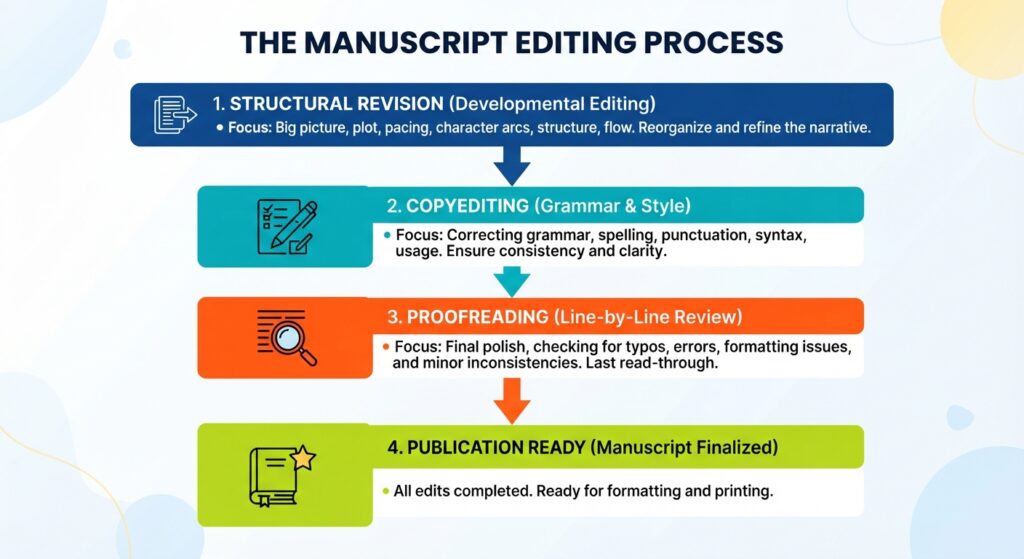
Industry-standard quality-control sequence
A practical sequence is:
Scientific revision → Structural editing → Language editing → Reference/citation audit → Journal-format check → Final proofreading
Do not proofread only the original manuscript and assume the revised sections will be equally polished. New paragraphs frequently contain terminology inconsistencies, tense shifts, citation errors, and formatting discrepancies.
For citation and academic-writing conventions, Purdue OWL provides widely used reference and academic-writing resources.
Also read: Academic Proofreading and Editing: What Authors Should Check Before Submission
A Practical Decision Framework for Reviewer Conflicts
Use the following hierarchy when reviewers disagree:
- Protect scientific accuracy.
- Follow explicit editorial instructions.
- Respect the study design and available evidence.
- Comply with journal requirements.
- Address the substantive concern behind each review.
- Synthesize compatible recommendations.
- Explain unresolved decisions transparently.
- Request editorial clarification when the conflict is consequential.
This framework prevents a common mistake: treating peer review as a voting system in which the author must determine whether Reviewer 1 or Reviewer 2 “wins.”
The purpose of revision is to strengthen the manuscript while preserving methodological integrity.
Final Pre-Submission Checklist for Contradictory Reviewer Feedback
Before uploading the revised manuscript, audit every element:
- Read the editor's decision letter separately from the reviewer reports.
- Categorized every reviewer comment by type and importance.
- Identified genuinely contradictory recommendations.
- Determined the underlying concern behind each conflicting comment.
- Checked methodological recommendations against the study design.
- Verified statistical and analytical changes.
- Incorporated compatible recommendations from both reviewers.
- Documented partial or non-implementation decisions.
- Provided a clear rationale for unresolved disagreements.
- Avoided confrontational or dismissive language.
- Included page, section, table, figure, or line references for revisions.
- Updated the Abstract after substantive manuscript changes.
- Checked consistency between Methods, Results, Discussion, tables, and figures.
- Updated references and citations in the required style.
- Checked journal-specific formatting requirements.
- Verified applicable reporting guidelines.
- Proofread all newly revised sections.
- Confirmed that the response letter accurately describes every change.
- Performed a final tracked-changes and clean-manuscript check.
- Confirmed that all required supplementary files are included.
Conclusion
Peer review dispute resolution for authors requires judgment, documentation, and respectful communication not an attempt to satisfy contradictory recommendations word for word. When Reviewer 1 and Reviewer 2 disagree, identify the underlying scientific issue, prioritize the editor's instructions and methodological integrity, synthesize compatible recommendations, and explain any unresolved decisions clearly.
A strong response does more than tell reviewers what changed. It demonstrates that you have evaluated the evidence, understood the concern, made a deliberate editorial decision, and strengthened the manuscript without compromising its scientific purpose.
Before resubmission, give the revised manuscript a final structural, language, citation, and formatting audit. PaperEdit's professional manuscript editing and proofreading services can help ensure that your response revisions are clear, consistent, and submission-ready.