


Receiving a revise-and-resubmit decision is only the beginning of the next stage of academic publishing. The difficult part is often not making the requested revisions it is demonstrating clearly, systematically, and professionally how every reviewer and editor comment has been addressed.
A point-by-point peer review response matrix is a structured table that maps each reviewer or editor comment to the author’s response, the action taken, and the exact location of the corresponding change in the revised manuscript. A well-constructed matrix reduces ambiguity, helps editors verify revisions efficiently, and creates an auditable record of how feedback was incorporated.
This guide explains how to structure a reviewer response table, what columns to include, how to format manuscript changes, how to handle critical or conflicting remarks, and how to convert the matrix into a polished response letter for resubmission.
💡 Ready to polish your research paper for publication?
Transform your manuscript with PaperEdit's professional editing and proofreading services!
What Is a Point-by-Point Peer Review Response Matrix?
A peer review response matrix is a table used to organize reviewer comments and document the authors’ responses to each one.
The basic logic is:
Reviewer comment → Author response → Manuscript action → Exact location
Publishers commonly recommend responding to reviewers point by point rather than providing a general summary of revisions. Elsevier, for example, advises authors to identify each comment separately, explain the response, and provide page and line information so editors can locate the changes efficiently.
A matrix is particularly useful when a manuscript receives:
- Multiple reviewers
- Major and minor revision requests
- Statistical or methodological critiques
- Requests for additional references
- Substantial restructuring suggestions
- Conflicting reviewer recommendations
- Numerous language and formatting corrections
Why use a matrix?
Without a systematic response document, authors can easily overlook a minor comment while concentrating on major methodological revisions. Reviewers may then have to search through the entire revised manuscript to determine whether their concerns were addressed.
A matrix solves this problem by creating a traceable revision pathway.
The industry-standard principle is simple: make it easy for the editor to verify what changed and why. Elsevier and Taylor & Francis both recommend clear point-by-point responses and specific references to revised manuscript locations.
What Columns Should Be Included in a Peer Review Response Table?
A strong response matrix normally contains four to six columns. The exact format should follow the target journal's instructions if it specifies a template.
| Column | Purpose | Recommended content |
| Comment ID | Creates traceability | R1.1, R1.2, R2.1 |
| Reviewer comment | Records the issue | Exact comment or faithful reproduction |
| Author response | Explains the action | Agreement, clarification, rebuttal, or partial acceptance |
| Action taken | Documents revision | Added analysis, revised paragraph, deleted text, etc. |
| Manuscript location | Enables verification | Page, section, paragraph, line, figure, or table |
| Revised text/evidence | Shows implementation | New wording, data, citation, or analysis |
For a complex revision, the Action Taken and Manuscript Location columns are especially valuable.
For example:
| ID | Reviewer comment | Response | Action taken | Location |
| R1.3 | Please clarify the sampling criteria. | We agree that the inclusion criteria required greater explanation. | Added explicit inclusion and exclusion criteria and clarified participant recruitment. | Methods, p. 7, lines 142–158 |
| R1.4 | The statistical analysis does not justify the stated conclusion. | We appreciate this concern and conducted an additional sensitivity analysis. | Added sensitivity analysis and revised the interpretation of the primary outcome. | Results, p. 12; Table 3; Discussion, p. 16 |
This format allows an editor to move directly from the criticism to the response and then to the revised manuscript.
Also read: Top 10 Research Cover Letter Mistakes That Get You Rejected Instantly
Step 1: Catalogue Every Reviewer and Editor Comment
Do not begin revising randomly.
First, extract every actionable comment from:
- The editor's decision letter
- Reviewer 1's report
- Reviewer 2's report
- Additional reviewer reports
- Statistical reviewer comments
- Editorial or technical requirements
Create a master spreadsheet or document before changing the manuscript.
Assign a unique identifier to every point:
- Editor 1
- Reviewer 1—Comment 1
- Reviewer 1—Comment 2
- Reviewer 2—Comment 1
- Reviewer 2—Comment 2
If one reviewer provides a paragraph containing four distinct requests, separate them into four response items.
This prevents a common submission failure: responding to the general theme of a comment while leaving one specific request unresolved.
Taylor & Francis similarly recommends cataloguing all requested revisions and maintaining separate sections for the editor and individual reviewers.
What counts as a complete response?
A response is complete only when the matrix answers three questions:
What did the reviewer identify?
What did the authors do about it?
Where can the editor verify the change?
Avoid vague responses such as:
"Done."
or:
"The manuscript has been revised accordingly."
These statements provide no audit trail.
Instead, write:
"We have revised the final paragraph of the Discussion to distinguish the observed association from causal interpretation. The revised text appears on page 16, lines 331–347."
Step 2: Classify Comments Before Responding
Not every reviewer comment requires the same type of response.
Classify each comment as:
A. Direct revision
The reviewer identifies a legitimate problem that can be corrected.
Example:
"Please define the abbreviation at first use."
Response strategy: Make the change and identify the location.
B. Additional analysis
The reviewer requests new statistical analysis, experiments, sensitivity testing, or robustness checks.
Response strategy: Conduct the analysis where scientifically and practically justified, report the method and result, and explain whether the interpretation changed.
C. Clarification
The underlying research may be sound, but the manuscript does not explain it clearly enough.
Response strategy: Rewrite the relevant section, add definitions, provide methodological detail, or improve figure/table legends.
D. Additional literature
The reviewer requests references or engagement with omitted scholarship.
Response strategy: Evaluate the suggested literature critically. Add relevant sources rather than inserting citations mechanically.
E. Partial agreement
The reviewer identifies a valid concern but proposes a solution that you do not fully adopt.
Response strategy: Explain which part you accepted, what you changed, and why you retained your alternative approach.
F. Respectful disagreement
You conclude that the requested change would be scientifically inappropriate, unsupported by evidence, outside the study's scope, or inconsistent with the study design.
Response strategy: Acknowledge the concern, provide evidence-based reasoning, and explain what you did instead.
Disagreement is permissible, but it must be reasoned rather than defensive. Publisher guidance emphasizes that authors can disagree with reviewers provided that the response is factual, professional, and supported by evidence.
Step 3: Construct Each Response Using a Four-Part Formula
A reliable response structure is:
Acknowledge → Answer → Action → Location
1. Acknowledge
Show that you understood the concern.
"We thank the reviewer for highlighting the need to clarify the participant selection criteria."
2. Answer
State your position directly.
"We agree that the original description did not sufficiently distinguish the inclusion and exclusion criteria."
3. Action
Describe precisely what changed.
"We have therefore expanded the Methods section to specify eligibility criteria and explain the recruitment procedure."
4. Location
Provide the exact location.
"The revised text appears in Section 2.2, page 6, lines 118–136."
This formula works because it connects the intellectual response to the physical manuscript change.
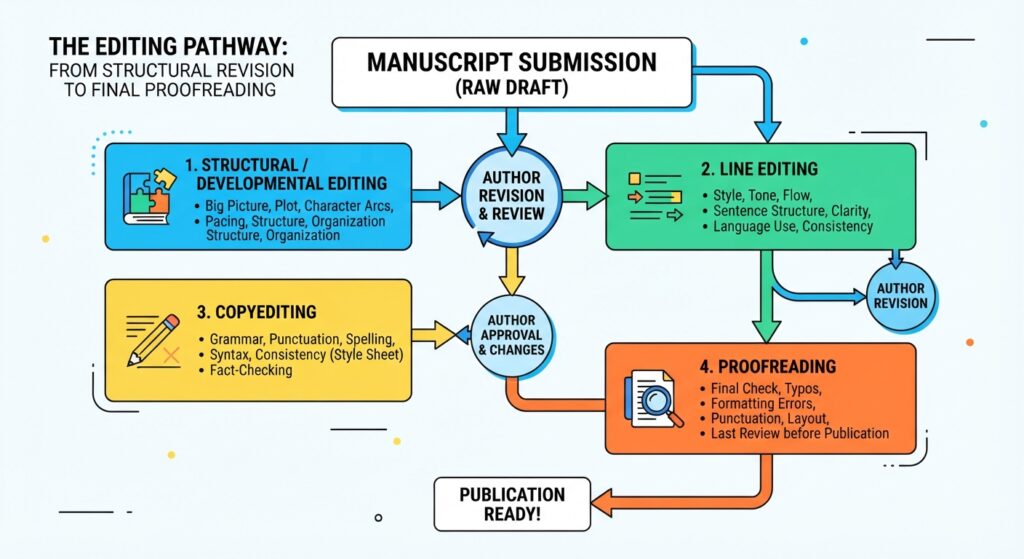
How Do You Format Changes Made in the Revised Manuscript?
Formatting conventions vary by journal, so the Instructions for Authors always take precedence.
In the absence of specific instructions, prepare two versions when the journal permits or requests them:
- Clean revised manuscript
- Tracked-changes or marked-up manuscript
Elsevier recommends submitting a revised manuscript with changes highlighted and a clean version showing the manuscript in its final readable form.
Recommended formatting hierarchy
For the response matrix:
- Use consistent reviewer labels.
- Number every comment.
- Keep reviewer comments visually distinct from author responses.
- Use page and line numbers where possible.
- Identify revised figures and tables explicitly.
- Quote revised text only when it materially helps verification.
- Maintain consistent terminology throughout the response document.
For the manuscript itself:
- Use Track Changes if requested or accepted by the journal.
- Do not leave unresolved comments or internal editing notes.
- Check that page and line numbers correspond to the submitted revision.
- Remove identifying information if the journal uses double-anonymized review.
- Submit a clean copy when requested.
Do not assume that colored text, boldface, or highlighting is universally acceptable. Some journals provide specific requirements for marking revisions; others want a clean manuscript plus a separate response document.
Step 4: Address Critical Reviewer Remarks Systematically
Critical comments require more than polite wording. They require an evidence-based decision process.
For each major criticism, ask:
1. Is the reviewer identifying a factual error?
If yes, correct it.
2. Is the criticism about insufficient explanation?
If yes, clarify the manuscript.
3. Does the criticism require additional analysis?
Determine whether the analysis is methodologically justified and feasible.
4. Does the requested change alter the study's research question?
If so, explain the scope limitation rather than silently changing the study.
5. Do you disagree with the premise?
Provide a concise scientific rationale and supporting evidence.
For example:
Reviewer comment: "The conclusion appears causal, but the study design does not establish causality."
Response: "We agree that the original wording overstated the strength of the inference. We have therefore replaced causal language throughout the Abstract, Results, and Discussion with language describing the observed association. We also added a limitation concerning the observational study design."
This is stronger than defending the original wording simply because it appeared in the submitted manuscript.
If a reviewer has misunderstood an important aspect of the study, consider whether the manuscript itself caused the misunderstanding. Taylor & Francis specifically recommends treating such misunderstandings as opportunities to improve clarity rather than simply dismissing the reviewer's interpretation.
Also read: Ultimate Guide to Academic Publishing & Peer Review Success: 2026 Author Guide
What If Two Reviewers Give Conflicting Recommendations?
Do not attempt to satisfy contradictory recommendations blindly.
First, identify the precise conflict.
For example:
- Reviewer 1: "Expand the theoretical framework."
- Reviewer 2: "Remove the theoretical discussion because it distracts from the empirical findings."
Then explain the editorially defensible solution.
A possible response is:
"We appreciate both perspectives. To address Reviewer 1's concern regarding theoretical positioning while responding to Reviewer 2's concern about length and focus, we have condensed the theoretical discussion and moved the extended conceptual treatment to the Supplementary Material."
When reviewer recommendations conflict, explain why the final revision adopts a particular approach. Editors can then assess the reasoning rather than attempting to infer it from the manuscript.
Elsevier advises authors to address differing reviewer perspectives individually and explain the reasoning behind the chosen approach.
Creating a Response to Reviewers Table: Recommended Template
A reusable peer review rebuttal matrix can follow this structure:
| ID | Reviewer comment | Author response | Revision/action | Location |
| R1.1 | [Insert exact comment] | [Explain your response] | [Describe manuscript change] | [Page/line/section] |
| R1.2 | [Insert exact comment] | [Explain your response] | [Describe manuscript change] | [Page/line/figure/table] |
| R2.1 | [Insert exact comment] | [Explain your response] | [Describe manuscript change] | [Page/line/section] |
| R2.2 | [Insert exact comment] | [Explain your response] | [Describe your response if no change was made] | [Location or N/A] |
For extensive revisions, add a sixth column:
Evidence / Revised Text
This is particularly useful when the reviewer has requested a methodological clarification, new statistical result, or substantial textual revision.
Response matrix vs. response letter
These documents overlap, but they serve slightly different purposes.
| Feature | Response Matrix | Response Letter |
| Primary purpose | Track individual revisions | Communicate the revision strategy |
| Format | Table/grid | Formal letter/document |
| Reviewer comments | Usually reproduced | Usually reproduced |
| Location references | Essential | Essential |
| Detailed revised text | Optional | Often included |
| Opening/closing | Minimal | Formal |
| Best use | Complex revisions | Journal resubmission package |
For a complicated revision, use both: a concise response letter followed by a detailed point-by-point matrix.
Also read: Navigating Peer Reviewer Comments without Stress: A 2026 Guide to Handling Academic Feedback
Step 5: Convert the Matrix Into a Professional Reviewer Response Letter
A strong response letter should not merely repeat "thank you" throughout the document.
Use a predictable architecture:
Opening
Identify the manuscript and acknowledge the opportunity to revise.
Summary of major revisions
Briefly describe the principal changes, such as:
- Expanded methodological explanation
- Additional statistical analysis
- Revised theoretical framework
- New limitations
- Updated figures
- Language and structural improvements
Editor comments
Address editorial instructions before reviewer-specific comments.
Reviewer 1
Use numbered responses.
Reviewer 2
Restart numbering or follow the journal's preferred convention.
Reviewer 3
Repeat the same structure if applicable.
Closing
Thank the editor and reviewers and indicate that the revised manuscript and supporting documents have been submitted.
A useful response document should be readable even if forwarded to a reviewer without additional explanation. Elsevier specifically recommends a response that is clear enough to be forwarded directly to reviewers.
Also read: PaperEdit Academic Proofreading Services
Common Submission Pitfalls to Eliminate
1. Missing one reviewer comment
Use unique IDs and a master checklist to ensure that every point receives a response.
2. Saying "revised as suggested"
This forces the reviewer to search for the revision.
Better: Identify the section, page, line, figure, or table.
3. Responding but not changing the manuscript
The matrix and manuscript must agree. Before submission, audit every "we have added..." statement against the actual document.
4. Changing the manuscript without mentioning the change
Unexpected revisions can make the response difficult to audit. Include substantive changes in the response matrix even if they were not explicitly requested.
5. Becoming defensive
Avoid statements such as:
"The reviewer clearly misunderstood our study."
Use:
"We recognize that the original wording may have led to this interpretation. We have revised the paragraph to clarify..."
6. Overloading the response with irrelevant detail
A response should be thorough but focused. Do not turn every minor correction into a lengthy scientific essay.
7. Ignoring journal-specific instructions
Some journals request separate files for the response letter, tracked manuscript, clean manuscript, supplementary data, or graphical materials.
Always verify the journal's current submission requirements before uploading the revision.
8. Failing to update cross-references
If a reviewer-requested deletion changes figure numbering, tables, supplementary files, citations, or section numbering, perform a complete cross-reference audit.
Industry-Standard Quality Criteria for a Reviewer Response Matrix
Before submitting, assess the matrix against five criteria:
Completeness: Every editor and reviewer comment has an identifiable response.
Traceability: Every substantive change can be located in the manuscript.
Consistency: The response letter, matrix, tracked manuscript, and clean manuscript describe the same revisions.
Evidence: Scientific disagreements are supported by data, methodological reasoning, or appropriate literature.
Professional tone: Responses remain objective, precise, and respectful.
The ICMJE Recommendations on submission and peer review responsibilities emphasize that peer review practices vary across journals, making it important for authors to follow the specific procedures and confidentiality requirements of their target publication.
For biomedical manuscripts, also check whether the journal requires reporting frameworks such as CONSORT, STROBE, or other study-specific checklists. ICMJE advises authors to consult journal-specific requirements and submit requested reporting checklists with the manuscript.
Pre-Submission Peer Review Response Checklist
Before uploading your revision, complete this final audit:
- Read the editor's decision letter again.
- Extracted every editor and reviewer comment.
- Assigned a unique ID to every substantive comment.
- Separated Reviewer 1, Reviewer 2, and additional reports.
- Addressed every major and minor comment.
- Explained disagreements with evidence and professional reasoning.
- Added page and line numbers wherever possible.
- Verified that every stated manuscript change actually appears in the revision.
- Checked that revised figures and tables match the response document.
- Updated citations and references introduced during revision.
- Checked all cross-references, section numbers, tables, and figures.
- Prepared the tracked-changes version if required.
- Prepared the clean manuscript if required.
- Removed unresolved comments and internal editing notes.
- Preserved anonymity if double-blind review applies.
- Checked the journal's latest Instructions for Authors.
- Confirmed that supplementary files and reporting checklists are included.
- Proofread the entire response letter and revised manuscript.
- Confirmed that the response matrix and cover letter are consistent.
Final Takeaway
A point-by-point peer review response matrix is more than an administrative table. It is a revision-control system for scholarly publishing. By linking every reviewer comment to a precise response, manuscript action, and verifiable location, you make the revision process easier for editors and reviewers to evaluate.
The most effective approach is systematic: catalogue every comment, classify the required action, respond objectively, document the revision, provide exact locations, and audit the final submission for consistency. When you disagree, defend the scientific position with evidence rather than rhetoric.
Before resubmission, treat the response matrix with the same editorial rigor as the manuscript itself. A carefully structured response demonstrates that the revision has been deliberate, complete, and professionally managed.
For authors preparing a demanding revise-and-resubmit package, PaperEdit's academic editing and proofreading support can help refine the manuscript, standardize language and formatting, check consistency across revision documents, and prepare the paper for journal submission.