

Finishing a research manuscript is only the beginning. Many researchers struggle with what comes next: choosing the right journal, meeting submission requirements, avoiding desk rejection, navigating peer review, and responding effectively to reviewer comments.
The academic publishing process is the sequence of preparing, selecting, submitting, reviewing, revising, and ultimately publishing a scholarly manuscript. Understanding each stage helps authors replace guesswork with a controlled publishing workflow.
For researchers, doctoral candidates, ESL authors, and early-career academics, publication success depends on more than strong research. Editors also assess journal fit, methodological transparency, reporting quality, manuscript presentation, ethical compliance, and adherence to author guidelines. The International Committee of Medical Journal Editors (ICMJE), for example, emphasizes that authors should follow both general publication recommendations and the specific instructions of their target journal.
This guide explains how to publish in peer-reviewed journals, how the academic journal submission process works, what happens after submission, how peer review operates, and how to prepare a manuscript that is technically and linguistically ready for editorial evaluation.
💡 Ready to polish your research paper for publication?
Transform your manuscript with PaperEdit's professional editing and proofreading services!
1. Understand the Stages of Academic Publishing
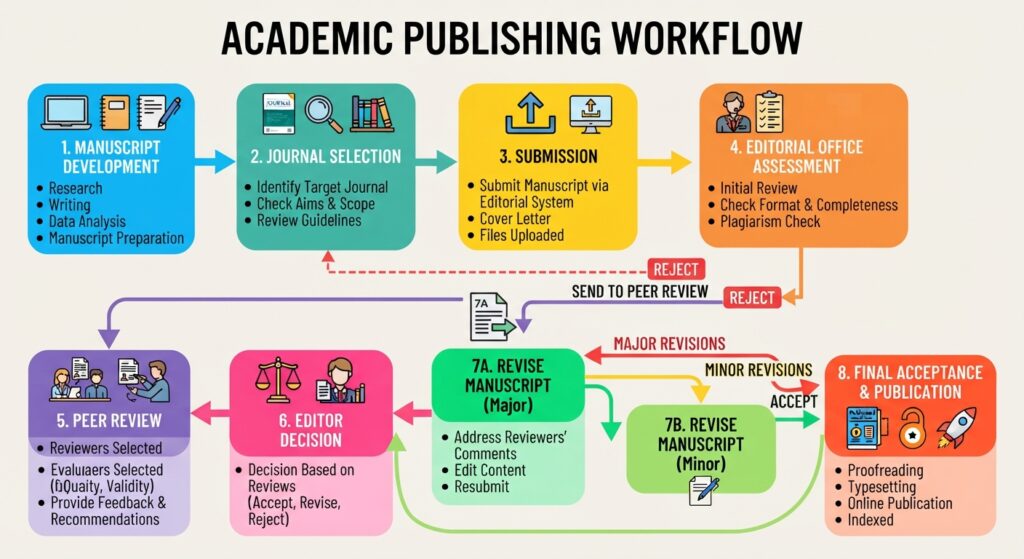
A successful submission follows a sequence rather than a single event. Understanding the stages of academic publishing allows you to identify potential problems before they reach an editor.
Stage 1: Complete and refine the research
Before manuscript preparation begins, confirm that the research question, methodology, analysis, results, and interpretation are sufficiently developed.
Your manuscript should answer four fundamental questions:
- What problem does the study address?
- Why is the problem important?
- How was the study conducted?
- What does the evidence demonstrate?
For original research, many journals use an IMRAD structure Introduction, Methods, Results, and Discussion although review articles, case reports, theoretical papers, and other article types may require different structures.
Stage 2: Select the target journal
Do not select a journal solely because it is prestigious or familiar. Evaluate its aims and scope, article type, readership, recent publications, indexing, publication model, word limits, reporting requirements, and submission policies.
IEEE, for example, advises authors to examine a journal's aims and scope and compare their manuscript with related articles before submission. An article can be rejected before peer review when it falls outside the journal's scope.
Stage 3: Prepare the manuscript
This is where structural editing, academic copyediting, citation checking, formatting, figure preparation, and reporting-standard compliance become critical.
Stage 4: Submit and undergo editorial screening
After submission, an editor or editorial team checks whether the manuscript meets basic requirements and is appropriate for the journal. A manuscript may be rejected without external peer review if it has a serious scope, quality, methodological, ethical, or presentation problem.
Stage 5: Peer review
If the manuscript passes editorial screening, it may be sent to independent experts. Reviewers assess elements such as originality, validity, methodology, interpretation, clarity, and significance.
IEEE describes peer review as an evaluation by independent reviewers whose feedback contributes to the editor's publication decision.
Stage 6: Revision and final decision
Possible outcomes include acceptance, revision, or rejection. A revision request is not the end of the publication process; it is an opportunity to demonstrate that you can respond systematically to expert criticism.
Stage 7: Production and publication
After acceptance, the manuscript may undergo copyediting, typesetting, proof correction, metadata processing, and online or print publication.
2. How Do I Choose the Right Journal for My Manuscript?
Journal selection is one of the most consequential decisions in the academic journal submission process.
What should you evaluate?
Create a journal-selection matrix covering:
| Criterion | What to Check | Common Submission Pitfall |
| Scope | Does the journal publish research addressing your topic? | Choosing a journal because its title sounds relevant |
| Article type | Research article, review, brief report, case study, etc. | Submitting the wrong manuscript category |
| Audience | Who reads the journal? | Ignoring whether your findings interest its readership |
| Recent literature | Are similar studies being published? | Assuming an inactive research area means poor fit |
| Word limit | Main text, abstract, references, or total limits | Exceeding limits before submission |
| Reporting standards | CONSORT, STROBE, PRISMA, STARD, JARS, etc. | Completing reporting requirements too late |
| Reference style | APA, Vancouver, IEEE, Chicago, or journal-specific format | Applying the wrong citation system |
| Publication model | Subscription, hybrid, or open access | Discovering article-processing charges after acceptance |
| Editorial process | Peer-review model and submission requirements | Failing to understand review expectations |
Industry-standard criterion: journal fit should be evaluated against the publication's official aims, scope, article types, and current author instructions not based solely on impact factor or reputation.
APA's journal guidance similarly directs authors to consult the instructions for the specific journal because requirements can vary among publications.
How to avoid journal mismatch
Read at least several recent papers from your prospective journal. Examine:
- Research questions
- Article structure
- Typical manuscript length
- Methodological sophistication
- Citation patterns
- Figure and table presentation
- Terminology
- Theoretical framework
- Types of conclusions published
Then write a one-sentence journal-fit statement:
“This manuscript is appropriate for Journal X because it addresses [research problem], uses [method], and contributes [specific finding] to the journal's readership.”
If you cannot write that sentence convincingly, reassess your target journal.
Also read: The Role of Google Scholar Citations in Academic Reputation
3. Prepare Your Manuscript to Editorial Standards
Knowing how to publish in peer reviewed journals requires understanding the difference between good research and publication-ready research.
A manuscript can contain sound research but still create unnecessary editorial friction because of inconsistent terminology, unclear argumentation, poor English, incorrect references, or formatting errors.
Structural editing: strengthen the argument
Structural editing examines the manuscript at the level of logic and organization.
Audit:
- Research question and hypothesis alignment
- Literature review relevance
- Methodological transparency
- Results-to-research-question alignment
- Discussion of limitations
- Strength of conclusions
- Logical progression between sections
For example, if the introduction establishes three research objectives but the Results section addresses only two, the manuscript contains an internal structural inconsistency.
Line editing and copyediting: refine the language
Academic copyediting should address:
- Grammar and syntax
- Sentence clarity
- Academic tone
- Terminological consistency
- Redundancy
- Verb tense
- Pronoun reference
- Parallel construction
- Abbreviation consistency
- Punctuation
- ESL-related language interference
Avoid editing merely to make prose sound “more sophisticated.” Effective academic language should make the research more precise, not more complicated.
Reporting standards: make the study assessable
Reporting guidelines help authors provide the information readers and reviewers need to evaluate research.
Examples include:
- CONSORT for randomized trials
- STROBE for observational studies
- PRISMA for systematic reviews and meta-analyses
- STARD for diagnostic-accuracy studies
- APA JARS for relevant quantitative, qualitative, and mixed-methods research
ICMJE specifically identifies CONSORT, STROBE, PRISMA, and STARD as examples of study-design reporting guidelines. APA's JARS similarly provides reporting guidance for quantitative, qualitative, and mixed-methods research to improve clarity and accuracy.
4. Standardize Formatting, References, Tables, and Figures
Formatting is not merely cosmetic. Consistent presentation reduces ambiguity and demonstrates compliance with the journal's technical requirements.
Follow the journal's instructions first
There is no universal manuscript format that overrides journal-specific requirements.
A journal may specify:
- Font family and size
- Line spacing
- Margins
- Page numbering
- Heading hierarchy
- Abstract structure
- Word count
- Reference format
- Figure file types
- Supplementary files
- Blinded-manuscript requirements
If the journal specifies double spacing, for example, use double spacing—even if another academic style guide recommends a different presentation.
Standardize citations
Use the exact citation system requested by the journal.
Common systems include:
- APA 7th
- Vancouver
- IEEE
- MLA
- Chicago
- Harvard
Do not manually switch between systems during final formatting. Use reference-management software where appropriate, but always perform a human verification.
ICMJE recommends verifying references against authoritative bibliographic sources or the original publications and checking for retracted articles.
Audit figures and tables
Every figure and table should:
- Be cited in the main text
- Have a descriptive title or legend
- Use consistent terminology
- Define nonstandard abbreviations
- Remain legible at publication size
- Match the data discussed in the manuscript
ICMJE notes that figures should use sufficiently clear lettering, numbers, and symbols to remain legible when reduced for publication.
For image-based figures, 300 DPI is a commonly used publication-quality benchmark, but authors should always follow the target journal's exact technical specifications because requirements differ by publisher and figure type.
Also read: Cover Letter for Journal & Manuscript Submission (With Examples + Template)
5. Understand the Peer Review Process Explained
The peer review process is the critical evaluation of a submitted manuscript by subject-matter experts who are generally independent of the editorial office.
However, peer review does not begin immediately after you click “Submit.”
A simplified lifecycle is:
Submission → Technical Check → Editorial Screening → Reviewer Selection → Peer Review → Editorial Decision → Revision → Re-review → Acceptance/Decision
What do reviewers examine?
Although reviewer forms differ by journal, common evaluation areas include:
- Originality
- Research question
- Methodological rigor
- Statistical analysis
- Data interpretation
- Literature coverage
- Reproducibility or transparency
- Ethical compliance
- Clarity
- Significance
- Limitations
- Conclusions
IEEE states that reviewers assess the quality, validity, and originality of research findings, while their feedback helps inform the editor's decision.
What editors look for in academic manuscripts
Editors commonly need to establish whether the manuscript is:
- Appropriate for the journal
- Sufficiently developed for external review
- Methodologically credible
- Ethically compliant
- Clearly written
- Relevant to the journal's readership
- Presented according to submission requirements
A technically strong manuscript can therefore encounter a desk rejection before peer review if it fails basic editorial criteria.
Also read: Open Access vs. Traditional Publishing: Which One is Right for You?
6. How Long Does the Academic Peer Review Process Take?
There is no universal peer-review turnaround time.
Duration varies according to:
- Journal
- Discipline
- Article type
- Reviewer availability
- Number of review rounds
- Editorial workload
- Manuscript complexity
- Revision requirements
Therefore, avoid treating a generic “average review time” as a guaranteed schedule.
Instead, examine the target journal's published processing information and recent author communications where available.
ICMJE recommends that editors work toward timely manuscript processing and respond to authors' status inquiries appropriately.
What happens if the review is delayed?
If a manuscript remains beyond the journal's stated or customary timeframe:
- Check the submission portal.
- Review the journal's status definitions.
- Wait an appropriate interval.
- Send a concise status inquiry to the editorial office.
- Do not submit the manuscript simultaneously to another journal unless you have formally withdrawn it and the journal confirms or otherwise recognizes the withdrawal according to its policies.
Common pitfall: sending repeated status emails every few days. This rarely accelerates peer review and may create unnecessary administrative work.
7. What Happens After Submitting an Academic Paper?
After submission, your manuscript typically enters a technical or administrative screening phase.
The editorial office may verify:
- Required files
- Author information
- Conflict-of-interest declarations
- Ethics documentation
- Formatting
- Word count
- Figure files
- Supplementary material
- Reporting checklists
- Blinded-review requirements
The manuscript may then undergo editorial assessment.
ICMJE recommends that submission materials address issues such as redundant publication, financial or other relationships, and authorship declarations where applicable.
Possible editorial outcomes
Desk rejection: The editor declines the manuscript without external peer review.
Reject after review: Reviewers identify issues significant enough that the journal does not invite further revision.
Major revision: Substantial changes are required before the manuscript can be reconsidered.
Minor revision: Specific corrections or clarifications are required.
Accept: The manuscript proceeds toward publication, although production-stage corrections may still be required.
A rejection is not necessarily evidence that the research itself lacks value. Editorial decisions are context-dependent and can reflect journal scope, space, priority, methodological expectations, or the reviewers' assessment.
8. How to Avoid Journal Desk Rejection
Desk rejection prevention begins before submission.
Conduct a pre-submission audit
Check:
- Is the manuscript within scope?
- Does the article type match the journal?
- Does the title accurately represent the study?
- Does the abstract meet the required structure and word count?
- Are all required sections present?
- Are ethical approvals documented?
- Are conflicts of interest disclosed?
- Are references formatted correctly?
- Are tables and figures numbered consistently?
- Are all figures cited?
- Is the manuscript anonymized if required?
- Are supplementary files included?
- Has the manuscript been proofread?
Check research transparency
Do not hide methodological weaknesses behind polished language. Instead, state limitations accurately.
A transparent Methods section should provide enough information for readers to understand how the study was conducted. ICMJE emphasizes that Methods should be sufficiently detailed to support assessment and, where appropriate, reproducibility.
Screen for publication ethics
Avoid:
- Duplicate submission
- Redundant publication
- Inappropriate authorship
- Undisclosed conflicts of interest
- Citation manipulation
- Plagiarism
- Fabricated or manipulated data
- Unverified references
ICMJE specifically warns authors about predatory or pseudo-journals and recommends that researchers evaluate journals carefully rather than relying on claims made by questionable publishers.
9. Respond Strategically to Peer Reviewer Comments
A revision should be treated as a technical response document, not as an argument with the reviewer.
Create a response matrix:
| Reviewer Comment | Author Action | Location of Revision | Response |
| Clarify sampling method | Added methodological detail | Methods, p. X | Explained recruitment and inclusion criteria |
| Add recent literature | Added relevant sources | Introduction, p. X | Updated literature review |
| Explain limitation | Expanded limitations | Discussion, p. X | Added limitation and its implications |
| Correct terminology | Standardized terminology | Throughout | Replaced inconsistent terminology |
Industry-standard revision practice
For every substantive comment:
- Quote or summarize the comment accurately.
- State what you changed.
- Identify exactly where you changed it.
- Explain your reasoning when necessary.
- Remain professional when disagreeing.
If you disagree with a reviewer, use evidence rather than emotion.
For example:
“We appreciate the reviewer's observation. We retained the original analytical approach because [methodological reason]. To clarify this decision, we have added an explanation to the Methods section.”
Do not write:
“The reviewer misunderstood our study.”
The first response advances scholarly dialogue; the second can sound defensive.
Also read: Language Errors in Manuscripts: How to Avoid Rejection
10. Academic Publishing Best Practices for Graduate Students
Doctoral candidates and early-career researchers should treat publication as a workflow that begins well before the final submission.
Build a publication-ready manuscript system
Maintain:
- A master manuscript
- A journal-specific submission version
- A reference database
- Original figure files
- Supplementary data
- Reporting checklists
- Ethics documentation
- Cover-letter templates
- Reviewer-response templates
- Submission records
Do not overwrite the master manuscript with journal-specific formatting.
Keep a journal shortlist
Instead of selecting a journal at the last minute, maintain a list of potentially suitable publications. Record:
- Scope
- Article types
- Publisher
- Indexing information
- Open-access options
- Fees
- Word limits
- Reference style
- Typical article structure
- Submission platform
- Peer-review information
This approach makes journal selection evidence-based rather than reactive.
11. The Final Manuscript Readiness Checklist
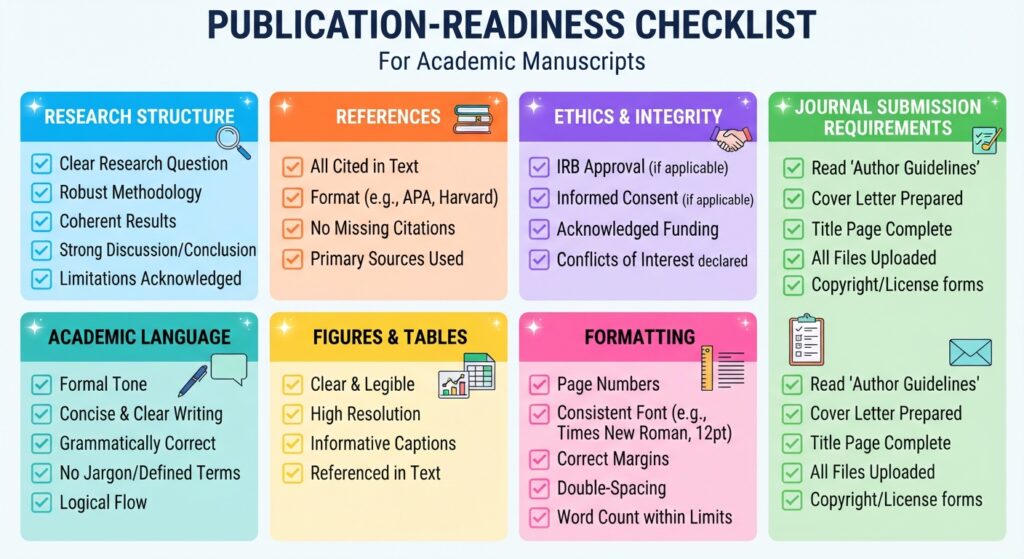
Before uploading your manuscript, complete this final audit.
Research and structure
- Research question is clearly stated.
- Objectives and hypotheses align with the analysis.
- Introduction establishes the research gap.
- Methods contain sufficient methodological detail.
- Results report findings without unnecessary interpretation.
- Discussion distinguishes evidence from speculation.
- Limitations are explicitly acknowledged.
- Conclusions answer the research question.
Language and editing
- Grammar and syntax have been checked.
- Academic tone is consistent.
- Terminology is standardized.
- Abbreviations are defined at first use.
- Tense is appropriate and consistent.
- Redundant statements have been removed.
- ESL-related phrasing has been professionally polished where necessary.
Formatting and references
- Journal-specific formatting has been followed.
- Required font, spacing, and margins are correct.
- Word count meets the journal limit.
- Citation style is consistent.
- Every in-text citation appears in the reference list.
- Every listed reference is cited where required.
- References have been checked against original sources.
- Retracted or inappropriate references have been identified.
Figures and tables
- Every figure and table is cited in the text.
- Numbering is sequential.
- Legends are complete.
- Abbreviations are explained.
- Figure resolution and file formats meet journal requirements.
- Data in tables and figures match the manuscript.
Submission and ethics
- Cover letter is tailored to the journal.
- Author contributions are documented where required.
- Conflicts of interest are disclosed.
- Funding is reported.
- Ethics approval is documented where applicable.
- Data availability statement is included where required.
- Reporting checklist is completed where applicable.
- Manuscript anonymization requirements are satisfied.
- Supplementary files are included.
- The manuscript is not under simultaneous consideration elsewhere.
Conclusion: Turn Manuscript Preparation Into a Publishing Strategy
Successful academic publishing is not simply the act of submitting a finished paper. It is a controlled process of research reporting, journal selection, structural editing, language refinement, formatting, ethical compliance, submission, peer review, and revision.
The most effective authors work backward from the target journal's requirements. They evaluate journal fit before submission, audit the manuscript against reporting standards, verify references and figures, eliminate avoidable language problems, and prepare a systematic strategy for responding to reviewers.
For researchers asking how to publish in peer reviewed journals, the central principle is straightforward: make the manuscript easy for editors and reviewers to evaluate. Clear research questions, transparent methods, accurate reporting, disciplined academic language, consistent formatting, and a carefully documented revision process all contribute to that goal.
For additional support, explore PaperEdit's academic editing and proofreading services or arrange a professional manuscript review before submission.
Resources
- ICMJE Recommendations for scholarly manuscript preparation and submission — current recommendations updated in January 2026.
- APA Style Journal Article Reporting Standards (JARS) — reporting guidance for quantitative, qualitative, and mixed-methods research.
- IEEE Author Center: Article Submission Process — journal-selection and submission guidance for IEEE authors.
Ready for your next submission? Before clicking “Submit,” have your manuscript independently reviewed for structure, language, references, formatting, reporting compliance, and journal-specific requirements. A professional academic edit can identify publication-readiness issues that are difficult to detect when you have worked on the manuscript for months.