


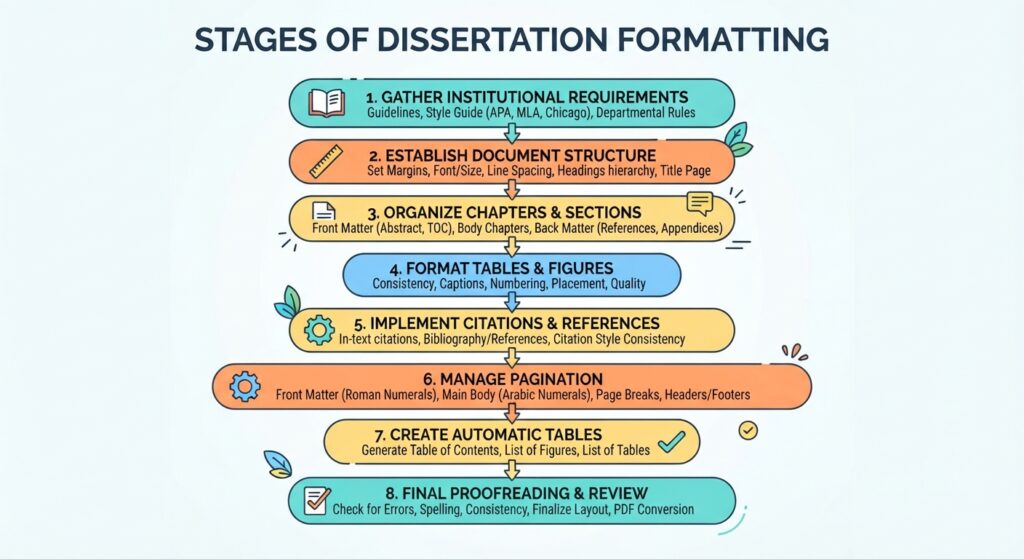
A dissertation can be academically complete yet still fail a final formatting review because of inconsistent headings, incorrect pagination, poorly positioned tables, mismatched references, or formatting that does not follow graduate-school requirements. Chapters 4 and 5 are particularly vulnerable because they often contain dense statistical results, tables, figures, quotations, interpretations, and cross-references to earlier chapters.
Dissertation Chapter 4 and 5 formatting is the process of standardizing the presentation of the results and discussion chapters so that they comply with institutional thesis formatting requirements, the required citation style, and the dissertation's approved structural framework.
Chapter 4 typically presents the study's findings, while Chapter 5 interprets those findings, connects them with the literature, discusses implications and limitations, and establishes the study's contribution. Although their intellectual purposes differ, both chapters must function as part of one technically consistent dissertation.
A rigorous dissertation final formatting review therefore goes beyond correcting fonts and margins. It verifies heading hierarchy, page layout, tables and figures, citations, cross-references, numbering, appendices, front matter, and document-wide consistency.
This guide explains how to prepare Chapters 4 and 5 for that final review, including thesis formatting requirements, APA/Harvard dissertation chapter formatting, data presentation, results-versus-discussion structure, and a final graduate-school dissertation formatting checklist.
💡 Ready to polish your research paper for publication?
Transform your manuscript with PaperEdit's professional editing and proofreading services!
1. Start With Your University's Thesis Formatting Requirements
Do not begin final formatting by opening Word and changing fonts.
Begin with the official dissertation manual or graduate-school formatting guide issued by your institution. University requirements override generic APA, Harvard, Chicago, or other style conventions when the two conflict.
What to audit
Collect the latest requirements for:
- Page size
- Margins
- Font and font size
- Line spacing
- Paragraph indentation
- Heading hierarchy
- Page numbering
- Chapter-opening pages
- Table and figure placement
- Captions and legends
- Citation and reference style
- Appendices
- Front matter
- Table of contents
- List of tables
- List of figures
- Digital submission requirements
- PDF conversion and accessibility requirements
A common academic standard is 1-inch (2.54-cm) margins, but some institutions impose larger margins—particularly on the binding edge. Never substitute a generic "standard" for your institution's specification.
Why this matters
Formatting offices frequently distinguish between:
- Academic correctness — whether the research is sound.
- Style compliance — whether citations and scholarly conventions are correctly applied.
- Institutional formatting compliance — whether the dissertation meets degree-award requirements.
A dissertation may satisfy the first two while failing the third.
Common pitfall
Do not assume that because your dissertation follows APA 7th edition, every layout requirement automatically follows APA.
APA provides extensive guidance on academic writing and presentation, but universities may impose additional dissertation-specific rules.
Consult the APA Style official guidance when APA is required, then reconcile it with your institution's dissertation manual.
2. Lock the Structure of Chapter 4 Before Formatting It
Chapter 4 should present the findings in a logical sequence that directly corresponds to your research questions, hypotheses, or analytical framework.
For quantitative research, the structure may include:
- Introduction
- Participant or sample characteristics
- Preliminary analysis
- Assumption testing
- Results by research question or hypothesis
- Statistical tests
- Additional analyses
- Chapter summary
For qualitative research, Chapter 4 may instead organize findings around:
- Research questions
- Themes
- Categories
- Participant perspectives
- Supporting quotations
- Case findings
- Cross-case analysis
The precise structure depends on the methodology and institutional guidelines.
What to check
Create a structural map before the formatting review:
Research Question → Analysis → Table/Figure → Finding → Chapter 5 Interpretation
This prevents Chapter 4 from becoming a collection of disconnected statistical outputs or qualitative excerpts.
Industry-standard criterion
Every major result should be traceable to the study's research questions, hypotheses, or analytical objectives.
Common pitfall
Avoid interpreting findings extensively in Chapter 4 when your approved dissertation structure reserves interpretation for Chapter 5.
Some disciplines combine results and discussion, but if your dissertation uses separate chapters, maintain that distinction consistently.
3. Format Chapter 4 Results With Consistent Data Presentation
Formatting Chapter 4 results in a dissertation requires more than inserting statistical software output.
Raw SPSS, R, SAS, Stata, NVivo, or other software output is rarely appropriate as a finished dissertation table unless specifically required.
Transform analytical output into reader-oriented tables and figures.
Standardize statistical presentation
Check:
- Decimal places
- Statistical symbols
- Italicization of statistical variables where required
- Confidence intervals
- p values
- Effect sizes
- Sample sizes
- Table numbering
- Figure numbering
- Notes and abbreviations
- Units of measurement
For example, if means are reported to two decimal places, do not switch between 4.2, 4.20, and 4.200 without methodological justification.
If reporting inferential statistics, follow the conventions required by your discipline and style guide.
Table construction
Each table should have:
- A unique table number.
- A descriptive title.
- Clearly labeled columns and rows.
- Appropriate units.
- Necessary notes or abbreviations.
- A clear relationship to the surrounding narrative.
Do not repeat every number from a table in the prose. Use the narrative to identify the most important findings and direct readers to the table for detail.
Common pitfall
Do not paste screenshots of statistical software output into Chapter 4.
Screenshots frequently create problems with:
- Resolution
- Typography
- Accessibility
- Page breaks
- Alignment
- Table numbering
- Consistency with the rest of the dissertation
Instead, reconstruct important results as professionally formatted dissertation tables.
4. Standardize Figures, Charts, and Visual Data
A dissertation's figures should look like components of the same scholarly document—not images copied from unrelated software.
For visual data, check:
- Figure numbering
- Figure titles or captions
- Axis labels
- Units
- Legends
- Font consistency
- Image resolution
- Color accessibility
- Placement relative to discussion
- Cross-references in the text
For raster images, 300 DPI is a commonly used publication-quality target, although the exact requirement should come from your institution or intended publisher.
Use vector graphics where practical for charts, diagrams, and line-based illustrations because they remain sharp during PDF generation and scaling.
How to format data presentation in a dissertation
Do not add a figure merely because software generated one.
Ask:
What question does this figure answer that the accompanying prose cannot communicate as efficiently?
Use tables for precise values and figures for patterns, comparisons, trends, distributions, or conceptual relationships.
Also read: The Ethical Landscape of ChatGPT in Academic Writing: What Researchers Must Understand in 2026
5. Prepare Chapter 5 as an Interpretation Chapter
Formatting Chapter 5 discussion in a dissertation requires particular attention to hierarchy because discussion chapters often contain multiple layers of interpretation.
A typical Chapter 5 structure may include:
Introduction
Briefly establish the purpose of the chapter.
Summary of Key Findings
Restate the most important findings without reproducing the entire results chapter.
Interpretation
Explain what the findings mean and why they matter.
Relationship to Previous Research
Compare your findings with relevant literature.
Theoretical Implications
Explain how the results support, extend, refine, or challenge the theoretical framework.
Practical or Clinical Implications
Identify consequences for practice, policy, education, technology, or other relevant contexts.
Limitations
Identify methodological, sampling, measurement, analytical, or contextual limitations.
Recommendations
Provide evidence-based recommendations for practice or future research.
Conclusion
State the dissertation's central contribution clearly.
The exact structure must follow your approved proposal, departmental requirements, and supervisor guidance.
The key distinction
Chapter 4 primarily answers:
What did the study find?
Chapter 5 primarily answers:
What do those findings mean?
This distinction is fundamental to results vs. discussion chapter formatting.
6. Create Cross-Chapter Consistency
Chapter 5 should not introduce terminology that contradicts Chapter 4.
Run a cross-chapter audit for:
- Research-question numbering
- Hypothesis labels
- Participant/sample counts
- Variable names
- Theme names
- Statistical values
- Table references
- Figure references
- Abbreviations
- Key terminology
- Study objectives
For example, if Chapter 4 reports a sample of 186 participants, Chapter 5 should not accidentally refer to 168.
Similarly, if Chapter 4 identifies four qualitative themes, Chapter 5 should not discuss five unless the change is explicitly explained.
Why this matters
Reviewers and examiners often read Chapters 4 and 5 together when assessing whether the conclusions are supported by the evidence.
Small inconsistencies can undermine confidence in the research even when the underlying analysis is correct.
7. Standardize APA/Harvard Dissertation Chapter Formatting
APA and Harvard are not interchangeable.
APA 7th edition provides detailed guidance for headings, citations, references, tables, figures, and scholarly presentation. Harvard, by contrast, is a broad author-date referencing family with substantial institutional variation.
If your dissertation uses APA:
- Follow the required APA heading hierarchy.
- Apply APA table and figure conventions.
- Standardize author-date citations.
- Format statistical notation consistently.
- Follow the institution's dissertation-specific requirements.
If your dissertation uses Harvard:
- Identify the exact institutional Harvard variant.
- Follow its author-date citation rules.
- Audit punctuation and capitalization against that guide.
- Do not import APA table or heading rules unless your university permits them.
Comparison of common requirements
| Element | APA 7th | Harvard | Final Review Action |
| In-text citations | Author-date | Usually author-date | Verify against prescribed guide |
| Headings | Structured APA hierarchy | Institution-dependent | Match dissertation template |
| Tables | APA-specific conventions | Institution-dependent | Standardize throughout |
| Figures | APA-specific conventions | Institution-dependent | Audit captions and placement |
| References | APA rules | Harvard variant | Check every entry |
| Font | Multiple permitted options | Institution-dependent | Follow university manual |
| Margins | Commonly 1 inch | Institution-dependent | Follow graduate school |
| Line spacing | Usually double-spaced in manuscripts | Institution-dependent | Follow institutional rule |
The important point is that citation style does not automatically determine every page-layout requirement.
8. Fix Headings, Pagination, and Navigation Before Final PDF Creation
Formatting errors often become visible only when the complete dissertation is assembled.
Use Word styles rather than manually formatting individual headings.
For example:
- Heading 1 → Chapter title
- Heading 2 → Major section
- Heading 3 → Subsection
- Heading 4 → Lower-level heading, if permitted
Then generate the table of contents automatically.
Audit pagination
Check:
- Chapter opening pages
- Preliminary page numbering
- Arabic vs. Roman numerals where required
- Headers and footers
- Page breaks
- Blank pages
- Orphaned headings
- Tables split across pages
- Figures separated from captions
- References and appendices
Do not insert dozens of manual page breaks simply to make the current PDF look correct. Structural formatting should remain stable when content changes.
Common pitfall
Manual formatting creates fragile documents.
If every heading has been individually formatted, changing the dissertation's font or heading size can create inconsistent pages and force a second formatting pass.
Use styles, section breaks, automatic numbering, cross-references, and automated tables of contents wherever possible.
9. Audit Citations, References, and Cross-References
A dissertation final formatting review should include a citation audit, not just a visual page check.
Verify that:
- Every in-text citation has a corresponding reference.
- Every reference cited in the dissertation appears in the required reference list.
- Author names are consistent.
- Publication years are correct.
- DOIs and URLs are accurate where required.
- Journal titles and volume numbers are formatted correctly.
- Table and figure citations are accurate.
- Cross-references point to the correct numbered item.
Reference managers such as Zotero, EndNote, and other systems can reduce manual errors, but generated references still require human verification.
Common submission pitfall
Never assume a citation manager has correctly interpreted every source.
Imported metadata can contain:
- Incorrect capitalization
- Missing authors
- Wrong publication dates
- Abbreviated journal titles
- Incorrect page ranges
- Duplicate records
A final manual reference audit remains essential.
For general academic-writing and citation guidance, Purdue OWL provides widely used instructional resources.
10. Complete a Professional Final Formatting Review
Once Chapters 4 and 5 are structurally complete, conduct three separate reviews.
Pass 1: Structural review
Check:
- Chapter organization
- Heading hierarchy
- Research-question alignment
- Logical transitions
- Table and figure sequencing
- Chapter summaries
Pass 2: Technical formatting review
Check:
- Margins
- Font
- Line spacing
- Indentation
- Page numbers
- Captions
- Tables
- Figures
- References
- Cross-references
Pass 3: Language and proofreading review
Check:
- Grammar
- Spelling
- Punctuation
- Academic tone
- Sentence clarity
- Terminology
- Abbreviations
- Voice consistency
- Typographical errors
This separation is valuable because proofreading while simultaneously changing page layout can introduce new errors.
A professional academic proofreading and editing service can provide an additional quality-control layer, particularly when English is not the author's first language.
11. Validate the Final PDF Before Submission
Do not assume that a correctly formatted Word document will automatically produce a compliant PDF.
After exporting, inspect the actual submission file.
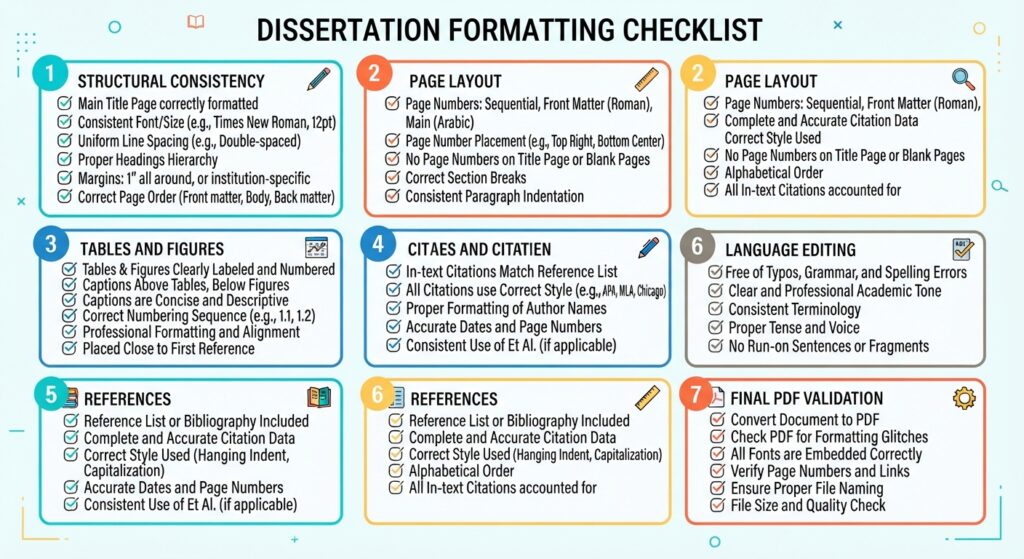
Check:
- Page count
- Fonts
- Hyperlinks
- Bookmarks
- Table of contents links
- Page numbers
- Figure resolution
- Table alignment
- Special characters
- Greek letters and mathematical symbols
- Equation rendering
- Headers and footers
- Blank pages
- File naming
- PDF accessibility requirements
If your graduate school specifies PDF/A, embedded fonts, accessibility tags, or a particular naming convention, follow those requirements exactly.
Why PDF validation matters
Conversion can introduce:
- Font substitutions
- Broken line wraps
- Shifted figures
- Missing symbols
- Altered page breaks
- Incorrect hyperlinks
The file uploaded to the dissertation portal not the Word document on your computer—is the final product.
Pre-Submission Graduate School Dissertation Formatting Checklist
Before submitting Chapters 4 and 5 for final review, complete this checklist:
- Download the latest institutional dissertation manual.
- Confirm required margins and page size.
- Confirm approved font and font size.
- Confirm line-spacing requirements.
- Standardize heading styles.
- Verify Chapter 4 structure against research questions or hypotheses.
- Verify Chapter 5 structure against the approved dissertation framework.
- Separate reporting of results from interpretation where required.
- Standardize table numbering and titles.
- Standardize figure numbering and captions.
- Reformat statistical-software output into professional tables where appropriate.
- Check decimal places and statistical notation.
- Verify sample sizes and reported values across chapters.
- Check all table and figure cross-references.
- Audit in-text citations.
- Audit the reference list.
- Confirm APA, Harvard, or other required citation style.
- Remove inconsistent formatting and duplicate references.
- Update the table of contents.
- Update lists of tables and figures.
- Verify front matter and appendices.
- Check preliminary and chapter page numbering.
- Perform a dedicated language and proofreading pass.
- Export the final PDF.
- Inspect the PDF page by page.
- Confirm the submission filename and file type.
- Complete any graduate-school submission declaration or checklist.
Conclusion
Preparing Chapters 4 and 5 for final formatting review requires more than applying a uniform font. Dissertation formatting is a document-wide quality-control process that connects institutional requirements, chapter structure, data presentation, citation style, pagination, visual consistency, and final PDF validation.
Treat Chapter 4 as the controlled presentation of evidence and Chapter 5 as the structured interpretation of that evidence. Then audit both chapters against the same terminology, numbering, citation, heading, table, figure, and pagination standards.
A final formatting review should eliminate avoidable technical distractions so that examiners can focus on what matters most: the quality, originality, rigor, and contribution of your research.
For a final expert review, use PaperEdit's professional manuscript editing and proofreading services to identify language, consistency, citation, and formatting issues before you submit your dissertation.