


International researchers often face a difficult question during the final stages of manuscript preparation: Should this sentence be active or passive?
The answer is not simply “avoid passive voice.” In academic writing, passive voice can be useful when the action, procedure, result, or object is more important than the researcher who performed it. However, excessive or poorly constructed passive sentences can obscure responsibility, weaken sentence clarity, and make an otherwise strong manuscript unnecessarily difficult to read.
Passive voice in academic writing occurs when the grammatical subject receives the action rather than performs it for example, “The samples were analyzed using spectroscopy.” Active voice would make the actor the subject: “We analyzed the samples using spectroscopy.” Purdue OWL similarly notes that active voice makes the doer and action clearer, while passive voice can be appropriate when the recipient or object deserves emphasis.
For international researchers, mastering this distinction is an important part of academic English for international researchers. Clear voice choices can improve readability without forcing every sentence into an artificial active construction.
This guide explains seven practical academic English passive voice rules, shows when passive voice works, identifies common manuscript problems, and provides a final editing checklist for journal submission.
💡 Ready to polish your research paper for publication?
Transform your manuscript with PaperEdit's professional editing and proofreading services!
Why Passive Voice Matters in Academic English
Passive voice is a grammatical construction—not a writing error.
Consider:
- Active: We collected blood samples from 120 participants.
- Passive: Blood samples were collected from 120 participants.
Both sentences are grammatically correct. The difference is information emphasis.
The active construction emphasizes the researchers. The passive construction emphasizes the samples and the procedure.
This distinction becomes particularly important in scientific writing, where researchers must balance clarity, objectivity, methodological precision, and disciplinary conventions.
Purdue OWL notes that some disciplines may prefer passive constructions and recommends considering the conventions of the relevant field rather than treating passive voice as universally undesirable.
Likewise, IEEE emphasizes clear, simple sentences and advises authors to communicate technical information without unnecessary complexity.
The practical goal is therefore not to eliminate passive voice. The goal is to use the appropriate voice for the rhetorical purpose of each sentence.
Rule 1: Use Active Voice When the Researcher or Actor Matters
The first rule is straightforward:
Use active voice when identifying the actor improves clarity or accountability.
Compare:
It was determined that the intervention improved adherence.
with:
The research team determined that the intervention improved adherence.
The second sentence immediately tells the reader who made the determination.
This is particularly useful when describing:
- analytical decisions;
- interpretations;
- recommendations;
- comparisons;
- literature reviews;
- arguments;
- methodological choices.
What to check
During English editing for research papers, scan sentences containing constructions such as:
- “it was determined”
- “it was observed”
- “it was found”
- “it was concluded”
- “it is suggested”
- “it has been demonstrated”
Ask one question:
Does the reader need to know who performed this action?
If yes, consider an active construction.
Common submission pitfall
International authors sometimes use passive constructions because they associate passive voice with greater objectivity:
It was found that...
However, grammatical impersonality does not automatically create scientific objectivity. If the researchers performed the analysis, naming them may make the sentence more transparent.
Better:
We found that...
or, where disciplinary conventions favor a less personal formulation:
The analysis showed that...
Rule 2: Keep Passive Voice When the Procedure or Object Is More Important
Do not automatically convert every passive sentence into active voice.
Passive voice is often effective when the recipient of the action is the main topic.
For example:
The specimens were stored at −80°C until analysis.
Here, the specimens and their storage conditions matter more than the identity of the person who placed them in the freezer.
Similarly:
The questionnaire was administered electronically.
The methodological procedure not the researcher is the important information.
This is particularly relevant to passive voice in the methodology section, where researchers frequently describe standardized procedures.
Current ICMJE guidance emphasizes that Methods sections should explain how and why a study was conducted with sufficient detail to enable reproducibility.
Industry-standard criterion
Ask whether removing the actor:
- preserves the meaning;
- keeps the procedure reproducible;
- maintains logical emphasis;
- avoids unnecessary repetition.
If all four conditions are satisfied, passive voice may be the better choice.
Common submission pitfall
Avoid inserting “by the researchers” simply to force an active-looking construction:
The samples were analyzed by the researchers.
If the researchers are already obvious from context, this adds words without useful information.
Prefer:
The samples were analyzed using gas chromatography.
Rule 3: Do Not Use Passive Voice to Hide Responsibility
Passive voice becomes problematic when it conceals who made a decision or performed an important action.
Consider:
Errors were introduced during data processing.
Who introduced them?
If the researchers know, the sentence may need to identify the actor.
For example:
The data-processing algorithm introduced several classification errors.
This version is more precise because the grammatical subject identifies the source of the problem.
This principle matters beyond grammar. Scientific writing must allow readers to understand who did what, when, and under which conditions.
ICMJE guidance similarly emphasizes transparency in methodological descriptions and requires authors to provide sufficient detail for readers to evaluate and reproduce research.
Editing test
Whenever you encounter a passive construction involving:
- errors;
- exclusions;
- methodological changes;
- analytical decisions;
- deviations from protocols;
- interpretations;
- conclusions;
ask whether the actor needs to be identified.
If the answer is yes, rewrite.
Rule 4: Use Passive Voice Carefully in the Methodology Section
The Methods section is where passive voice is most commonly associated with scientific writing.
For example:
Participants were recruited from three university hospitals.
Serum samples were centrifuged at 3,000 × g for 10 minutes.
The samples were stored at −20°C before analysis.
These constructions work because the methodological process is the focus.
However, excessive passive voice can produce a repetitive sequence:
Participants were recruited. Samples were collected. Data were analyzed. Results were compared. Conclusions were generated.
The prose becomes mechanically repetitive.
A better approach
Alternate strategically between active and passive structures:
We recruited participants from three university hospitals. Blood samples were collected at baseline and stored at −20°C. We analyzed the samples using enzyme-linked immunosorbent assays.
This combination preserves methodological objectivity while improving readability.
Common submission pitfall
Do not assume that every Methods sentence should be passive.
The relevant question is not:
“Is passive voice scientific?”
It is:
“Which construction communicates this procedure most clearly?”
Also read: Proofreading vs Editing vs Copyediting: What your Academic Manuscript Actually Needs
Rule 5: Avoid “Be + Past Participle” When It Creates Unnecessary Wordiness
One of the easiest ways to identify passive voice is to look for a form of be + past participle:
- was measured;
- were analyzed;
- is considered;
- has been demonstrated;
- will be evaluated.
But do not mechanically treat every “be + participle” construction as bad writing.
Instead, identify unnecessary passive constructions.
For example:
It was found that the treatment was effective.
could become:
We found that the treatment was effective.
Or:
The analysis showed that the treatment was effective.
The revision reduces grammatical distance between the finding and its source.
Apply the “shorter and clearer” test
When editing, compare:
| Passive construction | Possible revision | Best when |
| The data were analyzed using R. | We analyzed the data using R. | Researcher action matters |
| The data were analyzed using R. | R was used to analyze the data. | Tool/process matters |
| The samples were stored at −80°C. | We stored the samples at −80°C. | Researcher action matters |
| It was found that X increased. | The analysis showed that X increased. | Finding matters |
The correct revision depends on information emphasis, not a blanket prohibition against passive voice.
Rule 6: Do Not Confuse Passive Voice With Impersonal Academic Style
A major problem in Academic English for international researchers is the assumption that academic writing must sound impersonal at all times.
It does not.
A sentence can be formal and active:
We evaluated the reliability of the instrument.
It can also be passive:
The reliability of the instrument was evaluated.
Both can be appropriate.
The choice should follow the journal, discipline, study design, and rhetorical purpose.
Purdue OWL's academic-writing guidance emphasizes that voice conventions vary by discipline.
IEEE likewise focuses on clear, concise technical English rather than unnecessary complexity or excessive formality.
What researchers should standardize
During manuscript editing, establish a consistent approach to:
- first-person pronouns;
- active/passive constructions;
- tense;
- terminology;
- abbreviations;
- sentence length;
- reporting verbs;
- hedging language.
Then apply that approach consistently throughout the manuscript.
Common submission pitfall
Do not switch unpredictably between:
We measured...
The samples were measured...
The researchers measured...
Measurements were performed...
unless there is a deliberate reason for changing emphasis.
Inconsistent voice can make a manuscript feel less polished even when individual sentences are grammatically correct.
Rule 7: Follow the Journal and Discipline Before Applying a Universal Rule
The final rule is the most important:
Your target journal's author guidelines take priority over generic writing advice.
There is no universal passive-voice percentage that every journal requires.
A biomedical paper, engineering article, qualitative social-science study, and humanities manuscript may have different expectations regarding first person, active voice, passive voice, and reporting conventions.
For example, IEEE's Author Center provides discipline-specific guidance for technical writing, while ICMJE provides recommendations for medical-journal manuscripts.
ICMJE specifically advises authors to use its recommendations alongside the individual journal's instructions for authors and relevant reporting guidelines such as CONSORT, STROBE, and PRISMA.
Before submission, audit:
- The journal's author instructions.
- The journal's preferred manuscript structure.
- First-person usage.
- Preferred terminology.
- Reporting standards applicable to your study.
- Required language or formatting conventions.
- Discipline-specific expectations for Methods and Results.
Never replace a journal-specific requirement with a generic “always use active voice” rule.
Active vs. Passive Voice in Scientific Writing: A Practical Comparison
The following framework can help researchers make faster editing decisions.
| Writing purpose | Usually prefer | Example | Why |
| Identify researcher action | Active | We analyzed the samples. | Makes responsibility explicit |
| Emphasize experimental material | Passive | The samples were analyzed. | Keeps focus on samples |
| Describe standardized procedure | Passive | The solution was heated to 80°C. | Procedure is the focus |
| Explain interpretation | Active | We interpret these findings as... | Clarifies analytical responsibility |
| Report a finding | Either | The analysis showed... / A significant increase was observed... | Choose based on emphasis |
| Explain an error | Active when actor matters | The algorithm produced errors. | Identifies source |
| Maintain topic continuity | Passive | The samples were then transferred... | Keeps the same topic as subject |
The objective is controlled variation, not maximum use of either voice.
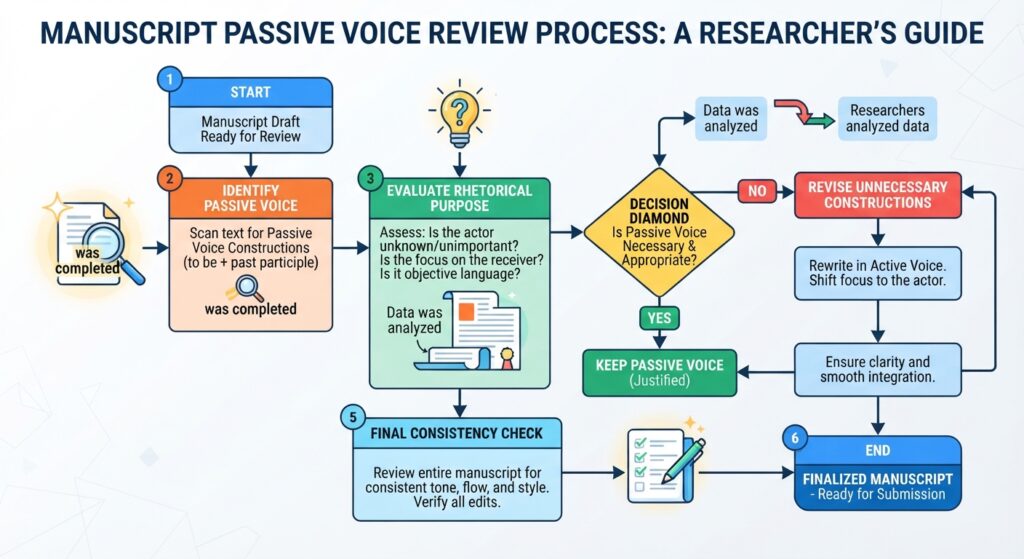
How to Edit Passive Voice in a Research Article
Use a four-stage editing workflow.
Stage 1: Identify
Search the manuscript for forms of:
- is;
- are;
- was;
- were;
- be;
- been;
- being.
Then check whether the following word is a past participle.
Remember that not every construction containing “is” or “was” is passive. For example:
The result was significant.
is not passive voice.
Stage 2: Diagnose
For every passive sentence, ask:
Who performed the action?
Then ask:
Does the reader need to know?
If yes, consider active voice.
If no, determine whether passive voice improves emphasis or topic continuity.
Stage 3: Revise
Replace unnecessary passive constructions with precise active alternatives.
Weak:
It was determined that the intervention was effective.
Stronger:
The analysis showed that the intervention was effective.
Or:
We determined that the intervention was effective.
Stage 4: Standardize
After sentence-level editing, read the entire paragraph.
Check whether:
- subjects remain consistent;
- tense is appropriate;
- terminology is stable;
- transitions remain logical;
- the paragraph's main topic remains prominent.
This final pass is essential because a grammatically correct sentence can still disrupt paragraph-level coherence.
Passive Voice and the Major Sections of a Research Paper
Voice preferences can change according to manuscript function.
Introduction
Use active voice when discussing established literature, research gaps, and the purpose of your study.
Previous studies have identified several limitations.
Passive voice may work when the object of the action is more important:
Several limitations have been identified in previous studies.
Methods
Passive voice can efficiently foreground procedures:
Participants were randomly assigned to two groups.
Active voice is useful when researcher decisions need emphasis:
We excluded participants with incomplete baseline data.
Results
Use whichever voice keeps the finding clear.
The intervention increased treatment adherence.
or:
Treatment adherence was increased following the intervention.
The first is often more direct.
Discussion
Active voice is particularly useful when interpreting evidence:
We interpret these findings as evidence of...
However, passive constructions can appropriately emphasize the evidence:
These findings can be interpreted as evidence of...
Conclusion
Prefer concise, direct constructions.
These findings suggest that...
is generally clearer than:
It is suggested by these findings that...
Also read: How to Get a Paper Published Without Being at a University: Independent Researchers's Guide
When to Use Passive Voice in Research Papers: The Final Decision Test
Before changing a passive sentence, run this five-question test:
1. Is the actor important?
If yes, use active voice.
2. Is the object or procedure more important?
If yes, passive voice may be preferable.
3. Does passive voice hide responsibility?
If yes, identify the actor.
4. Does active voice make the sentence shorter and clearer?
If yes, revise.
5. Does the journal or discipline have a specific convention?
If yes, follow it.
This approach is more reliable than using a blanket rule such as “never use passive voice.”
Common Passive-Voice Problems in International Manuscripts
During academic proofreading, editors frequently encounter several recurring patterns.
1. Excessive “It was found” constructions
Replace vague reporting structures with precise subjects:
The analysis showed...
The results indicated...
We observed...
2. Long passive chains
Avoid stacking several passive constructions:
The samples were collected, processed, analyzed, and compared.
Sometimes this is perfectly acceptable. But if different actors perform different actions, identify them.
3. Missing agents
The protocol was modified.
Why?
By whom?
For what reason?
If the modification affects reproducibility, explain it.
4. Unnecessary nominalization
An evaluation of the samples was conducted.
Prefer:
We evaluated the samples.
The second version uses a stronger verb and removes unnecessary words.
5. Inconsistent voice
Do not alternate randomly between “we analyzed,” “the data were analyzed,” and “analysis was performed.”
Choose based on emphasis and maintain consistency within the relevant section.
A Professional Academic English Polish Goes Beyond Passive Voice
Correcting passive voice is only one component of manuscript language editing.
A publication-ready manuscript should also be audited for:
- grammar and syntax;
- article usage;
- prepositions;
- subject–verb agreement;
- academic vocabulary;
- tense consistency;
- punctuation;
- terminology;
- abbreviations;
- logical transitions;
- sentence-level clarity;
- paragraph coherence;
- citation consistency;
- journal-specific style.
For international researchers, academic proofreading services can be particularly useful when the science is strong but the language obscures the contribution.
PaperEdit Academic Proofreading Services can provide a final language-focused review designed to identify grammatical errors, inconsistencies, awkward constructions, and publication-readiness issues.
IEEE also notes that authors who are not fully proficient in English may benefit from professional language editing before submission, while emphasizing that editing does not guarantee publication acceptance.
Pre-Submission Academic English Checklist
Before uploading your manuscript to the journal submission system, complete this final audit.
Voice and clarity
- I have not attempted to eliminate every passive construction.
- I have used active voice when the researcher or actor matters.
- I have retained passive voice when the object or procedure deserves emphasis.
- I have removed vague constructions such as “it was found” where a precise subject is available.
- I have identified responsibility for important methodological decisions.
- I have checked for unnecessarily long passive chains.
- I have maintained consistent voice within each section.
Academic English
- Grammar and syntax have been professionally reviewed.
- Tenses are consistent and appropriate to each section.
- Terminology is standardized throughout the manuscript.
- Abbreviations are defined at first use.
- Sentences are concise without sacrificing technical precision.
- The manuscript maintains an appropriate academic tone.
- ESL-related phrasing has been checked for naturalness and clarity.
Journal readiness
- The manuscript follows the target journal's Instructions for Authors.
- Applicable reporting standards such as PRISMA, CONSORT, or STROBE have been addressed.
- References follow the required citation style.
- Tables and figures follow journal specifications.
- The abstract accurately reflects the manuscript.
- The final manuscript has undergone a line-by-line proofreading pass.
ICMJE emphasizes that reporting guidelines should be considered according to study design and that manuscripts should be prepared alongside the specific requirements of the target journal.
Authoritative Resources for Academic English and Manuscript Preparation
For additional guidance, consult the official resources below:
- Purdue Online Writing Lab (Purdue OWL) — academic writing, grammar, APA, and active/passive voice guidance.
- IEEE Author Center — technical English, article structure, and IEEE manuscript preparation.
- ICMJE Recommendations — manuscript preparation, reporting, and publication guidance for medical journals. The recommendations were updated in January 2026.
Conclusion: Use Passive Voice Strategically, Not Automatically
Strong academic English is not defined by eliminating passive voice. It is defined by making deliberate grammatical choices that improve precision, emphasis, readability, and reproducibility.
For international researchers, the most effective strategy is simple: identify the actor, decide what information deserves emphasis, follow disciplinary conventions, and revise sentences that obscure meaning. Use active voice when responsibility and action matter. Retain passive voice when the procedure, object, or result should remain the focus.
Before submission, combine this voice audit with comprehensive copyediting, language polishing, citation review, and journal-guideline compliance.
When the research is ready but the English needs refinement, PaperEdit's professional manuscript editing and proofreading services can help ensure that your manuscript communicates its contribution with the clarity, consistency, and precision expected by international journals.