

ChatGPT has moved beyond just being new to existing in academic spaces and has moved to widely disseminated across academia. But whether you are actually breaking an institution’s integrity by using ChatGPT, or some other AI mechanic, is the much larger question. The Academy is still hashing out how to approach this and there continues to be a lot on the line, as many scholars have been impacted negatively by unclear guidelines regarding using AI in assisting with the creation of dissertational work (e.g., having defended for your dissertation only to have it removed from existence, and having published work retracted due to illegitimate authorship from AI-generated content).
There is no intent to instill “fear” by having you re-think these issues concerning the use of ChatGPT for academic purposes; it is about providing you the clarification necessary to understand both how best to perform ethical scholarship in the mid-2020s and what ethical scholarship really means in 2026.
AI in Academic Writing: How It's Changing Research & Publishing
Why ChatGPT Feels Like a Shortcut (But Isn't Always One)
ChatGPT can feel like a fine line between right and wrong. It can help with writing a paper, formatting citations, and finding errors. However, just because ChatGPT can provide a fast finish does not mean it is ethical.
The problem is not ChatGPT's abilities; rather, the problem lies with how the user intends to use it and how transparent they are about that use. If a student is using ChatGPT to help them think, brainstorm ideas for research, or refine arguments that the student has already created, then this is acceptable. If a student uses ChatGPT to take the place of their opinions, hide their own voice, and bypass academics that must be completed for degrees, then they violate at least their university's ethical standards if not the laws of the state or country they reside in.
Professional academic standards serve a valuable purpose. The ACA's Code of Ethics (American Counseling Association) and institutional guidelines establish integrity, honesty, and transparency. However, the unfortunate truth is that these guidelines were all created long before generative artificial intelligence (AI) existed. As a result, they were written long before generative artificial intelligence (AI) existed and therefore cannot refer to tools like ChatGPT.
Many universities have yet to adopt policies regarding the use of ChatGPT in academic research and writing; thus, they are lagging behind in defining these policies while being engaged in eliminating ChatGPT from academic settings. Although students use ChatGPT for many reasons, they do not know what constitutes acceptable use.
The ACA Code of Ethics and AI: Where Do They Intersect?
This situation creates an "ethical dilemma" according to ethics specialists — in other words, circumstances in which the applications of existing ethical frameworks cannot easily assign the new behaviors to an adequate path. For example, is using ChatGPT to create an outline an act of academic dishonesty? What if you use ChatGPT to verify your research or if it discovers a mistake in your research methodology? Each institution has its own rules regarding these situations, and the answer is not easy to come by.
Nonetheless, the fundamental ethical guideline common to all ethical principles and frameworks is transparency and honesty. As such, if you choose to use ChatGPT in some way, you must acknowledge that fact. The great majority of allegations about academic dishonesty in research have very little to do with any type of tool; instead, they arise from researchers not revealing how many tools or sources they actually used. Whenever researchers attempt to minimize or obscure their use of AI resources, an investigation will usually be initiated by the institution.
Therefore, the true ethical equivalent of "responsible academic writing" by 2026 will be "transparent academic writing." In other words, you may use ChatGPT; you simply need to disclose that you did.
A Scoping Review of ChatGPT Research in Accounting and Finance
The accounting and finance sectors have been particularly thorough in examining ChatGPT's role in research and professional practice. A scoping review of chatgpt research in accounting and finance reveals several critical findings:
- Efficacy in routine tasks: ChatGPT performs well at literature summarization, data interpretation, and technical writing polish. Firms are integrating it for efficiency.
- Risk in analytical work: Where accounting and finance require original analysis—auditing conclusions, risk assessment, investment recommendations—ChatGPT shows limitations and potential for generating plausible-sounding but inaccurate outputs.
- Disclosure gaps: Studies found that even when professionals used ChatGPT, many failed to document it in their final reports or publications.
The accounting field's experience is instructive because it combines technical rigor with professional liability. You can't claim an analysis is your original work if you outsourced the reasoning to an AI system. Your professional credibility—and your firm's legal standing—depends on accuracy you can personally verify and defend.
For academic researchers, the parallel is direct. Whether you're in finance, biology, or literature, ChatGPT-generated content requires human verification before it becomes part of your scholarly record.
Hence, an Ai generated content must be bypassed with human verification. For a detailed analysis, read:
Can AI Replace Human Proofreaders? The Limitations of Automation
Visit PaperEdit for professional proofreading services.
Medicines Ethics and Practice: The Clinical Research Parallel
Medical research operates under some of academia's strictest ethical protocols. The frameworks governing medicines ethics and practice offer valuable lessons for all researchers navigating ChatGPT.
In clinical trials, researchers must disclose any external influences on data interpretation or conclusions. Drug companies fund studies—and that gets disclosed. Regulatory bodies want to know about potential biases. The principle is simple: readers and evaluators need complete information to assess credibility.
That same logic applies to ChatGPT use. If an AI system contributed to your methodology, data analysis, or even manuscript revision, that's material information for your readers. It affects how they interpret your credibility.
Consider a pharmaceutical researcher who uses ChatGPT to draft the methods section of a paper. That's different from a researcher who uses ChatGPT to rewrite conclusions they've already reached independently. The first involves an AI system in knowledge generation. The second is editing. Both should be disclosed, but they carry different ethical weight.
The clinical research model also emphasizes something crucial: institutional review and oversight matter. You can't self-judge whether your ChatGPT use crosses ethical lines. Your institution's research ethics committee exists for this reason. Before you finalize work involving ChatGPT assistance, check with your IRB or ethics board.
What Universities Are Actually Saying (and Why It's Complicated)
As of 2026, institutional policies on ChatGPT vary wildly. Some universities ban it outright. Others allow it with disclosure. A few treat it like any research tool—permitted if used transparently.
Here's what that variance actually means: your institution's policy is the floor. If your university permits ChatGPT with disclosure, that's your minimum requirement. If it bans ChatGPT entirely, you're in violation using it at all, regardless of how ethically you'd otherwise use it.
The universities that have developed the most nuanced policies tend to ask these questions:
- Did the AI system contribute to original analysis? (Red flag)
- Did you disclose its use? (Essential)
- Could you replicate the work without it? (Tests genuine understanding)
- Does the output misrepresent your individual capability? (Integrity concern)
Major research institutions like MIT and UC Berkeley have issued guidance suggesting ChatGPT use is acceptable for brainstorming, literature review assistance, and manuscript refinement—but not for analysis, interpretation, or authoring conclusions. The distinction matters enormously.
The Mechanics of Disclosure: How to Document ChatGPT Use
If you're using ChatGPT ethically, you need to document it clearly. Here's where many researchers stumble. "I used ChatGPT" in a footnote is vague. Institutions want specifics.
Effective disclosure should include:
- What task ChatGPT performed (literature summary, code debugging, outline generation)
- What stage of your research it occurred (planning, drafting, revision)
- How you verified or modified the output (critical for credibility)
- Whether it was original analysis (it wasn't—be clear about that)
Some journals now have supplementary information requirements for AI assistance. Nature, Science, and other major publications are asking authors to disclose generative AI use. If you're publishing, check the target journal's policy before submission. Getting rejected for undisclosed AI use is increasingly common, and it damages your credibility far more than transparent disclosure would have.
Internal documentation also protects you. If your institution ever questions whether you used ChatGPT, having dated records of prompts, outputs, and how you modified them demonstrates good faith and transparency.
The Skills You're Actually Sacrificing When You Over-Rely on ChatGPT
This is the uncomfortable part that nobody wants to discuss: ChatGPT use can atrophy crucial academic skills if you're not intentional about it.
Writing isn't just about producing coherent sentences. It's about developing your analytical voice, learning to construct arguments from evidence, and practicing the intellectual rigor that defines scholarship. When you outsource writing to ChatGPT extensively, you're skipping the part where your brain actually does the work.
AI Output vs Journal Standards: The Gap
Similarly, research synthesis—reading papers, synthesizing findings into original frameworks—is a skill you develop through doing it, not through reading ChatGPT's summaries of what others synthesized. The difference between understanding literature and having ChatGPT narrate literature to you is profound.
This isn't an argument against ChatGPT. It's an argument for using it strategically:
- Use it for efficiency, not replacement
- Use it for brainstorming, not thinking
- Use it for editing, not ideating
- Use it for formatting, not analyzing
The researchers who integrate ChatGPT most ethically are the ones who use it to accelerate work they could do themselves, not to replace their own intellectual contribution.
To better understand this, read our detailed guide on:
Combining AI and Human Editing: Best Workflow for Researchers
The Real Risk: Institutional Consequences and Career Damage
Let's be direct about consequences. Universities are increasingly investigating undisclosed ChatGPT use. PhD students have had dissertations rejected. Faculty members have faced retraction notices. In some cases, careers have been damaged.
But here's what's striking: most of these cases involved undisclosed use or misrepresented authorship. The researchers who used ChatGPT transparently, within their institution's guidelines, and for legitimate assistance generally faced no consequences.
The pattern is clear. Academic misconduct around ChatGPT isn't about using the tool—it's about lacking honesty about using it. That's a choice.
Explore more with this guide 'The Future of Academic Publishing in the AI Era'
Comparative Framework: Understanding ChatGPT's Role in Academic Work
| Academic Task | ChatGPT Use Status | Disclosure Required? | Ethical Consideration |
| Literature review summarization | Permitted with verification | Yes | AI cannot replace critical synthesis |
| Brainstorming research angles | Permitted | Yes | Use as ideation scaffold only |
| Methods section drafting | Conditional (varies by field) | Yes | Verify accuracy and relevance to your design |
| Statistical analysis interpretation | Not recommended | If attempted, yes | Risk of plausible-sounding errors |
| Manuscript grammar editing | Permitted | Disclosure optional but recommended | Standard editing practice |
| Generating original findings/conclusions | Not permitted | N/A | Core violation of authorship |
| Code debugging/writing | Permitted with review | Yes | Especially in computational research |
| Literature database searching | Not recommended | N/A | Human searches find nuances AI misses |
| Rewriting your own arguments | Permitted | Disclosure recommended | Verify tone and accuracy match intent |
| Creating study designs | Not recommended | If attempted, yes | Requires disciplinary expertise |
Moving Forward: A Practical Framework for Ethical ChatGPT Integration
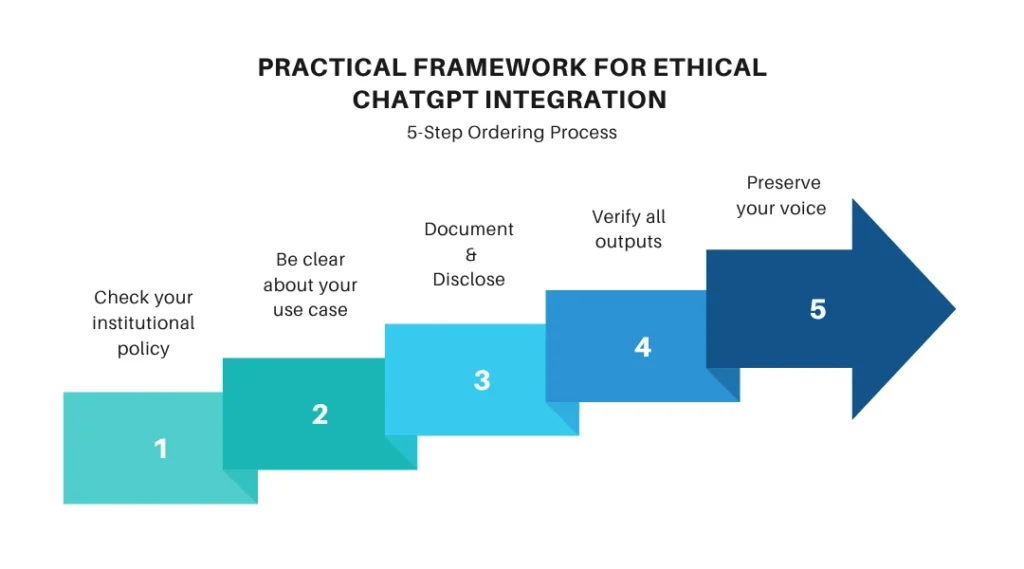
So how do you actually use ChatGPT in a way you can defend academically?
- Step One: Check your institutional policy. Literally read what your university says. Most have updated guidelines by now. If yours hasn't, ask your department chair or research ethics board. Don't assume.
- Step Two: Be clear about your use case. Are you using ChatGPT to accelerate work you'd do anyway, or are you using it as a substitute for your own thinking? That distinction determines everything.
- Step Three: Document and disclose. Keep a record of what you used ChatGPT for and when. If your final work included any ChatGPT assistance, disclose it—in a footnote, supplementary materials, or methods section depending on format.
- Step Four: Verify all outputs. This is non-negotiable. ChatGPT generates plausible-sounding misinformation regularly. Before ChatGPT's prose becomes part of your scholarly record, you need to verify its accuracy, relevance, and alignment with your argument.
- Step Five: Preserve your voice. ChatGPT has a recognizable style. If your entire paper sounds like ChatGPT, that's a problem. Use it for assistance, not replacement. Your writing should still sound like you—because it should be you, with ChatGPT as a tool rather than an author.
The Bottom Line: Ethical Doesn't Mean Forbidden
Many people are panicking over the impact of using ChatGPT on academic integrity. However, using modern technology and retaining academic integrity are not mutually exclusive concepts; there is a choice between using technology in an honest manner versus using it in a deceptive manner.
If researchers use ChatGPT in their projects and disclose this fact, they are not doing anything wrong. Undisclosed use of ChatGPT, claiming authorship for something created by ChatGPT, and treating AI-generated work as if it has been fact-checked by an expert are examples where using ChatGPT may lead researchers into trouble.The successful researchers in 2026 will not be the ones who act like ChatGPT does not exist, but rather those who use it openly, strategically, and ethically.
They're the ones who use it to accelerate legitimate work, not replace their thinking. They're the ones who disclose it because they have nothing to hide.Your academic credibility depends on one thing: honesty about what you did and how you did it. ChatGPT is just a tool. Your integrity is yours alone.
Furthermore, refer to the resources below to get increased acceptance rates: