

The gatekeeping is real. Traditional academic publishing still expects you to have a university email address, an institutional affiliation, and sometimes a PhD on your resume. But here's the truth: independent publishing is no longer a fringe path—it's becoming the default for serious researchers operating outside institutional walls.
Whether you're a postdoc between positions, a corporate researcher, an independent scholar from the Global South, or someone who left academia on purpose, you have legitimate routes to publish peer-reviewed work. This guide walks you through exactly how.
Read How to Create a Research Portfolio to Boost Your Career?
The Reality of Independent Publishing in Academia Today
There is an old myth that independent researchers cannot publish. However, it is now 2023/2024 and leading journals have explicitly removed the requirement to be affiliated with an organisation when publishing.
The problem was not intellectual rigor, it was visibility and gatekeeping; this has now changed as the leading publishers (Elevier, Springer, Taylor & Francis) are now allowing independent non-affiliated researchers to submit and be published.
The move towards open-access publishing models and the establishment of platforms such as OSF Preprints; arXiv; PubPeer have helped create a credible platform for independent researchers to publish their work.
Some journals are also actively trying to grow the diversity of their authors by fast-tracking independent non-affiliated submissions.
While there is still going to be a degree of friction when submitting work independently, and you will likely take longer than the average author, editors will likely assume that you have less than average rigor in your work and you will need to go the extra mile to document and provide evidence of your methodology and credentials in order to pass the "smell test".
However, this friction doesn't prevent thousands of independent researchers publishing each year, and they all follow a systematic process to do so.
Understanding the Publishing Landscape for Unaffiliated Researchers
Before submitting anywhere, you need to understand where independent publishing actually happens. Not all journals are created equal for researchers without institutional backing.
The three-tier system:
Tier 1: Legacy academic journals
It requires peer review through traditional gatekeepers. They're slower, more conservative, but highest in prestige and impact factor.
Tier 2: Hybrid open-access journals
They accept independent submissions more readily. They're faster and more transparent about review criteria.
Tier 3: Preprint servers and open-access platforms
They operate with lighter gatekeeping. Papers are still reviewed, but acceptance criteria emphasize methodology over affiliation status.
Your strategy depends on your field, your career stage, and what "published" means to you. An independent researcher in climate science might target journals differently than someone in philosophy.
The key metric isn't where you publish—it's whether peer review actually happened and whether your work is discoverable through academic databases.
Explore more with Open Access vs. Traditional Publishing: Which One is Right for You?
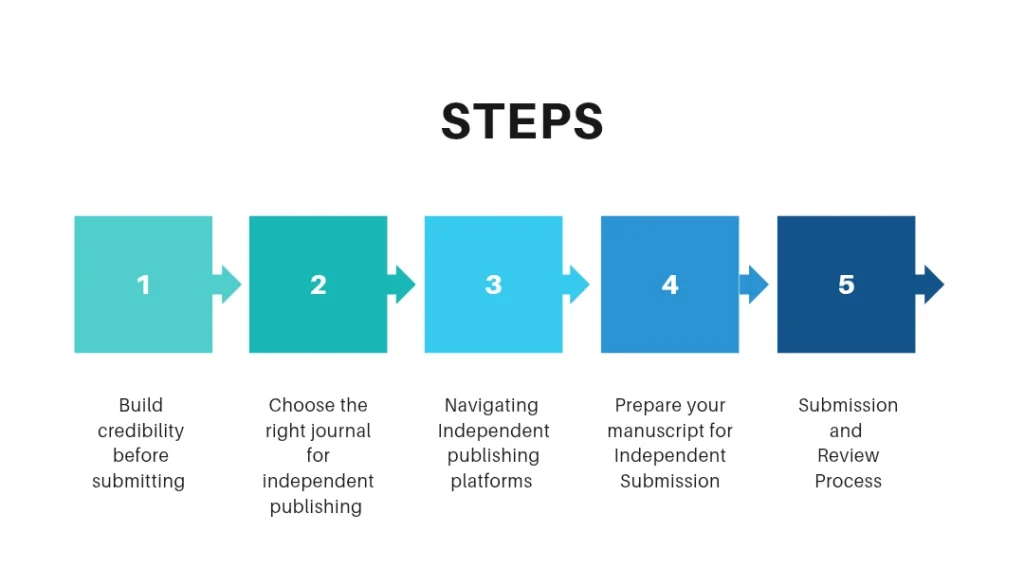
Step 1: Build Credibility Before Submitting
This is the unglamorous part that separates successful independent researchers from ones who rack up rejection letters.
Establish your research presence:
Your personal research website should exist before you submit anything. Include:
- A clear CV highlighting your publications and credentials
- A statement of research interests and current projects
- Contact information (not hidden behind forms)
- Links to your ORCID profile and Google Scholar account
An ORCID is non-negotiable. It's a persistent identifier that follows you across institutions and makes your work discoverable independent of any single platform. Register at orcid.org—it's free and takes 5 minutes.
Create a Google Scholar profile. It automatically aggregates your published work and tracks citations. Many editors check this before reviewing submissions.
Post your preprints. This is the actual secret. Let you timestamp your work and establish priority. Editors see that you've shared your research publicly and welcomed scrutiny. It signals confidence.
Get cited before you publish.
This sounds backwards, but it works. If your preprint gets cited in other people's published work, journals view your subsequent submission differently. You're not unknown anymore.
Explore more with our detailed guides like: Research Portfolio vs CV: What Every Researcher Needs to Understand
Step 2: Choose the Right Journal for Independent Publishing
You can refer to this detailed guide on Best Platforms to Showcase Your Research Portfolio for appropriate journal selection.
This decision makes or breaks your submission. Targeting journals that actively accept unaffiliated researchers cuts rejection rates by roughly half.
Research journal policies explicitly:
Does the journal's submission guidelines mention affiliation requirements? If the language says "must include institutional affiliation," flag it. Some journals won't reject based on this alone, but the red flag suggests lower receptiveness.
Search the journal's recent issues: What percentage of authors are listed as unaffiliated or with non-institutional addresses? Use your field's citation database or Google Scholar. If you see zero unaffiliated authors in the last 50 papers, that's your signal.
Check the journal's editorial board. Are editors from universities only, or do they include independent researchers, government labs, and corporate R&D? A diverse board suggests openness.
Practical screening questions:
- Is the journal open-access or hybrid open-access? (Open-access journals need author fee income and are less selective about affiliation.)
- Has the journal published work on controversial or under-funded topics? (They're more likely to welcome diverse author backgrounds.)
- Does the journal publish across multiple countries? (International journals have fewer affiliation hangups.)
Use databases like DOAJ (Directory of Open Access Journals) to filter for journals matching your criteria. DOAJ lists 20,000+ legitimate open-access journals and lets you filter by field and review type.
Step 3: Navigating Independent Publishing Platforms and CreateSpace Models
CreateSpace independent publishing platform and similar CreateSpace independent publishing companies serve a different niche—they're for books, not peer-reviewed journal articles. But understanding them clarifies why journal publishing is the better path for academic work.
CreateSpace lets authors self-publish paperbacks and hardcovers with print-on-demand technology. You retain control, but you lose peer review and academic legitimacy. In academia, "published on CreateSpace" isn't credible the same way "published in Nature Communications" is.
The distinction matters: independent publishing in academic contexts means your work passed peer review and lives in discoverable journals or preprint servers—not print-on-demand platforms.
Independent publishing companies vary wildly. Some are predatory—they'll publish anything for a fee and use deceptive practices. Others are legitimate small presses serving niche academic fields.
Red flags for predatory publishers:
- They accept everything without review
- They charge excessive author fees (legitimate open-access fees: $500–$3,500)
- They use misleading names that copy established publishers
- They're not indexed in journal citation databases
- They spam researchers with "congratulations, you're invited to publish" emails
Check the Beall's List (maintained by researchers, not official but widely used) and the DOAJ blacklist to screen publishers.
Step 4: Preparing Your Manuscript for Independent Submission
Your manuscript needs to be flawless because editors will scrutinize it more carefully when you lack institutional backing.
Structure and methodology:
- Your methods section must be transparent enough that someone could replicate your work without your help
- Include a section acknowledging limitations—this shows intellectual honesty
- Disclose any funding sources or conflicts of interest, even if minimal
- If you've received feedback from colleagues, thank them by name (builds credibility by association)
Writing and presentation:
- Use active voice where appropriate. Research shows that mixing active and passive voice (roughly 70% active, 30% passive) reads as more authoritative while maintaining academic tone
- Avoid hedging language. Don't write "it appears that" or "it might be argued." Say what your data shows
- Cite comprehensively. Independent researchers need to show they've engaged with the literature. Miss citations and editors assume you're unaware of the field
- Proofread obsessively. A single typo gets attributed to carelessness; a university catches these before submission
Metadata and formatting:
- Follow the journal's formatting guide exactly—no exceptions. This is where independent researchers lose submissions without peer review
- Include a cover letter addressing the editor by name (look up their recent papers; reference one)
- Write an abstract that's self-contained—many readers won't read the full paper
Step 5: The Submission and Review Process
When you submit, your affiliation status will be apparent. Some journals have separate fields for "unaffiliated researcher" or "independent researcher." Use these honestly.
In your cover letter, briefly explain your research independence as a fact, not an apology. Something like: "As an independent researcher currently based in [location], I've [brief credibility marker]. This work has been [metrics: months in development, reviewed by X colleagues, presented at Y conference]."
The review process works the same regardless of affiliation, with one caveat: anonymous peer review is supposed to be blind, but reviewers can sometimes identify authors. When they see you're independent, unconscious bias may arise. Counteract this by being meticulous.
Expect the process to take longer. Journal timelines for independent researchers average 4–6 months versus 3–4 for affiliated researchers. This isn't written anywhere; it's just how incentives work.
Rejection happens more. Independent researchers have higher desk-reject rates (immediate rejection before review) because editors apply stricter initial screening. Don't internalize this—keep submitting.
Building a Publication Strategy as an Independent Researcher
One-off publications won't build a career. You need a strategy.
The pyramid approach:
- Start with preprints and open-access journals. These establish your credibility and give your work public visibility fast. Preprints take 2–4 weeks to appear online.
- Move to hybrid open-access journals next. These have moderate impact factors and faster timelines. Expect 3–5 months.
- Target the top journals once you have 3–4 publications. By then, your citation record speaks for itself, and you're no longer an unknown.
- Plan for 2–3 submissions per year. This is sustainable without institutional resources. Each paper takes 40–60 hours to prepare for submission-quality.
How to Independently Publish a Book (If That's Your Path)
If you're writing a monograph, the rules differ. Academic book publishing has three paths:
- University press (traditional, 18–24 month timeline, highest prestige)
- Independent academic publishers (8–12 months, moderate prestige)
- Self-publishing with ISBN (immediate, lowest prestige but fastest)
Canadian independent publishers, like between-the-lines.ca and red deer press, operate differently than legacy university presses. They're faster, more flexible on topics, but less rigorous on editorial standards. They work well for niche academic work.
If you're publishing a monograph independently, insist on ISBN assignment and distribution to academic libraries. Without these, it's invisible to your field.
Can an Independent Researcher Publish? A Practical Reality Check
Yes. Unequivocally yes. But it requires:
- Rigorous methodology that withstands scrutiny.
- Clear communication of your credentials and research independence.
- Strategic journal selection.
- Persistence through more rejections than affiliated researchers face.
- Consistency over years, not months.
The barrier isn't intellectual—it's administrative and social. You're swimming upstream against decades of institutional gatekeeping. But the water's moving. Academic publishing news today increasingly covers independent researcher pathways and how journals are removing affiliation requirements.
Watch the academic publishing news. In 2024, Nature, PLOS, and Springer explicitly announced expanded support for independent researchers. These aren't edge cases anymore.
You can explore more with this analysis:
Can You Publish Without a Supervisor? Independent Academic Publishing
Publishing Timeline and Resource Comparison Table
Here's what you're actually looking at, resource-wise:
| Publishing Route | Timeline (Acceptance to Publication) | Cost | Peer Review | Prestige | Best For |
| Open Access Journal | 3–6 months | $500–$2,500 | Yes, transparent | Moderate to High | First publications, building credibility |
| Hybrid Journal | 4–8 months | $0–$3,000 | Yes, standard | Moderate | Established researchers, follow-up work |
| Preprint Server | 2–4 weeks | $0 | Minimal to none | Low-to-Moderate | Speed, visibility, establishing priority |
| University Press Book | 18–24 months | $0 (author) | Yes, extensive | High | Monographs, books for academic audience |
| Independent Publisher | 8–12 months | Variable | Yes, less rigorous | Moderate | Niche topics, faster turnaround |
| Self-Publishing Platform | Immediate | Variable | No | Low | Speed, control, non-academic audiences |
Funding, Fees, and Financial Reality
Open-access journals charge author processing fees (APCs). For an independent researcher without grant funding, this stings. Legitimate fees range $500–$3,500.
Ways to cover fees:
- Many journals waive fees for researchers from low-income countries. Ask.
- Some open-access journals offer fee waivers based on financial hardship. Explain your situation.
- Academic publishing organizations like SPARC offer micro-grants to cover APCs.
- Publish with fully open-access journals (funded by institutions) that don't charge authors.
Don't let fees pressure you into predatory publishers. A journal that charges $8,000 APC with instant acceptance is robbing you, not publishing you.
Academic Publishing News and Staying Current
The landscape is changing monthly. Recent developments matter:
- Academic publishing news today includes journal policies shifting toward affiliation-neutral submissions
- Academic publishing news from 2024 shows increased preprint adoption across STEM fields
- Funder mandates (NIH, EU Horizon) now require open-access publication, which benefits independent researchers financially
Subscribe to SPARC updates, follow journal blogs, and check Scholarly Kitchen for legitimate debates about publishing reform.
Common Mistakes Independent Researchers Make
- Mistake 1: Targeting journals with 40+ impact factors immediately. You'll get desk-rejected. Build a publication record first.
- Mistake 2: Submitting to predatory journals thinking they're shortcuts. They're credibility killers. One predatory publication and you're radioactive to legitimate journals.
- Mistake 3: Hiding your independent status. Transparency builds trust. Editors respect honesty more than false affiliation claims.
- Mistake 4: Expecting the same timeline as affiliated researchers. You'll face longer review periods. Plan accordingly.
- Mistake 5: Only publishing in open-access journals for cost reasons. Mix your strategy. Some hybrid journals let institutions pay author fees. Some have waivers.
Final Thought: The Changing Narrative
The story that independent researchers can't publish is dying. It's being replaced by a harder truth: independent researchers can publish, but they'll work harder to prove their credibility and navigate rejection more frequently.
That's not gatekeeping disappearing. That's gatekeeping shifting from "are you affiliated?" to "is your work rigorous?" Which is better. It's merit-based instead of credential-based.
If you're an independent researcher, you're not excluded from academic publishing. You're entering it without institutional infrastructure, which changes your strategy but not your eligibility.
The path is clear. The friction is real. But it's navigable.
Reference Books
- "Planned Obsolescence: Publishing, Technology, and the Future of the Academy" by Kathleen Fitzpatrick (2011) – Essential for understanding how academic publishing is evolving and why institutional gatekeeping persists.
- "Open Access" by Peter Suber (2012) – The definitive guide to understanding open-access publishing models, legitimate journals, and how to navigate the landscape as an independent researcher.