


In the discussion portion of the paper, you will either establish yourself as a credible researcher or lose that credibility. Many researchers fail miserably in this part of their papers, not because of any intelligence deficits, but rather due to their conflating discovery with interpretation. The distinction between a strong discussion and an overly inflated one is the difference between a published paper and a rejected paper.
The discussion section is not a place for you to take a victory lap. Instead, it is an opportunity for you to have an honest conversation with a reader about your data’s true, as well as false, meaning—and why it is crucial to understand such differences. This section is where you will manifest the integrity of academia. Therefore, when developing this section, you will need restraint, precision, and the bravery to acknowledge any limitations in your work as well as its positive findings.
You may also refer to our 'The Complete Academic Writing Guide for Researchers: Grammar, Structure, Style & IMRaD'
What Is a Strong Discussion Section, and Why Does It Matter?
The discussion section of a research paper is where your findings are synthesized with the existing scholarship, and therefore, it is the heart of your intellectual contribution to the world through your research. The purpose of this section is not only to restate the results of your study; it is also to make sense of them, relate them to other studies, and explore their implications.
The American Psychological Association’s (APA) framework for writing the discussion section outlines five elements that should be addressed in this section: summary of findings; interpretation of findings; discussion of limitations of the study; discussion of theoretical and practical implications of the research; recommendations for future research. If done well, the discussion section is the part of the paper that will stick in the reader’s memory. Readers will not remember what you found; they will remember what those findings mean.
The consequences for writing a weak discussion section can be severe. A weak discussion suggests that you did not fully understand your own research and have resulted in a paper that has no relevancy to readers. An over-inflated discussion is a sign that you are desperate, and reviewers can spot that from thousands of miles away. The key to writing a successful discussion section is to combine intellectual honesty with confidence in the interpretation of your research findings. This combination is extremely rare, and it is this combination of attributes that distinguishes research that influences policy and research that sits in libraries as digital dust.
The Core Problem: Why Researchers Overstate Findings
Researchers overstate findings for understandable reasons. You've invested months—sometimes years—in your project. There's pressure to publish, pressure to make results sound groundbreaking, pressure to justify the time and resources spent. That pressure creates temptation to push interpretations beyond what data supports.
Overstating happens in subtle ways. A correlational finding becomes causal language. A trend in one sample becomes a law. Statistical significance becomes practical importance. Each slip feels small until you read it alongside fifteen others in your discussion, and suddenly your work looks like scientific overreach.
The costs are real. Journals reject papers for overstated claims. Grant agencies fund researchers with integrity. Practitioners won't implement guidance that seems empirically shaky. If you damage your reputation by overstating the facts then rebuilding your reputation will be much more difficult than getting it correct at the beginning. Understanding the issue is not being negative; it's being realistic. The best way to guarantee your long-lasting impact on research is to create an honest discussion section in your papers as a strategic decision
How Long Should Your Discussion Section Be? Manuscript Guidelines for Scientific Journals
The length of your discussion section depends on your research design, journal requirements, and field conventions. There's no universal rule, but guidelines exist.
For empirical studies in psychology and social sciences, how long discussion section for manuscript scientific journal requirements typically suggest 15–25% of your total paper length. If your paper is 8,000 words, your discussion likely runs 1,200–2,000 words. For brief reports, this might compress to 500–800 words. In qualitative research, where interpretation is central, discussions sometimes extend further.
Journal-specific guidance trumps general rules. Some journals specify discussion length in their author guidelines. Nature and Science demand extreme efficiency—discussions of 300–400 words. Specialty journals allow more space for nuance. Before writing, consult your target journal's published articles and instructions for authors.
What is APA?
Read Now!
APA style discussion sections have no fixed length requirement, but the style guide emphasizes that length should be proportional to complexity. A straightforward study with clear findings might need less discussion than research with unexpected patterns or methodological limitations requiring explanation.
The principle underlying all this: length serves function, not ego. Your discussion should be as long as necessary to interpret findings honestly and no longer. Padding weakens impact. Compression obscures meaning. The right length is determined by intellectual necessity, not ambition.
For further inderstandinng refer to:
Structuring Your Discussion Section: A Framework for Clarity
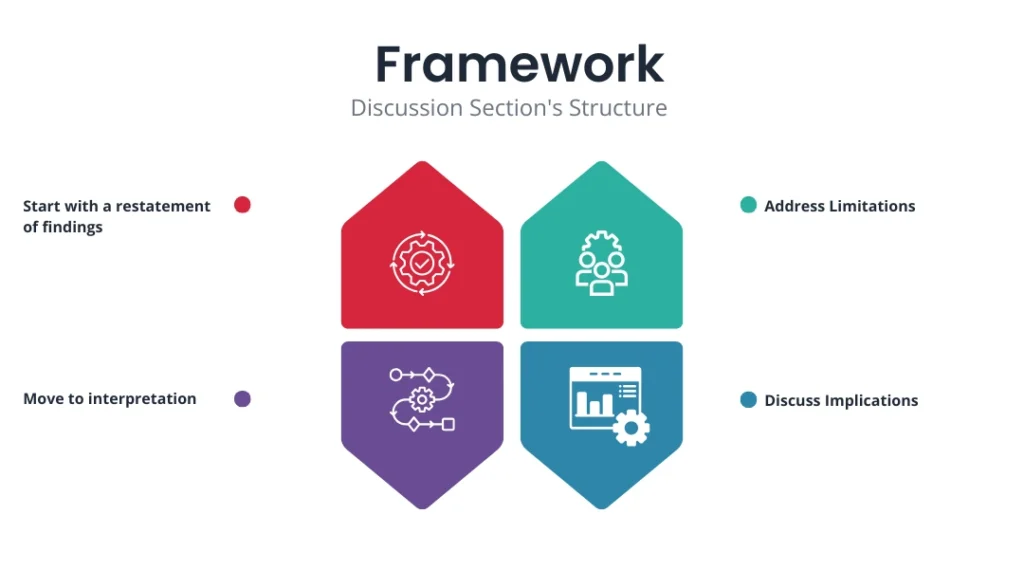
A discussion section of a research paper example that works follows a predictable architecture. Understanding this structure prevents rambling and keeps interpretation focused.
Start with a restatement of findings. Not a detailed methods recap—readers remember those. A 1–2 sentence summary of what you found. This grounds your interpretation in the actual results.
Move to interpretation. What do these findings mean? Why might they have occurred? This is where you engage with theory, mechanisms, and context. Connect your results to existing literature. Show readers how your work fits into the conversation researchers have been having.
Address limitations. This is non-negotiable. Every study has constraints—sample size, design choices, measurement decisions. Acknowledging them isn't weakness; it's credibility. Researchers who hide limitations look defensive. Those who address them head-on look honest.
Discuss implications. Practical, theoretical, and methodological implications all matter. But distinguish between what your findings directly support and what requires speculation. "Our results suggest..." is stronger language than "Our results prove..." The first acknowledges appropriate uncertainty.
Propose future directions. What questions remain unanswered? What would strengthen understanding of this phenomenon? This positions your work as a stepping stone rather than a final word.
This structure isn't arbitrary. It's designed to guide readers through interpretation while maintaining intellectual safety rails. Following it doesn't guarantee a strong discussion, but violating it almost guarantees a weak one
For furthe academic paper structure, review: IMRaD Structure Explained with Real Examples.
Distinguishing Between Findings, Implications, and Speculation
This distinction is where most overstating happens. Your findings are what your data actually shows. Your implications are what reasonably follows from those findings. Speculation is everything else.
Consider an example: You find that students who use a particular study app score 8% higher on average than those who don't (p < .05). This is your finding. It's a real statistical effect.
A reasonable implication: The app may support learning outcomes. This follows from the data.
Overstated claim: The app is a revolutionary breakthrough that will transform education. This imports hope and hype beyond what the data supports.
Reasonable speculation: Further research using randomized controlled designs could help determine whether the app's features causally influence learning. This points toward future work without overreaching.
The precision matters. Your language signals to readers—and to yourself—how confident you should be about each claim. By using precise language now, you protect yourself from future criticism and maintain credibility with the scientific community.
APA Style Discussion Section: Technical Requirements
APA style discussion sections follow specific conventions that reinforce clarity and consistency.
Maintain third-person perspective. Don't write "I found" or "we discovered." Write "The results demonstrate" or "This study revealed." This convention isn't pedantic; it emphasizes that findings matter independently of the researcher's identity.
Use past tense when describing methods and results ("The participants completed..." "Data were analyzed..."). Use present tense for interpretations and accepted knowledge ("These findings suggest..." "Research demonstrates...").
Address the discussion section of a legal memorandum-style obligations if your work involves policy implications. Be explicit about actionable recommendations versus speculative applications. If findings inform practice, say so. If they inform future research but not immediate practice, say that too.
Cite consistently. When building arguments in your discussion, support claims with literature citations. Your interpretation isn't isolated opinion; it's grounded in evidence and scholarly conversation.
Follow APA's heading structure. If your discussion uses subsections (which isn't required but often helps organization), use appropriate heading levels. This maintains consistency with your entire paper.
Discussion Section of Qualitative Research: Unique Considerations
Qualitative research demands different discussion approaches. Qualitative findings aren't generalizable in the same way quantitative data are. Overstating in qualitative work often means claiming universality for patterns observed in specific contexts.
In qualitative studies, your discussion should emphasize depth and contextual understanding rather than breadth and predictability. You're not claiming "X happens in this population." You're describing "How X manifests in this particular context, based on these participants' experiences."
Addressing transferability becomes crucial. Can findings apply elsewhere? Partially? Under what conditions? Being explicit about scope prevents readers from overgeneralizing your work. It also protects your reputation by managing expectations appropriately.
Qualitative discussions benefit from showing rather than telling. Use illustrative quotes that ground interpretations in actual data. This transparency allows readers to evaluate whether your interpretations match the evidence. It's the qualitative equivalent of reporting effect sizes and confidence intervals—concrete enough to scrutinize.
Common Overstating Mistakes (and How to Avoid Them)
Understanding where researchers typically overstate helps you catch these errors in your own writing.
| Mistake | Example of Overstating | Appropriate Alternative |
| Causal language from correlational data | "Social media use causes depression" | "Social media use is associated with depressive symptoms" |
| Generalizing from sample to all populations | "Teenagers don't value privacy" | "In this sample, teenagers showed reduced privacy concerns in specific contexts" |
| Treating trends as significance | "We see a pattern suggesting..." | "The trend did not reach statistical significance (p = .08)" |
| Overstating theoretical implications | "This disproves X theory" | "This finding challenges aspects of X theory in this population" |
| Ignoring effect sizes | "There's a significant difference" | "There's a statistically significant but small effect (d = 0.35)" |
| Failing to acknowledge alternatives | "Our theory explains the results" | "Our theory explains the results, though X and Y alternatives remain plausible" |
| Extending beyond methodology | "Online training works for all contexts" | "Online training effectiveness in this structured context suggests potential for similar environments" |
Each correction moves language from overconfident to proportionally confident. That's the entire discipline in action.
Using Evidence to Support Interpretation Without Overreaching
Strong discussions are evidence-dense but intellectually humble. You support every interpretation with reference to data, literature, or both—but you acknowledge when data underdetermines conclusions.
Structure interpretive paragraphs around evidence. Present your finding first. Connect it to literature. Explain why this matters. Then state any limitations on that interpretation. This prevents readers from assuming certainty where you don't intend it.
When discussing theory, distinguish between results that directly test theoretical predictions versus results that are merely consistent with theory. Testing ≠ supporting completely. Consistency ≠ proof. Precise language signals precise thinking.
Consider multiple explanations. "While X mechanism explains our findings, Y and Z mechanisms remain plausible alternatives." This intellectual generosity is actually strategic—it prevents reviewers from dismissing your work because you failed to consider obvious alternatives.
Balancing Confidence and Humility: The Art of Intellectual Honesty
This balance defines the difference between a strong discussion and a mediocre one. Confidence without supporting evidence is bluster. Humility without substantive claims is timidity. The sweet spot requires both.
Demonstrate confidence through precise, evidence-based interpretation. You're not tentative about what your data shows—you're clear about findings. The humility emerges in acknowledging what data don't show, what limitations constrain conclusions, and what questions remain.
Phrases that calibrate confidence appropriately: "These findings suggest..." "The data are consistent with..." "This pattern indicates..." "Future research should examine whether..." These aren't hedging; they're accuracy.
Phrases that overstate: "Clearly proves," "Obviously demonstrates," "Unequivocally shows," "Every student will benefit." These claim certainty research rarely provides.
Reading your discussion aloud helps. Overstated claims often sound grandiose when spoken. Intellectual honesty usually sounds reasonable, measured, and compelling.
Practical Checklist: Evaluating Your Discussion Section
Before submitting, apply this checklist:
- ✓ Does my opening restate findings clearly without editorializing?
- ✓ Do I connect findings to existing literature with appropriate citations?
- ✓ Have I acknowledged at least three limitations of my study?
- ✓ Is my language proportional to my evidence (no "proves" for correlations)?
- ✓ Do I distinguish between findings, implications, and speculation?
- ✓ Could a skeptical reader understand exactly what my data supports?
- ✓ Have I avoided causal language for non-causal designs?
- ✓ Is my tone confident but not defensive?
- ✓ Do my practical implications follow logically from results?
- ✓ Have I proposed meaningful future research directions?
If you answer "yes" to eight or more, your discussion likely meets publication standards. Fewer than eight? Revise.
Final Thoughts: Discussion Sections Build Research Credibility
Your discussion section is where you earn or lose researcher credibility. Journals, practitioners, and the public evaluate your trustworthiness partly through how you interpret findings. Overstating loses trust instantly. Honest interpretation builds it permanently.
The pressure to make findings sound groundbreaking is real. The remedy is remembering that honest, well-contextualized research becomes more impactful over time than inflated claims. A modest finding that holds up under scrutiny influences policy more than an exaggerated one that collapses when tested.
Writing a strong discussion section requires intellectual courage—the willingness to stand by findings without embellishing them. That courage is the mark of researchers whose work survives scrutiny and shapes their fields. That's worth more than any single publication.
Reference Books for Further Reading
- Booth, Wayne C., Colomb, Gregory G., & Williams, Joseph M. (2016). The Craft of Research (4th ed.). University of Chicago Press. – A comprehensive guide to research writing that emphasizes intellectual integrity and evidence-based argumentation throughout the research process.
- Belcher, Wendy L. (2019). Writing Your Journal Article in 12 Weeks: A Guide to Academic Publishing Success (2nd ed.). University of Chicago Press. – Offers practical strategies for writing strong discussions and managing the revision process for academic journals.