


You receive an email and the moment you see it come across your screen, your heart rate increases. You quickly scroll past the auto-generated subject line and find your answer: Major Revision or Minor Revision. In that one moment — everything about your timeline to publish has now changed. However, the majority of researchers still don't fully comprehend either term's definition, implications of either option; nor do researchers completely understand what each means for the future viability of their work.
Major revisions vs minor revisions — although there are nuances between the two types of revisions, there are also significant differences as well. When it comes to doing peer review, editorial staff and peer reviewers communicate through codes when using major revision and minor revision, but these coded terms indicate severity as well as feasibility. To put it simply: if you don't translate either of these terms correctly, then there is a possibility that you may waste months making revisions that were unnecessary or worse; follow correct protocol in making revisions and miss submission deadlines for the journal you want to publish with.
This guide will eliminate confusion regarding these revisions. We will explain the difference between major revision and minor revision and how they are different than being outright rejected; we will explain why the journal's acceptance rates are important for researchers to know; we will also give you guidelines for how to respond strategically to each of the above decisions.
How to Submit a Research Paper for Publication?
The Binary That Changed Everything: Understanding the Decision Letter
There are four possible results from each peer review process. Every submission goes through one of four outcomes from the peer review process: acceptance, minor revisions, major revisions, or rejection. The creation of these categories resulted from a need for journals to communicate a continuum of results, ranging from publishing a manuscript as is (i.e., 'Publish') to not publishing a manuscript at all (i.e., 'Do not publish'). By establishing a spectrum of possibilities for publishing, ranging from publish to not publish, journals can now establish both quality of article and how much can be fixed.
The question that a journal editor or reviewer has to answer when assigning one of these categories is: 'What does the author have to do to get to the standard of publish?'' The answer to that question is critical because it will dictate all other facets of that author's paper (e.g. time, stress, likelihood of being published).
Published papers will help authors and journals to build a strong author/editor relationship; however, when an author is faced with a minor, major or rejection from a peer review process, the author needs to understand how to interpret that feedback, so that the author can develop a response that is strategic and accurate, rather than having an emotional response to a reviewer’s red ink on their manuscript.
Major Revision vs Minor Revision: The Core Differences
There is a significant difference between the severity of changes needed for a minor revision versus those needed for a major revision. Minor revisions are focused on making small changes to the paper that do not alter its foundation, such as clarifying language or adding data. Most importantly, the reviewers believe that your argument is sound, and all they need you to do is to make the necessary adjustments to improve the paper.
Major revisions are typically due to issues with the author’s methodology, the need for new analyses, the need for major restructuring of arguments, and/or the need to conduct additional experiments. Additionally, the robustness of the core contribution may also be uncertain. Thus, the author is not assured of acceptance of their paper after completing any revised work.
This distinction has significant consequences. When a journal desk rejects a paper with a major revision, they are not just being polite; they are telling the author that the paper needs substantial remedial work to become appropriate for submission to their journal. While this situation is different from outright rejection, it is also entirely different from a minor revision where the author can clearly see how to proceed.
What Does Major Revision Mean? Decoding the Signal
What does major revision mean when an editor writes it in your decision letter? It means the following:
The journal sees potential in your work but has identified structural or methodological problems that require substantial intervention. You aren't being invited to tweak language or add citations. You're being asked to engage seriously with fundamental critiques.
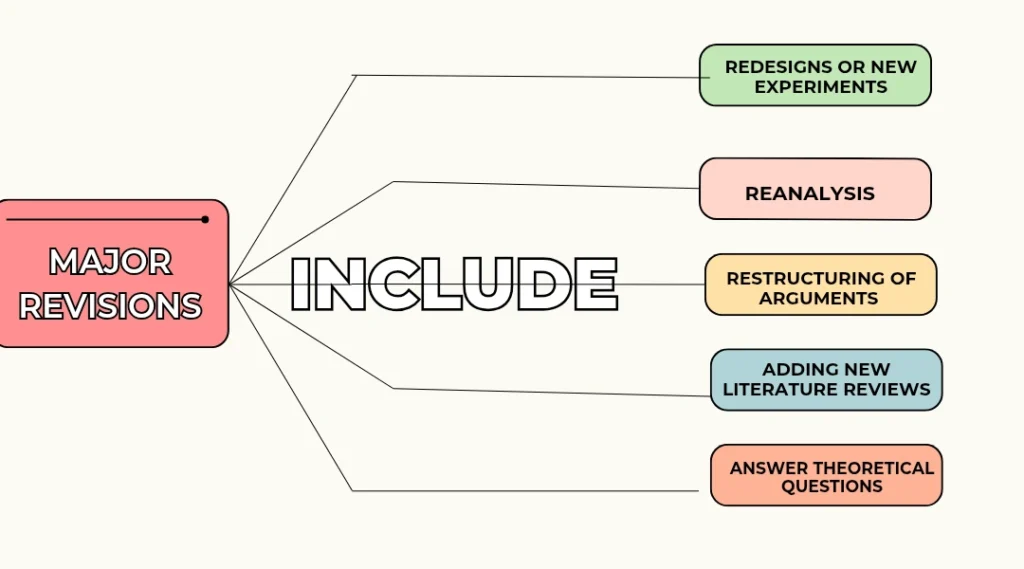
Major revisions typically include:
- Substantial methodological redesigns or new experiments
- Significant reanalysis of existing data with different statistical approaches
- Complete restructuring of arguments or sections
- Addition of entirely new literature reviews or theoretical frameworks
- Answers to substantial theoretical questions reviewers have raised
The critical insight: Major revision acceptance rate varies dramatically by discipline and journal. In top-tier venues, the acceptance rate for papers undergoing major revision may be as low as 40-60%. In other fields and journals, rates exceed 80%. This variance exists because standards differ. Some journals use "major revision" liberally; others reserve it for papers with genuinely fixable problems. Your specific journal's track record matters.
Minor Revision vs Major Revision in Peer Review: Where They Diverge
Understanding the specific contexts where major vs minor revision peer review distinctions become critical helps you navigate your response.
Minor revisions emerge when reviewers trust your judgment but want specific evidence. They might request:
- Clarification of unclear methodology sections
- Addition of supplementary analyses to strengthen conclusions
- Reorganization for clarity without changing content
- Minor language polishing and citation additions
The fundamental assumption: Your data supports your claims; reviewers just need reassurance about specific points.
Major revisions, by contrast, emerge from deeper epistemic doubt. Reviewers question whether your data actually supports your claims, whether your methodology was appropriate, or whether your arguments hold logically. The entire edifice requires inspection.
The peer review form itself often provides clues. Reviewers checking "major revision" typically write longer critiques, identify multiple problem areas, and explicitly state that acceptance depends on how thoroughly you address concerns. Minor revision reviews often feel more mechanical—"add this," "clarify that," "rerun this analysis."
Explore what is peer review.
Reject and Resubmit vs Major Revision: When You're Actually Being Rejected
Here's where reject and resubmit vs major revision becomes a crucial distinction that saves researchers from misinterpreting catastrophic feedback as constructive feedback.
Some journals use language like "Reject and Resubmit" or "Rejection" with comments suggesting the paper could succeed if substantially revised. This is not major revision. This is rejection. The editor is saying: Submit a new manuscript after changes. You're not invited to revise within the system; you're invited to reapply.
This distinction matters for psychological and practical reasons. Major revision maintains your place in the submission system. Reject and resubmit sends you back to square one. You're not guaranteed consideration in the next round. A different editor or reviewer panel might assess your resubmitted work differently.
The difference signals: With major revision, the journal has faith in the paper's direction. With reject and resubmit, the journal wants to see how you respond but hasn't committed to considering your revised version.
Some researchers treat these identically, but they're psychologically distinct. One is a formal revision; the other is a rejection with hope attached. Managing this distinction prevents false confidence after reject and resubmit decisions.
The Hidden Math: Major Revision Acceptance Rates Explained
Major revision acceptance rate statistics reveal uncomfortable truths about the peer review system.
Research on this topic produces surprising findings. According to analyses of major journal practices, approximately 50-70% of papers undergoing major revisions eventually get accepted after resubmission (these figures vary significantly by discipline). This means that 30-50% of papers assigned major revisions are ultimately rejected even after authors complete substantial work.
Why? Several factors:
- Misaligned expectations. Reviewers identify fixable problems, but authors' solutions don't address what reviewers actually wanted. Communication breaks down.
- Scope creep. Major revisions often spiral. Addressing one concern creates new questions. What begins as fixing methodology becomes redesigning the entire study.
- Luck in reassignment. After major revisions, journals often send papers back to the original reviewers. But sometimes they don't. New reviewers bring fresh skepticism. What one reviewer accepted as resolved, another finds inadequate.
- Genuine unfixability. Some papers assigned major revision have problems that can't be fixed within the paper's conceptual frame. The original idea simply doesn't work.
Understanding these rates matters because they shape how you allocate effort. If your journal has an 80% major revision acceptance rate, invest heavily in responding. If it's 40%, consider whether resubmitting elsewhere might be faster.
Beyond Revise and Resubmit: What the Words Actually Imply
The phrase revise and resubmit appears in various forms: "revise," "revise and resubmit," "revised," "revise," and sometimes just "revision." These terms carry different meanings depending on context.
When editors say "revise and resubmit," they're using formal terminology that means: Make changes, then submit again. The system expects your revision. You're not applying fresh; you're continuing a dialogue.
"Revise" alone sometimes appears in acceptance letters (rare) meaning essentially "revise before publication, but you're accepted." This is the rare gift.
Revised meaning in decision letters shifts contextually. A decision saying "this paper in revised form may be acceptable" conveys less certainty than "please revise and resubmit." Language precision matters.
The critical insight: Pay attention to the specific words in your decision letter. "Revise and resubmit" is an invitation. "Reject with invitation to resubmit" is conditional re-application. "Rejection" is rejection. These phrases might seem synonymous, but they legally and professionally carry different weight.
When Your Paper Gets Major Revision: What This Actually Requires
Receiving a major revision decision initiates a substantially different process than minor revisions. Here's what you should do immediately:
- Read the entire decision letter before reacting. Don't skim. Major revision decisions often contain specific language about what the journal needs to see before reacceptance. Some editors state explicitly: "Address these three points and we'll likely accept." Others are vaguer. The specificity level tells you how much interpretation you'll need to do. Read our guide on How to Respond to Reviewer Comments Without Destroying Your Manuscript?
- Distinguish between must-do and should-do revisions. Not all reviewer suggestions carry equal weight. Your job is identifying which criticisms the editor considers make-or-break versus which are peripheral. Editors usually signal this through decision letters or reviewer comments marked as "essential" versus "optional."
- Build a revision management system. Create a detailed table mapping each reviewer comment to your planned response. Track whether you'll address it, how, and why (if you're declining). This prevents the chaos that emerges when attempting major revisions without systematic documentation.
- Set realistic timelines. Major revisions involving new experiments or analyses can take months. Many researchers underestimate this. Plan accordingly, and communicate new timelines to collaborators.
- Consider whether the work is worth doing. This sounds heretical, but it's practical. If major revisions require experiments you can't ethically conduct, don't have funding for, or fundamentally disagree with on methodological grounds, sometimes walking away and submitting elsewhere is wiser than grinding through impossible requirements.
For further assistance, use our guide: Journal Revision Process
A Comparative Analysis: Major Revision vs Minor Revision Side-by-Side
To crystallize these distinctions, here's a structured comparison:
| Dimension | Minor Revision | Major Revision |
| Core concern | Clarification and minor strengthening | Fundamental methodological or theoretical questions |
| Scope of work | Days to 2-3 weeks | Weeks to months; may require new data collection |
| New experiments/analyses required? | Rarely; mostly reanalysis of existing data | Often; original research may be needed |
| Acceptance probability after completion | 90-95% | 40-80% (varies by field and journal) |
| Reviewer reassignment likelihood | Low; usually same reviewers evaluate revision | Moderate to high; may get new reviewers |
| Core thesis questioning | Assumed sound; peripheral elements questioned | May be questioned; direction may need reconsidering |
| Estimated time to publication | 2-4 months after revision completion | 6-12+ months after revision completion |
| Typical reviewer language | "Please clarify," "Add analysis of," "Strengthen discussion of" | "The methodology is problematic," "Insufficient evidence for claim," "This approach cannot answer the research question" |
| Signal conveyed | Confidence in your work with minor polish needed | Serious doubts requiring substantial remediation |
Strategic Response: How to Handle Each Decision Type
The difference between success and frustration in responding to revisions lies in strategy, not just effort.
For Minor Revisions:
Treat these as validation. Reviewers believe in your work. They want specific improvements, not wholesale reconstruction. Read their comments carefully, but don't overthink peripheral suggestions. Address what they explicitly request, document your reasoning, and prepare a clear response letter explaining changes.
The typical timeline: Minor revision response should take 2-4 weeks for most papers. Rushing introduces errors. Moving too slowly signals disrespect for the editor's time. Find the middle ground.
For Major Revisions:
Approach these methodically. First, separate "must address" from "could address" feedback. If the editor's letter contains explicit guidance ("please redesign experiment X"), that's non-negotiable. If a reviewer suggests an analysis but the editor doesn't emphasize it, you have more discretion.
Second, respond directly to methodology critiques. Don't dance around them. If reviewers question your statistical approach, explain your choice clearly or change it. Defensive responses waste editor time and frustrate readers who'll eventually see your published paper.
Third, document everything. Your revision response letter should map comprehensively to reviewer comments, demonstrating that you've engaged substantively with every concern.
The Psychological Reality: What These Decisions Mean for Your Career
Beyond the technical aspects, these decisions carry emotional weight that affects researcher wellbeing.
Minor revisions feel like validation. Your work is almost there. You'll be published. Confidence increases; stress decreases. This is neurologically different from major revisions, which trigger threat responses. Your work is questioned. Publication isn't guaranteed. The amygdala activates.
Understanding these psychological responses helps you manage them. Major revisions aren't personal attacks. They're editorial feedback about work, not worth. Separating these prevents the impostor syndrome spirals that derail many early-career researchers.
Additionally, acceptance after major revision carries unique psychological benefits. You've proven your ability to respond to serious critique. You've demonstrated resilience. That teaches you something valuable about your research abilities that acceptance after minor revision doesn't.
Read Fear of Rejection in Academic Publishing for exploring further academic psychology.
Institutional Context: How Journals Use These Terms
Different journals deploy major and minor revision categories differently, which affects how you interpret them.
- Top-tier journals (Nature, Science, Cell) rarely issue major revisions. They either accept or reject. When they do issue major revisions, it means something exceptional—genuine salvageability despite serious flaws. These are comparative gifts. Acceptance rates after major revision at elite journals can exceed 85%.
- Mid-tier journal practices vary. Some use major revision liberally—it's their standard feedback mechanism. Others reserve it for genuinely fixable problems. Understanding your target journal's specific practices helps calibrate expectations.
- Lower-tier journals sometimes use major revision as their default "not yet ready" category, with the assumption that authors will address concerns. In these venues, major revision acceptance rates might exceed 80% because the bar for issuing major revision versus rejection is lower.
Knowing your journal's practices prevents misinterpreting whether major revision feedback indicates salvageability or condemnation. The identical feedback carries different meaning across different venues.
Henceforth, choosing the appropriate journal is as crucial as writing the manuscript. Read How to Analyze Previously Published Papers to Pick Your Journal
The Path Forward: Decision-Making After Receiving Your Decision
Once you have your decision letter, consider these questions systematically:
If minor revision: Can you address these points within 2-4 weeks without changing core claims? If yes, proceed with confidence. These almost always lead to acceptance.
If major revision: Does the editor's letter suggest the journal wants to see your revision, or is it closing the door conditionally? Do you have the resources, time, and methodological flexibility to address these concerns? If answering "no" to either question, consider whether resubmitting to a different journal might serve you better.
If reject and resubmit: Are the suggested changes aligned with your research vision? Do you have time to implement them before submission deadlines you've identified at other venues? Is the editor's tone inviting (suggesting real reconsideration likely) or closing (this is rejection with a theoretical pathway)?
If rejection: Read the feedback regardless. Even rejections contain useful information. Understanding why this journal passed helps you pitch more strategically elsewhere.
Moving Past the Decision: Implementation and Learning
Regardless of which category you receive, the implementation phase teaches more than the decision itself.
When you're actively revising, you're engaging with your work at a deeper level than even peer review forces. Reviewers point out problems; revision forces you to solve them. That process—the problem-solving itself—builds research skill that transcends this single paper.
Document what you learn from revision. What did reviewers consistently misunderstand about your work? That suggests communication problems in your writing. What analyses did they request that strengthened your conclusions? Consider building similar analyses into future studies from the outset.
The revision process, especially major revisions, is painful but educational. Researchers who learn to view revisions as learning opportunities rather than ego wounds develop thicker skin and stronger work over time.
Reference Books for Further Study
For deeper engagement with peer review processes and revision strategies, these seminal works provide invaluable perspective:
- "Winning the Publication Game: How to Get Published and Promote Your Work" by Stanley E. Porter and David J. Cole – This comprehensive guide explores the entire publication ecosystem, including detailed sections on interpreting reviewer feedback and strategically responding to major and minor revisions with empirical insights from thousands of published researchers.
- "The Craft of Research" by Wayne C. Booth, Gregory G. Colomb, and Joseph M. Williams – While broader in scope, this work includes essential chapters on revision philosophy and the iterative nature of academic writing, providing theoretical grounding for understanding why revision categories exist and how to approach them intellectually rather than defensively.
Closing Thoughts: The System Isn't Perfect, But It's Useful
The major revision vs minor revision system isn't flawless. Reviewers disagree. Standards drift across journals. Interpretation varies. But for all its imperfections, this binary provides essential information about how seriously to take feedback and how to allocate your limited revision energy.
Understanding what each decision means—not just linguistically, but practically—arms you to respond strategically rather than reactively. You'll waste less time, stress less unnecessarily, and ultimately publish more effectively.
Your next decision letter is coming. When it arrives, you'll know exactly what the words mean. That clarity changes everything.
But do you want to try avoiding revisions?
Make your manuscript upto the benchmark and you will save your time. Before that beware The Last Step to Journal Acceptance Is Editing and Proofreading.