


Writers often make the mistake of thinking that a conclusion merely restates previous arguments but does not add anything new. However, a conclusion should not simply act like a playback button; rather it should help draw conclusions by bringing all arguments together into one cohesive whole, allowing readers to see and contemplate their implications – not just those of the original article.
This guide offers clear steps for writing effective research conclusions, which will enable you to produce documents that demonstrate maturity of thought. In addition to discussing both discussion and conclusion sections, you will develop the structural frameworks necessary to create coherent findings regardless of academic discipline and learn how to identify and use cliche patterns commonly found within academic research papers as follows: A great amount of effort goes into writing an academic paper; thus you can expect considerable progress after finishing each successive revision!"
To know more about the sections of an academic paper, understand What is an Academic Paper? A Beginner's Guide
Understanding the Fundamental Difference: Discussion vs Conclusion in Research Paper
Prior to writing anything, you must have clarity regarding the definitions of these two sections that are frequently misused by many authors causing both sections to become weaker in strength and substance.
The Discussion Section interprets your data. Here you will provide an understanding of what happened within your data, how your result relates to existing literature regarding your results and the reasons behind the data’s findings and trends you see. The Discussion Section is where analysis and interpretation occur in accordance with your research objectives.
The Conclusion Section gives an overall impression. You will take a broad view of what your data means on a grander scale (out of the details) and ask "So what? What should we do with this newly found data?" You will provide information of practical use for your area of study and lay out recommendations for future research in respect to your data findings. The Conclusion Section is focused on what will be precipitated from the data rather than what has come to fruition (backward-looking).
Think of your Discussion Section as saying "This is what we found and why," and your Conclusion Section as saying "This is what this data means to my field and the world as a whole."
This is a very important distinction as your reader will look for differing intellectual qualities from each of your sections. If you don't keep them separate, your reader will not be able to locate where your discussion stops and your conclusion starts. Therefore, your paper will become uncoordinated and repetitive. Therefore, by keeping them separate you will build the authority of your research. Having the ability to distinguish between the two sections will give you a foundation upon which to learn how to write your research paper conclusion.
The Core Function of a Research Conclusion
Your conclusion serves three non-negotiable functions in academic writing:
First, it provides synthesis. You're not rehashing bullet points—you're weaving findings into a coherent narrative that shows how components connect. This is where patterns emerge that weren't visible in isolated results. Our comprehensive guide to academic writing fundamentals explains how to establish significance in scholarly work.
Second, it acknowledges limitations without self-sabotage. Every study has boundaries. Readers respect writers who recognize theirs honestly. Limitations aren't weaknesses if you frame them as opportunities for future research.
Third, it answers the "so what" question. This is critical. Your conclusion must explain why your research matters. To whom does it matter? How should it influence practice, policy, or further investigation? Without this layer, your paper feels academically sterile.
Understanding how to make a conclusion of a research paper means grasping that conclusions perform intellectual work—they don't simply recap.
The Five Essential Components of Writing Research Conclusion
1. The Restatement (Refined, Not Repeated)
Don't simply restate your thesis. Reframe it in light of what you've discovered. Your opening thesis was a question or claim. Your conclusion's restatement is that thesis transformed by evidence.
Weak approach: "This paper examined the relationship between social media usage and academic performance."
Strong approach: "This research reveals that the relationship between social media usage and academic performance isn't linear; rather, it's moderated by purposefulness of engagement and disciplinary context."
The difference is that the second version incorporates the actual findings. It's not repetition—it's synthesis. Your reader sees immediately that you've moved beyond your initial inquiry into substantive findings.
2. The Synthesis of Major Findings
Here's where you connect dots. Pull your three to five strongest findings and show how they interact. Don't treat them as isolated pieces of evidence.
Use language like "together, these findings suggest" or "when considered collectively, the data indicates" to signal integration. Many writers writing conclusion research paper miss this opportunity because they assume readers will make connections independently. They won't. You must make the intellectual connections visible.
This section typically runs three to five paragraphs, depending on your paper's complexity. Keep it focused on major findings—not every minor result deserves space in your conclusion.
3. The Limitations Section
Be honest about your limits. For example, the sample size in a study may have limited its ability to represent all populations or all geographical regions because it was limited to 30 participants or less and cannot be generalized to populations that differ in demographic distribution (e.g., age demographic distributions) or to time periods that are considerably different from the sample group's ages.
The key is how you frame your limitations. You would not say, "This study has too few participants." Rather, you might say something like, "This study has a sample of 150, which is sufficient to evaluate medium-sized effects, but cannot generalize to other populations." This type of language shows that you are familiar with the methodology and understand the implications of how limitations affect interpretation, and therefore enhances your credibility. If you demonstrate that you have evaluated the limitations and the implications of your study, you will inspire confidence in your readers.
Explore more about How to Write Limitations and Future Directions in a Research Paper?
The Architecture of an Effective Conclusion Structure
When learning how to write a research conclusion, most guides suggest a generic template. Here's a better framework that adapts across disciplines:
Layers Rather Than Linear Structure
Many resources on how to write the conclusion tend to provide a standard template. However, there is a more useful framework that is applicable for all research domains:
Layered Structure vs. Linear Structure
Instead, consider your conclusion as having three layers that overlap instead of three separate paragraphs, as you will see in more detail in our Guide to Structuring Academic Arguments. So-called “layered reasoning” improves the strength of the research paper through multiple layers of evidence.
- Layer One: Synthesis (30% to 35%) — In this layer, combine all your findings into a pattern of findings. Illustrate how your research either answers the initial question you had posed, or helps fill in the gap identified in your introduction.
- Layer Two: Implications (40% to 45%) — This is where you will go beyond merely summarizing your findings to stating the impact that these findings will have on one or more of the following —Theory, Practice, Policy, or Future Research. Also describe who needs to know about these findings and why? The second layer of the conclusion will be what separates superior conclusions from average conclusions. Many writers only spend 10-15% of their conclusion in this section, therefore most conclusions will seem inadequate.
- Layer Three: Boundaries and Forward Direction (20% to 25%) — In this final layer of your conclusion, you must (1) state some of the limitations that are present within your research; and (2) provide suggestions on what future studies could be conducted. What methodology or population would strengthen understanding? Where should research move next?
This architecture ensures your conclusion doesn't rehash the discussion. Each layer adds intellectual value.
For additional guidance for research paper formatting, read:
When Research Designs Enable—And Prevent—Certain Conclusions
Understanding which of the following research designs will allow cause-and-effect conclusions shapes what claims you can legitimately make in your conclusion. This is where intellectual honesty becomes critical.
- Experimental designs (with random assignment) allow cause-and-effect conclusions because they isolate variables and control for confounds. Your conclusion can state "X caused Y."
- Quasi-experimental designs (without random assignment) allow provisional causal language: "results suggest X may influence Y" or "evidence indicates a likely causal pathway."
- Correlational designs do not allow causal conclusions, even if associations are strong. Your conclusion must frame findings as relationships or associations, not causation.
- Qualitative designs typically yield exploratory or descriptive conclusions that generate hypotheses rather than test them.
Many writers overreach in their conclusions by making causal claims their design doesn't support. This signals either sloppiness or dishonesty. Know your design's limits and respect them. Your credibility depends on it.
| Research Design | Causal Claims | Appropriate Conclusion Language | Strength |
| Randomized Controlled Trial | Direct causation | "X causes Y" | Highest |
| Quasi-experimental | Provisional causation | "Results suggest X may cause Y" | High |
| Correlational | No causation | "X is associated with Y" | Moderate |
| Qualitative | Exploratory/descriptive | "Findings suggest patterns indicating..." | Context-dependent |
| Meta-analysis | Depends on included studies | Varies based on synthesis | Depends on quality |
This table clarifies the relationship between design and appropriate conclusion claims.
Avoiding the Clichéd Conclusion Trap
Weak conclusions often fall into predictable patterns. Recognize and avoid these:
- The "future research" dump. "Future research should examine..." appears in every weak conclusion. Yes, future research matters. But make your suggestions specific and justified. Our resource on targeted research suggestions provides frameworks for identifying meaningful directions for future inquiry. Don't list ten vague directions. Propose two or three that emerge logically from your limitations and findings.
- The oversimplification. "In conclusion, this research proves that social media is bad for students." Nuance is your friend. The complexity you've developed throughout your paper should carry through to your conclusion. Oversimplifying betrays the intellectual work you've done.
- The false universalization. "This study demonstrates how all teenagers think about..." No. This study demonstrates patterns in your specific sample. Be precise about scope. Overreach damages credibility.
- The motivational speaker moment. "We must work together to solve this problem!" Unless you're writing an opinion piece, resist the urge to turn academic conclusions into calls to action. Conclusions should motivate through intellectual clarity, not emotional appeal.
- The last-minute introduction of new material. Your conclusion isn't where you introduce novel concepts, unexpected findings, or previously unmentioned studies. Everything here should connect to work already presented. Your conclusion synthesizes; it doesn't expand.
Practical Framework: The Five-Paragraph Conclusion Model
For papers between 5,000–10,000 words, this structure works reliably. PaperEdit's section-by-section tutorial walks writers through each component.
- Paragraph 1 (Synthesis & Reframing): Restate your research question or thesis in refined form based on what you discovered. In 3-4 sentences, show how your paper has advanced understanding.
- Paragraph 2-3 (Major Findings Integration): Integrate your strongest findings, showing patterns and relationships. This is where you make explicit the connections between results. Use transitions like "collectively," "in tandem," and "when considered together."
- Paragraph 4 (Implications & Applications): Explain significance. Who should care about this research? How might findings influence practice, policy, or theory? What problems does this research help solve? What new possibilities does it open? This paragraph should energize readers by showing relevance.
- Paragraph 5 (Limitations & Future Directions): Acknowledge boundaries, frame them productively, and identify specific next steps. Even one or two well-considered future directions beat a list of ten generic suggestions.
This structure can contract for shorter papers (three paragraphs) or expand for longer ones (six to eight), but the intellectual architecture remains consistent.
Voice, Tone, and Academic Authority in Conclusions
Your conclusion's voice matters. It should feel assured but not arrogant—authoritative without being defensive.
Use active voice where possible: "This research reveals..." rather than "It can be shown..." Active voice sounds more confident and typically performs better for readability.
However, strategic passive voice works when you're intentionally muting your voice to emphasize findings: "The relationship between variables was confirmed through multiple regression analysis" places focus on the analysis, not the researcher.
Balance active and passive, but lean toward active. Most weak academic conclusions suffer from excessive passive construction that mutes the writer's voice entirely.
Avoid hedging language in conclusions. Phrases like "it seems," "it might be argued," and "arguably" belong in exploratory sections, not conclusions. If you've done rigorous research, your conclusion should reflect that confidence. Replace "seemingly important" with "important because..." and provide the because.
Simultaneously, avoid the false certainty of overclaiming. You're looking for the narrow path between wishy-washy and overconfident.
Explore this further with 'Language Errors in Manuscripts: How to Avoid Rejection.'
How This Aligns With Your Paper's Overall Argument
Your conclusion must feel like the inevitable endpoint of your entire paper. Every claim you make in the conclusion should trace back to your introduction, literature review, methodology, or results sections. Nothing should feel grafted on.
If your reader finishes your conclusion thinking "but where did that come from?" you haven't integrated your sections successfully. This is why writing your conclusion last makes sense—you're reflecting on the full architecture you've built.
The conclusion also invites re-reading of your introduction. Readers should see how their understanding has evolved. In your introduction, you identified a gap. In your conclusion, you've addressed it (at least partially). That intellectual journey is the paper's spine.
Common Mistakes That Undermine Otherwise Strong Research
Even rigorous researchers make conclusion mistakes that diminish impact:
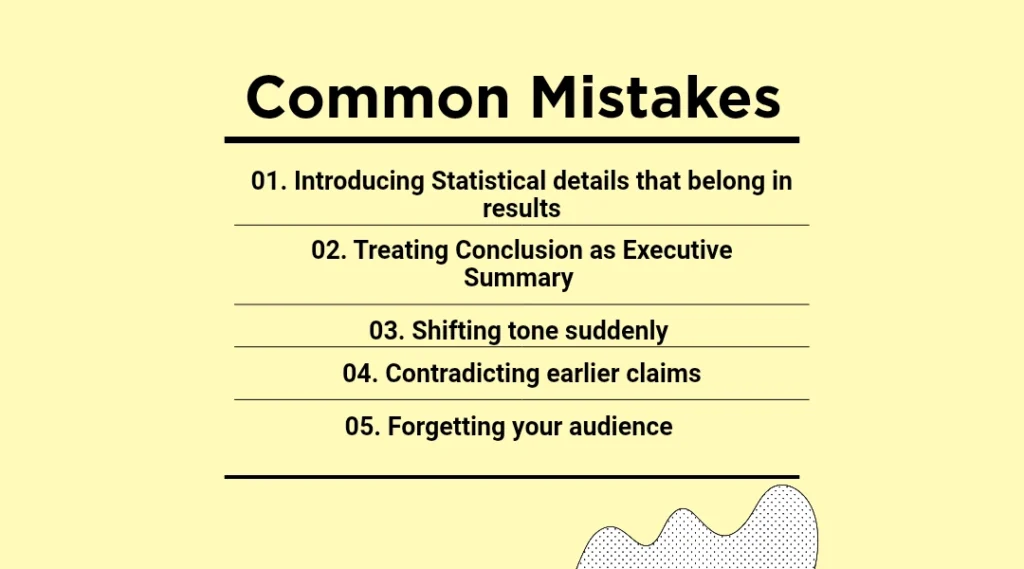
- Introducing statistical details that belong in results. Your conclusion isn't a secondary reporting venue. Results already presented shouldn't get rehashed with new statistical framing.
- Treating conclusion as executive summary. An executive summary recaps comprehensively. A conclusion synthesizes and elevates. Different work entirely.
- Shifting tone suddenly. If your paper maintains formal academic tone throughout, your conclusion shouldn't suddenly shift to journalistic brevity or conversational language. Maintain consistency.
- Contradicting earlier claims. If your discussion acknowledged a finding's strength, your conclusion shouldn't diminish it. Internal consistency signals rigorous thinking.
- Forgetting your audience. Are you writing for specialists in your field or general academics? Your conclusion's technical level should match your paper's overall register.
The Role of Writing Research Conclusion in Academic Integrity
How you write your conclusion reflects your ethical standards as a researcher. Overreaching in claims, ignoring limitations, or misrepresenting findings' scope are integrity violations. They might be subtle ones, but they matter.
Strong conclusions demonstrate intellectual honesty. They're rigorous about what can and can't be concluded from your design. They acknowledge uncertainty without dissolving into relativism. They make bold implications without making false claims.
For students learning how to write the conclusion of a research paper, understanding that conclusions are ethical statements—not just summary work—changes everything. You're demonstrating to readers that you can be trusted with knowledge, and that trustworthiness depends on precision and honesty.
Revising Your Conclusion: Questions to Ask
Once you've drafted your conclusion, ask yourself:
Does my restatement reflect actual findings, or does it repeat my introduction unchanged?
If you can swap your conclusion's first paragraph with your introduction's thesis, you haven't done the synthesis work.
Are my implications grounded in findings, or am I speculating?
Implications should feel like natural extensions of evidence, not imaginative leaps.
Have I acknowledged all major limitations without overstating them?
You're looking for honest realism, not false modesty.
Does this conclusion make someone in my field think about my topic differently?
If your conclusion doesn't shift perspective at least slightly, it's not doing full work.
Does my conclusion's length reflect its intellectual content?
Generally, conclusions run 10-15% of total paper length. Check that you're giving it adequate space. PaperEdit's revision checklist helps writers identify gaps and strengthen weak claims through systematic review.
Can I identify exactly which prior sections support each claim in my conclusion?
If you can't trace connections, your reader won't see them either.
For further guidance, you may give this article on Plos a read.
REFERENCE BOOKS
- Booth, W. C., Colomb, G. G., & Williams, J. M. (2016). The Craft of Research (4th ed.). University of Chicago Press. — Comprehensive guide to research methodology and presenting findings, with dedicated chapters on conclusion writing strategies and framing implications.
- Day, R. A., & Gastel, B. (2016). How to Write and Publish a Scientific Paper (8th ed.). ABC-CLIO. — Industry-standard reference for scientific writing that includes detailed sections on conclusion writing, causal claim appropriateness, and maintaining integrity in academic conclusions.