


Receiving peer reviewer comments can be one of the most demanding stages of academic publishing. A manuscript that felt complete after months of research may suddenly return with dozens of questions, methodological concerns, language corrections, and requests for additional analysis.
Navigating peer reviewer comments means systematically evaluating reviewer feedback, separating substantive scientific concerns from editorial preferences, revising the manuscript where appropriate, and preparing a clear point-by-point response for the editor and reviewers. A revise-and-resubmit decision is not necessarily a sign that the research has failed; it commonly indicates that the manuscript requires further development before publication. APA journal guidance, for example, describes major revisions as substantive changes that may include reorganizing a conceptual structure, conducting additional experiments, or modifying analyses.
The key is to replace an emotional first reaction with a structured revision workflow. This guide explains how to handle emotional or harsh peer review comments, organize a response to reviewers, manage major revisions, and reduce stress during academic peer review.
💡 Ready to polish your research paper for publication?
Transform your manuscript with PaperEdit's professional editing and proofreading services!
1. Read Reviewer Comments Strategically Before Revising
The first step is not opening your manuscript and immediately changing sentences. Audit the decision letter and reviews first.
What to do
Read the editor's decision letter separately from the individual reviewer reports. Identify:
- The editorial decision: minor revision, major revision, revise and resubmit, or another decision category.
- The editor's principal concerns.
- Major methodological or analytical issues.
- Requests for additional literature.
- Structural or interpretive concerns.
- Language, formatting, and citation corrections.
- Conflicting reviewer recommendations.
Then read each review completely without responding immediately.
Why this matters
Reviewers and editors serve different roles. The editor makes the publication decision; reviewer recommendations inform that decision but do not independently determine it. ICMJE explicitly notes that journals are not obligated to follow reviewer recommendations and that the editor remains responsible for selecting published content.
This distinction can reduce unnecessary anxiety. A statement such as "the study needs substantial clarification" is feedback to evaluate not a final verdict on your research career or scientific contribution.
Industry-standard approach
Create a revision matrix before making substantive changes:
| Reviewer comment | Category | Required action | Manuscript location | Response status |
| Clarify sampling criteria | Major | Add methodological explanation | Methods, §2.3 | Pending |
| Explain conflicting result | Major | Expand interpretation | Discussion, §4.2 | Pending |
| Add recent references | Substantive | Audit literature | Introduction/Discussion | Pending |
| Correct terminology | Minor | Copyedit | Throughout | Complete |
| Fix citation formatting | Editorial | Standardize | References | Complete |
This transforms an unstructured review into a finite project.
Common submission pitfall
Do not revise in the order comments appear. A reviewer may begin with a minor wording issue before raising a fundamental methodological concern later in the report.
Prioritize comments according to their effect on the manuscript's:
- Research validity
- Methodological transparency
- Analysis
- Interpretation
- Literature positioning
- Structure and clarity
- Grammar and formatting
2. Separate Harsh Language from Useful Academic Feedback
One of the hardest aspects of dealing with harsh peer reviewer feedback is separating tone from substance.
What to do
Translate emotionally worded comments into neutral revision questions.
For example:
“The discussion completely fails to explain the findings.”
Convert this into:
What explanation is missing from the Discussion, and what evidence should be added?
Likewise:
“The methodology is inadequate.”
Ask:
- Which methodological component is considered inadequate?
- Is the concern about study design?
- Sampling?
- Statistical analysis?
- Reproducibility?
- Reporting detail?
- Alignment between research question and method?
Why this works
Academic peer review is intended to evaluate and improve scholarly work, although individual reviews can vary considerably in clarity and tone. APA reviewer guidance emphasizes that effective reviews should be critical but constructive, while noting that some reviews can be difficult for authors to respond to because they contain long, unstructured collections of issues.
The practical lesson is important: respond to the scholarly issue, not the emotional wording.
What not to write
Avoid responses such as:
- “The reviewer clearly misunderstood our paper.”
- “This criticism is unfair.”
- “The reviewer did not read the manuscript carefully.”
- “We completely disagree with this ridiculous comment.”
Instead, use professional language:
“We appreciate the reviewer’s concern. We have clarified the rationale for…”
or:
“We respectfully disagree with this interpretation because…”
or:
“We considered this suggestion carefully. However, implementing the proposed analysis would not be appropriate because…”
Professional disagreement is entirely compatible with a strong response letter.
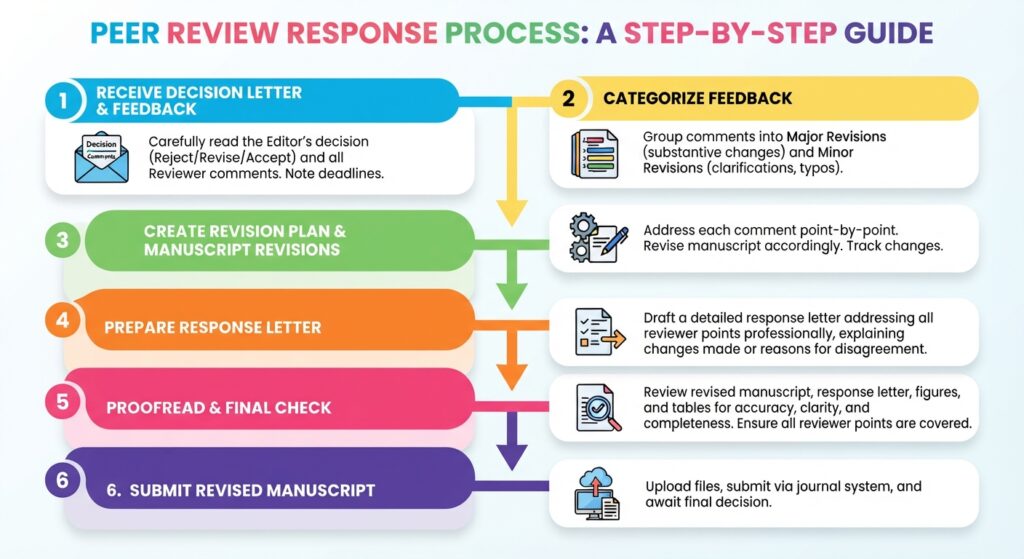
3. Use the “Comment → Action → Evidence” Response Framework
When handling academic peer review feedback, every substantive comment should lead to a traceable response.
What to include
For each comment, identify three components:
1. Comment — reproduce or accurately summarize the reviewer’s concern.
2. Action — explain what you changed.
3. Evidence — identify where the change appears in the revised manuscript.
A strong response might follow this structure:
Reviewer 1, Comment 3: The reviewer requested greater clarification of the participant-selection criteria.
Response: We thank the reviewer for highlighting this issue. We have expanded the description of the inclusion and exclusion criteria and clarified the recruitment procedure. The revised text appears in Section 2.3, pages 6–7.
If you did not make the requested change:
Response: We appreciate this suggestion and carefully considered the proposed analysis. We have not conducted the additional analysis because the available dataset does not contain the variables required to perform it reliably. Instead, we have clarified this limitation in Section 4.4 and have moderated our interpretation accordingly.
Why this is an industry-standard approach
APA guidance for revise-and-resubmit manuscripts specifically calls for detailed cover letters containing point-by-point responses to reviewer comments and substantive issues.
The objective is traceability. The editor should be able to move from:
Reviewer comment → response letter → revised manuscript → exact location of change
without searching through the entire paper.
Common submission pitfall
Do not write:
“We have revised the manuscript as requested.”
That response gives the editor no evidence of what changed.
Instead, identify the section, page, paragraph, table, figure, or line number, according to the journal's preferred format.
Also read: Top 10 APA 7th Formatting Errors That Cause Journal Rejections and How to Fix Them
4. Decide When to Accept, Modify, or Challenge a Reviewer Request
Not every reviewer recommendation should be implemented exactly as written.
What to do
Classify every substantive request into one of three groups:
A. Accept and implement
Use this when the reviewer identifies a legitimate problem that can be corrected.
Examples:
- Missing methodological information
- Incorrect citation
- Ambiguous terminology
- Unclear statistical reporting
- Unsupported interpretation
- Missing relevant literature
B. Modify and partially implement
Use this when the underlying concern is valid but the requested solution is not the only reasonable approach.
For example, a reviewer may request an additional experiment when a clearer limitation statement and supplementary analysis can adequately address the concern.
C. Explain why you cannot implement it
Use this when the proposed change would compromise the study, exceed the dataset's scope, conflict with the research design, or introduce an inappropriate analysis.
Why this matters
A response letter should demonstrate reasoned scholarly judgment, not automatic compliance.
APA's guidance states that authors should respond to every reviewer comment, including comments with which they disagree, but authors do not necessarily have to make the exact requested change. Instead, they should carefully consider the concern and provide a detailed rationale for accepting or declining the suggestion.
Industry-standard criterion
Ask of every requested revision:
Does this change improve the validity, clarity, transparency, reproducibility, or interpretation of the research?
If yes, revise.
If not, determine whether a concise evidence-based explanation is more appropriate.
Common submission pitfall
Never treat disagreement as a confrontation.
A response such as:
“The reviewer is wrong.”
should become:
“We appreciate the reviewer’s observation. However, we interpret this issue differently because…”
The second formulation preserves the scholarly relationship while defending your methodological position.
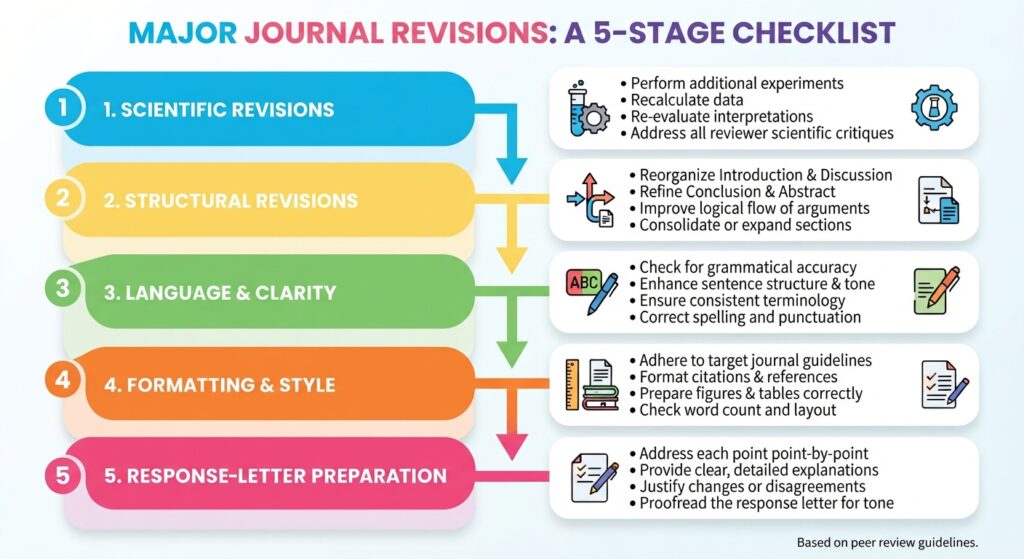
5. Organize Major Revisions as a Project, Not a Crisis
Managing major revisions for journal articles becomes considerably easier when you divide the work into stages.
Stage 1: Editorial triage
Within your first review session, identify the 5–10 issues most likely to influence the editor's decision.
Stage 2: Scientific revision
Address:
- Study design
- Sampling
- Data analysis
- Statistical methodology
- Results presentation
- Interpretation
- Limitations
- Literature positioning
Stage 3: Structural revision
Reassess:
- Introduction logic
- Research objectives
- Section order
- Transitions
- Argument development
- Discussion structure
- Conclusion
Stage 4: Language revision
Conduct academic copyediting for:
- Grammar
- Syntax
- Article usage
- Verb tense
- Subject–verb agreement
- Terminology
- Academic tone
- ESL language issues
Stage 5: Formatting and compliance
Audit:
- Reference style
- In-text citations
- Tables
- Figures
- Figure legends
- Supplementary files
- Reporting checklists
- Word count
- Journal-specific formatting
Stage 6: Response-letter audit
Cross-check every reviewer comment against the response letter and revised manuscript.
6. Build a Response Letter That Editors Can Navigate Quickly
A response letter is not a formality. It is an editorial navigation document.
Recommended structure
Begin with a short professional opening:
We thank the editor and reviewers for their careful evaluation of our manuscript. We have considered all comments and revised the manuscript accordingly. Below, we provide a point-by-point response and identify the location of substantive changes in the revised manuscript.
Then organize responses by:
Reviewer 1
Comment 1: [Reviewer comment]
Response: [Your response]
Change in manuscript: [Section/page/line]
Comment 2: …
Repeat the same structure for Reviewer 2 and Reviewer 3.
Industry-standard criteria
A high-quality response letter should be:
- Point-by-point
- Numbered
- Concise
- Evidence-based
- Professionally worded
- Cross-referenced
- Consistent with tracked changes
- Consistent with the clean manuscript
For substantial revisions, use tracked changes if the journal requests them. Also maintain a clean version when required by the submission system.
Common submission pitfalls
Avoid:
- Combining unrelated reviewer comments into one response
- Omitting comments because you disagree
- Failing to explain substantial methodological changes
- Giving page numbers that no longer correspond to the revised manuscript
- Making changes in the manuscript that are not acknowledged in the response letter
- Referencing “the reviewer” ambiguously when multiple reviewers are involved
Also read: Addressing Desk Rejection: How to Rewrite Your Abstract in 2026: A Complete Author Guide
7. Reduce Stress by Separating the Manuscript from Your Identity
The most useful answer to “What is the best mindset for approaching a revise and resubmission?” is to treat revision as an evidence-management exercise rather than a personal evaluation.
What to do
Replace:
“They criticized my research.”
with:
“They identified claims, methods, explanations, or presentation elements that require clarification.”
That distinction matters particularly for doctoral candidates and early-career researchers.
A review may contain comments about writing quality, study limitations, analysis, novelty, journal fit, or interpretation. None should automatically be interpreted as a judgment of the author's overall scholarly ability.
A practical stress-reduction workflow
Use a 24-hour rule when possible:
- Read the decision.
- Take notes, but do not draft defensive responses.
- Categorize the comments.
- Discuss substantive methodological concerns with coauthors.
- Build the revision matrix.
- Revise only after the response strategy is clear.
If a comment is genuinely unclear, consult the editor rather than guessing what the reviewer intended.
ICMJE emphasizes that journals should maintain clear descriptions of their peer-review processes, while recognizing that peer-review models and procedures differ between journals.
Also read: PaperEdit Academic Proofreading Services
8. Know the Difference Between Scientific Revision and Proofreading
Not every reviewer comment requires the same editing intervention.
| Revision level | Primary purpose | Typical issues | Appropriate action |
| Scientific/structural revision | Strengthen research argument | Design, analysis, interpretation | Author-led substantive revision |
| Developmental/structural editing | Improve organization | Logic, section sequence, argument flow | Restructure manuscript |
| Copyediting | Improve technical expression | Grammar, syntax, terminology, consistency | Line-by-line language editing |
| Reference editing | Standardize citations | APA 7th, Vancouver, IEEE, Chicago | Citation/reference audit |
| Proofreading | Eliminate final errors | Typos, punctuation, formatting | Final pre-submission check |
The distinction is important because proofreading cannot repair a methodological weakness. Similarly, a statistical concern cannot be solved merely by improving academic English.
For ESL authors, professional language polishing can help make a valid scientific argument clearer, but language editing should preserve the author's intended scientific meaning.
9. Recheck Reporting Standards Before Resubmission
Reviewer comments sometimes expose missing reporting information rather than flaws in the underlying study.
Depending on your research design, check applicable reporting frameworks such as:
- CONSORT for randomized trials
- PRISMA for systematic reviews and meta-analyses
- STROBE for observational studies
- Relevant discipline-specific reporting guidelines
ICMJE recommends that authors check whether their target journal requires specific reporting checklists and submit them when requested.
For medical and health-science manuscripts, consult the current ICMJE Recommendations, which were updated in January 2026.
For APA-related submissions, authors can also consult the APA peer-review resources for journal-specific publishing guidance.
For broader academic writing and citation guidance, Purdue OWL remains a useful reference resource.
Common submission pitfall
Do not assume that addressing a reviewer's specific comment automatically makes the manuscript compliant with the journal.
After revision, perform a fresh submission-readiness audit against the journal's current author guidelines.
Also read: Ultimate Guide to Academic Publishing & Peer Review Success: 2026 Author Guide
Final Pre-Submission Checklist
Before uploading your revised manuscript, complete this audit:
Reviewer responses
- Every substantive reviewer comment has a response.
- Responses are numbered and easy to navigate.
- Disagreements are explained professionally.
- Major methodological changes are clearly documented.
- Page, section, paragraph, or line references are accurate.
Manuscript revision
- All agreed changes appear in the manuscript.
- Conclusions remain supported by the revised analysis.
- New claims have appropriate citations.
- Limitations have been updated where necessary.
- Tables and figures remain consistent with the text.
- Supplementary materials reflect any analytical changes.
Language and style
- Grammar and syntax have been checked.
- Academic tone is consistent.
- Terminology is standardized.
- Abbreviations are defined consistently.
- Tense usage is appropriate for each section.
- ESL language issues have been professionally polished where necessary.
Formatting and submission
- Journal-specific formatting requirements have been checked.
- Citation and reference style are consistent.
- Figure resolution and file formats meet journal requirements.
- Figure legends are complete.
- Reporting checklists are included when required.
- Tracked-changes and clean versions are prepared as requested.
- Cover letter and response letter are finalized.
- All author metadata and submission files are correct.
Conclusion: Turn Reviewer Comments into a Revision Strategy
Navigating peer reviewer comments without stress requires structure, not perfection. Read the decision carefully, separate tone from substance, categorize comments by priority, and convert each substantive concern into a documented action. When you disagree, respond with evidence and reasoning rather than defensiveness. When you agree, make the change traceable.
A well-prepared response letter demonstrates more than compliance: it shows the editor that you have carefully evaluated the manuscript, understood the reviewers' concerns, and strengthened the paper through deliberate revision.
Before resubmission, consider an independent academic proofreading and manuscript editing review from PaperEdit to identify language inconsistencies, citation errors, formatting problems, and unresolved editorial issues that can be difficult to spot after multiple rounds of revision.
The goal is not to make every reviewer comment disappear. The goal is to produce a clearer, more rigorous, more transparent manuscript and a response that makes those improvements easy for the editor to see.