


A desk rejection can be particularly frustrating when your research is scientifically sound but the editor does not send the manuscript for peer review. In many cases, the abstract is one of the first places an editor looks to determine whether a submission fits the journal’s scope, communicates a clear contribution, and meets the publication’s expectations.
Rewriting an abstract after desk rejection means more than correcting grammar or replacing a few keywords. It requires a strategic revision of the abstract’s structure, research focus, methodological clarity, findings, and alignment with the target journal.
A strong abstract should allow an editor to understand, within a few seconds, what problem the study addresses, how it was investigated, what was found, and why the findings matter.
This guide explains why editors may desk-reject manuscripts based on abstracts, how to interpret rejection feedback, how to rewrite an abstract for a new journal, and how to conduct a final pre-submission audit in 2026.
💡 Ready to polish your research paper for publication?
Transform your manuscript with PaperEdit's professional editing and proofreading services!
Why Do Journal Editors Desk-Reject Manuscripts Based on Abstracts?
A journal editor typically has to make an initial assessment before investing reviewer time in a manuscript. The abstract provides a compact representation of the study and can expose problems with scope, novelty, methodology, reporting, or writing quality.
A desk rejection does not necessarily mean that the research is invalid. It may indicate that the manuscript, as presented, does not sufficiently match the journal's editorial priorities or submission requirements.
Common journal desk rejection reasons associated with abstracts include:
- Poor journal fit: The abstract does not clearly address the journal's subject area or readership.
- Unclear research question: The objective or hypothesis is vague.
- Weak statement of contribution: The manuscript does not establish what it adds to existing knowledge.
- Insufficient methodological information: Readers cannot determine how the study was conducted.
- Missing or vague results: The abstract describes the study but does not report its principal findings.
- Unsupported claims: Conclusions extend beyond the evidence presented.
- Excessive background: Too much space is devoted to general context.
- Formatting noncompliance: The abstract exceeds the word limit or ignores a structured format required by the journal.
- Language problems: Grammar, terminology, sentence construction, or academic tone make the research difficult to evaluate.
- Inconsistent terminology: The abstract uses different terms for the same variable, population, intervention, or outcome.
What Editors Look for During an Initial Abstract Assessment
Although editorial workflows differ across journals and disciplines, an effective abstract should quickly answer five questions:
- What problem does the study address?
- What was the specific objective or research question?
- What methods were used?
- What were the principal results?
- What do those results mean?
If an editor must search the abstract for these answers, the manuscript may lose clarity at precisely the stage when concise communication matters most.
Also read: Top 10 APA 7th Formatting Errors That Cause Journal Rejections and How to Fix Them
How to Rewrite an Abstract After Desk Rejection
Do not immediately rewrite the entire abstract sentence by sentence. First, determine why the original version failed to communicate the manuscript's value to the target journal.
Step 1: Diagnose the Rejection Before Editing
Read the editor's decision letter carefully. Separate explicit feedback from implied concerns.
For example:
| Editorial feedback | Possible abstract issue | Revision response |
| "Outside the scope of the journal" | Weak or absent statement of journal-relevant contribution | Reframe the contribution around the journal's readership |
| "Insufficient novelty" | Contribution is buried or undefined | State the research gap and specific contribution explicitly |
| "Not suitable for our readership" | Excessive technical detail or inadequate context | Adjust terminology and emphasize relevant implications |
| "Methodological concerns" | Study design is unclear | Add essential design, sample, intervention, or analytical details |
| "Priority does not align with the journal" | Abstract does not foreground the relevant research problem | Reorganize the opening and objective |
| Generic editorial rejection | Multiple presentation or positioning issues may be involved | Conduct a complete abstract and journal-fit audit |
Do not treat a brief rejection as an invitation to make cosmetic changes only. If the abstract fails to communicate the study's central contribution, a structural rewrite is usually more appropriate than proofreading.
Step 2: Study the New Journal's Abstract Requirements
When rewriting a research abstract for a new journal, start with the journal's current author guidelines.
Check:
- Maximum word count
- Structured versus unstructured format
- Required headings
- Required keywords
- Number and type of abbreviations permitted
- Whether references are prohibited
- Whether statistical results are expected
- Whether clinical trial registration information is required
- Whether graphical abstracts are requested
- Whether the journal specifies reporting standards
Do not assume that the abstract format used by the previous journal will work for the new submission.
For example, a structured abstract may require headings such as Background, Methods, Results, and Conclusions, while another journal may require a single narrative paragraph.
Consult the official author instructions rather than relying on formatting conventions from another journal.
Step 3: Rebuild the Abstract Around the Research Question
A high-impact abstract begins with a precise research problem rather than an extended literature review.
Instead of writing several sentences about a broad societal or scientific issue, establish the specific gap that motivated the study.
A useful progression is:
Context → Knowledge gap → Objective → Method → Results → Interpretation
The knowledge gap should be specific. Avoid statements such as:
"Limited research exists on this important topic."
Instead, identify what remains unknown, inconsistent, underexplored, or methodologically unresolved.
For example:
"Previous studies have established X, but evidence remains limited regarding Y in population Z."
The objective should then directly address that gap.
Also read: Cover Letter for Journal & Manuscript Submission
What Are the Key Structural Components of a High-Impact Abstract?
A well-structured abstract is essentially a compressed version of the manuscript's argument.
1. Background or Context
Use one or two sentences to establish the research problem.
Purpose: Explain why the study was necessary.
Industry-standard criterion: The background should provide enough context for an informed reader without reproducing the introduction.
Common pitfall: Spending 40–50% of the abstract discussing background while leaving insufficient space for results.
2. Objective or Research Question
State exactly what the study investigated.
Use precise verbs such as:
- examined
- evaluated
- compared
- quantified
- investigated
- characterized
- determined
- assessed
Avoid vague formulations such as "this paper discusses" or "the present study looks at."
3. Methods
Include only the methodological details necessary to understand the evidence.
Depending on the discipline, this may include:
- Study design
- Population or sample size
- Setting
- Intervention or exposure
- Comparator
- Primary outcome
- Analytical method
- Study period
For quantitative research, important statistical findings may require effect sizes, confidence intervals, or significance measures where appropriate and where permitted by the journal.
For clinical research, ensure that the abstract aligns with relevant reporting expectations such as CONSORT, STROBE, or other applicable standards.
4. Results
The results section is often the most important component for an editor assessing whether a manuscript warrants further consideration.
Do not simply write:
"The results demonstrated significant differences."
State what changed, between which groups, and by how much when the information is appropriate for the discipline and journal.
For example:
"The intervention group demonstrated a 14% greater reduction in symptom scores than the control group."
Specificity makes the research contribution easier to evaluate.
5. Conclusion and Implications
The conclusion should interpret the findings without overstating them.
Distinguish between:
Evidence: What the study directly demonstrated.
Interpretation: What those findings may mean.
Implication: Why the findings matter.
Avoid claims such as "This study proves..." when the design only supports an association or limited inference.
How Can I Make My Abstract More Appealing to a New Editor?
An editor does not need an abstract that sounds promotional. The goal is editorial relevance and information density.
Make the abstract more effective by applying four tests.
Test 1: The Scope Test
Ask:
Could an editor immediately identify why this study belongs in this journal?
If not, revise the framing.
However, do not artificially insert journal-specific terminology merely to appear relevant. The abstract must accurately represent the manuscript.
Test 2: The Contribution Test
Underline the sentence that communicates the study's original contribution.
If you cannot identify one, the contribution may be buried in the abstract or manuscript.
A contribution can involve:
- New empirical evidence
- A novel dataset
- A new methodological approach
- A replication that addresses a documented gap
- A theoretical refinement
- A clinically or practically relevant finding
- Evidence from an underrepresented population or setting
Test 3: The Results Test
Circle every sentence containing an actual result.
If the abstract contains extensive background and methods but very few concrete findings, restructure it.
Test 4: The Compression Test
Remove every sentence that does not contribute to one of the abstract's core functions:
Context → Gap → Objective → Method → Result → Meaning
This is particularly important when the journal imposes a strict 150-, 200-, 250-, or 300-word limit.
Also read: PaperEdit Academic Proofreading Services
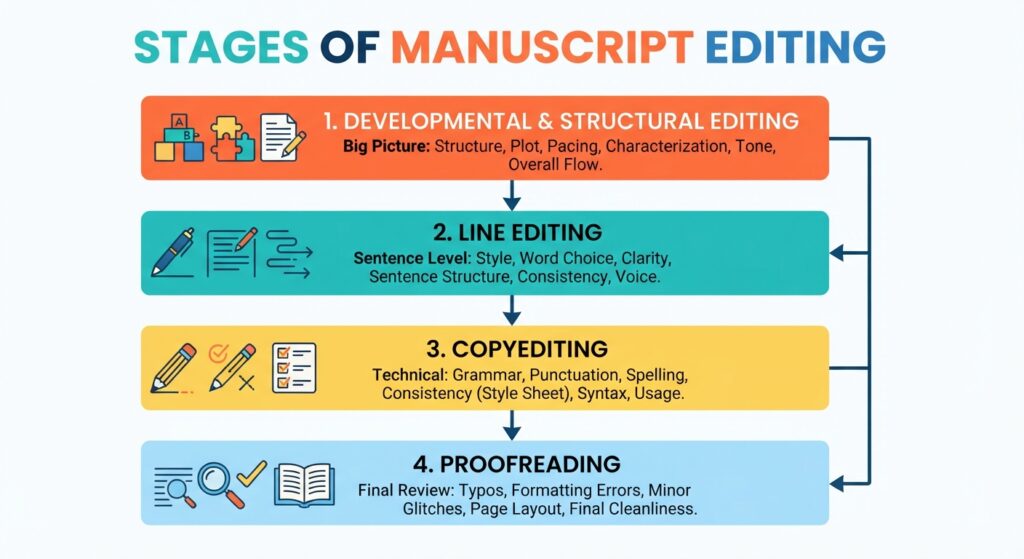
Abstract Editing: Copyediting vs. Proofreading
Rewriting after desk rejection often requires more than proofreading. Authors should distinguish between language correction and substantive editing.
| Editing level | Primary purpose | Typical intervention | Best used when |
| Structural editing | Improve logic and organization | Reorders background, objective, methods, results, and conclusion | Abstract lacks a clear narrative |
| Line editing | Improve clarity and academic expression | Refines sentence structure, emphasis, transitions, and tone | Ideas are sound but difficult to follow |
| Copyediting | Correct language and consistency | Grammar, terminology, punctuation, capitalization, abbreviations | Technical content is established |
| Proofreading | Catch final surface errors | Typos, spacing, punctuation, formatting inconsistencies | Final manuscript is ready for submission |
A desk-rejected manuscript may require structural editing first and proofreading last.
Correcting grammar in an abstract that has a weak research narrative does not solve the underlying editorial problem.
How to Handle Addressing Desk Rejection Feedback
Create a rejection-response matrix before revising.
For each editorial comment, record:
- What the editor said
- What the comment indicates
- What will change
- Where the change will appear
- Whether the manuscript requires corresponding revisions
For example:
| Feedback | Action |
| Scope mismatch | Select a better-aligned journal and revise the abstract's framing |
| Contribution unclear | State the specific research gap and contribution |
| Methods insufficiently described | Add the essential study design and sample information |
| Results unclear | Replace general claims with specific findings |
| Language concerns | Conduct academic copyediting and manuscript proofreading |
| Formatting problems | Reformat according to the new journal's author guidelines |
This approach prevents authors from making isolated abstract changes while leaving contradictory language elsewhere in the manuscript.
Rewriting an Abstract for a New Journal: What Changes?
Do not simply replace the previous journal's name or keywords.
A new journal may have a different:
- Disciplinary emphasis
- Reader profile
- Article type
- Abstract structure
- Word limit
- Keyword taxonomy
- Reporting expectation
- Preferred terminology
- Emphasis on theory, methodology, clinical relevance, or application
Your manuscript's underlying evidence should remain accurate, but the presentation of its contribution can legitimately be adapted to the new readership.
For example, a multidisciplinary journal may require broader contextualization, while a specialist journal may expect greater methodological specificity.
The goal is not to make the study appear to be something it is not. The goal is to make its genuine contribution immediately understandable to the intended audience.
Also read: 5 Cover Letter Templates for High-Impact Journals: 2026 Author Guide
Technical Editing Checks Before Resubmission
After the substantive rewrite, perform a detailed language and formatting audit.
Language and Style
Check for:
- Subject–verb agreement
- Article usage
- Tense consistency
- Parallel construction
- Ambiguous pronouns
- Unnecessary nominalizations
- Redundant phrases
- Informal expressions
- Overuse of passive constructions
- Undefined abbreviations
- Inconsistent terminology
For ESL authors, pay particular attention to sentence structures that may be grammatically correct but unnecessarily complex for an international academic audience.
Numbers and Statistical Reporting
Verify that:
- Numerical results match the main manuscript.
- Percentages correspond to the reported sample.
- Decimal places are consistent.
- Statistical symbols follow the target style.
- Confidence intervals and effect sizes are reported accurately where required.
- P values are presented consistently with the journal's instructions.
Never introduce or round statistical values during language editing without checking the original analysis.
Keywords
Select keywords strategically rather than repeating every important word from the title.
Use terminology that accurately represents:
- The research topic
- Population
- Intervention or exposure
- Method
- Outcome
- Field or discipline
Where appropriate, check whether the journal recommends controlled vocabulary or a specific indexing system.
Final Pre-Submission Abstract Checklist
Before uploading your manuscript, confirm each item:
- The abstract follows the target journal's current word limit.
- The required structured headings are present.
- The research problem is clearly defined.
- The knowledge gap is specific.
- The objective matches the manuscript.
- The study design is accurately described.
- Essential sample or methodological information is included.
- Principal results contain specific findings rather than vague claims.
- Statistical values match the main manuscript.
- The conclusion does not overstate the evidence.
- Abbreviations are defined where required.
- Terminology is consistent throughout the abstract and manuscript.
- Keywords comply with journal requirements.
- No unsupported claims have been introduced.
- The abstract accurately represents the full manuscript.
- The manuscript's scope aligns with the new journal.
- Grammar, punctuation, spelling, and academic tone have been checked.
- Figures, tables, and supplementary materials are referred to consistently where applicable.
- The final manuscript has undergone a separate proofreading pass.
Conclusion
Rewriting an abstract after desk rejection should be treated as a strategic manuscript revision, not a cosmetic proofreading exercise. A successful revision makes the research question explicit, identifies the knowledge gap, presents the essential methodology, reports concrete findings, and communicates the contribution in language appropriate for the target journal.
Before resubmission, audit the abstract against the new journal's scope, author guidelines, reporting expectations, word limit, and terminology. Then conduct a final academic editing and proofreading pass to eliminate language and consistency problems that could obscure the research.
A precise, well-structured abstract gives editors the information they need to understand the manuscript quickly and accurately.
Ready to address the weaknesses identified during editorial screening? Have your abstract and full manuscript professionally reviewed before the next submission with PaperEdit's academic editing and proofreading services.