

Receiving a Turnitin Similarity Report with large sections highlighted can be unsettling especially when you have researched carefully, cited your sources, and written the paper yourself. A high percentage does not automatically mean plagiarism, and highlighted text does not automatically require rewriting.
A Turnitin similarity report identifies text that overlaps with material in Turnitin's databases. It does not, by itself, determine whether plagiarism has occurred. Matches may come from properly cited quotations, references, commonly used academic terminology, previously submitted drafts, or legitimately shared language.
The correct response is therefore not to rewrite every highlighted sentence simply to obtain a lower percentage. Instead, read the match, identify why it occurred, verify the citation, and revise only where the wording or attribution creates a genuine academic-integrity problem.
This guide explains how to read a Turnitin similarity report, what constitutes a potentially problematic match, how to fix Turnitin highlighted text without changing meaning, and how academic proofreading and editing can help you produce a clearer, more original manuscript.
💡 Ready to polish your research paper for publication?
Transform your manuscript with PaperEdit's professional editing and proofreading services!
What Is a Turnitin Similarity Report?
A Turnitin Similarity Report compares submitted text with material contained in Turnitin's available search databases. Depending on the assignment settings, these sources can include Internet content, previously submitted papers, journals, periodicals, and publications. The resulting percentage represents the proportion of text identified as matching or similar to material in those databases.
The crucial distinction is this:
Similarity is not the same as plagiarism.
A paper containing properly attributed quotations may produce a higher similarity percentage than a paper containing few quotations. Conversely, a paper with a relatively low percentage may still contain an improperly paraphrased passage or an uncited idea.
What the similarity percentage actually tells you
Turnitin calculates the overall similarity by comparing matching words with the total number of words in the submission. The percentage is therefore a measurement of textual overlap—not an academic-integrity verdict.
For example:
- A 10% similarity score can include a serious uncited passage.
- A 30% score can include legitimate quotations and a long reference list.
- A lower score does not guarantee that every source has been cited correctly.
- A higher score does not automatically establish plagiarism.
This is why asking “What is a high Turnitin similarity score?” has no universal answer. Your university, instructor, department, journal, or assignment may establish its own expectations, and the composition of the matches matters more than the percentage alone.
Turnitin itself presents percentage ranges as indicators of the amount of matching text rather than definitive judgments about misconduct.
How to Read a Turnitin Similarity Report
Do not begin by rewriting highlighted passages. Begin by auditing the report.
Step 1: Review the overall similarity percentage
Treat the percentage as a diagnostic signal.
Ask:
- How much text is actually matched?
- Are the matches concentrated in one section?
- Are they distributed across many sources?
- Are quotations and references contributing to the score?
- Are any substantial passages uncited?
- Does the assignment have specific similarity requirements?
The percentage becomes meaningful only when interpreted alongside the individual matches.
Step 2: Open the Match Overview
Turnitin's newer Similarity Report organizes matches into categories and provides source information so that authors or instructors can examine the context of each overlap.
Examine each substantial match rather than focusing exclusively on the largest percentage.
A highlighted passage may represent:
- Properly quoted material
- Properly paraphrased material
- A missing citation
- A citation without quotation marks
- Excessively close paraphrasing
- Common academic wording
- A reference-list match
- Institutional template language
- A previous version of your own work
Step 3: Compare your wording with the original source
Open the source associated with a significant match and compare the two passages.
Look beyond individual words. Examine:
- Sentence order
- Argument structure
- Distinctive terminology
- Clause structure
- Examples
- Technical descriptions
- Sequence of ideas
- Attribution
A passage can remain too close to the source even when several individual words have been replaced with synonyms.
What Is the Difference Between Plagiarism and Similarity on Turnitin?
The difference between plagiarism and similarity on Turnitin is fundamental.
Similarity is an automated textual comparison. Plagiarism is an academic-integrity problem involving the presentation of another person's words, ideas, or intellectual contribution without appropriate acknowledgment.
Turnitin explicitly states that it checks submissions for matching text rather than making a determination that plagiarism has occurred.
For example, consider these three situations:
| Situation | Turnitin may highlight it? | Academic concern |
| Exact quotation with correct citation and quotation marks | Yes | Usually legitimate |
| Properly paraphrased idea with citation | Possibly | Usually legitimate |
| Closely copied passage with no citation | Yes | Potential plagiarism |
| Reference-list entry matching another paper | Yes | Usually expected |
| Common technical phrase | Possibly | Usually low concern |
| Your previous submitted draft | Yes | Depends on institutional rules |
The appropriate response is therefore contextual review, not automatic rewriting.
How to Fix Turnitin Highlighted Text Without Changing Meaning
When a highlighted passage genuinely needs revision, preserve the underlying research claim while changing the expression through legitimate scholarly writing.
1. Determine whether the passage should be quoted
If the author's exact wording is important, retain it as a quotation and provide the required citation.
Do not disguise a quotation by replacing a few words with synonyms.
A quotation should remain recognizably the source's wording, while a paraphrase should communicate the source's idea using genuinely independent language.
Turnitin provides exclusion options for quoted material and bibliography content in applicable versions of the Similarity Report because these elements can otherwise contribute to the apparent similarity.
2. Paraphrase from understanding, not from the sentence
Effective paraphrasing begins with comprehension.
Use this sequence:
Read → Understand → Close the source → Reconstruct the idea → Compare → Cite
After reading the source, explain the concept in your own academic language. Then reopen the original source and compare your version against it.
This method is safer than performing word-for-word substitution.
3. Change the sentence structure when appropriate
One legitimate way to improve a paraphrase is to reconstruct its grammatical organization.
For example:
Source-like structure:
Researchers identified X as a major factor because it influenced Y.
Independent structure:
The influence of X on Y led researchers to identify it as a significant factor.
The underlying relationship remains intact, but the sentence has been independently constructed.
Do not, however, change the structure merely to deceive a similarity checker. Your objective should be clearer academic expression with proper attribution.
4. Preserve technical terminology
Do not replace established scientific terminology simply because Turnitin highlights it.
Terms such as statistical significance, randomized controlled trial, machine learning, climate variability, or systematic review may appropriately recur across academic literature.
Academic writing requires precision. A technically correct term should not be replaced with an inaccurate synonym merely to reduce textual overlap.
5. Cite the underlying idea
Paraphrasing does not eliminate the need for attribution.
If the idea originated with another researcher, cite the source even when every sentence has been rewritten.
Purdue OWL likewise emphasizes that summaries and paraphrases require appropriate citation.
Also read: How to Check Your References and Citations for Accuracy Before You Submit
How to Reduce Turnitin Similarity Ethically
If you need to reduce Turnitin similarity, focus on eliminating unnecessary textual overlap rather than attempting to manipulate the score.
Use these academic writing strategies:
Audit quotations
Ask whether every quotation is necessary. If a source's exact wording is not essential, a genuine paraphrase with appropriate attribution may communicate the information more efficiently.
Improve synthesis
Excessive source-by-source writing can produce a manuscript that closely follows individual publications.
Instead of writing:
- Source A says X.
- Source B says Y.
- Source C says Z.
Synthesize:
- Several studies identify X as a common factor, although their findings differ regarding Y and Z.
This approach demonstrates your own analytical contribution while maintaining citations to the relevant literature.
Eliminate accidental duplication
Check whether you have copied text into notes and later incorporated it into the manuscript without recognizing that the wording came directly from a source.
Maintain a clear distinction between:
- Direct quotations
- Your own notes
- Paraphrases
- Your original analysis
Review self-overlap
Turnitin may identify your earlier submissions or drafts. Whether this constitutes a problem depends on the assignment or institutional policy.
Do not simply delete or rewrite legitimate previous work. Determine whether your institution permits reuse and whether the earlier submission should be excluded from the comparison. Turnitin provides mechanisms for instructors to exclude relevant previous submissions or sources where appropriate.
Can Turnitin Detect Rephrased Text?
The question “Can Turnitin detect rephrased text?” requires a careful distinction.
Turnitin's similarity system looks for textual similarity against its comparison databases. A genuinely independent paraphrase may not produce the same textual match as a copied passage. However, changing a handful of words does not transform copied writing into an original paraphrase.
More importantly, academic integrity does not depend on whether software detects the wording.
If the structure and expression remain substantially dependent on the source, the passage can still constitute improper paraphrasing even if a similarity report does not highlight it.
Therefore, do not use paraphrasing as a technique for bypassing detection. Use it to demonstrate genuine understanding and scholarly synthesis.
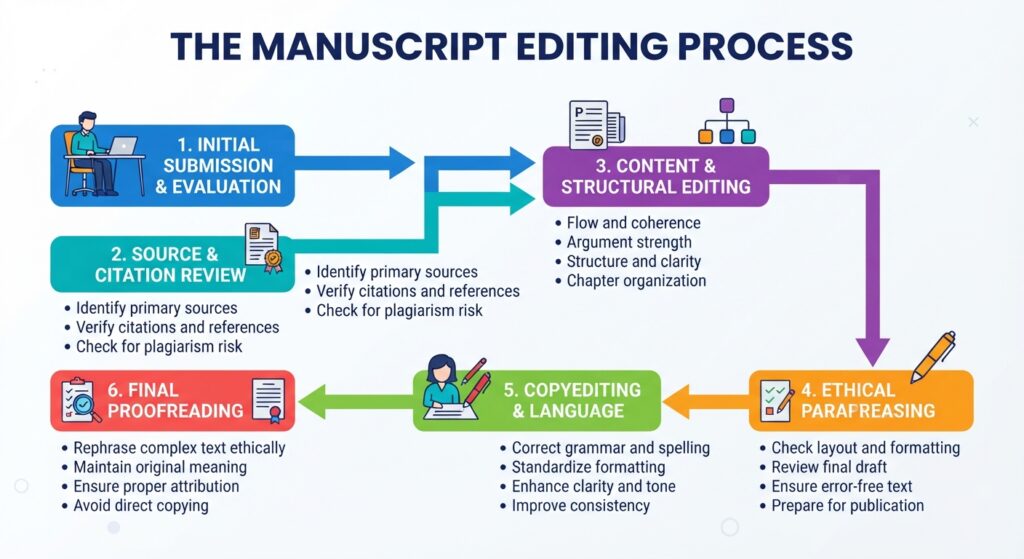
Proper Paraphrasing vs. Accidental Plagiarism
The boundary between proper paraphrasing and accidental plagiarism often becomes unclear when authors work with dense technical literature.
Use the following test.
A proper paraphrase should:
- Express the source's idea in independently constructed language.
- Preserve the original meaning accurately.
- Include the appropriate citation.
- Avoid unnecessary replication of distinctive wording.
- Fit naturally into your own argument.
- Distinguish the source's conclusion from your interpretation.
Accidental plagiarism often involves:
- Replacing individual words with synonyms.
- Keeping the original sentence structure.
- Copying distinctive phrases without quotation marks.
- Omitting a citation because the passage has been rewritten.
- Combining copied fragments from multiple sources.
- Treating notes copied from sources as original writing.
Purdue OWL identifies inadequate understanding of citation systems and paraphrasing as common causes of unintentional plagiarism.
How to Change Sentence Structure for Similarity Reports Without Distorting Meaning
Sentence restructuring can improve originality when it is part of legitimate paraphrasing.
Consider four techniques.
Convert active and passive constructions
Original conceptual structure:
Researchers measured participants' responses.
Alternative:
Participants' responses were measured by the research team.
Use this only when the change remains stylistically appropriate. Do not introduce passive voice simply to make text look different.
Combine related sentences
Two short source-derived statements can sometimes be synthesized into one sentence that emphasizes the relationship between them.
Change information order
Academic paragraphs often allow you to present:
Finding → explanation → implication
instead of:
Explanation → finding → implication
The meaning should remain unchanged.
Add your analytical connection
The strongest academic writing does not merely reproduce what sources say. It explains why the evidence matters to your research question.
This creates an opportunity to write genuinely original analytical sentences around properly attributed source material.
Citation Errors That Create Avoidable Matches
A substantial portion of similarity-report problems can be addressed through better citation practice.
Check:
- Author names
- Publication years
- Page numbers for direct quotations where required
- In-text/reference-list consistency
- Quotation marks
- Block quotation formatting
- Reference-list completeness
- Citation style requirements
Whether you use APA 7th, MLA, Chicago, IEEE, Vancouver, or another system, apply the required style consistently.
For example, APA-style paraphrasing requires an appropriate author-date citation, while exact quotations have additional citation requirements. Purdue OWL's current APA resources provide guidance on citation treatment for summaries and paraphrases.
Also read: PaperEdit's Academic & Scientific Proofreading and Editing Services
Similarity Report: What to Fix and What to Leave Alone
Not every highlighted passage requires intervention.
| Match type | Recommended action | Priority |
| Uncited copied passage | Rewrite or quote and cite | High |
| Closely paraphrased source | Reconstruct independently and cite | High |
| Correct quotation | Verify quotation and citation | Medium |
| Reference-list match | Usually leave intact | Low |
| Standard technical terminology | Usually leave intact | Low |
| Common academic phrase | Usually leave intact | Low |
| Properly cited paraphrase | Review for independence | Medium |
| Previous submission | Check institutional policy | Medium–High |
Turnitin itself provides filters for bibliography, quoted material, cited text, and small matches in applicable versions of its system. These filters are designed to make the report more meaningful; they do not change the underlying manuscript.
When Academic Proofreading and Editing Can Help
A similarity report can identify textual overlap, but it cannot replace editorial judgment.
Academic proofreading and editing for research papers can help when your manuscript contains:
- Repetitive source-based phrasing
- Awkward paraphrases
- Inconsistent terminology
- Unclear attribution
- Grammar problems introduced during rewriting
- Citation inconsistencies
- Weak transitions between sources
- Excessive quotation
- ESL-related sentence construction issues
The distinction between editing and proofreading is important. Editing can address clarity, structure, flow, and sentence construction, while proofreading is primarily concerned with final-stage errors such as grammar, punctuation, spelling, and formatting.
PaperEdit provides academic and scientific proofreading and editing, including manuscript and dissertation support, while its formatting services cover citation, references, figures, tables, and journal-specific presentation requirements.
For authors preparing a thesis, dissertation, or journal article, professional review can therefore address the broader writing problem rather than simply attempting to produce a lower similarity percentage.
Final Turnitin Pre-Submission Checklist
Before submitting your research paper, thesis, or dissertation, complete this audit:
- Read the overall similarity percentage, but do not interpret it in isolation.
- Open and review every substantial highlighted match.
- Confirm that all borrowed ideas have appropriate citations.
- Put exact wording in quotation marks where required.
- Rewrite closely paraphrased passages independently.
- Preserve the meaning and technical accuracy of the source.
- Do not replace established technical terms merely to reduce similarity.
- Check that paraphrases remain faithful to the original evidence.
- Verify every in-text citation against the reference list.
- Check your required citation style, such as APA 7th, IEEE, MLA, Chicago, or Vancouver.
- Review possible self-plagiarism or duplicate-submission issues under your institution's policy.
- Check quotations and bibliography exclusions where your institution's Turnitin settings permit them.
- Proofread the revised passages for grammar and academic tone.
- Review transitions so that the manuscript demonstrates synthesis rather than source-by-source reporting.
- Run a final citation and formatting audit before submission.
Conclusion
A Turnitin Similarity Report should be treated as an editorial diagnostic tool, not a target percentage. Highlighted text does not automatically indicate plagiarism, and a high similarity score does not automatically mean that your research is academically unacceptable. The important question is why the text matches another source and whether the source has been used appropriately.
When a passage genuinely requires revision, fix the underlying writing problem: quote accurately, paraphrase from understanding, cite the original idea, synthesize multiple sources, and strengthen your own analytical contribution. Do not distort technical meaning or manipulate wording solely to defeat similarity detection.
The most effective way to reduce unnecessary similarity is to strengthen your scholarly writing so that it is properly attributed, independently expressed, analytically connected, and carefully edited.
If your manuscript still contains awkward paraphrasing, citation inconsistencies, language problems, or repeated source-dependent phrasing, consider a professional manuscript review before submission. PaperEdit's professional academic editing and proofreading services can help refine clarity, language, consistency, and publication readiness while preserving the substance of your research.