


A manuscript can contain rigorous research and still create avoidable problems at submission because of inconsistent APA formatting. Incorrect DOI URLs, citation–reference mismatches, improper headings, poorly formatted tables, and inconsistent statistical notation can make a paper appear insufficiently prepared for peer review.
APA 7th edition formatting provides a standardized framework for presenting scholarly content, citations, references, tables, figures, headings, and statistical information. However, authors must distinguish between APA style requirements and the specific manuscript-formatting instructions of their target journal. Journal guidelines take precedence whenever they prescribe a different format.
Getting these details right matters because formatting errors can signal inadequate attention to submission requirements and may contribute to editorial queries, return-to-author requests, or, in some cases, desk rejection. This guide identifies the top 10 APA 7th formatting errors, explains why each matters, and provides practical fixes for researchers preparing manuscripts for journal submission in 2026.
💡 Ready to polish your research paper for publication?
Transform your manuscript with PaperEdit's professional editing and proofreading services!
1. Using Incorrect APA 7th DOI URL Formatting
What is the error?
One of the most common reference-list problems is formatting a DOI as outdated or incomplete information.
APA 7th edition presents a DOI as a clickable URL using the https://doi.org/ format.
Incorrect:
doi:10.1037/abc0000123
Also problematic:
Preferred APA 7th format:
Why does it matter?
A DOI provides a persistent identifier for a scholarly work. Presenting it consistently makes references easier for editors, reviewers, and readers to verify.
Industry-standard criteria
Before submission:
- Use the complete DOI URL beginning with https://doi.org/.
- Do not add DOI: before the URL.
- Do not insert a period after the DOI URL if it would become part of the clickable link.
- Verify that the DOI actually resolves to the cited work.
- Preserve the DOI exactly as assigned by the publisher or Crossref.
Common submission pitfall
Authors frequently copy DOI information directly from older reference-management databases. Older records may contain legacy DOI formats. Run a pre-submission reference check rather than assuming that an exported bibliography is publication-ready.
2. Creating APA 7th Citation and Reference Mismatches
What is the error?
Every source cited in the manuscript should correspond to an entry in the reference list, and every reference-list entry should normally be cited in the text.
For example, if the manuscript states:
Smith and Lee (2024) demonstrated that...
the reference list must contain the corresponding Smith and Lee (2024) publication.
Why does it matter?
A citation reference mismatch makes source verification difficult and can raise concerns about incomplete reference management.
Industry-standard criteria
Audit three elements:
- Author names — spelling and ordering must correspond.
- Publication year — the year in the citation must match the reference.
- Source identity — the cited work must be the same work represented in the reference list.
Pay particular attention to:
- 2024a and 2024b designations
- multiple works by the same author
- organizational authors
- translated works
- preprints and published versions
- references imported from citation software
Common submission pitfall
Do not rely exclusively on Word's search function. Citation managers can retain deleted references or fail to update manually edited citations.
A final citation-to-reference reconciliation should be performed after all substantive revisions are complete.
Also read:Tables and Figures in Research Papers: A Complete Formatting Guide
3. Making APA 7th Heading Hierarchy Mistakes
What is the error?
APA 7th edition uses a five-level heading hierarchy. Authors frequently apply heading levels based on visual appearance rather than structural hierarchy.
The key principle is simple: heading levels communicate the logical organization of the manuscript.
Why does it matter?
Poor heading hierarchy can make a manuscript difficult to navigate and may conflict with a journal's required article structure.
Industry-standard criteria
A simplified hierarchy is:
| APA Level | Formatting Principle | Typical Use |
| Level 1 | Centered, bold, title case | Major sections |
| Level 2 | Flush left, bold, title case | Major subsections |
| Level 3 | Flush left, bold italic, title case | Subsections within Level 2 |
| Level 4 | Indented, bold, title case, ending with a period | Detailed subsection |
| Level 5 | Indented, bold italic, title case, ending with a period | Lowest-level subsection |
Do not skip heading levels merely because one level looks visually attractive.
Common submission pitfall
A journal may modify APA's general heading system. Always compare the manuscript with the journal's author guidelines before final formatting.
Avoid manually inserting inconsistent spaces, tabs, or font changes to make headings appear aligned.
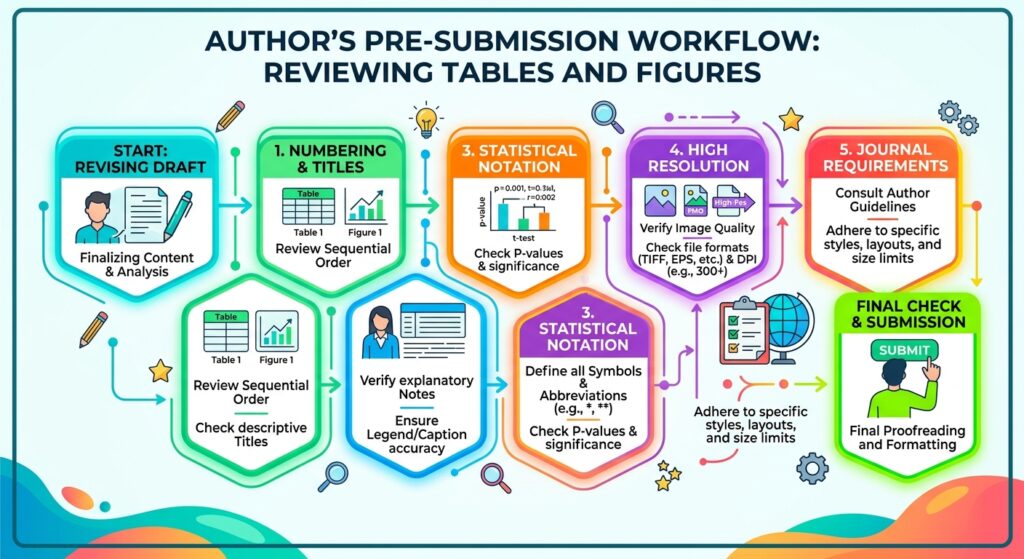
4. Misformatting Tables and Figures
What is the error?
Tables and figures are often treated as decorative elements rather than components of the scholarly argument.
APA 7th edition requires consistent presentation of table numbers, titles, notes, and figure information.
Why does it matter?
Poorly designed visuals can obscure results and create problems during typesetting.
Industry-standard criteria
For every table or figure:
- Number tables and figures sequentially.
- Mention each table or figure in the text.
- Give each visual a meaningful title or caption according to APA requirements.
- Explain abbreviations and relevant symbols in notes.
- Ensure that statistical information is readable.
- Keep formatting consistent across visuals.
- Follow the target journal's requirements for file type, dimensions, color, and placement.
For raster images, 300 DPI is a common production-quality benchmark, although the journal's technical specifications should always take precedence.
Common submission pitfall
Do not insert a screenshot of a statistical output table simply because it was generated by SPSS, R, Stata, SAS, or another program.
Statistical software output often contains unnecessary borders, excessive decimal places, labels intended for machine output, and inconsistent terminology.
Instead, interpret, simplify, and format the table for human scholarly readers.
5. Reporting Statistics Inconsistently
What is the error?
Statistical reporting errors include inconsistent decimal places, incorrect italicization, missing statistical information, and unclear presentation of test results.
Why does it matter?
Statistical notation must allow readers to understand and evaluate the reported analysis. Inconsistent formatting can also create discrepancies between the Results section, tables, figures, and supplementary files.
Industry-standard criteria
Audit:
- Statistical symbols and abbreviations
- Decimal precision
- Italicization of statistical symbols where required
- Exact versus threshold reporting of p values
- Confidence intervals
- Effect sizes
- Degrees of freedom
- Test statistics
- Consistency between prose and tables
For example, statistical results should not report one decimal convention in the text and a completely different convention in tables without justification.
Common submission pitfall
Authors sometimes report only statistical significance while omitting effect sizes or confidence intervals when these are required or strongly expected by the field.
APA formatting is not a substitute for appropriate statistical reporting. Check the journal's methodological and reporting requirements as well as applicable reporting standards.
6. Using et al. Incorrectly
What is the error?
APA 7th edition changed several author-citation conventions compared with earlier editions.
For in-text citations, works with three or more authors generally use the first author's surname followed by et al. from the first citation.
Example:
(Garcia et al., 2025)
However, authors must distinguish this from the reference list, where APA 7th has separate rules for displaying authors.
Why does it matter?
Incorrect et al. usage can create inconsistent citations and may produce ambiguity when multiple works have similar author combinations.
Industry-standard criteria
Check:
- Whether the work has three or more authors
- Whether the citation is narrative or parenthetical
- Whether two different works become ambiguous when shortened
- Whether et al. is italicized correctly
- Whether the period after al. is present
Common submission pitfall
Do not apply the same author-shortening rule to the reference list. The reference-list format is substantially more detailed than the in-text citation format.
Use your reference manager cautiously: automatically generated citations still require human verification.
7. Formatting the Reference List Without a Hanging Indent
What is the error?
A common APA 7th reference-list formatting mistake is presenting references as ordinary paragraphs.
APA references use a hanging indent, meaning the first line begins at the left margin and subsequent lines are indented.
Why does it matter?
The hanging indent visually separates individual references and makes long reference lists easier to scan.
Industry-standard criteria
Apply:
- Alphabetical ordering according to APA rules
- Hanging indentation
- Consistent line spacing
- Correct author formatting
- Correct publication year
- Correct title capitalization
- Correct journal title and volume formatting
- Correct issue and page information where applicable
- DOI or URL information where required
A hanging indent is commonly set to 0.5 inch (1.27 cm) in word-processing software, unless the journal's manuscript template specifies otherwise.
Common submission pitfall
Do not press the Tab key manually at the beginning of every reference. Use the word processor's paragraph-formatting controls or your reference-management software.
Manual indentation frequently breaks when references are edited or reordered.
8. Confusing APA Student and Professional Manuscript Requirements
What is the error?
APA 7th edition distinguishes between student papers and professional papers.
Researchers preparing journal manuscripts should not automatically use a student-paper template.
Why does it matter?
A journal manuscript is a professional scholarly document. Applying student-paper conventions can create unnecessary formatting discrepancies.
Industry-standard criteria
For a professional paper, verify requirements concerning:
- Title page
- Author affiliations
- Author note where applicable
- Page numbering
- Running head requirements
- Abstract
- Keywords
- Manuscript sections
- Journal-specific submission metadata
The running head is not automatically required in every APA 7th professional manuscript; authors should follow the target journal's instructions.
Common submission pitfall
Authors sometimes copy a university assignment template directly into a journal manuscript. This can introduce elements that the journal does not request and omit required submission components.
Before uploading, compare the document against the journal's official manuscript template.
9. Applying Generic APA Formatting Instead of the Journal's Requirements
What is the error?
APA 7th edition is a style guide, but a journal's author instructions determine the actual submission requirements.
A journal may use APA for references while imposing different rules for:
- Word count
- Abstract length
- Headings
- Tables and figures
- Supplementary material
- Reference limits
- Manuscript sections
- Line spacing
- Figure placement
- File naming
- Blinded review
Why does it matter?
Submitting an APA-formatted manuscript that ignores journal-specific instructions is still a submission-formatting failure.
Industry-standard criteria
Create a journal compliance matrix before submission.
| Requirement | APA 7th Baseline | Journal Requirement | Final Status |
| Reference style | APA | Confirm journal version | ☐ |
| Abstract | APA framework | Check word limit | ☐ |
| Headings | APA hierarchy | Check deviations | ☐ |
| Tables | APA conventions | Check placement/file rules | ☐ |
| Figures | APA conventions | Check resolution/type | ☐ |
| Title page | Professional-paper principles | Check journal template | ☐ |
| Blinding | Not universally required | Check review model | ☐ |
| Supplementary files | Journal dependent | Check portal | ☐ |
Common submission pitfall
Do not assume that a journal's statement "APA style required" means every APA recommendation should be applied without modification.
Journal guidelines always deserve a final compliance check.
Also read: How to Prepare a Manuscript for Journal Submission
10. Treating APA Formatting as a Substitute for Final Proofreading
What is the error?
Formatting a manuscript does not eliminate language errors.
A document can be technically APA-compliant while still containing:
- Grammar errors
- Typographical mistakes
- Inconsistent terminology
- Subject–verb disagreement
- Awkward academic phrasing
- Missing words
- Incorrect cross-references
- Inconsistent capitalization
- Duplicate references
- Broken hyperlinks
Why does it matter?
Journal editors evaluate the manuscript as a complete scholarly communication. Language quality affects readability and can obscure otherwise strong research.
This is particularly important for ESL authors, whose manuscripts may contain grammatically correct sentences that nevertheless require academic tone refinement, idiomatic polishing, and voice consistency.
Industry-standard criteria
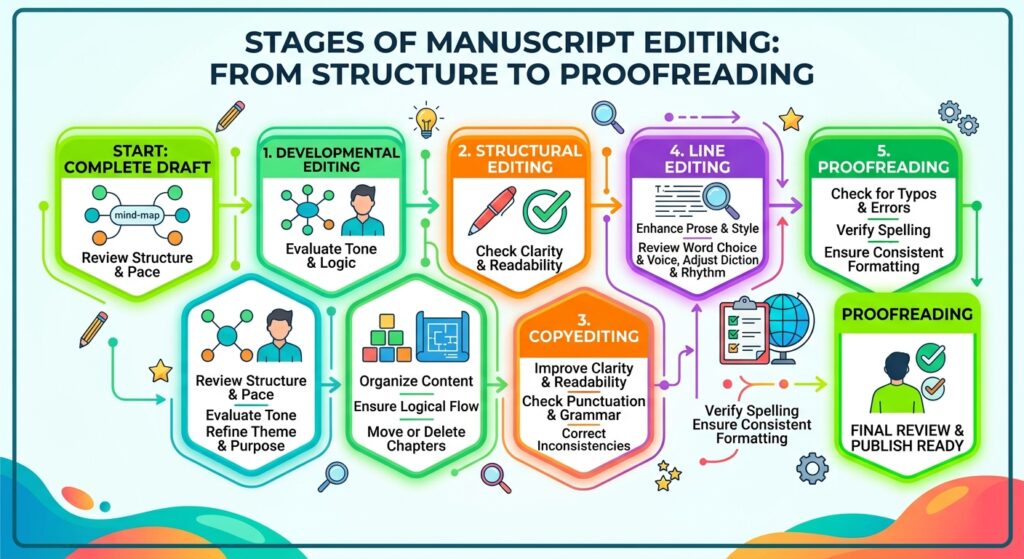
Complete editing in stages:
1. Structural editing
Check argument flow, section organization, research questions, methodology, results, and discussion.
2. Line editing
Improve clarity, precision, sentence structure, transitions, and academic tone.
3. Copyediting
Standardize terminology, capitalization, abbreviations, references, numbers, and style.
4. Proofreading
Perform the final line-by-line check after formatting and layout are locked.
A professional academic proofreading service can provide an independent final review before submission.
Common submission pitfall
Proofreading too early is inefficient. If authors proofread every sentence before completing substantive revisions, subsequent edits can introduce new errors.
The final proofreading pass should occur after the manuscript's content, references, tables, figures, and formatting are stable.
APA 7th Formatting Errors: Quick Comparison
Use this table as a final diagnostic tool before submission.
| Error | What to Check | Recommended Fix |
| DOI formatting | Legacy DOI syntax | Convert to https://doi.org/... |
| Citation mismatch | Missing or extra references | Reconcile citations and reference list |
| Heading hierarchy | Skipped/inconsistent levels | Apply logical APA levels |
| Tables/figures | Numbering, titles, notes | Standardize and follow journal specifications |
| Statistics | Symbols, decimals, p values | Audit text, tables, and figures together |
| et al. | Incorrect author shortening | Apply APA 7th in-text rules |
| Reference indent | Paragraph formatting | Apply 0.5-inch hanging indent |
| Title page | Student/professional confusion | Follow professional and journal requirements |
| Journal guidelines | Generic APA application | Build a journal compliance matrix |
| Final proofreading | Language and consistency errors | Proofread after all formatting changes |
How to Fix APA 7th Formatting Errors Efficiently
Do not attempt to correct every issue randomly. Use a controlled pre-submission formatting workflow.
Step 1: Lock the target journal
Record the journal's:
- Author guidelines
- Manuscript template
- Reference style
- Word limit
- Abstract requirements
- Figure specifications
- Reporting standards
- Blinding requirements
- Submission file requirements
Step 2: Audit references
Run a dedicated reference check for:
- Citation reference matches
- Author names
- Publication years
- DOI URLs
- URLs
- Journal titles
- Volume and issue numbers
- Page ranges
- Hanging indents
Step 3: Audit document structure
Review:
- Heading hierarchy
- Title page
- Abstract
- Keywords
- Main text
- Tables
- Figures
- Notes
- Appendices
- Supplementary files
Step 4: Audit statistical presentation
Compare statistical information across:
- Main text
- Tables
- Figures
- Supplementary analyses
Look specifically for conflicting sample sizes, p values, confidence intervals, decimal places, and test statistics.
Step 5: Complete the final language edit
Perform a final academic proofreading for journal submission only after substantive revisions and formatting are complete.
Professional APA 7th editing services can be particularly useful when a manuscript requires simultaneous language polishing and reference-format verification.
APA 7th Pre-Submission Formatting Checklist
Before uploading your manuscript to the journal portal, confirm that you have:
☐ Downloaded and reviewed the latest journal author guidelines
☐ Confirmed whether APA 7th is required and whether the journal modifies it
☐ Checked the title page and author information
☐ Verified professional-paper versus student-paper requirements
☐ Reviewed heading hierarchy
☐ Checked page numbering and running-head requirements
☐ Confirmed abstract and keyword requirements
☐ Reconciled every in-text citation with the reference list
☐ Removed uncited references where appropriate
☐ Verified author names and publication years
☐ Converted DOI information to the correct URL format
☐ Checked reference-list hanging indents
☐ Standardized capitalization and italicization
☐ Checked et al. usage
☐ Audited tables and figures
☐ Confirmed table and figure numbering
☐ Checked figure resolution and file specifications
☐ Verified statistical notation and decimal consistency
☐ Checked abbreviations and terminology
☐ Performed a final spelling and grammar review
☐ Removed tracked changes and comments if the journal requires a clean file
☐ Checked anonymous/blinded files where applicable
☐ Verified all supplementary files
☐ Confirmed that the final manuscript matches the journal's submission checklist
Conclusion
APA 7th formatting errors are often preventable because they arise from systematic inconsistencies rather than difficult research problems. The most effective approach is to audit, standardize, and verify the manuscript in a defined sequence: reconcile citations and references, correct DOI URLs, establish heading hierarchy, format tables and figures, standardize statistical reporting, and complete final academic proofreading.
Most importantly, do not treat APA 7th edition as a substitute for journal-specific instructions. A submission-ready manuscript must satisfy both the relevant APA conventions and the target journal's author requirements.
Before submission, give your manuscript an independent quality check. PaperEdit's academic editing and proofreading services can help researchers identify language, formatting, citation, and consistency issues before the manuscript reaches the journal editorial office.
Polish the details before the editor has to find them. A carefully formatted manuscript demonstrates the same precision that readers expect from the research itself.