


A research paper is more than a long academic essay. It is a structured scholarly document that investigates a focused question or problem, evaluates evidence, develops an interpretation or argument, and communicates findings according to academic conventions. Understanding what is a research paper is therefore essential for students, doctoral candidates, ESL authors, and researchers preparing manuscripts for publication.
A strong paper must do more than demonstrate that you have read relevant sources. It should establish a clear research purpose, use credible evidence, follow an appropriate methodology or analytical framework, document sources accurately, and present conclusions that logically follow from the evidence. For journal submission, the manuscript must also comply with the target journal's formatting, reporting, ethical, and submission requirements.
This guide explains the definition of a research paper, major types of research papers, research paper examples, the difference between a research paper and an essay, standard academic research paper components, empirical and analytical structures, the IMRaD format, and essential pre-submission checks.
💡 Ready to polish your research paper for publication?
Transform your manuscript with PaperEdit's professional editing and proofreading services!
What Is a Research Paper?
A research paper is an academic document that presents the results, analysis, interpretation, or synthesis of systematic research on a defined topic or research question.
The research may involve primary evidence, such as experiments, surveys, interviews, observations, or laboratory measurements, or secondary evidence, such as published studies, archival documents, datasets, and scholarly literature.
A research paper normally has four defining characteristics:
- A focused research problem or question — The paper investigates something specific rather than discussing a broad subject without direction.
- Evidence-based reasoning — Claims are supported by data, scholarly sources, observations, or a documented analytical process.
- A systematic structure — Ideas and evidence are organized according to the research design and discipline.
- Transparent documentation — Sources, methods, limitations, and relevant analytical decisions are reported clearly.
The exact structure varies by discipline. An original scientific study may use IMRaD (Introduction, Methods, Results, and Discussion) whereas a humanities paper may use a thesis-driven introduction followed by analytical sections and a conclusion. Medical journals commonly use IMRaD for original research, while systematic reviews and other article types can require different structures.
Why Does a Research Paper Matter?
Research papers serve several purposes. They can:
- communicate original research findings;
- analyze existing scholarship;
- evaluate competing explanations;
- synthesize evidence from multiple studies;
- develop or test theoretical propositions;
- present a defensible academic argument; and
- contribute evidence to an ongoing scholarly conversation.
For researchers seeking publication, the paper is also the primary vehicle through which editors and peer reviewers evaluate the significance, rigor, originality, clarity, and reproducibility of the work.
A technically sound study can still encounter editorial problems when its research question is unclear, its methods are inadequately described, its citations are inconsistent, or its manuscript does not comply with journal requirements.
Research Paper vs. Essay: What Is the Difference?
A research paper and an academic essay can look similar because both may contain an introduction, body paragraphs, evidence, citations, and a conclusion. Their purpose and evidentiary expectations, however, are often different.
An essay may primarily explain, interpret, or argue a position using a relatively limited body of evidence. A research paper generally requires a more systematic investigation and engagement with scholarly literature, data, methodology, or a defined analytical framework.
| Feature | Research Paper | Academic Essay |
| Primary purpose | Investigate, analyze, synthesize, or report research | Explain, interpret, or argue |
| Research question | Usually explicit or strongly implied | May be explicit or implicit |
| Evidence | Scholarly sources, datasets, experiments, observations, or other research evidence | Often primarily textual or scholarly evidence |
| Methodology | Required for empirical research and important in many systematic investigations | Usually not a formal section |
| Literature review | Often substantial | Usually integrated into discussion |
| Structure | Determined by research design and discipline | Commonly introduction, body, conclusion |
| Citations | Frequently extensive and style-specific | Required when sources are used |
| Publication readiness | May be prepared for journal submission | Usually prepared for coursework or general academic assessment |
The distinction is not absolute. A university research essay can contain substantial research, while a short research paper may resemble an extended essay. The decisive question is how systematically the work investigates and documents its subject.
Major Types of Research Papers
There is no single universal classification of research papers. Terminology differs among disciplines, universities, and journals. Nevertheless, several categories are widely used.
1. Empirical Research Paper
An empirical research paper reports research based on observed or measured evidence.
Examples include:
- randomized controlled experiments;
- laboratory studies;
- observational studies;
- surveys;
- interviews;
- field studies; and
- quantitative or qualitative investigations.
An empirical research paper format commonly includes:
Title → Abstract → Introduction → Methods → Results → Discussion → Conclusion → References
In scientific and medical publishing, this often corresponds to the IMRaD model. The Methods section should provide sufficient detail for readers to understand how the study was conducted and, where applicable, reproduce the work.
Example:
A researcher investigates whether a six-week intervention improves reading comprehension among university students. The paper describes the participant sample, intervention, measurement instruments, statistical analysis, findings, limitations, and implications.
Common pitfall: Reporting conclusions that are stronger than the data support. Statistical significance does not automatically establish practical significance, causality, or generalizability.
2. Analytical Research Paper
An analytical research paper examines evidence to develop an interpretation rather than merely describing information.
A typical analytical research paper example might examine how climate policy affects energy investment by comparing empirical studies, economic models, policy documents, and competing interpretations.
A strong analytical paper should:
- establish a precise analytical question;
- define the concepts being examined;
- evaluate evidence rather than merely summarize it;
- compare competing interpretations;
- identify patterns or relationships; and
- develop a reasoned conclusion.
Common pitfall: Turning the literature review into a sequence of summaries. Analysis requires synthesis and evaluation. Each source should contribute to the paper's central analytical purpose.
3. Argumentative Research Paper
An argumentative research paper presents a defensible claim and supports it with credible evidence.
A useful argumentative research paper structure is:
Research problem → Thesis/claim → Evidence → Analysis → Counterargument → Rebuttal → Conclusion
For example, a paper might argue that universities should adopt structured research-data management policies. The author would need to establish the problem, evaluate evidence, address objections, and demonstrate why the proposed position is justified.
A credible argument is not simply a strongly worded opinion. The central claim must be supported by appropriate evidence and logical reasoning. Purdue OWL similarly emphasizes the relationship among claims, reasons, evidence, and counterarguments in academic argumentation.
Common pitfall: Using emotionally persuasive language where empirical evidence is required.
4. Literature Review Paper
A literature review paper evaluates and synthesizes existing scholarship on a defined topic.
It should answer questions such as:
- What has already been established?
- Where do researchers disagree?
- What methodological patterns appear across studies?
- What limitations recur?
- What research gaps remain?
A literature review is not simply an annotated bibliography. The writer must organize studies around concepts, themes, methodologies, findings, or debates.
Example:
A literature review examines research published between 2018 and 2026 on artificial intelligence-assisted language learning, identifying methodological trends and unresolved questions.
Common pitfall: Organizing the review only by publication date or author name without developing a synthesis.
5. Systematic Literature Review
A systematic literature review is a structured review that uses predefined and transparent methods to identify, select, evaluate, and synthesize relevant studies.
A systematic literature review definition therefore goes beyond "a review of many papers." It involves an explicit research question, documented search strategy, eligibility criteria, screening process, and method of synthesis.
Depending on the discipline, systematic reviews may follow reporting frameworks such as PRISMA. ICMJE identifies PRISMA as a relevant reporting guideline for systematic reviews and meta-analyses.
Common pitfall: Calling a conventional narrative literature review "systematic" without documenting the search and selection methodology.
6. Theoretical or Conceptual Research Paper
A theoretical paper examines, develops, critiques, or extends theoretical concepts.
It may:
- propose a conceptual framework;
- compare competing theories;
- identify limitations in an existing model;
- integrate theories from different disciplines; or
- develop propositions for future empirical testing.
The evidence base may consist primarily of existing scholarship rather than newly collected data.
7. Methodological Research Paper
A methodological paper focuses on a research method, analytical technique, measurement instrument, computational procedure, or research protocol.
For example, a methodological paper might introduce a new statistical model for detecting bias in survey responses.
Its central contribution is the method or methodological insight, not necessarily a conventional empirical finding.
8. Case Study Research Paper
A case study examines a particular organization, community, event, patient case, policy, institution, or other bounded phenomenon in depth.
Case studies can use qualitative, quantitative, or mixed-method evidence.
Common pitfall: Treating one case as automatically representative of an entire population. Authors must distinguish between what the case demonstrates and what can reasonably be generalized.
What Are the Main Components of a Research Paper?
Although the exact requirements vary, most academic research papers contain a recognizable set of components.
Title
The title should identify the subject, population, intervention, relationship, phenomenon, or research problem clearly.
Avoid unnecessarily long titles, unexplained abbreviations, and vague phrases such as "A Study of..."
Abstract
The abstract provides a compressed representation of the study. Depending on the discipline, it may include:
- background;
- objective;
- methods;
- results;
- conclusion; and
- keywords.
Follow the target journal's word limit rather than assuming a universal abstract length.
Introduction
The introduction establishes the research context and explains why the problem matters.
A strong introduction generally moves from:
Broad context → research problem → knowledge gap → research objective/question → contribution
Literature Review
The literature review positions the research within existing scholarship. It should demonstrate knowledge of relevant studies while identifying the gap the paper addresses.
Methods
The Methods section explains how the research was conducted.
Depending on the study, it may include:
- study design;
- participants or datasets;
- materials and instruments;
- procedures;
- variables;
- inclusion/exclusion criteria;
- statistical or qualitative analysis;
- ethical approval; and
- reproducibility information.
Results
Results report what the study found without unnecessarily interpreting the implications.
Use tables and figures strategically. Every table or figure should serve a clear analytical purpose and be cited in the text.
Discussion
The Discussion interprets the findings, connects them with previous research, explains implications, acknowledges limitations, and identifies appropriate directions for future work.
Conclusion
The conclusion should answer the research question without introducing major unsupported claims or entirely new evidence.
References
Every cited source should be traceable, accurately documented, and formatted according to the required citation style.
Understanding the IMRaD Format
The IMRaD format research paper structure is one of the most recognizable models in scientific publishing:
Introduction → Methods → Results → Discussion
The structure reflects the logic of empirical research: establish the problem, explain how it was investigated, report the findings, and interpret their significance. ICMJE describes IMRAD as the usual structure for articles reporting original research.
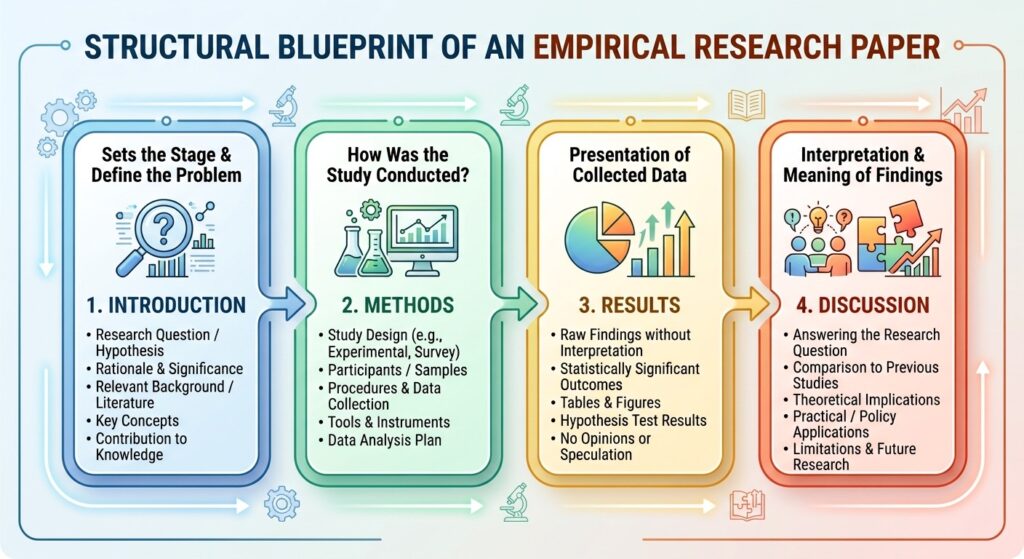
Introduction: Why was the study conducted?
State the problem, establish relevant context, identify the research gap, and define the objective or hypothesis.
Methods: How was it conducted?
Describe the research design and procedures with sufficient precision.
Results: What was found?
Present the evidence generated by the research. Avoid interpreting every result immediately.
Discussion: What do the findings mean?
Interpret the findings in relation to the research question and previous scholarship.
Industry-standard criterion: The four sections should form a logical chain. A reader should be able to connect the research objective in the Introduction to the methods used, the reported results, and the conclusions drawn from those results.
Common submission pitfall: Mixing Results and Discussion indiscriminately when the target journal requires separate sections.
Also read: How to Format Tables and Figures in APA 7th Edition
Research Paper Structure and Layout: A Practical Model
The research paper structure and layout depend on the target discipline and journal. Never treat a generic university template as a substitute for journal-specific instructions.
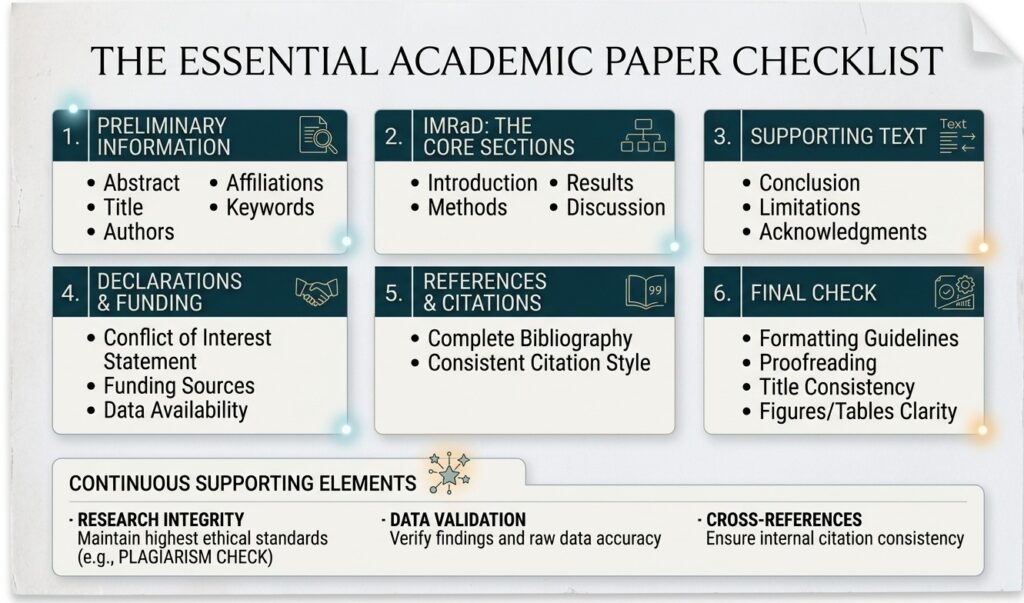
A publication-oriented manuscript may contain:
- Title page or title information
- Abstract
- Keywords
- Introduction
- Literature review or background
- Methods
- Results
- Discussion
- Conclusion
- Acknowledgments
- Funding statement
- Conflict-of-interest statement
- Data availability statement
- References
- Tables
- Figures
- Supplementary material
Not every paper requires every element.
For example, ICMJE's manuscript-preparation guidance addresses title pages, abstracts, Introduction, Methods, Results, Discussion, references, tables, illustrations, units, and abbreviations, while also emphasizing journal-specific instructions.
Formatting Standards
There is no universal font, margin, line-spacing, or figure specification for every research paper.
However, common academic formatting conventions include:
- consistent font and heading hierarchy;
- readable line spacing;
- standard page margins;
- numbered pages where required;
- consistent paragraph formatting;
- properly formatted tables and figures;
- continuous or journal-specified line numbering;
- correctly formatted citations and references; and
- figures prepared at the resolution and file type specified by the journal.
For example, IEEE provides official Word and LaTeX templates to help authors prepare articles for peer review, including guidance on structural and stylistic elements.
Do not assume that 12-point Times New Roman, double spacing, 1-inch margins, or 300-DPI figures are universal journal requirements. These conventions may be appropriate in some academic contexts, but publication requirements are journal-specific.
Citation Styles: APA 7th, IEEE, MLA, Chicago, and Vancouver
Citation style is part of manuscript compliance, not cosmetic formatting.
| Citation Style | Common Fields | In-Text Approach | Reference Organization |
| APA 7th | Psychology, education, social sciences | Author-date | Alphabetical |
| IEEE | Engineering, computing, technology | Numbered | Order of citation |
| Vancouver | Medicine, health sciences | Numbered | Order of citation |
| MLA | Literature, humanities | Author-page | Alphabetical |
| Chicago | History and multidisciplinary research | Notes or author-date | Depends on system |
| Harvard | Multiple disciplines | Author-date | Usually alphabetical |
What to audit: author names, publication years, article titles, journal titles, volume/issue information, page ranges, DOIs, URLs where required, capitalization, italics, punctuation, and citation-reference matching.
Common pitfall: Using reference-manager output without manually checking it. Automated reference formatting can preserve incorrect metadata or apply the wrong style variant.
Research Paper Examples: How the Types Differ
Consider the topic "Remote Work and Employee Productivity."
Empirical example
Research question: Does remote work influence employee productivity?
The researcher collects productivity data from 500 employees and analyzes the relationship between work arrangement and measured output.
Analytical example
Research question: Why do studies of remote-work productivity produce conflicting findings?
The researcher compares existing studies, evaluates their methodologies, and identifies factors that may explain divergent results.
Argumentative example
Thesis: Organizations should adopt flexible hybrid-work policies for roles that can be performed effectively outside the office.
The paper evaluates productivity research, employee well-being studies, organizational evidence, and counterarguments before defending the proposed policy.
Systematic review example
Research question: What does the published evidence show about the relationship between remote work and employee productivity?
The authors define eligibility criteria, search multiple databases, screen studies systematically, assess evidence, and synthesize findings.
These examples demonstrate an important principle: the topic does not determine the research-paper type; the research question and method do.
Common Research Paper Mistakes That Weaken a Manuscript
1. The research question is too broad
"How does technology affect education?" is difficult to investigate rigorously.
A stronger question specifies a population, intervention or exposure, outcome, context, or timeframe where appropriate.
2. The literature review becomes a summary
Listing what each researcher said does not constitute synthesis. Compare findings, methodologies, assumptions, limitations, and gaps.
3. The thesis is not evidence-based
A research paper should not depend on unsupported personal opinion.
4. Methods are incomplete
Readers need enough methodological information to understand how conclusions were generated.
5. Citations are inconsistent
Switching between APA, Harvard, and numbered citations signals inadequate manuscript control.
6. The manuscript contains language errors
Grammar, terminology, article usage, sentence structure, and inconsistent academic tone can obscure otherwise strong research particularly for ESL authors.
7. Plagiarism screening is treated as a substitute for citation practice
A research paper plagiarism scan can identify textual similarity, but it cannot determine whether every source has been appropriately attributed or whether an author's synthesis is academically sound.
8. Journal guidelines are checked too late
A manuscript can be scientifically strong and still require substantial pre-review corrections if it fails basic submission requirements.
Also read: Professional Academic and Scientific Proofreading Services for Journal-Ready Manuscripts
How to Prepare a Research Paper for Journal Submission
Before submission, move through the manuscript in stages rather than attempting one final proofreading pass.
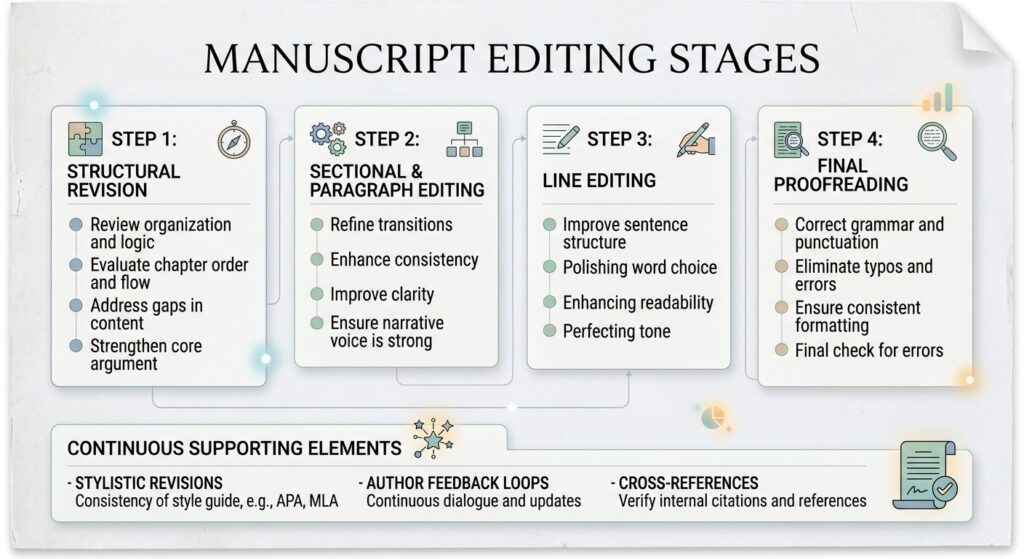
Stage 1: Audit the research logic
Confirm that:
- the research question is explicit;
- the objectives align with the methods;
- the methods generate evidence capable of answering the question;
- the Results correspond to the stated methods; and
- the conclusions do not exceed the evidence.
Stage 2: Refine the structure
Check heading hierarchy, paragraph progression, transitions, repetition, and logical relationships among sections.
Stage 3: Perform academic copyediting
Review:
- grammar;
- syntax;
- terminology;
- academic tone;
- voice consistency;
- abbreviations;
- tense;
- subject–verb agreement;
- article usage; and
- sentence-level clarity.
This stage is particularly valuable for ESL authors because language polishing should improve clarity without changing the author's scientific meaning or intellectual voice.
Stage 4: Standardize references
Choose the required citation style and audit every in-text citation against the reference list.
Stage 5: Format the manuscript
Apply the journal's requirements for:
- manuscript length;
- headings;
- tables;
- figures;
- references;
- supplementary files;
- line numbering;
- title page;
- abstract;
- keywords; and
- file format.
Stage 6: Conduct final proofreading
Proofread the final version after all substantive changes have been made. Check the PDF or submission-ready file visually as well as the editable manuscript.
Stage 7: Verify submission requirements
Review the journal's current author instructions immediately before submission. For medical journals, ICMJE guidance also highlights cover letters or submission forms, disclosures, authorship statements, and other submission information.
Scientific Paper Submission Guidelines: What to Verify
Journal submission requirements differ significantly. Your final audit should therefore be journal-specific.
Verify:
- article type;
- scope and aims;
- word count;
- abstract format;
- keyword requirements;
- reference style;
- maximum number of references;
- table and figure limits;
- figure file specifications;
- supplementary-material requirements;
- reporting guidelines;
- ethics statements;
- informed-consent requirements;
- conflict-of-interest declarations;
- funding information;
- data availability;
- author contribution statements;
- ORCID requirements;
- cover letter requirements; and
- anonymization requirements for double-blind review.
For biomedical research, select the relevant reporting guideline rather than applying a generic checklist. ICMJE identifies frameworks including CONSORT for randomized trials, STROBE for observational studies, and PRISMA for systematic reviews and meta-analyses.
The ICMJE Recommendations were updated in January 2026, including expanded guidance on AI in publishing and authors' access to data.
For IEEE submissions, consult the IEEE Author Center and use the appropriate official template rather than recreating the format manually.
For general academic writing and citation guidance, the Purdue Online Writing Lab (Purdue OWL) provides resources covering academic writing and major citation styles.
Final Research Paper Pre-Submission Checklist
Before uploading your manuscript, audit every layer of the paper:
Research quality
- Research question is focused and clearly stated.
- Objectives and hypotheses are consistent with the research question.
- Methods are appropriate and adequately described.
- Results answer the stated research objectives.
- Conclusions are supported by the evidence.
- Limitations are acknowledged appropriately.
Academic writing
- Academic tone is consistent.
- Grammar and syntax have been checked.
- Terminology is consistent throughout.
- Acronyms are defined at first use.
- Repetition and unnecessary wording have been eliminated.
- ESL language issues have been professionally reviewed where necessary.
Citations and references
- Every in-text citation appears in the reference list.
- Every listed reference is cited in the manuscript where required.
- Citation style matches the target journal.
- DOI and bibliographic information have been verified.
- References have been checked against original sources.
Formatting
- Manuscript follows the current journal template or instructions.
- Heading levels are consistent.
- Tables and figures are numbered correctly.
- Every table and figure is cited in the text.
- Figure legends are complete.
- Required resolution and file formats have been followed.
- Supplementary files are correctly labeled.
Submission readiness
- Abstract meets the journal's structure and word limit.
- Keywords meet journal requirements.
- Required reporting guideline has been followed.
- Ethics and consent statements are included where applicable.
- Funding and conflict-of-interest declarations are complete.
- Author information and contributions are correct.
- Cover letter is prepared if required.
- Manuscript has undergone final scientific manuscript proofreading.
- Appropriate plagiarism/similarity screening has been completed.
- Final files open correctly and contain no tracked changes or comments unless requested.
Conclusion
A research paper is a structured scholarly investigation—not simply an extended essay. Its defining features are a focused research problem, evidence-based reasoning, transparent methodology or analytical process, engagement with relevant scholarship, and disciplined academic presentation. The appropriate structure depends on the research design: an empirical study may follow IMRaD, an analytical paper may be organized around competing interpretations, an argumentative paper around claims and evidence, and a systematic review around a documented search and synthesis methodology.
For publication, strong research must be matched by strong manuscript preparation. Audit the argument, refine the academic language, standardize citations, format every element according to the target journal, verify reporting requirements, and proofread the final submission carefully.
If you need an additional layer of expert review, PaperEdit's professional academic and scientific proofreading and editing services can help refine research papers, dissertations, and manuscripts for clarity, consistency, accuracy, and publication readiness.