


Most manuscripts don’t fail because the research is weak. They fail because the writing hides the research.
That distinction matters.
If your paper keeps getting rejected, delayed, or returned with heavy revisions, the issue is rarely just grammar. It’s deeper—structural flaws, unclear positioning, weak logic, or poor adherence to journal expectations. These are real manuscript problems, and they are diagnosable if you know where to look.
This guide breaks down how to audit your manuscript like an editor—section by section—so you can identify what’s not working and fix it before reviewers ever see it.
A professional review from PaperEdit can also help uncover blind spots before submission.
Why Manuscript Problems Often Go Undetected
Writers read what they meant to say.
Reviewers read what is actually written.
That gap is where most problems live.
After multiple revisions, your brain auto-fills missing logic, weak transitions, and vague arguments. But reviewers approach your manuscript cold. They don’t assume clarity—they expect it.
According to standards emphasized by the Committee on Publication Ethics, transparency and clarity are core to credible research reporting. If your paper lacks either, it loses trust immediately.
Common hidden issues include:
- Logical gaps between sections
- Weak or missing research gaps
- Redundant paragraphs
- Inconsistent terminology
- Poorly explained methods
- Overstated conclusions
- Formatting errors
These aren’t surface mistakes. They’re structural failures.
Diagnose Structure Before Fixing Language
If your manuscript is not working, don’t start with grammar. Start with architecture.
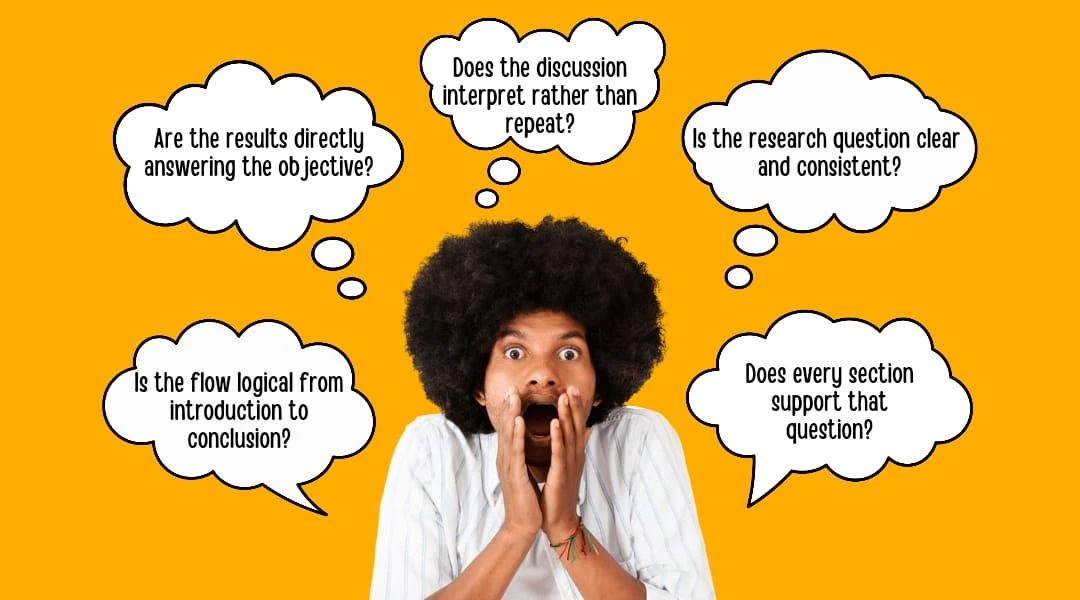
Ask yourself these questions.
If the structure is weak, sentence-level editing will not fix it.
Think of your manuscript as a system. If the foundation is unstable, polishing sentences is wasted effort.
If you’re unsure about structure, PaperEdit proofreading support can help identify high-level issues early.
Fixing Introduction-Level Manuscript Problems
The introduction is where most manuscripts quietly fail.
Too many authors treat it as a background section instead of a strategic argument. They summarize existing research but fail to define what is missing—and why their study matters.
A strong introduction answers three things fast:
- What is already known?
- What is missing?
- Why does your study matter now?
If your reader cannot answer these questions within the first page, your introduction needs revision.
Common Introduction Errors
- Starting too broad
- No clear research gap
- Listing studies without synthesis
- Weak objective statement
- Excessive citations with no direction
What to Do Instead
Narrow quickly. Move from a general context to a precise research gap. Then state your objective clearly and directly.
A focused introduction builds reviewer confidence immediately.
Evaluating Your Manuscript Format and Presentation
Formatting is not cosmetic—it’s strategic.
A poor manuscript format signals carelessness, even when the research is strong. Editors notice presentation within seconds.
Before submission, confirm:
- The title page is complete
- Abstract meets journal requirements
- Headings follow a consistent structure
- References match journal style
- Tables and figures are properly labeled
- Word count is within limits
- File format matches submission guidelines
Most scientific papers follow structured formats like IMRaD, widely documented by the National Library of Medicine. Learn more with the guide "IMRaD Structure Explained with Real Examples."
Drafting on blank manuscript paper, using free manuscript paper, or working from an old template is fine initially—but final formatting must match journal-specific instructions.
If formatting feels overwhelming, PaperEdit journal formatting services can ensure compliance before submission.
Diagnosing Weak Methods Sections
The methods section determines whether your study is believable.
If reviewers cannot understand exactly what you did, they cannot trust your results.
Key Questions to Ask
- Is the sample clearly defined?
- Are the inclusion and exclusion criteria stated?
- Are tools and instruments described?
- Is the study design clear?
- Are statistical methods appropriate and explained?
- Is ethical approval mentioned?
Common Methods Problems
- Missing procedural detail
- Vague descriptions
- No justification for choices
- Incomplete statistical reporting
- Lack of reproducibility
For health and scientific writing, frameworks supported by the EQUATOR Network provide structured guidance to improve reporting quality.
If your methods cannot be replicated, your paper loses credibility—no matter how strong your findings are.
Results Section: Where Clarity Often Breaks
The results section should present findings, not interpret them.
Yet many authors mix analysis and explanation, creating confusion.
Common Results Mistakes
- Repeating data already shown in tables
- Adding interpretation prematurely
- Presenting results without logical order
- Ignoring negative findings
- Overloading tables with data
A Better Approach
Structure your results clearly:
- Start with sample characteristics
- Present primary outcomes
- Move to secondary findings
- Include relevant subgroup analyses
Use tables and figures strategically. A clean, readable manuscript layout improves readability and reduces reviewer fatigue.
If readers struggle to follow your results, the issue is clarity—not content.
Discussion Section: The Most Misused Part of a Manuscript
This is where many serious manuscript problems emerge.
Authors often repeat results, overstate significance, or ignore limitations.
A strong discussion does four things:
1. Interprets Findings
Explain what your results actually mean.
2. Connects to Existing Literature
Show how your findings align or differ.
3. Acknowledges Limitations
Be honest about constraints.
4. Highlights Relevance
Explain why your findings matter.
Editorial standards reflected in journals like The BMJ emphasize balanced interpretation over exaggerated claims.
Warning Signs
- Overconfident conclusions
- Ignoring contradictory evidence
- No limitations section
- Repetition of results
- Lack of real-world relevance
Precision builds credibility. Overstatement destroys it.
Language Problems vs. Thinking Problems
Not all writing issues are grammatical.
Some are conceptual.
Surface-Level Issues
- Grammar mistakes
- Typos
- Awkward phrasing
Deep-Level Issues
- Weak argument structure
- Poor logical flow
- Redundant sections
- Missing connections between ideas
Most rejected manuscripts suffer from thinking problems—not just language issues.
That’s why services like PaperEdit focus on both structure and clarity, not just proofreading.
Diagnosing Weak Conclusions
A conclusion should reflect what your study actually proved, not what you wish it proved.
Common Conclusion Errors
- Overgeneralization
- Repeating the abstract
- Introducing new ideas
- Ignoring study limitations
Strong Conclusion Strategy
- Restate the key finding
- Keep claims proportional to evidence
- Suggest future research carefully
- Avoid exaggerated language
A disciplined conclusion signals academic maturity.
Journal Fit: The Overlooked Problem
Sometimes the manuscript is not the issue—the journal is.
A mismatch between your paper and the journal’s scope can lead to rejection regardless of quality.
Evaluate Fit Carefully
- Does the journal publish similar studies?
- Is your methodology aligned?
- Is your audience appropriate?
- Are your findings relevant to their readership?
Submitting a niche study to a broad-impact journal—or vice versa—reduces your chances immediately.
For submission strategy support, refer to this guide: How to Turn Your Thesis into a Publishable Journal Article?
Co-Author Inconsistencies That Hurt Manuscripts
Multi-author papers often suffer from uneven writing.
Each contributor brings a different style, leading to:
- Inconsistent tone
- Repeated background sections
- Conflicting terminology
- Disjointed flow
Solution
Assign one lead editor to unify the manuscript before submission.
Without this step, the paper feels fragmented—even if the research is strong.
Final Self-Diagnosis Checklist
Before submitting your paper, run this audit:
| Section | Key Question | Risk |
| Title | Is it clear and specific? | High |
| Abstract | Can it stand alone? | Critical |
| Introduction | Is the research gap clear? | High |
| Methods | Reproducible? | Critical |
| Results | Logical and clean? | High |
| Discussion | Balanced and insightful? | Critical |
| Conclusion | Evidence-based? | High |
| Formatting | Journal-compliant? | High |
If multiple areas feel uncertain, revise before submission.
When to Seek Professional Help
You should consider expert editing when:
- Rejections repeat without clear reasons
- Reviewer feedback highlights clarity issues
- English is not your first language
- You are targeting a high-impact journal
- Your draft feels complete but not convincing
A rough manuscript book of ideas can become a publishable article—but only with strong editorial refinement.
That’s where PaperEdit helps transform drafts into submission-ready manuscripts.
Final Thought
Most rejected manuscripts are not weak—they are unclear.
Hence, the difference between acceptance and rejection often comes down to how well your research is communicated, structured, and presented.
If you can identify and fix manuscript problems before submission, you shift the advantage in your favor.
Write with clarity.
Revise with discipline.
Submit with confidence.
References