


Choosing the correct citation system can be challenging when preparing a research paper, dissertation, or journal manuscript. The Chicago Manual of Style offers two primary citation systems: Notes-Bibliography and Author-Date. Both document sources, acknowledge intellectual contributions, and help readers verify evidence, but they differ in how citations appear in the text and how source details are organized at the end of a manuscript.
Selecting the appropriate system affects more than reference formatting. It influences readability, the presentation of historical evidence, the integration of scholarly commentary, and compliance with journal submission guidelines. An inconsistent citation system can also create avoidable editorial corrections during manuscript screening.
This guide explains the Chicago Manual of Style Notes-Bibliography vs. Author-Date systems, including their formatting rules, footnote and endnote conventions, bibliography requirements, and practical applications. You will also learn how to select the appropriate system, convert between the two, and audit your manuscript before submission.
💡 Ready to polish your research paper for publication?
Transform your manuscript with PaperEdit's professional editing and proofreading services!
1. What Are the Two Chicago Citation Systems?
The Chicago Manual of Style (CMOS) is a widely used editorial reference for academic writing, publishing, and manuscript preparation. Its two principal documentation systems serve the same purpose identifying sources accurately but organize citations differently.
Notes-Bibliography (NB)
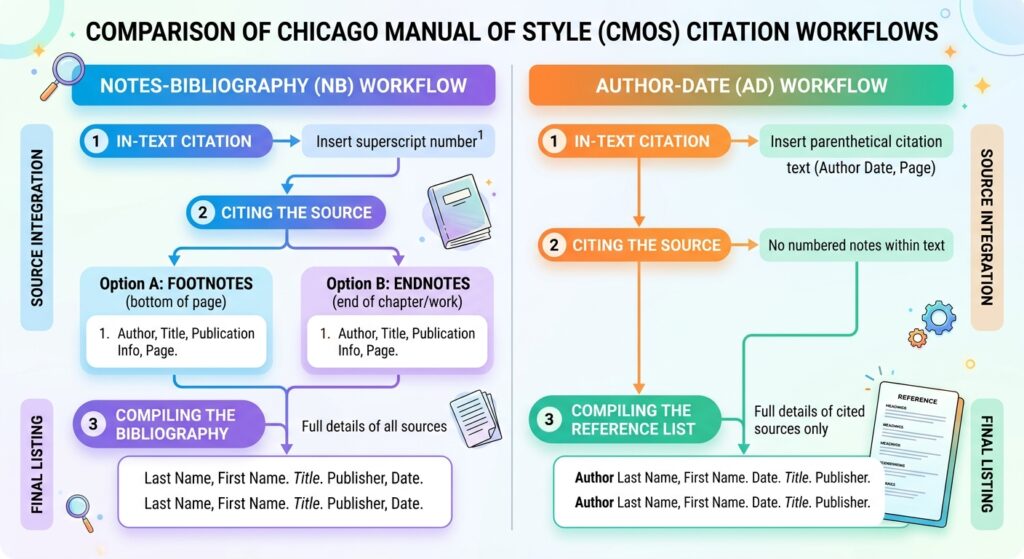
The Notes-Bibliography system identifies sources through numbered superscript citations in the text, corresponding to footnotes or endnotes. These notes can provide publication details and, where appropriate, supplementary explanations. A bibliography generally appears at the end of the manuscript.
This system is particularly useful in history, literature, philosophy, art history, and other humanities disciplines, where researchers often work with archival documents, primary sources, editions, and interpretive commentary.
Author-Date (AD)
The Author-Date system places brief parenthetical citations in the text, usually containing the author's surname and publication year. A page number is added when needed to direct readers to a specific passage, quotation, or claim. Full publication details appear in a reference list, commonly titled References.
For example, a citation might appear as (Garcia 2024, 87). This compact format allows readers to identify the author and publication year without interrupting the main argument with a footnote.
Author-Date is frequently used in the social sciences and sciences, where publication chronology and concise source attribution are important.
The essential distinction: Notes-Bibliography directs readers to numbered notes, while Author-Date integrates source information directly into the text through parenthetical citations.
2. Chicago Notes-Bibliography vs. Author-Date: Key Differences
Use the following comparison to determine which system best fits your manuscript.
| Feature | Notes-Bibliography | Author-Date |
| In-text citation | Superscript note number | Parenthetical author and year |
| Source details | Footnotes or endnotes | Parenthetical citations |
| End matter | Usually a bibliography | Usually a reference list |
| Explanatory commentary | Can be incorporated into notes | Generally kept in the main text or handled through limited notes |
| Repeated citations | Full notes and shortened notes | Author-year citations repeated as needed |
| Typical applications | Humanities and historical research | Social sciences and empirical research |
| Reader navigation | Follows numbered notes | Identifies sources through author and date |
| Main formatting concern | Note placement, numbering, and shortened citations | Author names, dates, and consistency with the reference list |
Neither system is universally superior. The correct choice depends on the target journal's instructions, the discipline's conventions, and the needs of the research. Always prioritize explicit submission requirements over general disciplinary preferences.
Also read: Complete Master’s & PhD Dissertation Defense & Formatting Checklist
3. How Does Chicago Notes-Bibliography Work?
Notes-Bibliography is designed to document sources while allowing the main text to remain relatively uncluttered. It also provides room for clarifications that would interrupt the flow of an argument.
Step 1: Insert numbered citations in the text
Place a superscript Arabic numeral at the appropriate point in the sentence. In standard Chicago practice, the note number normally follows punctuation, including commas and periods.
Example:
Historical correspondence reveals how diplomatic priorities shifted during the negotiations.¹
The superscript directs the reader to the corresponding note.
Step 2: Format footnotes or endnotes correctly
A footnote appears at the bottom of the page containing the citation. An endnote appears in a dedicated section, typically near the end of the document or before the bibliography.
For a typical book citation, the first note includes the author's name in normal order, the title in italics, publication information, and the relevant page number.
Example:
- Maria Garcia, Diplomacy and Political Change (Chicago: Northbridge Press, 2024), 87.
This is an illustrative reference, not a real publication.
Use the citation placement and note format required by the journal, university, or publisher. Footnotes can be convenient for readers consulting individual pages, whereas endnotes can reduce visual clutter in some long manuscripts.
Step 3: Use shortened notes for repeated sources
After the first full citation, subsequent notes to the same work generally use a shortened form, often the author's surname, a shortened title, and the cited page number.
Example:
- Garcia, Diplomacy and Political Change, 102.
Shortened notes should identify the source unambiguously. If an author has multiple works in the manuscript, include enough of each title to distinguish them.
Avoid relying on ibid. as a default shortcut. Chicago's current guidance generally favors clear shortened citations, although particular publisher instructions may differ.
Step 4: Prepare the bibliography
A bibliography typically lists sources alphabetically by author surname. Its entries provide fuller publication details than shortened notes and usually follow a different name-order convention.
Bibliography example:
Garcia, Maria. Diplomacy and Political Change. Chicago: Northbridge Press, 2024.
The example is illustrative. Consult the current Chicago guidance for the exact treatment of books, journal articles, chapters, websites, archival materials, and other source types.
Industry-standard criteria and common pitfalls
A submission-ready Notes-Bibliography manuscript should have sequential note numbering, accurate source details, consistent shortened citations, and a bibliography that follows the applicable Chicago edition and publisher requirements.
Common problems include restarting note numbering unintentionally, omitting page numbers for specific quotations, mixing full and shortened notes inconsistently, and including bibliography entries that cannot be matched to the manuscript's sources. Do not assume that every note must have a corresponding bibliography entry or that every bibliography entry must be cited in the text; apply the relevant Chicago rules and the journal's specific requirements to each source category.
Also read: How to Write Thesis Discussion Chapter: Chapter 5 Structure & Future Research Directions 2026 Guide
4. How Does Chicago Author-Date Work?
Author-Date makes the relationship between a claim and its source visible within the paragraph. Readers can quickly recognize publication dates and trace evidence through the reference list.
Step 1: Insert parenthetical citations
A standard citation contains the author's surname and year of publication, separated by a space. A comma introduces a page number or page range when one is included.
Example:
Publication timing can shape the interpretation of institutional change (Garcia 2024, 87).
If the author's name already appears in the sentence, avoid unnecessary repetition:
Garcia (2024, 87) argues that publication timing shapes the interpretation of institutional change.
These examples are illustrative and do not refer to a verified publication.
Step 2: Cite direct quotations precisely
When quoting a source, provide a page number or another appropriate locator whenever available and required by the source type and context.
Example:
“[Illustrative quotation text]” (Garcia 2024, 91).
Replace the placeholder with the source's exact wording. Never invent quotations or page numbers. For unpaginated web content, use an appropriate locator when available, such as a section heading or paragraph number, if useful and permitted by the applicable guidance.
Step 3: Create a reference list
The reference list appears at the end of the manuscript and normally contains sources cited in the text. Entries are arranged alphabetically by author surname, with publication years positioned prominently after the author information.
Illustrative book reference:
Garcia, Maria. 2024. Diplomacy and Political Change. Chicago: Northbridge Press.
Check the applicable Chicago edition for exact punctuation and bibliographic details. Journal articles, edited-book chapters, online publications, and other sources require different entry formats.
Step 4: Match every citation to its reference
Audit each parenthetical citation against the reference list. Author surnames and publication years should correspond, and works by the same author published in the same year may require letter suffixes, such as 2024a and 2024b, according to the relevant rules.
Common errors include omitting a cited work from the reference list, listing uncited works without justification, using inconsistent publication years, and formatting page numbers incorrectly. In multi-author citations, follow the applicable Chicago rules rather than assuming that every source uses the same number of names in the parenthetical citation.
Also read: PaperEdit's academic editing and proofreading services can help authors identify citation inconsistencies and refine manuscripts before submission.
5. Should You Use Footnotes or Endnotes in Chicago Style?
The choice between footnotes and endnotes applies primarily to the Notes-Bibliography system. Both connect numbered citations to source information, but their placement affects the reading experience.
| Consideration | Footnotes | Endnotes |
| Location | Bottom of the relevant page | Dedicated notes section |
| Reader access | Immediate | Requires navigation to the notes section |
| Page layout | Can occupy substantial page space | Keeps individual pages visually cleaner |
| Common use | Books, humanities papers, and publications requiring accessible notes | Long manuscripts and publications with specific endnote requirements |
Choose footnotes when immediate access to citations and commentary improves readability and the publisher permits them. Choose endnotes when the submission guidelines specify them or when a consolidated notes section better serves the document.
Chicago footnote numbering and placement rules
- Use Arabic numerals for note callouts.
- Number notes consecutively throughout the work unless the publisher specifies another arrangement.
- Place note numbers where they clearly correspond to the relevant statement, ordinarily after punctuation.
- Ensure every callout corresponds to the correct note.
- Follow the journal's instructions for note font, spacing, indentation, and placement.
Do not manually format notes before checking the document template. Word-processing software can automate numbering, but conversion between file formats may disrupt placement or numbering. Inspect the final exported file rather than assuming the source document will render identically.
6. Chicago Reference List vs. Bibliography: What Is the Difference?
The distinction matters because the two systems organize end matter differently.
A reference list in Author-Date generally records the sources cited in the manuscript. A bibliography in Notes-Bibliography can include cited sources and, when appropriate, additional works consulted or relevant materials, subject to the assignment or publisher's instructions.
The labels are not interchangeable in every context. A journal may specify a particular heading, require only cited works, or request a more comprehensive bibliography. Follow the submission guidelines instead of changing the heading based on a general rule.
For both systems, verify the following:
- Author names and name order are consistent.
- Titles use the appropriate capitalization and italics.
- Publication dates and publisher information are accurate.
- Journal articles include the required journal, volume, issue, page range, and DOI or URL details where applicable.
- Online sources contain sufficient information for readers to locate them.
- Entries use consistent hanging indents and spacing as specified by the publisher.
A hanging indent is a common bibliographic convention, with the first line flush left and subsequent lines indented. The precise indentation, font, and spacing should follow the required template rather than an assumed universal specification.
7. When Should You Use Each Chicago Citation System?
Choose your citation system based on the research method, discipline, source material, and publication requirements.
Use Notes-Bibliography when:
- Your manuscript focuses on historical documents, archival records, literary texts, or other primary sources.
- You need to include explanatory notes alongside source citations.
- Your discipline or publisher expects numbered notes.
- Your argument benefits from keeping parenthetical citations out of the main text.
Use Author-Date when:
- Your research relies on empirical studies or a substantial body of recent literature.
- Publication chronology is important to interpreting the evidence.
- Frequent citations would interrupt the flow of a humanities-style argument.
- Your target journal explicitly requests author-year documentation.
These are practical tendencies, not absolute rules. Humanities journals can require Author-Date, and social science publications may use Notes-Bibliography.
Before choosing, review the target journal's author instructions, recent articles in the same journal, and any institutional thesis requirements. If the journal prescribes a system, do not substitute another one simply because it appears more convenient.
Official references for verification:
- The Chicago Manual of Style — consult the official manual for current rules and examples.
- Purdue OWL: Chicago Manual of Style — review an accessible overview of Chicago formatting conventions.
- University of Chicago Press — explore the publisher's resources and Chicago style publications.
Because detailed conventions can vary by edition and publisher, verify source-specific rules before finalizing a manuscript.
8. How to Convert Chicago Author-Date to Notes-Bibliography
Converting a manuscript between the two systems requires more than replacing parentheses with superscript numbers. You must restructure citations, revise source notes, and reconcile the end matter.
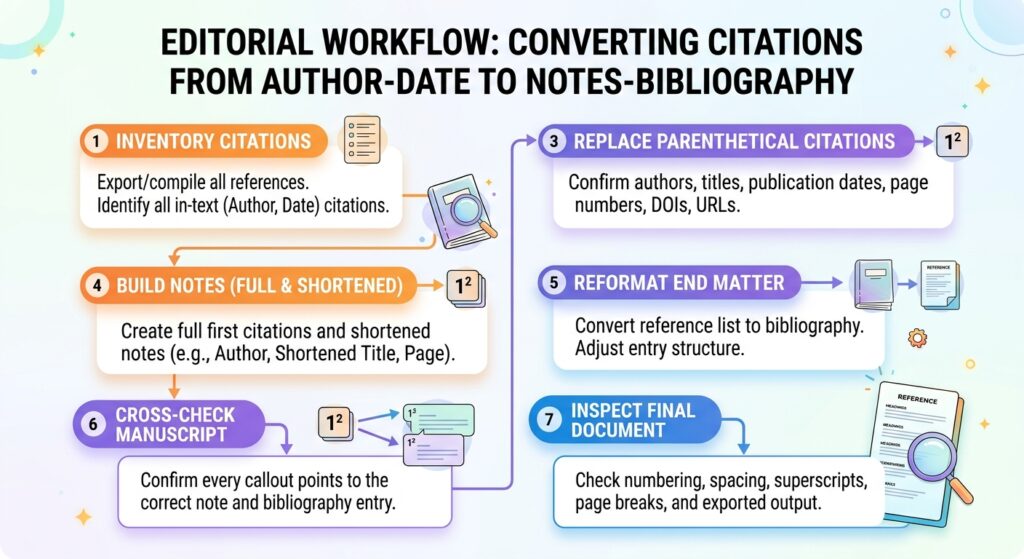
Reverse conversion requires comparable care. Moving from Notes-Bibliography to Author-Date means transferring relevant source information into parenthetical citations, creating or revising the reference list, and deciding how to handle explanatory material previously included in notes.
Citation managers can automate some formatting tasks, but their output is not infallible. Review the generated citations against the current style requirements, particularly for edited volumes, archival materials, translated works, online sources, and unusual publication types.
Also read: How to Write a Personal Statement?
9. Final Chicago Style Pre-Submission Checklist
Complete this audit before uploading your manuscript to the journal portal or institutional repository.
- Confirm that the target journal requires Notes-Bibliography or Author-Date.
- Verify the applicable Chicago edition and any journal-specific modifications.
- Standardize note callouts, numbering, and placement if using Notes-Bibliography.
- Check full notes and shortened notes for consistency.
- Verify author names, dates, page numbers, titles, and publication details.
- Match Author-Date citations to their reference-list entries.
- Confirm that the bibliography or reference list follows the required heading and ordering conventions.
- Check italics, capitalization, punctuation, DOI formatting, and URLs.
- Apply the journal's requirements for font, margins, line spacing, and hanging indents.
- Inspect tables, figures, captions, legends, and supplementary files for consistent source attribution.
- Review grammar, academic tone, terminology, and voice consistency.
- Remove tracked changes and resolve comments when required for submission.
- Check anonymization and metadata for double-blind peer review.
- Compare the final document and exported PDF to confirm that citations, notes, and page breaks display correctly.
Conclusion: Choose the Right Chicago Citation System Before Submission
The difference between Chicago Notes-Bibliography and Author-Date lies in how each system presents source information. Notes-Bibliography uses numbered notes and typically a bibliography, while Author-Date places author-year citations in the text and provides a reference list. Both can support rigorous, transparent scholarship when applied consistently.
Choose the system required by your target publication, verify source details, and audit every citation before submission. For additional confidence, use PaperEdit's professional manuscript editing and proofreading services to refine academic language, improve formatting consistency, and prepare your research paper for editorial review.