


Quoting sources correctly is essential to producing a credible, publication-ready research paper. Yet even experienced academic authors can struggle with the distinction between short direct quotations and block quotations, particularly when formatting citations, applying indentation, and placing punctuation according to APA 7th edition guidelines. These seemingly minor inconsistencies can make a manuscript look unpolished and complicate the final formatting review.
Formatting block quotes vs. direct quotes in APA 7 primarily depends on the length of the quoted passage. The Publication Manual of the American Psychological Association, Seventh Edition, establishes specific rules for presenting verbatim material, documenting its source, and integrating quotations into academic prose. Following these rules helps authors maintain citation accuracy, protect source attribution, and meet journal or university submission requirements.
This guide explains the APA 7th block quote rules and guidelines, including the 40-word threshold, indentation, quotation marks, punctuation placement, parenthetical citations, and common formatting errors. It also provides practical examples and a final checklist for preparing graduate research papers, dissertations, and journal manuscripts.
💡 Ready to polish your research paper for publication?
Transform your manuscript with PaperEdit's professional editing and proofreading services!
1. What Is the Difference Between Block Quotes and Direct Quotes in APA 7?
A direct quotation reproduces another author's words exactly as they appear in the original source. APA 7 distinguishes between short quotations, which appear within the text, and long quotations, which are presented as separate indented blocks.
The distinction matters because each format follows different rules for quotation marks, paragraph layout, and punctuation.
Short direct quotations: Fewer than 40 words
APA 7 requires quotations of fewer than 40 words to be incorporated into the surrounding sentence or paragraph. Place the quoted material inside double quotation marks and include an appropriate citation.
Example:
According to Smith (2024), “clear academic writing depends on precise terminology and logical organization” (p. 28).
In this example:
- Double quotation marks identify the borrowed wording.
- The author and publication year identify the source.
- The page number identifies the precise location of the quotation.
If a source does not have page numbers, use an appropriate alternative locator, such as a paragraph number or section heading.
Block quotations: 40 words or more
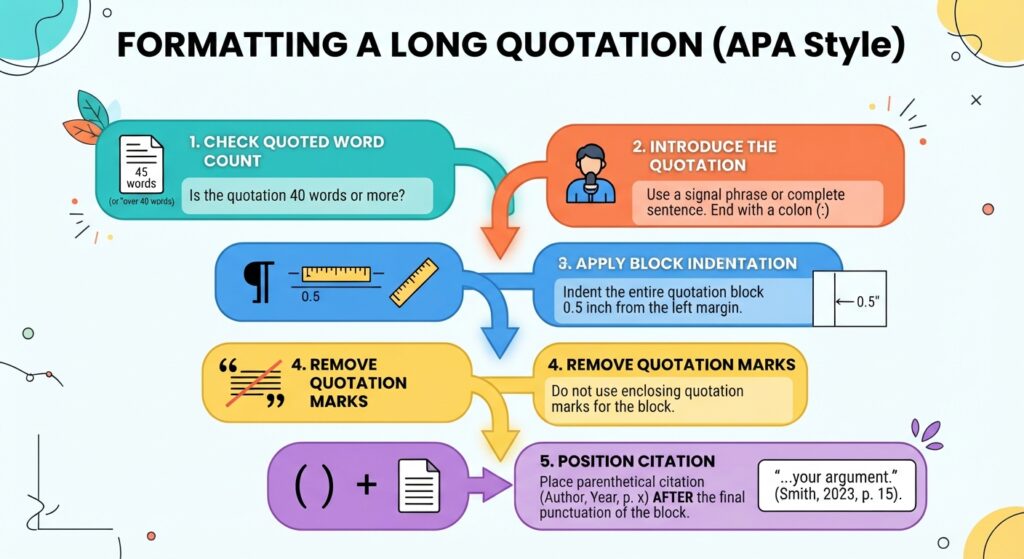
APA 7 requires quotations of 40 words or more to be formatted as block quotations. Begin the quotation on a new line, indent the entire block 0.5 inches (1.27 cm) from the left margin, and omit quotation marks.
Example:
Smith (2024) explained the importance of consistency in academic writing:
Academic writing requires more than grammatical accuracy. Authors must organize their arguments logically, define technical terms precisely, and maintain a consistent scholarly voice throughout the manuscript. These practices help readers follow complex ideas and evaluate the evidence supporting the conclusions. (p. 28)
Formatting note: In a manuscript, the quoted passage should appear as a continuous, indented block with the citation formatted according to APA 7. The example above illustrates the content and citation placement; apply the actual paragraph indentation in your document editor.
Key differences at a glance
| Formatting feature | Short direct quote | Block quote |
| Word count | Fewer than 40 words | 40 words or more |
| Placement | Within the paragraph | Separate block on a new line |
| Quotation marks | Double quotation marks | No quotation marks |
| Left indentation | Normal paragraph formatting | 0.5-inch indentation |
| Citation | Author, year, and locator | Author, year, and locator |
| Final punctuation | Usually after the closing quotation mark, following the citation | Before a parenthetical citation placed after the quotation |
| Spacing | Usually double-spaced | Usually double-spaced |
Industry standard: Apply the 40-word threshold consistently. Count the quoted passage itself, not the accompanying citation, and follow any additional journal-specific submission requirements that do not conflict with APA style.
Common pitfall: Authors sometimes format quotations based on the number of lines rather than the number of words. APA 7 uses the word-count threshold, not the visual length of the passage.
2. How Many Words Require a Block Quote in APA 7th Edition?
The threshold is straightforward: use a block quotation when the quotation contains 40 words or more. A quotation of exactly 40 words qualifies as a block quote.
When determining whether a passage meets this threshold, count the words reproduced from the source. Do not include the citation that identifies the source or the introductory wording that precedes the quotation.
For example:
- A 25-word quotation belongs within the paragraph and uses double quotation marks.
- A 39-word quotation remains an inline quotation.
- A 40-word quotation must be formatted as a block.
- A 75-word quotation also requires block formatting.
What if the quotation contains multiple sentences?
The same rule applies regardless of sentence count. A two-sentence passage containing 42 words qualifies as a block quotation, while a single sentence containing 35 words remains an inline quotation.
The decision should be based on the total number of words quoted from the source, rather than the number of sentences or lines.
Should every quotation of 40 words or more be retained?
Not necessarily. A block quotation may be appropriate when the original wording is analytically important, such as when discussing a participant's statement, interpreting a legal or policy passage, or examining the precise language of a theoretical definition.
However, excessive quotation can weaken a manuscript's argument. Paraphrasing may be more effective when the underlying idea matters more than the author's exact wording. A strong research paper balances direct evidence with the researcher's own analysis.
Common submission pitfall: Avoid using a long quotation simply because the original source expresses an idea clearly. Explain why the passage matters, connect it to your research question, and interpret its significance for the reader.
Also read: In-Depth Guide to APA 7th Edition In-Text & Reference Formatting
3. How to Format Block Quotes in APA Style
Correct indentation is only one part of block quotation formatting. Authors must also manage paragraph structure, line spacing, quotation boundaries, and citation placement.
Step 1: Start the quotation on a new line
Introduce the quotation in your own text. End the introductory sentence with appropriate punctuation, often a colon when the preceding sentence explicitly introduces the passage.
Start the block on the next line. Do not insert quotation marks around the passage.
Step 2: Indent the entire quotation by 0.5 inches
Indent the block 0.5 inches (1.27 cm) from the left margin. If the quotation contains multiple paragraphs, indent the first line of each subsequent paragraph an additional 0.5 inches relative to the block's existing indentation.
For example:
- The first line of the block begins 0.5 inches from the left margin.
- The first line of a second paragraph within the block begins 1 inch from the left margin.
- The remaining lines of that second paragraph align with the block's 0.5-inch indentation.
Do not add extra indentation to the right margin unless a journal's instructions specifically require it.
Step 3: Maintain double spacing
APA-style manuscripts generally use double spacing throughout the text, including block quotations. Do not reduce the line spacing merely to save space or make the quotation visually distinct.
Use your word processor's paragraph settings rather than inserting repeated spaces or tabs. This produces more consistent formatting and makes the document easier to revise.
Step 4: Omit quotation marks
Unlike short quotations, block quotations do not require opening or closing quotation marks. The indentation and separate paragraph establish the quotation's boundaries.
If the original passage contains a quotation within it, preserve the internal quotation marks as appropriate. Do not remove punctuation or quotation marks that belong to the source.
Step 5: Place the citation correctly
A block quotation must include an appropriate citation with the author, year, and locator when available. The exact placement depends on whether you use a narrative or parenthetical citation.
Narrative citation example:
Smith (2024) described the implications of the findings:
The results demonstrate that the relationship between language proficiency and academic performance is influenced by several contextual factors. These include prior educational experience, familiarity with disciplinary conventions, and access to appropriate academic support. (p. 42)
Here, the author and year appear in the introductory text, while the page number appears after the quotation's final punctuation.
Parenthetical citation example:
The results demonstrate that the relationship between language proficiency and academic performance is influenced by several contextual factors. These include prior educational experience, familiarity with disciplinary conventions, and access to appropriate academic support. (Smith, 2024, p. 42)
In the parenthetical example, the source information follows the quotation's final punctuation. In both cases, do not add a second period after the closing parenthesis.
These examples use illustrative source details. Replace them with accurate information from the source you actually consulted.
4. Punctuation Placement: Block Quotes vs. Inline Quotes
Punctuation placement is one of the most frequently misunderstood aspects of APA 7 direct quotation formatting. The central distinction is whether the citation appears before or after the quotation's final punctuation.
Where does the period go for inline quotes?
For a short direct quotation followed by a parenthetical citation, the closing quotation mark comes before the citation, and the sentence-ending period usually follows the closing parenthesis.
Correct:
The authors concluded that “the evidence remains inconclusive” (Smith, 2024, p. 16).
Incorrect:
The authors concluded that “the evidence remains inconclusive.” (Smith, 2024, p. 16)
The incorrect version places the sentence-ending period before the parenthetical citation.
Where does the period go for block quotes?
For a block quotation with a parenthetical citation at the end, the quotation's final punctuation comes first. The citation follows, and no additional period is placed after the citation.
Correct:
The findings indicate that the observed relationship varies across study settings and depends on the characteristics of the sample. (Smith, 2024, p. 16)
Incorrect:
The findings indicate that the observed relationship varies across study settings and depends on the characteristics of the sample (Smith, 2024, p. 16).
The same general principle applies when the author and year appear in the introductory narrative: the locator at the end of the block follows the quotation's final punctuation.
What if the quotation ends with a question mark or exclamation mark?
Preserve the original punctuation when it belongs to the quoted material. A question mark or exclamation mark may serve as the quotation's final punctuation, so a period is not automatically required before the citation.
For inline quotations, distinguish punctuation that belongs to the original quotation from punctuation required by the surrounding sentence. When necessary, revise the sentence structure to avoid awkward or ambiguous punctuation.
Common pitfall: Do not apply the inline quotation rule mechanically to block quotations. Check the citation placement after every long excerpt, particularly in manuscripts containing numerous participant quotations or theoretical passages.
5. Citation Rules for Direct Quotations in APA 7
APA 7 requires authors to identify the source of directly quoted material clearly enough for readers to locate it. In most cases, this involves the author's name, publication year, and a page number or another appropriate locator.
Quotations from paginated sources
For books, journal articles, and other sources with page numbers, include the relevant page number.
Examples:
- Parenthetical citation: (Smith, 2024, p. 18)
- Narrative citation: Smith (2024, p. 18)
- Multiple pages: (Smith, 2024, pp. 18–19)
Use p. for one page and pp. for a range of pages.
Quotations from sources without page numbers
For unpaginated material, provide a locator that helps readers find the quotation. Depending on the source, this may include a paragraph number, a section heading, or a combination of a heading and paragraph number.
Examples:
- Paragraph number: (Smith, 2024, para. 6)
- Section heading: (Smith, 2024, “Research Methods” section)
- Heading and paragraph: (Smith, 2024, “Research Methods” section, para. 3)
Do not invent page numbers for HTML webpages or other unpaginated sources. Use the most stable and informative locator available.
Quotations from secondary sources
Whenever possible, consult and cite the original source. If you cannot access it and must quote it through another author's work, identify the original author in the text and use as cited in to acknowledge the source you actually consulted.
For example:
Jones (2019, as cited in Smith, 2024, p. 36) argued that the framework required further validation.
In this example, Smith's work is the source consulted directly. The reference list generally includes Smith's work, not Jones's inaccessible work.
Common pitfall: Including a quotation in the text without a page number or another appropriate locator can make it difficult for reviewers to verify the wording. Audit every direct quotation against its source before submission.
Also read: Mastering Academic Style Guides: APA 7th, MLA 9th, and Chicago
6. Double vs. Single Quotation Marks in APA 7
APA 7 generally uses double quotation marks for short direct quotations incorporated into the main text. Single quotation marks are used for a quotation that appears within another quotation in running text.
Example of a quotation within a quotation:
The researcher observed that “participants repeatedly described the process as ‘difficult but worthwhile’ during the interviews” (Smith, 2024, p. 57).
The outer quotation uses double quotation marks, while the quoted phrase within it uses single quotation marks.
Block quotations follow a different rule: do not add double quotation marks around the entire block. However, preserve quotation marks that form part of the original material.
How should quotations within block quotations be handled?
If the source passage contains a quotation, reproduce the relevant internal punctuation accurately. APA's rules for quotations within quotations differ according to context, so check the original source and the relevant guidance rather than automatically replacing every internal mark.
When editing a manuscript, distinguish between quotation marks that belong to the source and marks added during drafting. This is particularly important when reproducing interview transcripts, historical documents, or excerpts from qualitative research.
Common pitfall: Applying single quotation marks to every direct quotation is inconsistent with standard APA 7 formatting for American English academic manuscripts. Use double quotation marks for ordinary short quotations and single quotation marks for quotations nested within them.
7. Common APA 7 Block Quote Formatting Errors
Even when authors understand the 40-word rule, small formatting errors can remain throughout a long manuscript. A systematic editing pass helps eliminate these inconsistencies.
| Common error | Correct APA 7 practice |
| Using a block quote for 35 words | Keep quotations under 40 words inline |
| Leaving a 40-word quotation inline | Format quotations of 40 words or more as blocks |
| Adding quotation marks around a block | Omit enclosing quotation marks |
| Indenting the block inconsistently | Use a 0.5-inch left indent |
| Single-spacing a long quotation | Maintain double spacing in standard APA formatting |
| Placing the period after a block citation | Put the quotation's final punctuation before the citation |
| Omitting the locator for a direct quote | Include a page number or suitable alternative locator |
| Copying a quotation without checking the source | Verify wording, spelling, punctuation, and omissions |
| Using a quotation without analysis | Explain how the excerpt supports the argument |
| Applying inconsistent paragraph settings | Standardize formatting across the manuscript |
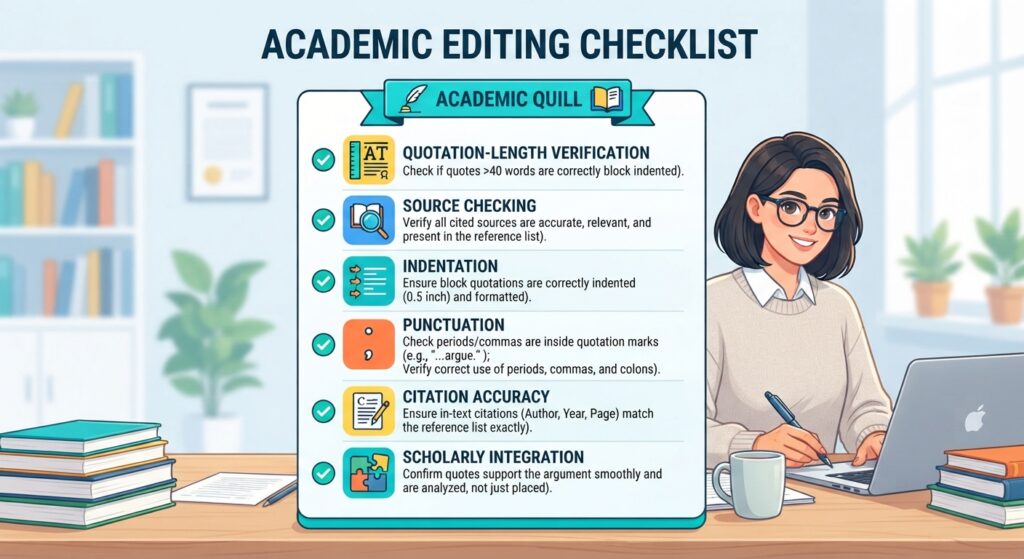
How can authors check long quotations efficiently?
Use a structured editing workflow:
- Audit quotation length. Identify every direct quotation and check whether it contains 40 words or more.
- Standardize layout. Apply the appropriate paragraph indentation and spacing settings.
- Verify source details. Match the quoted text and citation against the original source.
- Inspect punctuation. Confirm quotation marks, commas, periods, and citation placement.
- Review integration. Ensure each quotation supports the argument and is followed by appropriate interpretation where needed.
Also read: PaperEdit Academic Proofreading Services
8. APA 7 Quotation Formatting: A Practical Workflow for Graduate Researchers
Dissertations, theses, and journal manuscripts often contain dozens of quotations from theoretical literature, empirical studies, and participant interviews. Managing these consistently requires more than correcting individual punctuation errors.
Separate substantive revision from final formatting
During structural editing, evaluate whether each quotation is necessary. Consider whether paraphrasing would communicate the idea more efficiently and whether the quotation advances the research argument.
During copyediting, check quotation accuracy, citation completeness, and consistency with APA 7. During final proofreading, inspect the rendered document for indentation errors, inconsistent spacing, and accidental changes introduced during revision.
Use a comparison workflow
| Editing stage | Primary task | Expected outcome |
| Structural editing | Evaluate relevance and argument flow | Quotations support the research narrative |
| Line editing | Improve integration and academic tone | Quotations connect logically to the surrounding prose |
| Copyediting | Verify APA rules and citations | Consistent formatting and source attribution |
| Proofreading | Inspect the final document | No overlooked layout or punctuation errors |
For additional guidance, consult authoritative resources:
- APA Style: Quotations — official guidance on direct quotations and citation practices.
- Purdue OWL: APA Formatting and Style Guide — practical explanations and examples for academic writers.
- APA Style — the official APA Style website for grammar, formatting, and scholarly writing guidance.
When submitting to a journal, also review its author instructions. Some journals specify additional manuscript-layout requirements, file preparation rules, or restrictions on supplementary material. Follow those requirements while maintaining APA citation conventions where applicable.
9. Final APA 7 Direct Quotation Checklist
Before submitting your research paper, dissertation, or manuscript, verify the following:
- Every direct quotation matches the original source.
- Quotations containing fewer than 40 words appear inline.
- Quotations containing 40 words or more use block formatting.
- Short quotations use double quotation marks.
- Block quotations have no enclosing quotation marks.
- Every block is indented 0.5 inches from the left margin.
- Additional paragraphs within block quotations receive the required first-line indentation.
- Quoted passages follow the manuscript's standard double-spacing requirements.
- Every direct quotation includes an author, year, and appropriate locator.
- Unpaginated sources use suitable alternative locators.
- Inline quotation punctuation and citation placement are correct.
- Block quotation punctuation precedes a final parenthetical citation.
- Quotations are introduced clearly and integrated into the argument.
- Every source cited in the text is handled correctly in the reference list.
- Journal-specific submission instructions have been checked.
- The final document has been proofread after all formatting changes.
Conclusion: Format APA 7 Quotations with Confidence
Correctly formatting block quotes vs. direct quotes in APA 7 comes down to three essential practices: apply the 40-word threshold consistently, format long quotations with a 0.5-inch left indent and no enclosing quotation marks, and place citations and punctuation correctly. Equally important, verify each quotation against the original source and explain its relevance to your research argument.
A consistent approach improves readability, supports accurate attribution, and helps prepare a manuscript for academic review. Before submission, combine citation verification with a final formatting and proofreading pass.
Give your manuscript the final review it deserves. Explore PaperEdit's professional academic editing and proofreading services to refine your language, standardize APA 7 formatting, and prepare your research paper for submission with confidence.