


After completing a research paper, many authors face a deceptively difficult final stage: making every citation, author name, publication date, DOI, quotation, and reference-list entry conform to APA 7th edition. A manuscript can be scientifically strong yet appear careless when citations are inconsistent or references cannot be traced.
APA 7th edition in-text and reference formatting is the author-date system used to identify sources within academic writing and provide complete retrieval information in the reference list. Correct implementation requires more than inserting (Author, Year) throughout a manuscript; authors must also apply rules for multiple authors, organizational authors, missing dates, direct quotations, secondary sources, journal articles, DOIs, webpages, and reference-page layout.
This guide explains how to cite sources in APA 7th edition, how to construct and audit the reference list, how to handle complex journal citations, and how to use automated referencing tools without allowing them to introduce hidden formatting errors.
💡 Ready to polish your research paper for publication?
Transform your manuscript with PaperEdit's professional editing and proofreading services!
1. Understand the APA 7th Edition Author-Date System
What APA 7th citation formatting does
APA uses two linked citation components:
- An in-text citation identifies the source briefly within the manuscript.
- A reference-list entry supplies enough bibliographic information for the reader to locate the source.
For example:
- Parenthetical: (Garcia, 2025)
- Narrative: Garcia (2025) reported...
The two systems must correspond. A source cited in the text should normally have a matching reference-list entry, and every reference-list entry should be cited in the manuscript. Purdue OWL likewise identifies this correspondence as a fundamental APA reference-list requirement.
Why this matters for journal submission
Citation accuracy affects more than visual presentation. Incorrect author names, dates, titles, or DOI information can make sources difficult to retrieve and may signal inadequate manuscript preparation. Authors are ultimately responsible for verifying their references rather than assuming that a citation generator has produced correct metadata.
This principle is especially important in scholarly publishing. The current ICMJE Recommendations, updated in January 2026, explicitly emphasize authors' responsibility for reference accuracy and recommend verification against bibliographic databases or original sources.
Industry-standard criteria
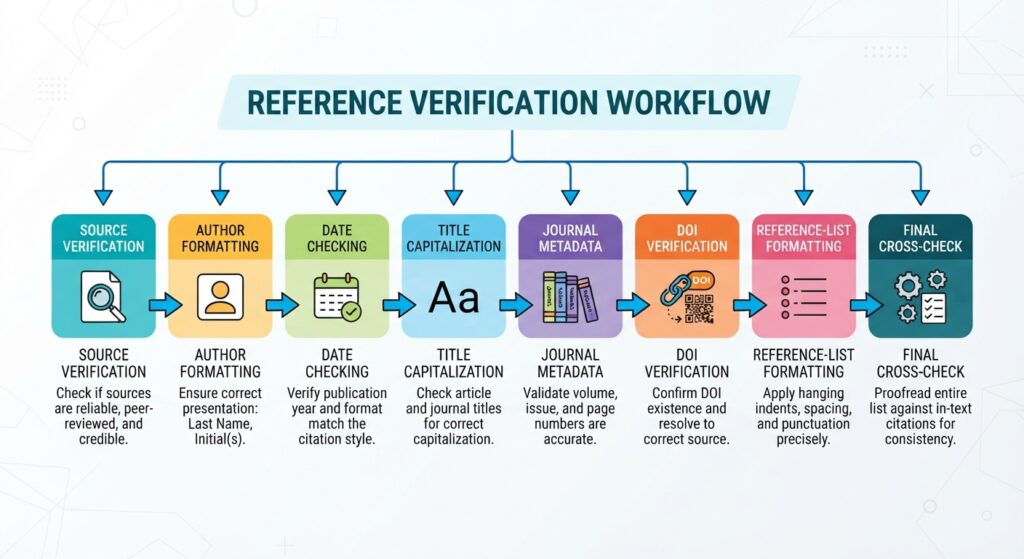
Before submission, audit every citation for:
- Author spelling and order
- Publication year
- Correct use of et al.
- Matching in-text and reference-list entries
- Accurate title capitalization
- Journal title and volume information
- Issue and page numbers where applicable
- DOI or URL
- Correct punctuation
- Consistent formatting
Also read: Top 10 APA 7th Formatting Errors That Cause Journal Rejections and How to Fix Them
2. Master APA 7th In-Text Citation Guidelines
APA 7 uses the author's surname and publication year for most standard in-text citations.
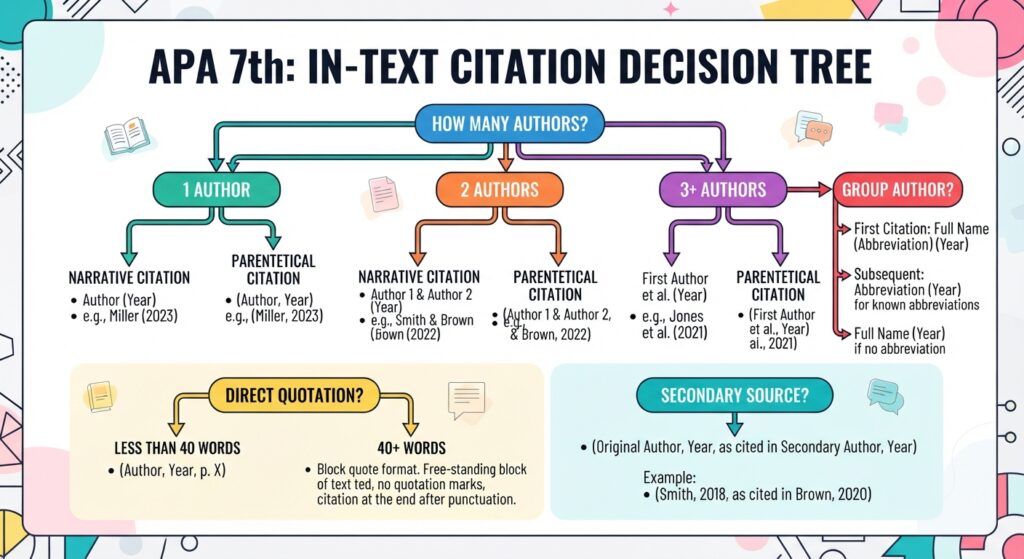
One author
Use:
- Parenthetical: (Ahmed, 2024)
- Narrative: Ahmed (2024) found that...
Do not include an author's first name or initials in an ordinary in-text citation.
Two authors
For two authors, cite both names every time.
- Parenthetical: (Ahmed & Khan, 2024)
- Narrative: Ahmed and Khan (2024) found...
Notice the distinction: APA uses & inside parentheses but and in a narrative citation.
Three or more authors
For a work with three or more authors, use the first author's surname followed by et al. from the first citation:
(Ahmed et al., 2024)
Narratively:
Ahmed et al. (2024) reported...
This is one of the most important answers to the question, “How do you format in-text citations for multiple authors in APA 7th?” Do not list all authors in the in-text citation merely because the reference list contains them.
Six or more authors in the reference list
APA 7 substantially changed author presentation compared with APA 6. Reference entries list all authors up to and including 20 authors. For 21 or more authors, APA uses an ellipsis after the 19th author and then gives the final author's name. Purdue OWL confirms the 20-author rule.
Group or organizational authors
When an organization is the author, use the organization's name:
(World Health Organization, 2025)
If an abbreviation is useful and the organization is cited repeatedly, establish the abbreviation according to APA conventions before shortening subsequent citations.
No author
When no individual or organizational author is available, use the title in the author position. The form depends on whether the source is a book, report, article, webpage, or another type of work.
No date
Use:
(Author, n.d.)
Here, n.d. means “no date.”
Multiple sources in one parenthetical citation
When several sources support the same statement, place them together in one parenthetical citation and order them according to APA's prescribed author-date conventions.
Do not treat a citation manager's default sorting as automatically correct. Review the resulting citation manually.
Also read: Mastering Academic Style Guides: APA 7th, MLA 9th, and Chicago
3. Format Direct Quotes and Secondary Sources Correctly
Direct quotations
A direct quotation requires more precise source information than a paraphrase.
For a quotation from a paginated source:
(Khan, 2025, p. 18)
For multiple pages:
(Khan, 2025, pp. 18–19)
If the source does not use page numbers, use another logical locator where appropriate, such as a paragraph number, section heading, or another identifiable location.
For quotations of 40 words or more, APA 7 uses a block quotation format rather than quotation marks. The exact formatting should follow the APA 7 manuscript conventions and the target journal's requirements.
Secondary sources
A secondary source is a source in which you learned about an original work without consulting that original work directly.
For example:
(Smith, 1989, as cited in Ahmed, 2025)
The reference list generally contains the source you actually consulted—in this example, Ahmed (2025)—rather than the inaccessible original source.
Use secondary citations sparingly. Whenever possible, locate and read the original research. Secondary citations can weaken source transparency when used unnecessarily.
Common submission pitfalls
Avoid:
- Adding a page number when you did not consult the cited page
- Quoting a source from a secondary work as though you read the original
- Using et al. incorrectly in direct quotations
- Mixing citation styles from different referencing systems
- Citing a source in the text but omitting it from the reference list
4. Build an APA 7 Reference List That Meets Journal Standards
What is the APA reference page?
The reference list appears at the end of the manuscript and contains the complete publication details for sources cited in the text.
The basic APA 7 reference-page rules include:
- Begin the reference list on a new page.
- Center and bold the heading References.
- Double-space the entries.
- Apply a 0.5-inch hanging indent to each entry.
- Alphabetize entries according to the first author's surname or appropriate author element.
- Use initials rather than full first and middle names.
- Maintain exact correspondence between in-text citations and reference entries.
These basic rules are documented in Purdue OWL's APA 7 reference-list guidance.
What should authors check?
Do not merely ask whether a reference “looks like APA.” Audit its underlying metadata.
Check:
Author → Date → Title → Source → DOI/URL
For example, a journal article generally follows this structure:
Author, A. A., & Author, B. B. (Year). Title of article. *Title of Journal, volume*(issue), page–page. https://doi.org/xxxxx
Article titles generally use sentence case, whereas journal titles retain the appropriate title capitalization. Journal titles and volume numbers are italicized in standard APA formatting.
Journal articles with DOIs
One of the most common questions is:
“How do I cite a journal article with a DOI in APA 7th style?”
Use the DOI in URL form:
Do not prepend labels such as DOI: to the identifier in a standard APA 7 reference.
APA 7 requires a DOI when a work has one, whether the source was accessed in print or digitally.
For example:
Ahmed, R. M., & Khan, S. T. (2025). Research transparency in interdisciplinary studies. Journal of Academic Research, 18(2), 115–129. https://doi.org/10.xxxx/xxxxx
The DOI must be verified against the actual article rather than copied from an unrelated database record.
What if there is no DOI?
For a journal article without a DOI, follow APA's source-specific rules. Do not automatically add a database URL merely because you accessed the article through a library database.
This is a common automated APA 7 referencing error: a reference manager may preserve an access URL that is unnecessary or inappropriate for the final reference.
5. Compare APA 7 Editing Requirements Across Citation Tasks
| Citation task | APA 7 standard | What to audit | Common error |
| One author | Surname + year | Author/date match | Adding initials in text |
| Two authors | Both surnames every time | & vs. and | Using & in narrative prose |
| 3+ authors | First surname + et al. | Consistency | Listing every author in text |
| Direct quote | Author, year, locator | Page/paragraph accuracy | Omitting locator |
| Secondary source | Original author + “as cited in” | Confirm source consulted | Pretending to have read original |
| Journal article | Author, date, article title, journal, volume/issue, pages | Metadata | Wrong volume or issue |
| DOI article | DOI as https://doi.org/... | DOI accuracy | Using doi: or broken URL |
| Reference page | Alphabetical, double-spaced, hanging indent | Layout and correspondence | Incorrect indentation |
| 21+ authors | 19th author + ellipsis + final author | Author sequence | Listing all authors |
Also read: How Many Research Papers Do You Need for a PhD in 2026?
6. Format Complex Journal Articles Without Losing Metadata
Journal references become particularly difficult when articles have:
- Multiple authors
- More than 20 authors
- An article number instead of conventional pages
- An online-first publication date
- A DOI
- A supplement or special issue
- No issue number
- A group or consortium author
- A correction or retraction
- An unusual publication format
Audit the source record, not just the citation
For every complex journal article, compare the reference against the publisher's article page or a trusted bibliographic database.
Verify:
- Author spelling
- Author sequence
- Year
- Article title
- Journal title
- Volume
- Issue
- Page range or article number
- DOI
- Whether the item is a correction, editorial, letter, preprint, or original research article
This is particularly important for biomedical manuscripts. The ICMJE's January 2026 Recommendations state that authors should verify references and check for retracted publications rather than relying on citation information blindly.
Also read: PaperEdit Academic Proofreading Services
7. Use Automated APA 7 Referencing Tools but Audit the Output
Reference managers and automated citation generators can dramatically reduce repetitive formatting work. They are useful for importing metadata, generating bibliographies, switching between styles, and identifying missing references.
They are not substitutes for editorial verification.
Why automated APA formatting fails
A citation generator can inherit incorrect metadata from:
- Publisher records
- Library databases
- DOI registration records
- User-created citation entries
- Incomplete webpage metadata
- Imported PDF metadata
The resulting citation may be technically formatted but bibliographically wrong.
For example, software may correctly apply APA punctuation to an incorrect article title. It may also interpret a corporate author as an individual author or fail to recognize an article number.
A reliable automated workflow
Use this sequence:
Import → Verify metadata → Select APA 7 → Generate → Compare with source → Proofread → Cross-check manuscript
Do not reverse the sequence by generating the complete reference list and assuming it is publication-ready.
Reference-management audit
Before submission, search the manuscript for:
- Citations without references
- References without citations
- Duplicate references
- Different spellings of the same author
- Conflicting publication years
- Missing DOIs
- Incorrect URLs
- Inconsistent capitalization
- Accidental APA 6 formatting
8. Follow the Target Journal Before Applying APA Formatting Blindly
APA 7 provides the baseline style, but journal instructions remain decisive.
A journal may specify:
- A different reference style
- A modified APA implementation
- Limits on reference numbers
- Particular DOI requirements
- Specific manuscript fonts
- Different line spacing
- Figure-resolution requirements
- Structured reference categories
- Supplementary-material formatting
- Reporting standards such as CONSORT, PRISMA, or STROBE
Therefore, “APA compliant” does not automatically mean “journal submission compliant.”
For example, the ICMJE emphasizes that authors should follow both its recommendations and the individual journal's instructions to authors.
For the official APA 7 resource set, consult the Purdue OWL APA 7 formatting and style guide.
For biomedical manuscripts, authors should also consult the current ICMJE Recommendations, which were updated in January 2026.
9. Perform a Final APA 7 Pre-Submission Audit
Use this checklist immediately before uploading your manuscript.
In-text citation checklist
- Every cited source has an identifiable author or appropriate title/group author.
- Publication years are correct.
- Two-author citations use and narratively and & parenthetically.
- Three-or-more-author citations use et al. correctly.
- Direct quotations include appropriate locators.
- Secondary citations clearly identify the source actually consulted.
- Multiple citations are consistently ordered.
- No citation is missing from the reference list.
Reference-page checklist
- References is centered and bold.
- The reference list begins on a new page.
- Entries are double-spaced.
- Every entry has a 0.5-inch hanging indent.
- References are alphabetized correctly.
- Author names and initials are accurate.
- Up to 20 authors are listed according to APA 7 rules.
- 21+ author entries use the correct ellipsis format.
- Titles use appropriate APA capitalization.
- Journal titles and volume numbers are formatted correctly.
- Issue numbers and page ranges are accurate where applicable.
- DOI links use the https://doi.org/ format.
- URLs are functional where required.
- Duplicate references have been removed.
Journal-submission checklist
- The target journal's author guidelines have been reviewed.
- The journal actually requires APA 7 rather than another style.
- Reference formatting has been checked against recent articles from the journal.
- Citation metadata has been verified against original sources.
- Retractions and corrections have been checked where relevant.
- Tables, figures, captions, and supplementary references have been audited.
- Reporting standards required by the target journal have been addressed.
- The final manuscript has undergone line-by-line proofreading.
Conclusion: Treat APA 7 Formatting as a Scholarly Accuracy Task
APA 7th edition formatting is not simply a matter of inserting parentheses and generating a bibliography. Effective citation management requires bibliographic accuracy, consistent author-date logic, source verification, correct DOI handling, disciplined reference-page formatting, and compliance with the target journal's submission instructions.
The most reliable workflow is straightforward: identify the source → verify its metadata → apply the appropriate APA 7 rule → cross-check the in-text citation and reference entry → proofread the final manuscript against the journal's requirements.
For authors working with complex literature reviews, multilingual sources, extensive reference lists, or publication-ready manuscripts, a professional editorial review can identify inconsistencies that automated citation tools overlook.
Ready to submit with confidence? Use PaperEdit's professional manuscript editing and proofreading services to refine your citations, references, academic language, formatting, and overall journal readiness.