


After completing the research, analysis, and results, many authors face a less obvious problem: the manuscript is scientifically sound, but the language does not sound sufficiently academic. Informal expressions, conversational vocabulary, contractions, unsupported personal claims, inconsistent terminology, and overly subjective statements can weaken an otherwise rigorous paper.
Formal academic writing is a structured style of communication that presents research objectively, precisely, and appropriately for a scholarly audience. It does not simply mean using complicated words. Instead, formal writing prioritizes accuracy, evidence, logical organization, discipline-specific vocabulary, grammatical control, and an appropriate academic tone in research papers.
Getting this distinction right matters because journal editors and peer reviewers evaluate more than research findings. A manuscript must communicate its contribution clearly and professionally while complying with the journal’s language and formatting expectations. This guide explains formal vs informal academic writing, the rules that define a formal writing style in academic papers, common informal words to avoid, the role of voice and perspective, and practical methods for converting informal writing to formal writing.
💡 Ready to polish your research paper for publication?
Transform your manuscript with PaperEdit's professional editing and proofreading services!
What Is Formal Academic Writing?
Formal academic writing is a precise, evidence-based style used in research papers, dissertations, theses, journal articles, conference papers, and other scholarly publications.
Its primary purpose is to communicate ideas, evidence, methods, and conclusions without unnecessary ambiguity or conversational language.
What makes academic writing formal?
A formal manuscript generally demonstrates:
- Objective language: Claims are based on evidence rather than personal impressions.
- Precise vocabulary: Words communicate specific meanings rather than vague or exaggerated ideas.
- Grammatical accuracy: Sentences follow accepted conventions of academic English.
- Logical organization: Arguments progress systematically from research questions to evidence and conclusions.
- Terminological consistency: Key concepts, variables, abbreviations, and technical terms are used consistently.
- Appropriate perspective: First-, second-, or third-person constructions are used according to disciplinary and journal conventions.
- Evidence-based claims: Assertions are supported by citations, data, or established scholarship.
- Controlled tone: The language avoids emotional, promotional, colloquial, or conversational expressions.
Formal does not mean unnecessarily complex. A sentence such as “The results indicate a significant association between sleep duration and cognitive performance” is more effective than an unnecessarily elaborate sentence filled with abstract terminology.
Why does formal tone matter?
An appropriate formal tone in research writing helps readers distinguish between evidence and opinion. It also reduces ambiguity and makes a manuscript easier for editors and reviewers to evaluate.
A paper may contain excellent research but still require substantial language revision if its prose resembles spoken English. This is particularly important for ESL authors, whose ideas may be strong but whose manuscripts contain direct translations, idiomatic expressions, or sentence structures influenced by their first language.
Formal vs Informal Academic Writing: Key Differences
Understanding the distinction is easier when the same idea is expressed in two different registers.
| Feature | Formal Academic Writing | Informal Academic Writing |
| Vocabulary | Precise, discipline-specific | Conversational or vague |
| Contractions | Generally avoided unless journal style permits | Common |
| Perspective | Objective and appropriately controlled | Personal or conversational |
| Claims | Evidence-based and qualified | Broad, subjective, or absolute |
| Phrasing | “The findings indicate…” | “The results show us…” |
| Second person | Generally avoided | “You can see…” |
| Idioms | Avoided | Frequently used |
| Emotional language | Minimized | May be present |
| Abbreviations | Defined on first use | May be unexplained |
| Sentence construction | Grammatically controlled | May resemble spoken language |
The industry-standard criterion is not simply whether a sentence “sounds sophisticated.” Editors assess whether it is clear, accurate, objective, concise, and appropriate for the intended scholarly audience.
7 Rules of Formal Academic Writing
1. Use precise and appropriate vocabulary
Appropriate vocabulary for academic writing should communicate the intended meaning with minimal ambiguity.
Replace vague terms such as:
- “a lot of” → “a substantial proportion of”
- “things” → the specific objects, variables, or phenomena being discussed
- “good” → “effective,” “beneficial,” “valid,” or another context-specific term
- “bad” → “adverse,” “ineffective,” “unreliable,” or another precise descriptor
- “huge” → “substantial,” “considerable,” or a quantified measurement
However, do not replace every simple word with a longer synonym. “Use” is often preferable to “utilize,” and “because” is usually clearer than “owing to the fact that.”
Common pitfall: Using a thesaurus to make a manuscript sound more academic can introduce inaccurate or unnatural vocabulary.
2. Eliminate conversational and informal expressions
Informal words to avoid in academic writing include conversational expressions, slang, idioms, and unsupported intensifiers.
For example:
Informal:
“This study looks at how social media really affects students.”
Formal:
“This study examines the effects of social media use on students.”
Informal:
“The results were pretty surprising.”
Formal:
“The results differed substantially from the initial hypothesis.”
Avoid expressions such as “a bunch of,” “kids,” “really,” “pretty,” “a lot,” “get,” “stuff,” “huge,” “totally,” and “kind of” unless they are appropriate within a quotation or specialized context.
3. Maintain objective language
Objective language in academic papers separates observations from personal judgments.
Instead of:
“We believe this is an extremely important discovery.”
Prefer:
“These findings have important implications for clinical practice.”
Better still, specify the implication and support it with evidence.
Objective language does not mean eliminating interpretation. Researchers must interpret results. The requirement is to make interpretations proportionate to the evidence.
Words such as “clearly,” “obviously,” “undoubtedly,” and “proves” should be used cautiously because they can imply a level of certainty that the data do not support.
4. Control first-, second-, and third-person perspective
The third-person perspective in academic writing has traditionally been associated with objectivity, but modern academic writing does not universally require third person.
Some disciplines and journals permit or even prefer first-person constructions:
“We analyzed 240 patient records.”
This can be clearer than:
“The patient records were analyzed.”
Second person, however, is generally inappropriate in most research papers:
“You can see from Figure 2 that…”
A formal alternative is:
“Figure 2 demonstrates…”
Always follow the target journal's author guidelines rather than applying a universal rule about grammatical person.
Common pitfall: Removing every occurrence of “we” can produce unnecessarily passive or awkward prose.
Also read:Top 10 APA 7th Formatting Errors That Cause Journal Rejections and How to Fix Them
Active vs Passive Voice in Formal Writing
The debate over active versus passive voice is often oversimplified.
Active voice
“We analyzed the survey responses.”
Passive voice
“The survey responses were analyzed.”
Both constructions can be formally appropriate.
Use active voice when identifying the researcher or agent improves clarity:
“We recruited 150 participants.”
Use passive voice when the action or procedure is more important than the actor:
“Samples were stored at −20°C until analysis.”
Modern academic editing generally favors clarity over mechanically choosing one voice.
Industry-standard criterion
A well-edited manuscript uses active and passive constructions strategically. Excessive passive voice can make writing cumbersome:
“It was observed that the samples were…”
A clearer version may be:
“The analysis showed that the samples…”
Common pitfall: Treating passive voice as inherently more academic. It is not. Academic tone comes from precision, evidence, and appropriate register not grammatical voice alone.
Academic Tone Examples: Informal to Formal
One of the most practical ways to improve academic writing is to revise sentences systematically.
| Informal Expression | Formal Revision |
| “The study looked at…” | “The study examined…” |
| “A lot of participants…” | “A substantial number of participants…” |
| “The results were really good.” | “The results demonstrated substantial improvement.” |
| “This proves that…” | “These findings provide evidence that…” |
| “We got the data from…” | “The data were obtained from…” |
| “You can see…” | “The findings indicate…” |
| “Kids in the study…” | “Children participating in the study…” |
| “This is a huge problem.” | “This represents a substantial challenge.” |
| “The researchers found out…” | “The researchers found…” |
| “The numbers went up.” | “The values increased.” |
Notice that formal revision is not simply about replacing individual words. It often involves changing the entire construction to make the statement more precise.
How to Convert Informal Writing to Formal Writing
Use a five-stage editing process when revising a draft.
Step 1: Identify conversational language
Search the manuscript for contractions, idioms, slang, vague nouns, intensifiers, and conversational verbs.
Look for terms such as:
- “doesn’t”
- “can’t”
- “a lot”
- “things”
- “get”
- “really”
- “basically”
- “obviously”
- “you”
- “pretty”
- “huge”
Do not automatically delete every occurrence. Evaluate each term according to context and journal requirements.
Step 2: Replace vague language with measurable language
Ask:
What exactly do I mean?
Instead of:
“Many patients experienced improvement.”
Consider:
“Thirty-seven percent of patients demonstrated improvement.”
Quantification is usually stronger than an approximate adjective when data are available.
Step 3: Strengthen verbs
Weak or conversational verbs often make scholarly prose less precise.
For example:
“The study looks at the relationship…”
becomes:
“The study investigates the relationship…”
Similarly:
- “shows” → “demonstrates” or “indicates,” where appropriate
- “finds out” → “determines”
- “deals with” → “addresses”
- “talks about” → “discusses”
- “gets” → a context-specific verb such as “obtains,” “receives,” or “acquires”
Do not substitute mechanically. Select the verb that accurately describes the research action.
Step 4: Check claims for appropriate certainty
Formal writing distinguishes between what the data demonstrate, what they suggest, and what remains uncertain.
For example:
“The intervention completely solves the problem.”
may be scientifically unjustified.
A more defensible construction is:
“The intervention was associated with a reduction in the observed outcome.”
This type of qualification is central to academic tone in research papers.
Step 5: Perform a final line edit
After structural and substantive revisions, perform a sentence-level review for:
- Grammar
- Punctuation
- Articles and prepositions
- Subject–verb agreement
- Tense consistency
- Word choice
- Sentence length
- Repetition
- Parallel structure
- Terminology
- Abbreviations
- Voice
- Academic register
A final academic proofreading pass should occur after major revisions because structural changes frequently introduce new language errors.
Formal Writing Is More Than Vocabulary
Authors sometimes attempt to create a formal manuscript by replacing simple words with longer words. This approach can reduce readability.
Compare:
“The utilization of an innovative methodological framework facilitated the acquisition of data.”
with:
“The new method enabled data collection.”
The second sentence is shorter, clearer, and equally formal.
A strong formal writing style in academic papers therefore follows the principle of precision without unnecessary complexity.
Four tests for formal academic language
Before submitting a sentence, ask:
- Is it precise?
- Is it objectively supported?
- Is it grammatically correct?
- Would a specialist reader interpret it exactly as intended?
If the answer to any question is no, revise the sentence.
Formatting and Style Still Matter
Tone editing should not be separated completely from manuscript preparation. Formal academic writing must operate within the broader requirements of the target journal.
Depending on the publication, authors may need to follow APA 7th, IEEE, MLA, Chicago, Vancouver, Harvard, or a journal-specific style.
For example, authors should verify:
- In-text citation format
- Reference-list consistency
- Heading hierarchy
- Abbreviation rules
- Figure and table captions
- Units and symbols
- Number formatting
- Capitalization
- Manuscript margins and spacing
- Reference-management output
- Supplementary-material labeling
The APA Style official guidance and IEEE Author Center are useful starting points for authors working under those systems. Biomedical researchers should also consult ICMJE Recommendations where applicable.
Also read: Academic Editing and Proofreading Services can help authors identify language, consistency, and presentation issues before journal submission.
When Professional Academic Editing Is Appropriate
Authors do not always need the same level of editorial intervention.
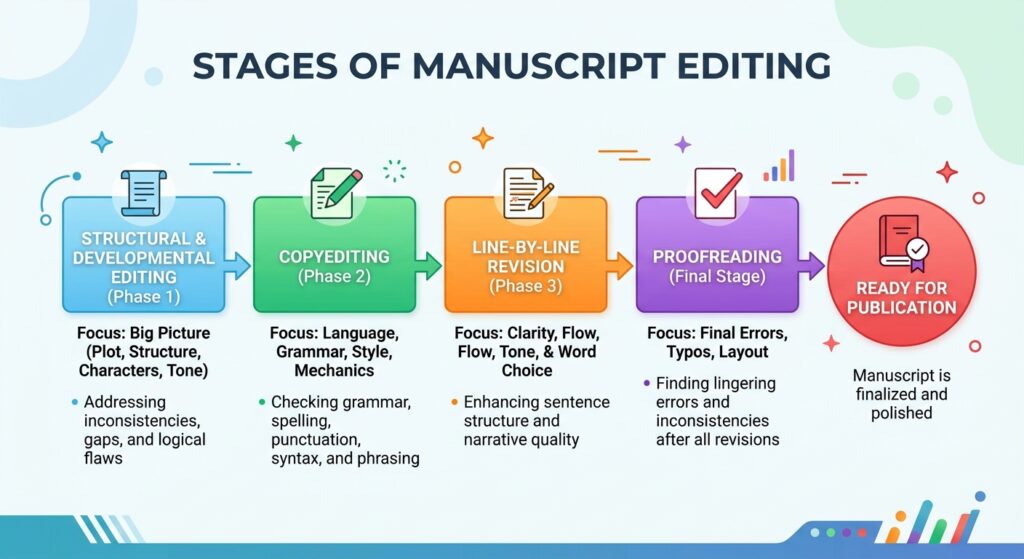
| Editing Level | Primary Focus | Best Used When |
| Structural editing | Argument, organization, section flow | The manuscript needs substantive restructuring |
| Line editing | Clarity, flow, tone, sentence construction | Ideas are sound but prose needs refinement |
| Copyediting | Grammar, syntax, terminology, consistency | The manuscript is structurally complete |
| Proofreading | Final errors and formatting inconsistencies | Manuscript is ready for submission |
For an ESL researcher, English academic paper editing services can be particularly valuable when language interference affects sentence structure, article use, prepositions, tense, or academic register.
Similarly, dissertation proofreading for tone and clarity should assess not only spelling and punctuation but also consistency of voice, terminology, transitions, and scholarly tone across chapters.
Professional editing should preserve the author's intellectual contribution. The editor's role is to improve how the research is communicated not to alter findings or introduce unsupported claims.
Explore PaperEdit's academic proofreading and editing services
Pre-Submission Formal Writing Checklist
Before uploading your manuscript to a journal portal, complete the following audit:
- Remove unnecessary contractions and conversational expressions.
- Replace vague words with precise terminology.
- Eliminate slang, idioms, and unnecessary intensifiers.
- Check whether claims are appropriately qualified.
- Replace unsupported subjective statements with evidence-based language.
- Review first-, second-, and third-person usage against journal guidelines.
- Balance active and passive voice for clarity.
- Confirm consistent terminology throughout the manuscript.
- Define abbreviations at first use.
- Check grammar, punctuation, articles, and prepositions.
- Verify tense consistency across Introduction, Methods, Results, and Discussion.
- Confirm that tables and figures are cited correctly in the text.
- Standardize citations and references according to the required style.
- Check journal-specific formatting requirements.
- Perform a final manuscript proofreading pass after all revisions.
- Review the title, abstract, keywords, and references separately.
- Confirm that the final document contains no tracked changes or editorial comments unless requested by the journal.
Conclusion: Make Formal Academic Writing Work for Your Research
Formal academic writing is not about making every sentence longer or filling a manuscript with sophisticated vocabulary. It is about communicating research with precision, objectivity, consistency, and discipline-appropriate clarity.
The most effective approach to formal writing combines appropriate vocabulary, controlled academic tone, evidence-based claims, strategic use of active and passive voice, consistent perspective, and rigorous proofreading. When these elements work together, readers can focus on the research itself rather than struggling with the language.
Before journal submission, audit your manuscript for informal expressions, vague claims, inconsistent terminology, grammatical errors, and deviations from the target journal's style. If language remains a concern, a professional editorial review can provide an additional layer of quality control.
Ready to strengthen your manuscript before submission? PaperEdit's professional academic editing and proofreading services can help refine academic tone, improve clarity, correct language inconsistencies, and prepare research papers and dissertations for publication.