


Using “hence” correctly can make academic writing more concise and logically connected but only when the word accurately expresses a consequence, result, or conclusion. Many researchers, ESL authors, and students misuse “hence” by treating it as a universal synonym for “therefore,” “because,” or “however.”
Hence is a formal transitional adverb that generally means “for this reason,” “as a result,” or “from this fact.” It is particularly useful when you need to show a logical connection between an earlier statement and its consequence.
For example:
The sample size was insufficient; hence, the statistical power of the study was limited.
Here, “hence” introduces a consequence: the insufficient sample size resulted in limited statistical power.
Correct use of transitional words can improve academic writing flow and clarity, strengthen logical relationships between claims, and create a more precise academic tone. Incorrect use, however, can make sentences sound unnatural or obscure the relationship between ideas.
This guide explains what “hence” means, where to place it, how to punctuate it, how it differs from “therefore” and “thus,” and how to use it effectively in research papers, dissertations, theses, and journal manuscripts.
💡 Ready to polish your research paper for publication?
Transform your manuscript with PaperEdit's professional editing and proofreading services!
What Does “Hence” Mean in Academic Writing?
Hence means “as a result,” “for this reason,” or “therefore.” It signals that the information following it is a logical consequence of something previously stated.
Simple definition
Hence = for this reason / as a result / therefore
Compare:
The participants reported severe fatigue. Hence, their productivity declined.
The second statement is presented as a consequence of the first.
“ Hence” is particularly common in formal and academic contexts because it expresses logical relationships economically.
What “hence” does not mean
Do not use “hence” to introduce:
- a contrast;
- an unrelated new idea;
- a cause when you mean “because”;
- an example;
- a comparison;
- a concession.
For example, this is incorrect:
The treatment was effective. Hence, however, several patients discontinued it.
“However” signals contrast, whereas “hence” signals consequence. The two transitions perform different logical functions.
Instead, write:
The treatment was effective; however, several patients discontinued it.
How to Use “Hence” in a Sentence
The most common academic construction is:
Statement 1 + hence + consequence
For example:
The intervention reduced blood pressure; hence, it may be useful for patients with hypertension.
You can also place “hence” after a semicolon:
The response rate was low; hence, the findings should be interpreted cautiously.
Or use it at the beginning of a new sentence:
The response rate was low. Hence, the findings should be interpreted cautiously.
The exact construction depends on the relationship between the two clauses and the journal's preferred style.
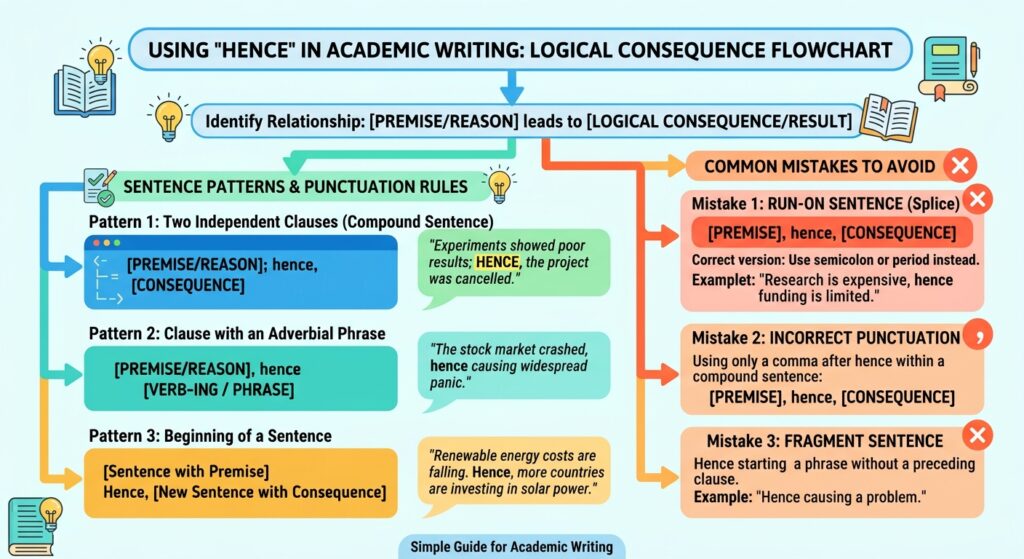
Three common sentence patterns
Pattern 1: Semicolon + hence + comma
The dataset contained several missing values; hence, the analysis was restricted to complete cases.
This is a clear formal construction when two independent clauses are closely related.
Pattern 2: Full stop + Hence + comma
The dataset contained several missing values. Hence, the analysis was restricted to complete cases.
This construction provides a stronger break between the two ideas.
Pattern 3: Hence at the end of a clause
“Hence” can sometimes appear at the end of a sentence, particularly in mathematical, scientific, or highly formal prose:
The intervention reduced the inflammatory response and hence improved patient outcomes.
This construction is especially useful when “hence” directly connects an action or finding with its consequence.
1. Use “Hence” to Show a Clear Result
The primary function of “hence” is to establish a cause-and-effect or premise-and-consequence relationship.
Example
The control group received no intervention; hence, differences between the groups could be evaluated.
The first clause establishes the condition, while the second describes its consequence.
Research-paper example
The study included only 42 participants; hence, the results may have limited generalizability.
This is appropriate because the sample size is presented as the reason for the limitation.
Common pitfall
Do not use “hence” when the connection between the two statements is merely chronological.
Incorrect:
The participants completed the questionnaire; hence, the researchers conducted the interviews the following week.
Completing the questionnaire did not necessarily cause the interviews. “Subsequently” or another time-related transition would be more appropriate.
Correct:
The participants completed the questionnaire. Subsequently, the researchers conducted the interviews.
2. Use “Hence” to Make Academic Writing More Concise
One advantage of “hence” is its ability to replace longer phrases.
Instead of:
The participants did not meet the inclusion criteria. For this reason, they were excluded from the analysis.
You can write:
The participants did not meet the inclusion criteria; hence, they were excluded from the analysis.
The second version is more concise without changing the meaning.
This makes “hence” useful in:
- Results sections;
- Discussion sections;
- scientific explanations;
- mathematical arguments;
- theoretical analyses;
- technical reports.
Conciseness matters in academic writing because many journals impose strict word limits.
Professional manuscript proofreading and editing can help identify repetitive phrases and replace unnecessarily long constructions while preserving scientific meaning.
3. Understand Where to Put “Hence”
Position affects readability.
At the beginning of a sentence
The sample was relatively small. Hence, the findings should be interpreted cautiously.
This is grammatically acceptable and emphasizes the consequence.
Between two clauses
The sample was relatively small; hence, the findings should be interpreted cautiously.
This creates a strong logical connection between the two clauses.
Within a clause
The sample was relatively small and hence may not represent the wider population.
Here, “hence” functions naturally as part of the clause.
Avoid excessive use
Repeatedly beginning sentences with “Hence” can make academic prose monotonous:
The sample was small. Hence, the analysis was limited. Hence, the findings were cautious. Hence, further research is needed.
Instead, vary your transitions:
The sample was small. Consequently, the analysis was limited, and the findings should therefore be interpreted cautiously. Further research is needed to confirm these results.
This is one reason an academic grammar and style checking process should assess the entire paragraph rather than individual sentences in isolation.
4. Learn the Difference Between “Hence,” “Therefore,” and “Thus”
These three words can often introduce a consequence, but they are not always interchangeable stylistically.
| Transition | Core meaning | Typical academic use | Example |
| Hence | For this reason; as a result | Formal deduction or consequence | The sample was small; hence, generalizability was limited. |
| Therefore | For that reason | Direct logical conclusion | The data were incomplete; therefore, the analysis was repeated. |
| Thus | In this way; as a result | Conclusion, consequence, or summary | The intervention reduced symptoms; thus, it may have clinical value. |
| Consequently | As a consequence | Strong emphasis on resulting effect | The protocol changed; consequently, the study timeline was extended. |
| As a result | Because of this | Clear and accessible cause-effect relationship | The sample was reduced; as a result, statistical power decreased. |
Which word should you choose?
Choose based on the logical relationship, not simply on vocabulary variety.
Use “hence” when you want a formal, concise statement of consequence.
Use “therefore” when drawing a direct conclusion from preceding evidence or reasoning.
Use “thus” when expressing a result, deduction, or manner.
Use “consequently” when emphasizing the resulting effect.
Use “as a result” when maximum clarity is more important than brevity.
Also read: Academic English Polish: 7 Passive Voice Rules International Researchers Need to know in 2026
5. Use “Hence” Correctly in Research Papers
Scientific writing frequently requires precise relationships between observations and conclusions.
Consider this example:
The intervention group demonstrated significantly lower blood glucose levels than the control group; hence, the intervention may improve glycemic control.
The transition is appropriate because the observed result provides the basis for the subsequent interpretation.
However, researchers must avoid overstating causality.
A stronger version might be:
The intervention group demonstrated significantly lower blood glucose levels than the control group; hence, the intervention may contribute to improved glycemic control.
The cautious wording is particularly appropriate when the study design does not establish definitive causation.
In the Results section
Use “hence” sparingly in Results sections because results should primarily report findings rather than interpret them.
Prefer:
The response rate was 62%; consequently, 38% of eligible participants did not provide follow-up data.
In the Discussion
“Hence” may be more appropriate when interpreting findings:
The study was conducted at a single institution; hence, the findings may not be generalizable to other clinical settings.
This distinction supports the conventional separation between reporting evidence and interpreting its implications.
6. Use “Hence” in Dissertations and Theses
In dissertations and theses, “hence” can help connect arguments across longer sections.
For example:
Previous studies have primarily examined short-term outcomes. Hence, the long-term effects of the intervention remain uncertain.
Or:
Existing research has focused on urban populations; hence, less is known about outcomes in rural communities.
The transition helps readers understand why the second statement follows from the first.
Dissertation writing tip
Do not use sophisticated vocabulary merely to sound academic.
A sentence is stronger when the transition accurately communicates its logical function.
Compare:
Previous studies have produced inconsistent findings. Hence, additional research is necessary.
with:
Previous studies have produced inconsistent findings. However, additional research is necessary.
The second sentence may actually be less logical because “however” signals contrast. If no contrast exists, “hence” is more appropriate.
For authors working on doctoral projects, specialist dissertation and thesis editing can help assess transitions, paragraph cohesion, argument structure, and academic voice across lengthy chapters.
7. Use “Hence” With Formal Academic Vocabulary
“Hence” works particularly well with precise academic terminology.
Examples include:
- hence, the findings;
- hence, the observed difference;
- hence, the reduced response rate;
- hence, the methodological limitation;
- hence, the need for further investigation;
- hence, the proposed framework;
- hence, the increased risk;
- hence, the discrepancy between groups.
However, do not combine “hence” with unnecessarily complicated language.
Weak:
Hence, notwithstanding the aforementioned methodological considerations, the aforementioned phenomenon may potentially...
Better:
Hence, these methodological limitations may explain the observed difference.
The objective of formal vocabulary for academic writing is precision, not complexity.
8. Follow the Correct Punctuation Rules
Punctuation depends on sentence structure.
Two independent clauses
Use a semicolon:
The sample was small; hence, the results should be interpreted cautiously.
Two separate sentences
Use a period:
The sample was small. Hence, the results should be interpreted cautiously.
Within a compound structure
The sample was small and hence may have reduced the statistical power of the study.
Avoid unnecessary punctuation:
The sample was small, hence, the results should be interpreted cautiously.
This construction can create a comma splice when both sides are independent clauses.
A safer revision is:
The sample was small; hence, the results should be interpreted cautiously.
Style-guide principle
Always prioritize the target journal's house style. APA, MLA, Chicago, IEEE, and discipline-specific styles can differ in punctuation conventions and preferred constructions.
Authors seeking APA MLA formatting and editing services should provide the target style guide and journal instructions before final formatting.
9. Avoid Common Misuses of “Hence”
Misuse 1: Using “hence” to mean “because”
Incorrect:
Hence the sample was small, the researchers reduced the number of variables.
Here, the intended meaning is “because.”
Better:
Because the sample was small, the researchers reduced the number of variables.
Misuse 2: Using “hence” to mean “however”
Incorrect:
The treatment was effective; hence, some patients experienced adverse effects.
If the adverse effects contrast with the effectiveness, “however” may be appropriate:
The treatment was effective; however, some patients experienced adverse effects.
Misuse 3: Using “hence” for sequence
Incorrect:
The samples were collected; hence, they were stored at −80°C.
If storage simply happened afterward:
The samples were collected and subsequently stored at −80°C.
Misuse 4: Adding “therefore” unnecessarily
Avoid:
Hence, therefore, the findings support the hypothesis.
Use one:
Hence, the findings support the hypothesis.
or:
Therefore, the findings support the hypothesis.
Misuse 5: Making unsupported causal claims
Incorrect:
The participants were older; hence, age caused the observed treatment failure.
Unless the study establishes causality, this is too strong.
Better:
The participants were older; hence, age may have contributed to the observed difference.
10. 15 Examples of “Hence” in Academic Writing
Use these examples as models, but adapt them to your actual evidence.
Scientific research
- The sample size was limited; hence, the findings should be interpreted cautiously.
- The intervention reduced inflammatory markers; hence, it may have therapeutic potential.
- Several participants withdrew from the study; hence, the final analysis included fewer subjects than initially planned.
- The assay demonstrated low sensitivity; hence, its clinical utility may be limited.
- The groups differed significantly at baseline; hence, adjusted analyses were performed.
Academic essays
- The policy increased access to education; hence, it may contribute to greater social mobility.
- The evidence remains inconclusive; hence, further investigation is warranted.
- The theory does not account for cultural variation; hence, its application may be limited across populations.
Dissertations and theses
- Previous studies have focused primarily on short-term outcomes; hence, the long-term effects remain unclear.
- The literature contains substantial methodological variation; hence, direct comparison across studies is difficult.
Technical and analytical writing
- The measured value exceeded the predefined threshold; hence, the null hypothesis was rejected.
- The variables were highly correlated; hence, multicollinearity was assessed before regression analysis.
- The model demonstrated poor predictive accuracy; hence, an alternative specification was evaluated.
Formal academic conclusions
- The intervention produced consistent improvements across the primary outcomes; hence, further clinical evaluation is justified.
- The available evidence is limited and heterogeneous; hence, definitive conclusions cannot yet be drawn.
The final example is particularly useful because “hence” can introduce a conclusion without overstating what the evidence demonstrates.
“Hence” Sentence Formula for ESL Academic Writers
For researchers whose first language is not English, this simple formula can help:
Evidence or premise + hence + logical consequence
For example:
Evidence: The study included only one hospital.
Consequence: Its findings may not generalize to other settings.
Combined:
The study included only one hospital; hence, its findings may not generalize to other settings.
Before using “hence,” ask:
“Does the second part logically follow from the first?”
If yes, “hence” may be appropriate.
If the relationship is contrast, use “however.”
If the relationship is time, use “subsequently.”
If the relationship is cause, use “because” or “because of.”
This simple diagnostic prevents many transition-word errors.
How to Improve Academic Writing Flow With Transitional Words
“Hence” is only one member of a much larger system of academic transitions.
Organize transitions according to their logical function.
| Function | Useful transitions | Example |
| Result | hence, therefore, thus, consequently | The sample was small; hence, the findings were limited. |
| Contrast | however, nevertheless, conversely | The treatment was effective; however, adverse effects occurred. |
| Addition | furthermore, moreover, additionally | Furthermore, the study included a diverse population. |
| Sequence | subsequently, thereafter, first, finally | Subsequently, the samples were analyzed. |
| Example | for example, for instance | For example, previous studies reported similar findings. |
| Qualification | nevertheless, although, despite this | Nevertheless, the evidence remains limited. |
| Summary | overall, in summary, collectively | Overall, the evidence supports the proposed mechanism. |
Using a structured academic transition words list and examples can help authors improve paragraph cohesion without repeatedly relying on “therefore,” “however,” or “hence.”
The goal is not to insert a transition into every sentence. Strong academic prose sometimes achieves cohesion through sentence structure, repeated terminology, topic sentences, and logical progression without an explicit transitional word.
When Should You Avoid “Hence”?
Avoid “hence” when:
- the causal or logical relationship is unclear;
- a simpler transition communicates the meaning better;
- the sentence contains multiple competing transitions;
- the word makes the prose unnecessarily formal;
- you are reporting an observation without drawing a conclusion;
- the journal's preferred style favors plainer language.
For example:
The participants were assessed at baseline and again after 12 weeks.
No transition is needed.
Adding “hence” would not improve the sentence:
The participants were assessed at baseline and hence again after 12 weeks.
The relationship is chronological, not consequential.
Professional online research paper proofreading should therefore evaluate transitions in context rather than automatically replacing ordinary language with more formal vocabulary.
Also read: Numbers in Academic Writing: When to Use Words and When to Use Numerals
Final Editing Checklist: Using “Hence” Correctly
Before submitting a research paper, dissertation, thesis, or academic essay, check every occurrence of “hence.”
- Does “hence” mean for this reason or as a result?
- Does the second clause logically follow from the first?
- Have you avoided using “hence” to mean “however”?
- Have you avoided using it to mean “because”?
- Have you avoided using it for simple chronology?
- Is the punctuation correct?
- Have you avoided using “hence” and “therefore” together?
- Does the sentence avoid an unsupported causal claim?
- Is a simpler transition more precise?
- Is the terminology appropriate for your discipline?
- Does the transition improve paragraph cohesion?
- Does the target journal permit the construction?
- Have you checked consistency across the manuscript?
- Have you completed a final paper editing before submission review?
Conclusion
Use “hence” when you need to express a clear logical consequence or result. In academic writing, the word can make sentences concise and formal, but its value depends on precision: it should connect evidence or a premise to a consequence that genuinely follows.
For researchers, ESL authors, and doctoral candidates, mastering transitions such as “hence,” “therefore,” “thus,” and “however” is part of developing a coherent academic voice. A final manuscript review should assess not only grammar but also logic, cohesion, terminology, formatting, and consistency.
When your paper is ready for submission, PaperEdit's professional academic proofreading and editing services can provide an additional quality-control layer for language, style, structure, and journal readiness.