


How many research papers do you need for a PhD? There is no universal number.
A doctoral degree is awarded for demonstrating independent, original research that makes a significant contribution to knowledge not simply for reaching a publication quota. Some PhD programs require a monograph and do not require published papers at all. Others permit or require a publication-based, article-based, or thesis-by-publication format, with the expected number of papers varying by discipline, university, and country.
This distinction matters. A doctoral candidate in biology may reasonably build a dissertation around several experimental papers, while a humanities PhD may complete a monograph without publishing a journal article before graduation. In the United States, universities commonly evaluate the dissertation as the central doctoral requirement, while universities in parts of Europe and Australia more frequently provide formal article-based or thesis-by-compilation routes.
This guide explains how many publications are typically expected for a PhD, how requirements differ across STEM and humanities, what changes between the US, UK, Europe, and Australia, and how to plan papers without sacrificing dissertation quality.
💡 Ready to polish your research paper for publication?
Transform your manuscript with PaperEdit's professional editing and proofreading services!
How Many Research Papers Do You Need for a PhD?
For a traditional PhD dissertation, zero published papers may be sufficient if the university and doctoral program do not make publication a degree requirement.
For a publication-based PhD, a common working range is approximately 2–5 substantial papers, but this is a planning range rather than a universal graduation rule.
The decisive criteria are usually:
- originality of the research;
- scientific or scholarly contribution;
- methodological rigor;
- coherence of the dissertation;
- candidate's independent contribution;
- quality and scope of the papers; and
- compliance with the university's doctoral regulations.
For example, the University of Helsinki's Faculty of Science recommends approximately three articles for an article-based dissertation, while allowing variation based on article scope, quality, publication venue, and the candidate's contribution. Its Faculty of Humanities likewise states that an article-based thesis ordinarily consists of three articles, with at least two published or accepted for publication.
By contrast, the University of Copenhagen states that an article-based PhD thesis in several faculties is typically 3–5 articles, but emphasizes that the number depends on article size, complexity, co-authorship, and overlap. Publication itself does not necessarily have to occur before thesis submission.
The critical distinction: papers in the thesis vs. published papers
These terms are often confused:
Paper included in dissertation: A chapter written in journal-article format.
Submitted paper: A manuscript sent to a journal but not yet accepted.
Accepted paper: A manuscript formally accepted for publication.
Published paper: An article already published online or in an issue.
A university may permit all four categories, or only some of them. Therefore, never assume that "three papers required" means "three papers must already be published."
PhD Publication Requirements by Country
National patterns provide useful context, but doctoral requirements are ultimately set by the university, graduate school, faculty, department, and doctoral program.
| Country/region | Typical doctoral model | Publication expectation | Key consideration |
| United States | Dissertation-centered | Often no universal publication quota | Program/field determines whether papers can form chapters |
| United Kingdom | Monograph or thesis-by-publication depending on institution/field | Highly variable | Check departmental doctoral regulations |
| Australia | Traditional thesis or thesis by compilation/publication | Often more publication-oriented | Compilation routes may specify papers and contribution |
| Netherlands | Often article-based research chapters | Publications may be incorporated without requiring prior acceptance | University/faculty rules determine format |
| Denmark | Monograph or article-based thesis | Article-based theses commonly use several papers | Publication before submission may not be mandatory |
| Finland | Monograph or article-based dissertation | Often explicit article guidance | Number and authorship depend on faculty |
| Canada | Program-specific dissertation model | Varies substantially | Check graduate school and department |
| Germany/other Europe | Highly institution- and field-dependent | Publication-based routes common in some disciplines | Confirm faculty-level regulations |
The Netherlands illustrates why national generalizations can be misleading. Utrecht University's Graduate School of Natural Sciences states that a PhD thesis contains a general introduction, publishable research chapters, and a general discussion; its guidance explicitly notes that chapters do not necessarily need to have been published or accepted in peer-reviewed journals.
Denmark shows a similar distinction. The University of Copenhagen describes both monograph and article-based PhD formats. In its Faculty of Law, an article-based thesis is generally 3–5 articles, while the articles need not have been published, peer-reviewed, or submitted before thesis submission.
Why country alone is not enough
A statement such as "Australia requires three papers" or "UK PhDs require four publications" is too broad to be academically reliable.
The correct hierarchy is:
Country → University → Faculty/School → Department/Program → Supervisor/doctoral regulations
Always verify the final level before setting a publication target.
How Many Papers Are Required for a PhD in the US?
For many US PhD programs, the answer is not a fixed publication number.
The dissertation and successful defense are central doctoral requirements. For example, Princeton describes the dissertation as the culminating work demonstrating technical mastery, independent research ability, and an original contribution to the field.
Cornell similarly identifies the dissertation as a requirement for the PhD. Some Cornell fields permit a "papers option", in which the dissertation consists of relatively independent papers that have been submitted or will be submitted to journals. The papers must generally be sole-authored or first-authored by the student.
UC Berkeley permits publishable papers and previously published or co-authored material to be incorporated into a dissertation, but requires those papers to form part of a larger, coherent argument with appropriate introductory, transitional, and concluding sections.
Practical US target
For a publication-oriented US PhD, 2–4 strong papers can be a useful planning target in many STEM environments, but it should not be presented as a graduation requirement unless the specific program says so.
In a traditional dissertation, publication may be unnecessary for the degree but highly valuable for career development.
Common pitfall
Do not delay your dissertation because you are waiting for journal acceptance unless your program explicitly requires acceptance.
Peer-review turnaround can extend for months or longer. A manuscript can be academically complete while its journal publication remains outside the candidate's control.
Also read:What is a Research Paper? Definition, Types & Examples
How Many Papers Are Needed for a PhD in the UK?
The UK has no single national paper-count rule for every PhD.
Many UK doctorates are based on a substantial thesis demonstrating original research. Some departments also offer thesis-by-publication or alternative formats, particularly in disciplines where journal articles are the normal research output.
The practical distinction is therefore between:
- traditional monograph-style PhD;
- PhD incorporating publications; and
- formal publication-based thesis route.
In a traditional humanities or social-science PhD, publishing before graduation may not be necessary. In biomedical, engineering, and laboratory-based fields, publishing several papers during the doctorate may be normal even when not formally required.
Oxford, for example, has specific regulations for thesis-by-publication routes in particular doctoral contexts rather than imposing a single publication quota across all DPhil programs.
Common UK target
For a publication-focused STEM PhD, candidates often plan for 2–4 substantial papers, with the exact expectation determined by the department.
For humanities, one or zero journal papers before graduation can be entirely compatible with a successful traditional monograph dissertation.
How Many Papers for a PhD in Australia?
Australia is particularly important when discussing thesis by publication, often called a thesis by compilation.
The Australian National University explains that a thesis by compilation can include journal article manuscripts that have been published or are in the publication process, while emphasizing that the thesis must still develop a central argument.
ANU's College of Science and Medicine provides a more specific example: its PhD thesis-by-compilation route is not prescriptive about the total number of publications because of disciplinary variation, but should include at least three publications, with the majority being first-author. A statement detailing the candidate's contribution is also required.
The University of Melbourne similarly permits publications to be incorporated into a thesis and gives multiple examples of how papers can be integrated with conventional thesis chapters. It notes that a thesis with publications can typically be shorter than a conventional PhD thesis, while the expected research volume and examination standards remain equivalent.
Australian planning range
For a publication-based Australian PhD, 3–5 papers is a reasonable planning range in many disciplines.
But treat this as a strategic target not an automatic graduation requirement.
How Many Papers for a STEM PhD?
STEM publication patterns are strongly influenced by experimental cycles, collaboration, laboratory structure, and disciplinary publishing norms.
Biology PhD publication requirements
A biology PhD may produce several research outputs because a multi-year project can generate distinct datasets or experimental questions.
A realistic planning range might be:
- 2–4 major research papers;
- 1 review or methods paper where appropriate;
- conference abstracts or presentations as supplementary outputs.
But publication count alone is a weak metric.
A single comprehensive paper containing several years of high-quality experimental work may contribute more to a dissertation than three narrow papers.
Engineering PhD publication requirements
Engineering dissertations frequently use article-based structures, especially in fields such as:
- biomedical engineering;
- chemical engineering;
- materials science;
- electrical engineering;
- environmental engineering; and
- computer engineering.
A candidate may reasonably plan for 2–4 substantial papers, depending on the research group's publication culture and doctoral regulations.
Computer science PhD publication requirements
Computer science is unusually heterogeneous.
A theoretical computer science PhD may produce fewer journal articles but substantial conference papers. In systems, machine learning, computer vision, and human-computer interaction, high-quality peer-reviewed conference publications can be central research outputs.
Therefore, asking only "how many papers are needed for a computer science PhD?" can produce a misleading answer.
Measure:
venue quality + originality + technical contribution + candidate contribution + dissertation coherence
rather than simply counting papers.
STEM vs Humanities PhD Publication Requirements
The difference between STEM and humanities becomes particularly important when setting expectations.
| Factor | STEM | Humanities |
| Typical thesis model | Article-based or mixed | Often monograph |
| Journal publication before graduation | Common | Less consistently expected |
| Number of papers | Often multiple | Often fewer |
| Co-authorship | Common | Less common in many fields |
| First authorship | Important in many disciplines | Less central |
| Conference publications | Important in some fields | Variable |
| Book publication | Usually supplementary | Can be highly significant |
| Publication-based thesis | Common in some disciplines | Available in selected programs |
| Main assessment | Research contribution and methods | Original argument, scholarship, evidence, interpretation |
This difference explains why a universal target such as "publish five papers before your PhD" is poor academic advice.
How Many First-Author Papers Do You Need?
There is no universal first-author quota.
However, first authorship becomes strategically important when your dissertation includes substantial co-authored research.
Why?
Because examiners need to determine what you personally contributed.
ANU requires a statement of contribution for papers in its thesis-by-compilation route, while the University of Helsinki similarly requires doctoral candidates to document their independent contributions to co-authored articles.
A practical target for many publication-based STEM PhDs is:
Aim to lead the core papers that constitute the intellectual spine of your dissertation.
That does not mean every paper must be first-authored. Collaborative research is normal. It means your dissertation should make your independent contribution unmistakable.
Common pitfall: counting co-authored papers as equivalent
Three papers where you are the lead researcher are not necessarily equivalent, for doctoral assessment purposes, to ten papers where your contribution is minor.
Quality, contribution, and coherence beat raw publication count.
Monograph vs Publication-Based PhD: Which Is Better?
Neither format is inherently superior.
Monograph PhD
A monograph develops one sustained scholarly argument across chapters.
Best suited to:
- humanities;
- some social sciences;
- theoretical research;
- projects requiring extensive contextual or conceptual development.
Publication-based PhD
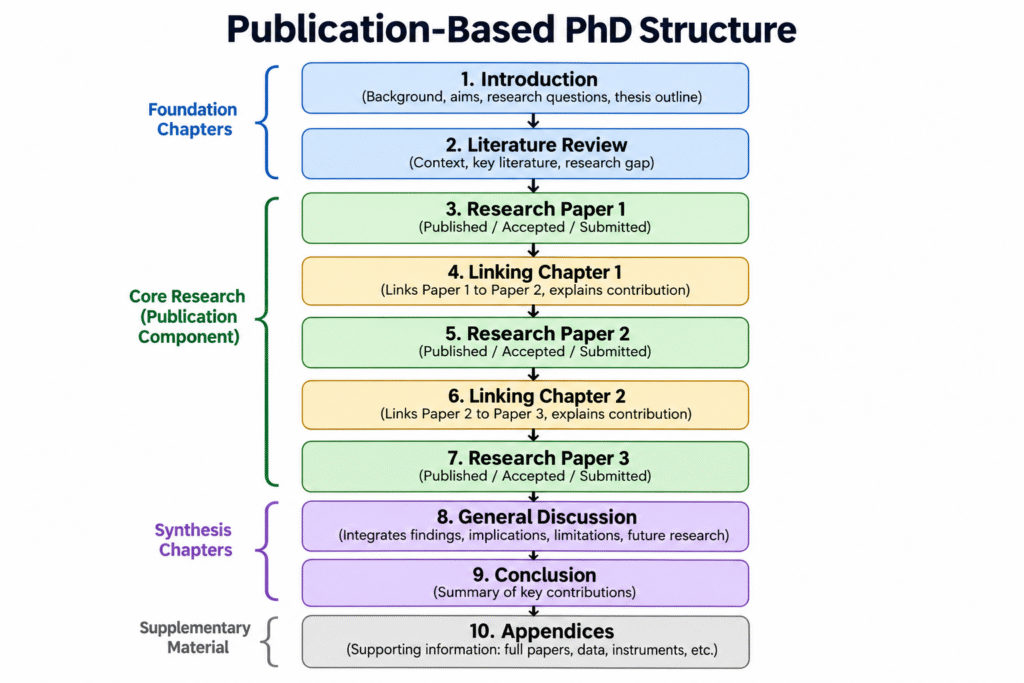
A publication-based dissertation combines several related papers with synthesis and framing material.
Best suited to:
- experimental sciences;
- medicine;
- engineering;
- quantitative social science;
- disciplines with strong article-based research cultures.
The publication-based route can accelerate journal submission because chapters are already structured as manuscripts. However, it introduces additional requirements around authorship, copyright, text recycling, journal formatting, and coherence.
The University of Melbourne specifically notes that incorporated publications must be integrated into the thesis and that additional material may be necessary because journal articles often abbreviate methods or other contextual information.
Also read: PaperEdit Academic Editing and Proofreading Services
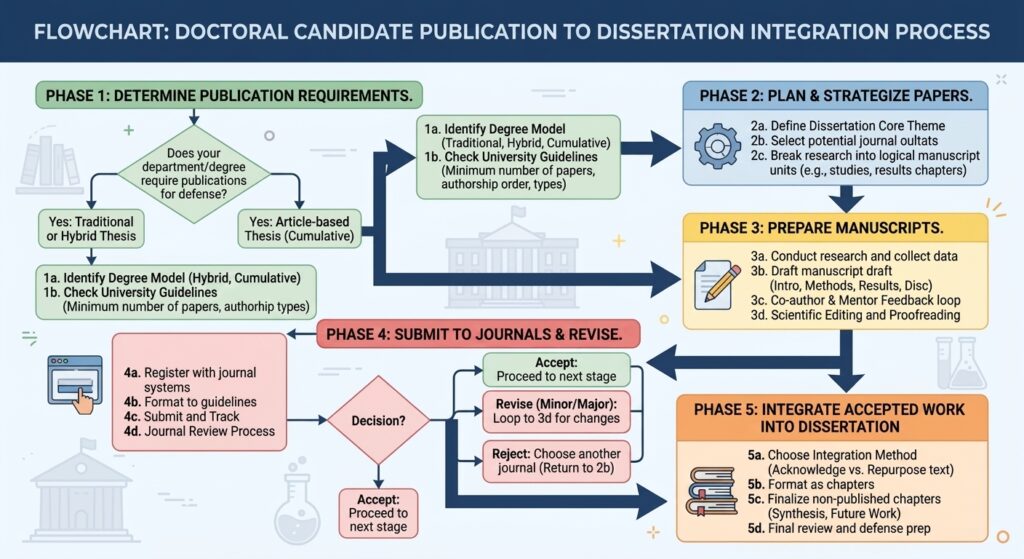
How to Publish Research Papers During Your PhD
Do not wait until your final year to think about publication.
Build your publication strategy into the research design.
Year 1: Map the publication architecture
Identify:
- research questions;
- datasets;
- expected studies;
- target journals;
- authorship arrangements;
- thesis format;
- reporting standards.
Create a publication matrix linking each research question to a potential manuscript.
Year 2: Produce the first major manuscript
Once a study reaches analytical maturity, begin manuscript preparation.
Do not postpone writing until every experiment is complete. Early writing exposes gaps in methods, analysis, literature coverage, and argumentation.
Year 2–3: Submit strategically
Prioritize manuscripts that represent the core contribution of your dissertation.
Before submission, audit:
- journal scope;
- article type;
- word limit;
- reference style;
- figure specifications;
- supplementary-material requirements;
- reporting checklist;
- ethics declarations;
- authorship;
- data availability;
- conflicts of interest.
For clinical and health research, align manuscripts with applicable standards such as PRISMA, CONSORT, or STROBE rather than treating journal formatting as the only submission requirement.
Final year: Convert papers into a coherent dissertation
A collection of papers is not automatically a dissertation.
Add:
- a strong general introduction;
- research rationale;
- integrated literature review;
- methodological context;
- linking sections;
- synthesis of findings;
- overall limitations;
- overarching contribution;
- conclusion and future directions.
Berkeley, for example, explicitly requires incorporated papers to be joined by introductory, transitional, and concluding material that establishes the common thread.
How Many Papers Should You Aim for?
Use this as a planning framework, not a universal graduation rule:
| PhD situation | Sensible planning target |
| Traditional humanities PhD | 0–2 papers |
| Traditional social sciences PhD | 1–3 papers |
| STEM PhD | 2–4 papers |
| Publication-based STEM PhD | 3–5 papers |
| Australian thesis by compilation | Often 3+; verify program rules |
| Highly collaborative laboratory PhD | 3–6+ research outputs |
| Computer science | 2–4 major outputs; venue norms matter |
| Medical/biomedical PhD | Often 2–4 substantial papers |
| Dissertation by publication | University-specific; often several linked publications |
Again, these are strategic ranges, not official universal requirements. Current university regulations demonstrate substantial variation even within the same country and discipline.
What Matters More Than the Number of Papers?
A doctoral examination ultimately evaluates the research, not the size of your publication list.
Prioritize:
1. Originality
Does the research generate genuinely new knowledge, interpretation, evidence, theory, or methodology?
2. Coherence
Do the chapters answer a connected research problem?
3. Independence
Can examiners identify your intellectual and methodological contribution?
4. Methodological rigor
Are your methods appropriate, transparent, reproducible where applicable, and correctly interpreted?
5. Scholarly significance
Does the dissertation explain why its findings matter?
6. Publication quality
If papers are included, are they appropriate for credible peer-reviewed venues rather than simply maximizing article count?
The University of Helsinki's doctoral criteria, for example, emphasize new scientific knowledge, critical thinking, methodological mastery, justified results, and research integrity alongside article requirements.
Pre-Submission PhD Publication Checklist
Before finalizing your dissertation, audit the following:
- Verify the official publication requirements for your exact PhD program.
- Confirm whether papers must be submitted, accepted, or published.
- Determine whether a monograph or publication-based thesis is permitted.
- Confirm the minimum/typical number of papers with your supervisor and doctoral school.
- Identify your required first-author or lead-author contribution.
- Document contributions for every co-authored paper.
- Check journal authorship and copyright policies.
- Confirm whether published papers can be reproduced in the dissertation.
- Check text-recycling and self-plagiarism rules.
- Standardize references across thesis chapters.
- Audit figures, tables, and figure legends.
- Apply the required citation style consistently.
- Check reporting standards such as PRISMA, CONSORT, or STROBE where applicable.
- Verify DOI, author, volume, issue, and page/article-number metadata.
- Prepare each dissertation chapter for potential journal submission.
- Complete structural editing before final manuscript proofreading.
- Perform a final line-by-line proofreading pass.
- Preserve submission-ready and thesis-formatted versions separately.
Conclusion
So, how many research papers do you need for a PhD? The safest answer is: as many as your doctoral program requires and no more than your research can support at a high scholarly standard.
For many publication-oriented STEM doctorates, planning around 2–4 substantial papers is reasonable. Publication-based programs may expect 3–5 or more, while traditional humanities PhDs may require no published journal articles before graduation. University regulations can differ substantially even within the same country.
Do not chase a publication number at the expense of research quality. Build a coherent dissertation, establish your independent contribution, select appropriate journals, and prepare each manuscript to professional publication standards.
A strong publication record can strengthen your academic CV, but the PhD itself is awarded for demonstrating original, rigorous, independent scholarship.
Before submission, use PaperEdit's professional academic editing and proofreading support to refine language, standardize citations, strengthen academic clarity, and ensure your dissertation and journal manuscripts are submission-ready.