


Writing a cover letter for journal submission can be surprisingly difficult even after the manuscript itself is complete. Authors often know their research is strong but struggle to explain its significance concisely, demonstrate journal fit, and avoid language or formatting mistakes that can undermine an otherwise polished submission.
A journal cover letter is a concise document submitted with a manuscript to introduce the research to the journal editor, explain its significance and suitability for the journal, and disclose relevant submission information. It is not a second abstract or a summary of the entire paper.
A well-structured cover letter helps an editor quickly determine whether your manuscript belongs within the journal's scope and whether it is ready to enter editorial assessment. This matters because editors must evaluate large numbers of submissions, and a vague, generic, or noncompliant letter can make it harder to identify your manuscript's contribution.
This guide provides five journal cover letter examples by article type, including original research, case reports, systematic reviews, and other common manuscript categories. It also explains what every effective cover letter should contain, which mistakes to eliminate, and how to adapt a template to your target journal.
💡 Ready to polish your research paper for publication?
Transform your manuscript with PaperEdit's professional editing and proofreading services!
What Should a Cover Letter for Journal Submission Include?
Before adapting any journal cover letter template, check the target journal's author guidelines. Requirements vary, but an effective cover letter generally contains:
- Date and editor information, when requested.
- Manuscript title and article type.
- Brief statement of the research problem.
- Principal finding or contribution.
- Why the manuscript fits the journal.
- Originality and publication-status statement.
- Disclosure of conflicts of interest, if required.
- Ethics approval or consent information, when relevant.
- Confirmation that all authors approved the submission, where required.
- Corresponding author's contact details, if requested.
- A professional closing.
What Editors Usually Need to Know
A strong cover letter answers three questions rapidly:
What did you study?
State the research question, population, intervention, dataset, or phenomenon clearly.
What did you discover?
Identify the central finding rather than repeating the entire abstract.
Why does this journal need it?
Connect the manuscript's contribution to the journal's readership, scope, and current research priorities.
Avoid unsupported claims such as “This groundbreaking study will revolutionize the field.” Replace promotional language with specific evidence of significance.
Also read: Top 10 APA 7th Formatting Errors That Cause Journal Rejections and How to Fix Them
Journal Cover Letter Example #1: Original Research Paper
An original research manuscript requires a cover letter that emphasizes the research question, methodological contribution, principal findings, and journal fit.
Cover Letter for Original Research Paper
Dear Editor,
Please consider our manuscript, “[Manuscript Title],” for publication as an Original Research Article in [Journal Name].
In this study, we investigated [research problem/question] using [study design, dataset, or methodology] among [population/sample]. Our analysis demonstrates that [principal finding]. These findings are important because [brief explanation of scientific, clinical, methodological, or practical significance].
The manuscript contributes to the existing literature by [specific contribution]. In particular, our findings address [identified knowledge gap] and provide [new evidence, methodological insight, theoretical implication, or clinical/practical application].
We believe the manuscript is well suited to [Journal Name] because its focus on [specific subject area] aligns with the journal's scope and will be relevant to readers interested in [relevant research community/topic].
This manuscript has not been published previously and is not currently under consideration by another journal. All authors have approved the manuscript and agree with its submission to [Journal Name]. [Include any required statement regarding conflicts of interest, funding, ethics approval, or data availability.]
Thank you for considering our manuscript. We appreciate your time and look forward to your response.
Sincerely,
[Corresponding Author Name]
[Institution]
[Department]
[Email Address]
Why This Structure Works
The sample does not reproduce the abstract. Instead, it gives the editor a high-level editorial rationale for considering the manuscript.
Industry-standard criteria: The letter should be concise, specific to the journal, professionally written, and consistent with the manuscript and submission-system declarations.
Common pitfall: Do not send the same generic letter to every journal. Replace “[Journal Name]” with a meaningful explanation of journal fit and identify the manuscript's actual contribution.
Journal Cover Letter Example #2: Case Report Cover Letter Template
Case reports require a different emphasis. Rather than presenting a large dataset or hypothesis-testing framework, the cover letter should explain why the case is unusual, educational, clinically significant, or relevant to the journal's readership.
Case Report Cover Letter
Dear Editor,
We are pleased to submit our manuscript, “[Case Report Title],” for consideration as a Case Report in [Journal Name].
This manuscript describes the case of a [patient description/general clinical context] presenting with [condition, symptom, diagnostic challenge, or unusual clinical feature]. The case is notable because [specific reason the case is unusual or educational].
The report highlights [key diagnostic, therapeutic, prognostic, or clinical lesson]. It may be particularly relevant to readers of [Journal Name] because [specific connection to the journal's clinical or scientific audience].
The manuscript provides a detailed account of [key feature] and discusses the implications of this presentation in relation to previously published evidence. We believe the case adds useful clinical insight into [topic] and may help clinicians recognize or manage similar presentations.
[If applicable: Written informed consent for publication was obtained from the patient/patient's legal representative.] The manuscript has not been published previously and is not under consideration elsewhere. All authors have reviewed and approved the manuscript.
Thank you for considering this submission.
Sincerely,
[Corresponding Author Name]
Case Report Submission Checklist
Before submitting a case report, verify:
- Patient consent requirements have been addressed.
- Identifying information has been removed or appropriately anonymized.
- The article type matches the journal's requirements.
- Required clinical reporting standards have been followed.
- Figures and clinical images comply with the journal's specifications.
- The cover letter accurately describes the novelty of the case.
Common pitfall: Do not describe a case as “rare” without explaining its educational or scientific relevance. Rarity alone does not necessarily establish publishable significance.
Journal Cover Letter Example #3: Systematic Review Cover Letter Example
A systematic review cover letter should demonstrate that the manuscript offers a rigorous synthesis of evidence rather than simply summarizing previously published studies.
Systematic Review Cover Letter
Dear Editor,
Please consider our manuscript, “[Systematic Review Title],” for publication as a Systematic Review in [Journal Name].
This systematic review evaluates the available evidence regarding [research question/intervention/exposure/outcome] across [population or research setting]. We systematically searched [databases, if appropriate] and synthesized evidence from [number/type] of eligible studies.
Our review identifies [principal finding or evidence pattern], while also demonstrating [important limitation, inconsistency, evidence gap, or emerging trend]. These findings are relevant because [clinical, scientific, policy, or methodological significance].
The review addresses an important gap in the literature by [specific contribution]. We believe it will be of interest to readers of [Journal Name] because [specific journal fit].
The review was conducted in accordance with [applicable reporting framework], and [protocol registration information, if applicable] is provided in the manuscript. The manuscript is original, is not under consideration elsewhere, and has been approved by all authors.
Thank you for considering our submission.
Sincerely,
[Corresponding Author Name]
What Editors Should See
A systematic review cover letter should make the review's evidence contribution clear.
If appropriate, mention:
- Protocol registration
- Search databases
- Number of included studies
- Major evidence gap
- Meta-analysis or synthesis approach
- Reporting framework
- Clinical or policy implications
Do not overwhelm the editor with search strings, detailed risk-of-bias scores, or statistical results. Those belong in the manuscript.
Common pitfall: Calling a narrative review a systematic review or describing a review as systematic without demonstrating systematic methods can create serious credibility problems.
Journal Cover Letter Example #4: Review Article
A narrative or expert review requires a different editorial pitch. The cover letter should emphasize timeliness, synthesis, conceptual clarity, and relevance to the journal's readership.
Review Article Cover Letter
Dear Editor,
We wish to submit our manuscript, “[Review Article Title],” for consideration as a Review Article in [Journal Name].
This article synthesizes recent evidence on [topic] and examines [major themes, mechanisms, controversies, or developments]. We focus particularly on [specific aspect], which remains an important area of discussion because [reason for relevance].
The review integrates findings from [relevant research areas] to provide a structured perspective on [problem]. In addition to summarizing established evidence, the manuscript identifies [key unresolved questions, research gaps, or future directions].
We believe this manuscript is appropriate for [Journal Name] because its focus on [specific topic] aligns with the journal's readership and complements current research in [field].
The manuscript is original and is not currently under consideration elsewhere. All authors have reviewed and approved the submitted version.
Thank you for your consideration.
Sincerely,
[Corresponding Author Name]
Common Submission Pitfall
Do not use a review-article cover letter to make unsupported claims about being the “first” or “most comprehensive” review unless your manuscript and literature search substantiate those claims.
Journal Cover Letter Example #5: Methods or Technical Article
Methods papers need to establish technical novelty, reproducibility, performance, and practical value.
Methods Article Cover Letter
Dear Editor,
We submit our manuscript, “[Methods Article Title],” for consideration as a Methods Article in [Journal Name].
The manuscript presents [name/description of method, protocol, analytical framework, software, or technical approach] for [research application]. The proposed approach addresses a limitation of existing methods, specifically [technical limitation].
In validation experiments using [dataset/sample/experimental system], the method demonstrated [key performance characteristic, such as improved accuracy, reproducibility, sensitivity, efficiency, or robustness].
The principal contribution of this work is [specific technical contribution]. We believe this method will be valuable to researchers working in [field/application] because it provides [practical advantage].
The manuscript includes sufficient methodological detail to support evaluation and reproducibility. [Add information about software, code, data, registration, or availability if required by the journal.]
This manuscript has not been published previously and is not under consideration by another journal. All authors have approved the submission.
Thank you for considering our manuscript.
Sincerely,
[Corresponding Author Name]
Journal Cover Letter Examples: Key Differences by Article Type
| Article type | Primary editorial emphasis | Evidence to highlight | Common mistake |
| Original research | Novel findings and research question | Study design, principal finding, contribution | Repeating the abstract |
| Case report | Clinical/scientific lesson | Unusual presentation and significance | Claiming rarity alone is novelty |
| Systematic review | Evidence synthesis | Search strategy, evidence gap, principal conclusion | Misrepresenting a review as systematic |
| Review article | Timely synthesis | Major themes, controversies, research gaps | Making unsupported “first” claims |
| Methods/technical | Technical innovation | Performance, reproducibility, practical value | Failing to explain methodological novelty |
How to Customize a Journal Cover Letter Template
A template is a starting point not a document you should submit unchanged.
Step 1: Audit the Journal Guidelines
Check the journal's instructions for authors before writing. Confirm:
- Whether a cover letter is mandatory.
- Maximum or recommended length.
- Required declarations.
- Preferred editor salutation.
- Required manuscript information.
- Article-specific requirements.
- Ethics and consent statements.
- Conflict-of-interest requirements.
- Reporting guideline expectations.
Step 2: Establish Journal Fit
Identify one or two concrete reasons your manuscript belongs in the journal.
Weak:
“This manuscript is suitable for your prestigious journal.”
Stronger:
“The manuscript addresses [specific topic], which aligns with the journal's focus on [specific scope area].”
The second version gives the editor an editorial reason to continue evaluating the submission.
Step 3: State the Contribution Precisely
Use one sentence to answer:
What does this manuscript add that the existing literature does not adequately provide?
For example:
“Our findings provide longitudinal evidence that [finding], addressing the limited evidence available from [previous limitation].”
Specificity is more persuasive than promotional language.
Step 4: Match the Manuscript and Portal
Every detail in the cover letter must agree with the manuscript and online submission system.
Audit:
- Manuscript title
- Article type
- Author names
- Corresponding author
- Study design
- Ethics information
- Trial registration
- Funding
- Conflicts of interest
- Supplementary materials
- Data availability
Inconsistencies can trigger administrative queries and delay editorial processing.
Also read: PaperEdit Academic Proofreading Services
Cover Letter Formatting: What Is the Industry Standard?
There is no universal cover-letter formatting specification across journals. Journal-specific author guidelines take precedence.
Unless the journal states otherwise, use a clean professional format:
- Font: typically 11–12 pt
- Line spacing: approximately 1.0–1.5
- Paragraph spacing: consistent throughout
- Alignment: left-aligned
- Margins: approximately 1 inch / 2.54 cm
- Length: generally one page where practical
- File format: follow the journal's submission-system requirements
- File naming: use a clear, professional filename if a separate upload is required
Avoid decorative fonts, excessive headings, colored text, graphics, and elaborate letterhead unless specifically appropriate.
For broader manuscript formatting, consult the relevant style and journal instructions. APA Style and IEEE Author Center provide authoritative guidance for their respective publishing ecosystems.
Cover Letter for Journal Submission: Common Mistakes to Eliminate
1. Repeating the Abstract
Editors already have access to the abstract. Use the cover letter to explain editorial relevance and journal fit.
2. Using Generic Praise
Phrases such as “your highly respected journal” add little value. Explain why the manuscript belongs there.
3. Overstating Novelty
Avoid “groundbreaking,” “revolutionary,” or “the first-ever study” unless the evidence supports such statements.
4. Ignoring Article Type
A case report, systematic review, original research article, and methods paper require different editorial pitches.
5. Failing to Check Submission Status
If the journal requires exclusive consideration, explicitly confirm that the manuscript is not simultaneously under review elsewhere.
6. Forgetting Required Declarations
Ethics approval, patient consent, conflicts of interest, funding, authorship approval, and registration details may be required depending on the study and journal.
7. Using Inconsistent Terminology
If the manuscript calls a study an “observational cohort study,” do not describe it as a “clinical trial” in the cover letter. Terminology must remain consistent across the title page, abstract, manuscript, cover letter, and submission portal.
A Practical Journal Submission Workflow
Use this workflow before uploading your manuscript:
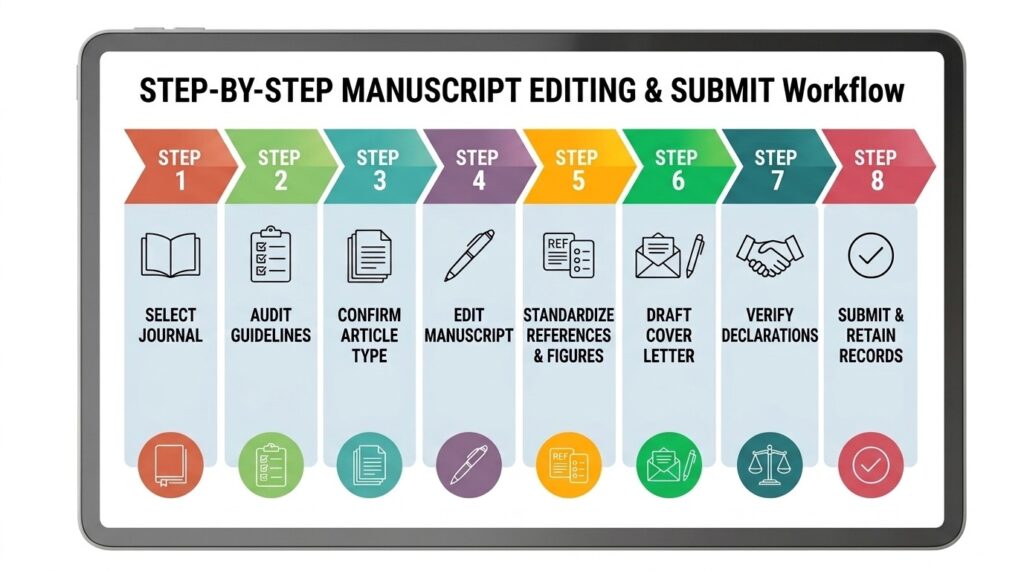
This sequence prevents a common problem: polishing a cover letter before determining whether the manuscript itself meets the journal's structural and reporting requirements.
For clinical research, also verify the reporting framework applicable to your study. Depending on the design, this may include CONSORT, STROBE, or PRISMA. The ICMJE Recommendations provide widely used guidance on manuscript preparation, authorship, disclosures, and related publication practices.
Final Pre-Submission Cover Letter Checklist
Before clicking Submit, audit the following:
- Correct journal name appears throughout the letter.
- Correct manuscript title is used.
- Article type matches the submission system.
- Editor's name is correct, if named.
- Research question is stated clearly.
- Principal contribution is identified.
- Journal fit is specific rather than generic.
- Manuscript is not under consideration elsewhere, if applicable.
- All authors have approved the submission.
- Conflict-of-interest information is accurate.
- Funding information is consistent with the manuscript.
- Ethics approval and consent statements are included where required.
- Trial or protocol registration details are accurate where applicable.
- No unsupported claims of novelty or importance are included.
- Language has been professionally edited.
- Author names and affiliations are consistent.
- Cover letter follows the journal's submission instructions.
- Final manuscript and supplementary files have been checked.
- References, figures, tables, and legends have been standardized.
- Reporting guideline requirements have been verified.
- The final PDF/Word file has been proofread after conversion.
Final Takeaway
A strong cover letter for journal submission is concise, evidence-based, and journal-specific. Its purpose is not to sell the manuscript through exaggerated claims; it is to help the editor understand the study's contribution, relevance, and readiness for peer review.
Use a journal cover letter template to establish structure, then customize every substantive section for the target journal and article type. Whether you are submitting an original research paper, case report, systematic review, review article, or methods paper, the most effective approach is consistent: identify the contribution, demonstrate journal fit, disclose required information, and eliminate avoidable errors.
If language quality, formatting inconsistencies, or submission readiness remain concerns, PaperEdit's professional manuscript editing and proofreading services can provide an additional quality-control stage before submission. A carefully edited manuscript and a precise cover letter give editors a clear, professional first impression and help ensure that preventable presentation problems do not distract from the quality of your research.