

Self-plagiarism may sound like a contradiction at first. We sometimes wonder how someone can potentially plagiarize themselves. However, owing to the misconception of self-plagiarism, many academics, students, and researchers have fallen into the trap of copying their paper for multiple purposes without understanding the ethical consequences.
Self-plagiarism clearly threatens academic integrity and violates the policies of institutions and undermines an entire ecosystem of scholarly communication.
If you have ever completed assignments with similar content, if you've ever reused chapters from your thesis into new papers, or if you have ever copied text from previous published works without giving credit, then you may have engaged in self-plagiarism and not even known it before now.
There is no such thing as a victimless crime when it comes to self-plagiarism. Self-plagiarism deceives readers; inflates the numbers for publication; and decreases trust in the institutions that grant degrees.
To be serious in your academic career, a good understanding of what constitutes self-plagiarism and how to prevent self-plagiarism is a requirement.
Read What Counts as Plagiarism in 2025? Updated Ethical Guidelines?
What Is Self-Plagiarism, Really?
When you submit content (which may include previously published or submitted work or a significant portion of previous work) as original content without proper disclosing or attributing it is also considered "self plagiarizing." This is true even if it is just a small percentage of the same text. Self plagiarizing includes the use of previous published text, research results, methods and empirical data, and even ideas that you have used in any other format.
While academic institutions may define self-plagiarism in different ways, the key is that regardless of how an academic institution defines it, self-plagirizing has the potential to violate academic integrity policies, as it would constitute presenting old work as being new and original.
For instance: Assume you have written a research paper on climate policy for one course, then you were assigned a similar paper from another professor later on, and you were submitted with very few changes to your original paper. This is an example of self plagiarism. Things can become more complicated when the author reuses less than 30% of their original paper, when the author reuses sections related to methodology, or when an author reuses previously published data or empirical data without disclosing this reuse.
One of the reasons students do not understand "is self plagiarism an issue" is that students are unaware that self-plagiarism is a legitimate academic integrity violation across the majority of colleges and universities around the World.
Why Institutions Treat Self-Plagiarism Seriously
For detailed analysis read: Why Avoiding Plagiarism in Research Paper Is Essential?
The intention behind academic policies is not to impose punishment on students, but rather to preserve the basic principles of education and research by generating new ideas through original sources through the use of self-plagiarism.
Duplicated Publications
Researchers who publish the same research in more than one journal without disclosing their self-plagiarism create a distortion of the literature. The scholarly community may be using one article when citing two articles for the same data when using self-plagiarism without being aware of this practice. This leads to an exaggerated perception of the article's value and erroneously creates a consensus among academics using the peer review process of duplicate publications. Academic journals are then faced with reviewing and evaluating research articles for their value and contributions that they have already reviewed as part of their normal academic practices.
Grade Inflation and Credential Devaluation
For students, submitting the same essay to multiple courses is a form of fraud. You're asking instructors to award credit for work that took you perhaps half the effort it should. This inflates grades and cheapens your degree. Employers and graduate programs rely on your GPA as a signal of competence. When it's padded with recycled work, you're misrepresenting your actual capabilities.
Trust Erosion in Academia
Research integrity is currency in academia. Once institutions discover systematic self-plagiarism, they lose confidence in an author's entire body of work. Reputations built over decades can crumble in weeks. Some of the most prominent academic scandals—from Nobel laureates to bestselling authors—have involved plagiarism that destroyed careers permanently.
The Gray Zones: Where Self-Plagiarism Gets Complicated
Not every instance of reusing your own work constitutes self-plagiarism. The devil is in the nuance.
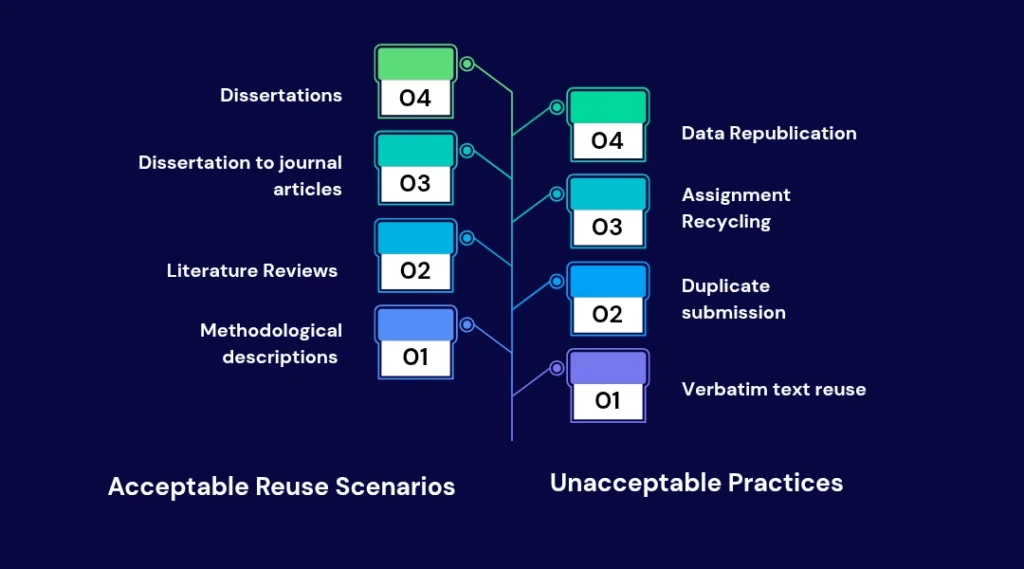
Acceptable Reuse Scenarios
- Methodological descriptions: Slightly reusing methodology sections across related papers is often acceptable if the core method is identical. You describe your lab protocol the same way because it's the same protocol. However, you should still disclose this in footnotes or author's notes.
- Literature reviews:It is common to condense (or ‘tier down’) a larger literature review for a variety of scholarly outlets (e.g., conference papers, journal articles), as long as the given output presents a distinct addition (theoretical or otherwise) to the previous repertoire of literature examined within the review.
- Dissertation to journal articles: Furthermore, there is often the case that a dissertation chapter can easily be developed into an independent journal article (many professors will encourage this type of journal article development from dissertation chapters). However, it is critical that when the chapter is developed into an article, it does provide a new contribution (findings, analysis, etc.) to the body of knowledge through its submission.
- Theses/dissertations: While there are some departments/colleges that expect (or at least allow) students to include previously published sources in their thesis/dissertation, it must be noted that usually there are specific guidelines and/or rules associated with requesting the right to do so, as well as guidelines for providing appropriate credit.
Unacceptable Practices
- Verbatim text reuse: Copying entire paragraphs or significant passages, even with minor word changes, is self-plagiarism. Paraphrasing your own work without attribution still counts.
- Duplicate submission: Sending the same manuscript to multiple journals simultaneously without disclosing prior submission is a breach of publishing ethics and can result in rejection from all outlets.
- Assignment recycling: Submitting the same essay for two different courses, or reusing papers across semesters, is universally prohibited.
- Data republication: Presenting the same research data as "new findings" in multiple publications without acknowledging the source is self-plagiarism, even if your analysis differs slightly.
How Detection Works (And Yes, They Catch You)
Academic institutions and publishers aren't relying on luck or manual review. Technology has made detection efficient and accurate.
Plagiarism Detection Software
Tools like Turnitin, iThenticate, and Grammarly (with plagiarism detection) scan submissions against:
- Student and institutional databases
- Published journal archives
- Internet sources
- Institutional repositories
These systems flag matching text and assign similarity scores. A 40% match to your own previous work isn't automatically flagged as problematic—context matters. But patterns do emerge. If you consistently submit work with high self-similarity across different courses or years, reviewers investigate.
You can also review detailed guide for better understanding.Read: Journals Detect Plagiarism: Tools + Methods You Need to Understand
Cross-Institutional Databases
Universities share data through systems like ProQuest's dissertation database and institutional repositories. When you submit a dissertation containing chapters from published journal articles you've already authored, systems detect this. It's not punishment; it's documentation.
Editor Vigilance
Journal editors maintain institutional memory. They remember authors and their previous submissions. Many editors personally review papers from prolific or flagged authors. If your submission closely mirrors a previously accepted manuscript, they'll catch it.
The Table: Self-Plagiarism vs. Legitimate Academic Practices
| Scenario | Classification | Why | Action Required |
| Reusing 20% of a methodology section across related papers | Acceptable with disclosure | Standard procedures don't change; restatement is efficient | Cite your previous work in footnote |
| Submitting identical essay to two courses without permission | Self-plagiarism | Deceptive; violates academic integrity policies | Fail; potential expulsion |
| Publishing dissertation chapter as journal article with new analysis | Legitimate | Transforms research into appropriate venue; requires permission | Disclose in cover letter; get advisor approval |
| Copying full paragraphs from previous paper; changing a few words | Self-plagiarism | Paraphrasing without attribution is still plagiarism | Fail; academic misconduct record |
| Using same dataset in three related studies with distinct questions | Acceptable with disclosure | Different analyses; new insights; proper practice in some fields | Cite data source; note prior publications |
| Republishing exact same findings in different journal; no mention | Self-plagiarism | Deceives readers; inflates publication count; violates ethics | Retraction; possible sanctions |
| Reusing your literature review synthesized for a conference | Acceptable | Different context; audience; original analysis stands | Cite previous conference presentation |
| Submitting rejected manuscript to new journal with changed title only | Self-plagiarism (borderline) | No substantial revision; intellectual dishonesty | Only submit substantially revised version |
Why AI Academic Writing Tools Don't Solve This
With the rise of best ai for academic writing platforms, some students believe AI can help them reuse work without detection. This is dangerously naive.
AI tools can rephrase text, but they don't change ownership or originality. Running your old essay through an AI paraphraser doesn't make it new work. In fact, it compounds the problem: you're now committing self-plagiarism and potentially violating your institution's AI use policy.
Many institutions now explicitly prohibit using AI to disguise self-plagiarism. Detecting AI-assisted paraphrasing is also becoming easier. Specialized tools can identify patterns characteristic of AI rewriting, even when similarity scores appear low.
Legitimate uses of ai academic writing tools include brainstorming, outlining, drafting, and editing—not recycling or disguising previous work. The technology itself is neutral; your intent determines whether it's ethical.
Explore more with: The Future of Academic Publishing in the AI
Institutional Consequences: The Real Stakes
Understanding the theoretical ethics of self-plagiarism is one thing. Understanding what actually happens when you're caught is another.
Most universities follow a formal process:
- Detection and allegation – You're notified of suspected academic misconduct
- Initial investigation – Department reviews evidence
- Hearing – You have opportunity to respond
- Decision – Misconduct found or dismissed
- Appeal – You can challenge the outcome
This process is time-consuming, stressful, and public within your institution. Even if you win, the stigma lingers.
Transcript Notation
If convicted of academic misconduct, many institutions place a notation on your transcript. Employers and graduate programs see this. Some schools permanently record the violation.
Grade Consequences
At minimum, expect:
- Automatic zero on the assignment
- Failure in the course
- Probation or suspension
At maximum:
- Expulsion
- Loss of degree (retroactive diploma revocation)
- Legal action if federal funding was involved
Career Impact
Self-plagiarism allegations can:
- Destroy graduate school applications
- Eliminate job offers (background checks include academic records)
- End academic careers before they start
- Derail research funding applications (funding agencies investigate misconduct)
Best Practices: How to Avoid Self-Plagiarism
Avoiding self-plagiarism requires intention and systems, not perfection.
Strategy 1: Understand Your Institution's Policy
Every school defines self-plagiarism slightly differently. Some allow reuse of methodology with disclosure; others don't. Read your student handbook and syllabus policies carefully. Ask your professors directly: "Can I build on my previous work for this assignment?"
Strategy 2: Create Original Work for Each Assignment
The simplest rule: treat each assignment as an opportunity to develop new ideas. If you write a paper on organizational leadership for your management class, approach it differently when writing on the same topic for your ethics class. New analysis, new sources, new angle.
Strategy 3: Disclose Previous Work When Reusing is Legitimate
If you're converting your thesis into journal articles (legitimate), disclose this proactively to the editor. If you're reusing methodology descriptions, note this in your paper. Transparency protects you and demonstrates integrity.
Strategy 4: Manage Multiple Submissions Properly
If you submit to multiple conferences or journals, follow these rules:
- Submit only substantially revised versions
- Disclose prior submission or publication in cover letters
- Don't submit to multiple outlets simultaneously unless explicitly allowed
- If rejected, significantly expand or refocus before resubmitting elsewhere
Strategy 5: Keep Detailed Records
Maintain a log of what you've submitted where and when. This prevents accidental self-plagiarism when you have multiple projects running simultaneously. Simple spreadsheet: date, assignment, platform, version number.
Strategy 6: Use Citation for Your Own Work
Yes, you can and should cite yourself. If you're building on previous research you conducted, cite it: "As I argued in my 2022 paper..." This shows intellectual development, not laziness.
Learn to maintain your tone with Avoiding Plagiarism Without Losing Your Voice
The Bigger Picture: Academic Integrity as Professional Habit
Self-plagiarism isn't just a rule to follow in college. It's a professional habit that defines your entire career.
Researchers who build reputations for integrity become trusted, cited, and influential. Those caught in plagiarism scandals—self-inflicted or otherwise—become cautionary tales. The stakes only increase as you advance.
If you're entering academia, consulting, policy work, or any field where credibility matters, now is the time to establish uncompromising integrity standards. Your future self will thank you when you're not explaining misconduct allegations during a job interview.
Conclusion: Originality as Academic Currency
Self-plagiarism violates the core promise of education: that you're doing original, rigorous work. When you recycle your own writing, you're not just breaking a rule. You're stealing from your own education, deceiving your instructors, and compromising the academic system that certifies your competence.
The solution isn't complicated. Write original work. Disclose when reuse is legitimate. Understand your institution's policies. Use academic writing book resources and your professor's office hours to learn proper research practices. And if you're tempted to recycle work, remember: you're always better off asking for an extension, clarification, or guidance than risking your academic career.
The academic world is built on trust. Protect yours by making originality non-negotiable.
Additional Resource: Industry Perspective
Many institutions now integrate training on self-plagiarism into their curriculum. Organizations like the Council of Canadian Academies and research institutions worldwide emphasize academic integrity as foundational to research ethics. Understanding self-plagiarism is part of becoming a responsible scholar.
REFERENCE BOOKS
- "They Say / I Say: The Moves That Matter in Academic Writing" by Gerald Graff & Cathy Birkenstein (3rd Edition, 2014) – Essential for understanding how to properly attribute and build upon previous arguments, including your own work.
- The Elements of Style" by William Strunk Jr. & E.B. White (4th Edition, 2000) – Foundational resource for clear academic writing and proper citation practices that help prevent unintentional self-plagiarism through precise language use.