


When you reach the final stage of your research paper you will have to make a choice that distinguishes the mediocre researcher from a serious scholar—a choice about how to deal with the weaknesses of your study.
You can either hide your weaknesses from the reader by writing in vague terms or you can acknowledge those weaknesses (embrace them). Writing about limitations and future directions does not mean you are giving up on your research; it is a demonstration of your intellectual honesty as well as your credibility as a researcher.
The fact is, researchers that are able to clearly articulate their limitations gain authority as researchers show confidence as opposed to displaying weakness. Furthermore, when you are specific in mapping out the future directions for your research you are positioning your research as a foundation, not a dead end. This guide will lead you step-by-step through how to develop and write both sections with the level of detail they warrant.
Scrutinize your paper more critically with the help of the guide: 13 Academic Writing Rules That Will Transform Your Papers.
Understanding Why Limitations Matter More Than You Think
Researchers often add a limitations section as an afterthought; that is, they check a box stating they met the requirement of addressing limitations, but do so in a way that they believe is "good enough." This is a mistake.
Learn how to effectively communicate your limitations with 'The Difference Between Academic Information and Academic Communication.'
The limitations section of a research paper has a direct effect on how reviewers, readers, and future researchers view the entire study in terms of credibility.
By honestly identifying (acknowledging) limitations/constrictions/constraints, you send a number of signals to the reader — you understand the scope of your research study. It shows you have critically analyzed your research study for validity, and you will not oversell your findings — none of which go unnoticed by journal editors, rewarded by grant committees, or make their way into accurate citations of your work when referenced in other researchers' work because of your established map of boundaries.
The limitations section of your research has a unique contribution to make that no other component of your research can make: build trust by being transparent about your study's limitations as opposed to concealing limitations or shortcomings — this will change the way your audience interprets your arguments and conclusions.
Why is this important for academic credibility?
Because the way future research is conducted depends on researchers accurately identifying/communicating what earlier researchers have done before them. If you write a research paper example that intentionally hides its limitations, you mislead the researchers that will continue building on your work to conduct further research. You will contaminate the pipeline from which all future researchers will draw their research. Writing limitations appropriately is a form of social responsibility.
What Exactly Counts as a Limitation?
Before you write a single word, you need clarity on what belongs in this section. Limitations are factors you couldn't control, decisions you made that constrained your study, or gaps that emerged during research—not flaws in your thinking.
Categories of Common Limitations:
- Sample-related limitations (Limited number of subjects, very specific demographic and/or geographical area)
- Methodology constraints. (Design choices that created obstacles for generalization)
- Resource constraints (such as limited access and/or funding)
- Measurement limitations (Reliability issues with instrumentation, self-report data)
- External validity issues (Study findings may not be applicable in another context)
- Statistical power issues (Unable to detect the effect of a particular treatment)
The primary difference between limitations and mistakes; Limitations arise from the design or context of your study. Limitations are boundaries you have to work within; they represent the reality of how you can or cannot complete your study based on your resources and lack thereof. When outlining your argumentative paper it is necessary to differentiate between limitations and flawed reasoning. Limitations should not read as an apology for poor methodology in your work but instead set forth realistic parameters for your work.
Explore more about research limitations!
How to Identify Your Own Study's Limitations
Most researchers discover limitations during writing, not after. You spot them as you analyze results or write your methodology section. The trick is capturing them systematically rather than letting them scatter across your draft.
You can create a limitations audit list as illustrated in the diagram 👇.
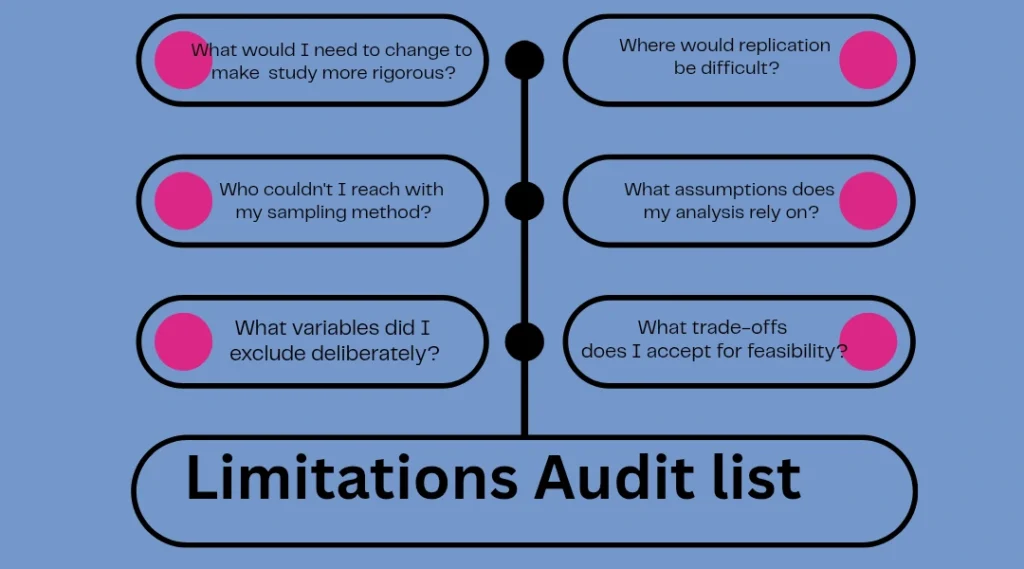
This exercise transforms vague unease into concrete statements. Instead of writing:
"future research might explore other variables,"
specifically write:
"This study exclusively examined undergraduate students; findings may not generalize to adult learners or non-traditional students."
Specificity signals expertise. Vagueness signals uncertainty.
Learn more about polishing your academic writing tone with 'Academic Writing Tone: Professional Without Sounding Robotic.'
Structuring the Limitations Section: From Acknowledgment to Context
Your limitations section should follow a deliberate architecture. Don't just list constraints; explain their implications.
The formula that works:
- Acknowledge the limitation clearly (what it is)
- Explain why it occurred (contextual factors)
- Describe its potential impact (what it might affect)
- Situate it within your design (why you accepted it)
Here's what this looks like in practice:
"This study relied on self-reported data for psychological well-being measures, which introduces social desirability bias. Participants may have minimized negative experiences or exaggerated positive ones. While validated instruments reduce this risk, the reliance on self-report remains a constraint that affects the precision of our findings regarding emotional outcomes. Future research employing physiological measures or third-party observation could strengthen these conclusions."
Notice the structure:
acknowledgment → reason → impact → rationale.
That's how you write limitations that enhance rather than undermine your credibility.
When you're working with a research paper example from your field, study how established researchers handle this. The patterns become obvious once you know what to look for. They don't apologize; they contextualize.
The Psychology of Reading Limitations: What Reviewers Actually Think
Here's an insight that changes how you approach this section: reviewers expect limitations. They read your study knowing that perfect research doesn't exist. What they're evaluating is whether you understand your own constraints.
A limitations section that's too brief signals arrogance or lack of critical thinking. A limitations section that's too long reads like self-sabotage. You're aiming for sophisticated self-awareness.
Reviewers ask themselves: "Does this researcher understand what they've actually accomplished versus what they've claimed?" Your limitations section answers that question directly.
This is especially critical when you're using paper article management for research. Digital tools let you track methodological decisions and their trade-offs throughout your project. The researchers who use these tools effectively catch limitations early and can explain them confidently rather than seeming to discover them as afterthoughts.
Writing Limitations and Future Directions: Connecting the Dots
Here's where most researchers make a structural error: they treat limitations and future directions as separate sections.
What is the better approach?
Connect them deliberately.
Your limitations naturally generate research questions. When you identify that your study couldn't include certain populations, that suggests a specific future direction: research that population. When your methodology had constraints, that suggests alternative methods for future investigation.
The integration formula:
Limitation → Implication → Future Direction
For example:
"Our reliance on cross-sectional data prevents causal inference about whether [variable A] influences [variable B] or vice versa. Longitudinal research tracking these variables over time would establish temporal precedence and strengthen claims of causation. We recommend that future studies employ panel designs with at least three time points."
This approach does several things:
- It prevents your future directions from feeling generic.
- It demonstrates that you've thought systemically about your research.
- It helps other scholars understand exactly what questions remain most pressing.
When addressing mental health misinformation on social media review and future directions, for instance, researchers should note that their study examined a specific platform during a specific timeframe. That naturally points toward future research on other platforms, other timeframes, or different demographic segments. The limitation and future direction are yoked together by logic.
Key Distinctions: What Doesn't Belong in Limitations
Many researchers contaminate their limitations section with material that belongs elsewhere. Let's clarify the boundaries.
Don't include:
- Statistical findings you didn't predict (that's discussion, not limitation)
- Recommendations for practitioners (that's implications for practice)
- Criticisms of prior research (that's literature review positioning)
- General statements about needing more research (that's not helpful)
- Methodological choices you're proud of (those are strengths)
To avoid mistakes your methodological sections, read Most Common Mistakes in Research Methodology Sections.
Your limitations are specifically about constraints that affected what you could measure, conclude, or generalize. Everything else has a home in another section.
This clarity becomes crucial when you're working on non-academic sources for research paper sections. Non-academic sources sometimes conflate limitations with discussions of broader gaps in the field. Academic writing separates these cleanly.
Building a Table: Limitations by Category and Impact
Here's a practical structure you can adapt for your own work:
| Limitation Category | Specific Limitation | Why It Occurred | Potential Impact on Findings | Mitigation Strategy |
| Sample characteristics | Participants recruited from single institution; N=145 | Funding and access constraints | May not generalize to other institutional contexts or regions | Future research should employ multi-site sampling |
| Measurement | Self-report data on sensitive behaviors | Participants' discomfort with direct observation | Social desirability bias may artificially inflate/deflate responses | Implement physiological measures or behavioral observation in replication studies |
| Design | Cross-sectional rather than longitudinal | Time and resource limitations | Cannot establish temporal precedence or causality | Recommend panel studies with minimum 12-month follow-up |
| Statistical power | Small sample size in subgroup analysis (n=28) | Budget constraints on recruitment | Reduced ability to detect effects in subgroup analysis | Conduct formal power analysis; pre-register sample size |
| Temporal scope | Data collected during single academic year | Naturally bounded research grant period | Seasonal effects may influence findings; year-to-year variation unknown | Replicate across multiple academic years to assess temporal stability |
| Geographic scope | Research conducted in urban US context | Institutional location and partnerships | Findings may not transfer to rural contexts or international settings | Collaborate with institutions in diverse geographic locations |
This table structure does several things simultaneously: it demonstrates that you've thought systematically about constraints, it provides reviewers with clear information about study boundaries, and it naturally generates specific future directions.
Future Directions: Moving Beyond "More Research Is Needed"
The worst future directions section ever written consists of three statements: "Future research should investigate X," "More studies are needed on Y," and "Z deserves additional attention." These are placeholders masquerading as scholarship.
Real future directions are specific, methodologically grounded, and built on your study's actual findings.
In order to structure strong future directions:
- Identify the specific unanswered question (generated from your limitations)
- Propose the methodology (specific enough to be useful)
- Explain why this question matters (based on your findings)
- Connect to broader implications (how this advances the field)
Example:
"Our findings suggest that [specific pattern] occurs, but the mechanisms remain unclear. Future research should employ qualitative interviews with participants who demonstrate this pattern to explore the cognitive processes underlying [phenomenon]. This methodological shift from quantitative survey to qualitative exploration would illuminate whether the pattern emerges from [mechanism A], [mechanism B], or [mechanism C]—distinctions with significant theoretical implications."
Additionally, you may also review the guide: Quantitative vs. Qualitative: Choosing the Right Research Approach.
Notice what this does: it's specific enough that another researcher could actually execute it. It's methodologically distinct from your study. It's grounded in your actual findings. That's how you write future directions that read like intellectual leadership rather than obligation.
What Is a Research Paper? Knowing Your Genre Shapes How You Handle Endings
Understanding what counts as a research paper helps you calibrate your limitations and future directions appropriately. Different genres have different conventions.
Review 'How to Submit a Research Paper for Publication?' for further clarity on what is a research paper.
A literature review research paper focuses on synthesized understanding of a topic. Its limitations center on scope (what databases were searched, what languages were included, what timeframe was examined) and its future directions point toward methodological syntheses or underexamined areas within the existing literature.
An empirical research paper based on original data examines specific hypotheses through primary research. Limitations address sample, measurement, design, and generalizability. Future directions propose specific studies that would extend findings or test competing explanations.
A theoretical research paper develops conceptual frameworks or arguments. Limitations acknowledge which phenomena the theory addresses and which it doesn't. Future directions suggest how the theory could be tested empirically or extended to other domains.
When you write a research paper example in your field, notice how established researchers calibrate these sections differently depending on genre. This is learned, not innate. Once you internalize the patterns, your own writing gains authority. Confused how to examine them?
Read: How to Analyze Previously Published Papers to Pick Your Journal?
Common Pitfalls and How to Avoid Them
Pitfall 1: Apologizing for your methodology
Wrong: "Unfortunately, our small sample size prevented us from detecting significant differences."
Right: "Our sample size (N=89) provided adequate power to detect medium effects but limited our ability to detect smaller effects. This design choice balanced precision against feasibility constraints."
Pitfall 2: Making limitations sound like failures
Wrong: "The study was limited to undergraduate students, which is a major weakness."
Right: "Participants consisted of undergraduate students, which allows examination of cognitive patterns in this developmental stage while suggesting that findings may not generalize to adult populations with established cognitive habits."
Pitfall 3: Generic future directions
Wrong: "Future research should investigate this topic further using different methods."
Right: "Longitudinal research following participants across the first three years of college would determine whether the patterns we observed represent stable traits or developmental changes associated with the transition to higher education."
Pitfall 4: Overloading the section
Limitations sections should be concise—typically 1-2 pages. Prioritize constraints that meaningfully affect your conclusions. Minor limitations clutter the section without adding value.
Practical Exercise: Conducting Your Own Limitations Audit
Before you finalize your draft, work through this systematically.
- Step 1: List every decision you made that constrained your study. Don't filter; just capture.
- Step 2: For each decision, ask: Does this affect what I can conclude?
- Step 3: Group decisions by category (sample, methodology, measurement, design, scope).
- Step 4: For each category, write one paragraph that explains the limitation, its origin, and its implications.
- Step 5: Identify specific future directions generated by each limitation.
- Step 6: Check for balance. Are you spending disproportionate space on any single limitation? That signals either that it's genuinely important (fine) or that you're being redundant (trim).
This exercise transforms limitations from something you write about into something you've genuinely analyzed.
Integration with Academic Writing Platforms
When you're managing research using paper article management for research, you can integrate this limitations-thinking throughout your project rather than retroactively. As you make methodological decisions, note their trade-offs immediately. As you encounter constraints, document them. This creates a running record that becomes your limitations section.
Digital tools let you flag passages related to specific limitations, track their implications through your analysis, and connect them naturally to future directions. The researchers who leverage this capacity produce stronger final documents because they've thought about limitations continuously rather than as an afterthought.
Standards Across Disciplines
Limitations sections have some discipline-specific conventions worth understanding.
In social sciences, limitations sections emphasize generalizability, social desirability bias, and external validity. Researchers focus heavily on how sample characteristics might limit applicability.
In natural sciences, limitations address measurement precision, instrument limitations, and environmental controls. The emphasis falls on how environmental or apparatus constraints affected results.
In health sciences, limitations emphasize participant recruitment challenges, comorbidities, and real-world applicability of controlled findings.
Recognizing these patterns in your discipline's top journals helps you calibrate appropriately. You're not writing for an imaginary universal audience; you're writing for specialists in your field who understand the constraints inherent to your methodology.
The Broader Picture: Why This Matters for Science
Here's what gets missed in most guides: limitations and future directions sections shape how knowledge progresses. When researchers honestly acknowledge constraints and identify specific next steps, the collective scientific enterprise moves faster. When they obscure limitations and make vague statements about future research, the field spins.
Your limitations section contributes to scientific integrity at scale. You're helping other researchers understand which claims they can confidently build on and where they need caution. That's not a small contribution.
This responsibility intensifies when you're writing about sensitive topics—like mental health misinformation on social media review and future directions, where readers are trying to understand real-world harms. Precise limitations sections communicate what you actually learned versus what remains speculation. That precision matters for public understanding.
Final Synthesis: Integration Across Your Paper
Strong research papers achieve integration: your limitations naturally emerge from your methodology, your future directions logically flow from your limitations, and your implications address what can confidently be concluded given your constraints.
A reader who's absorbed your methodology section should not be surprised by your limitations. A reader who understands your limitations should immediately grasp why your future directions matter. That coherence signals careful thinking.
When you finish drafting, reread these sections as a unit.
- Does each future direction address an actual limitation you identified?
- Do all significant limitations receive adequate attention?
- Is the tone consistent—neither defensive nor arrogant, but honestly reflective?
Those are your quality markers.
For professional support in your academic writing procedure, visit PaperEdit.
Reference Books
- Creswell, J. W., & Creswell, J. D. (2017). Research Design: Qualitative, Quantitative, and Mixed Methods Approaches (5th ed.). Thousand Oaks, CA: SAGE Publications. (Classic methodology resource addressing limitations and study design)
- Booth, W. C., Colomb, G. G., & Williams, J. M. (2016). The Craft of Research (4th ed.). Chicago: University of Chicago Press. (Essential guide for academic writing, including sections on acknowledging constraints and positioning future work)