


If you send your work to the wrong journal, it will be like sending your romantic letter to someone else's house. Your letter would be delivered, then read, and then returned to you. However, unlike your letter, waiting and being rejected from a journal can take you months and cause you to invest a lot of emotion in writing your paper.
The journal that you choose has a big effect on how likely it is that your paper will be accepted, how visible it is and how much of an impact it will have on your academic field. This guide will help you make every decision you need to make before you hit send.
For guidelines on journal publication, read:
- How to Submit a Research Paper for Publication?
- How to Write and Publish Your Paper in High-Impact Journals
Understanding What Is an Academic Journal
Before you can really narrow down your choices of journals, you need to know what an academic journal really is. An academic journal is not just a place where people publish their research as you might think. Academic journals are peer-reviewed publications that allow scholars to publish their original research, methods and results in order to share their findings with their peers. The advancement of scientific knowledge is dependent on academic journals; they provide a place for researchers to establish credibility in the field, build careers, and make new knowledge official.
According to the National Institutes of Health, the peer-review process is a way to ensure that only the most rigorous, ethical research is published. This is one reason why your decision about which journal to publish in is critical—your work will be published in a reputable journal (and therefore you will be demonstrating to other academics, employers and funders that your work).
Not all journals carry equal weight. Some are prestigious; others are predatory. Some have massive reach; others serve niche communities. Your job is matching your paper's profile to the journal's actual scope and standards.
Step 1: Define Your Paper's Core Identity
You can't choose a journal until you know what you're publishing.
Start with these honest questions:
- What field does your research belong to?
- Is this a quantitative study, qualitative analysis, mixed methods, or theoretical piece?
- What's your target audience—specialists in your subfield, or a broader disciplinary audience?
Let's say you've conducted research on quantitative academic journal about at-risk youth behavior at school. Your paper has hard data: statistical analysis, control groups, effect sizes. This detail matters. Quantitative studies often require different venues than qualitative explorations of the same topic.
Similarly, if your work falls into social work academic journals, you're looking at different expectations than, say, a management academic journals piece focused on organizational behavior. Social work journals prioritize practice-informed research and community engagement. Management journals often emphasize theoretical contribution and organizational application.
Be brutally honest about what you've actually done. Misrepresenting your work's scope, methodology, or significance wastes editor time and guarantees rejection.
Step 2: Audit Journal Scope, Impact Factor, and Editorial Bias
Not every journal accepts every paper type. Academic journal editor jobs posts often highlight what kinds of submissions each journal prioritizes, and that's useful intelligence.
Start by examining the journal's stated scope. Read the "About" section. Scan the last 12 months of published articles. Do they align with your topic? Are they at your methodological level? If the journal publishes primarily qualitative case studies and you've got quantitative data, it's not your match—even if the topic seems close.
Next, investigate academic medicine journal impact factor and similar metrics for your field. Impact factor measures how frequently published articles are cited. A higher impact factor suggests broader influence, but it's not always better. A hyper-prestigious general journal might reject your specialized work, while a focused, moderate-impact journal might champion it.
Check indexing. Is the journal indexed in PubMed, JSTOR, Web of Science, or Scopus? If you care about discoverability (and you should), indexing matters. The Directory of Open Access Journals (DOAJ) is a trustworthy resource for identifying legitimate open-access journals.
Step 3: Investigate Journal Quality Indicators (And Watch for Predatory Signs)
You've probably heard the term "predatory journal." These are fake academic publications that charge fees, provide zero peer review, and accept nearly everything. They're reputation destroyers.
Legitimate journals signal quality through:
- Transparent peer review processes—the journal explains how many reviewers evaluate submissions, typical timelines, and rejection rates.
- Real editorial boards—search the names. Are these actual academics with verifiable credentials and publications? Predatory journals list fabricated editors or padding.
- Clear authorship guidelines—legitimate journals specify formatting, reference styles, methodology disclosure requirements.
- Visible publication fees (if applicable)—open-access journals charge publication fees, which is normal. But the fee should be reasonable ($500–$3,000) and transparent. Suspicious: journals asking $100 or $10,000.
- Established publication history—check when the journal launched. How many issues has it published? Are archives accessible?
Use Beall's List historical resources to familiarize yourself with red flags. When in doubt, ask your advisor or librarian.
Step 4: Match Your Work to Journal Tiers (Prestige, Reach, and Specialization)
Academic journals operate in tiers. Understanding where you realistically fit prevents wasted submissions and strategic misdirections.
Tier One (Elite or Flagship) Journals These include Science, Nature, and discipline-specific equivalents. The acceptance rate is typically somewhere in the range of 5%-10%. These journals prefer to publish ground breaking discoveries with broad significance. If your research is not truly innovative and you do not have evidence that it will make a major contribution to the literature, you should consider sending your work elsewhere because you will be wasting one of your submission opportunities.
Tier Two (High Impact Specialized) Journals These journals have a very strong reputation in their respective fields. The acceptance rate is usually in the range of 15%-25%. Some examples would be the Journal of the American Medical Association (JAMA) for medicine and field-specific equivalents. Your work will need to represent a significant contribution to the literature and have clear implications for your field. It typically takes between 4-8 months for these journals to process their submissions.
Tier Three (Mid-Tier) Journals These journals are well established and indexed. They would have a solid or at least good reputation. The acceptance rate would be in the range of 30%-40%. Most researchers will publish in these types of journals so they are good publication venues for researchers to submit solid empirical research or significant theoretical contributions.
Tier Four (Niche or Emerging) Journals These journals only accept papers that are focused on a specific sub-field or methodology. The acceptance rates vary widely and range between 40%-50% (and may be higher). Niche or emerging journals are good for researchers who are focused on their niche area, are early-career researchers, or are trying to utilize an innovative methodology.
Explore more about Journal Rejection Rate Explained (And How to Beat It).
The strategic move: start with your realistic tier. If rejected, move down or across, not up.
Step 5: Investigate Editorial Team Alignment and Previous Publications
Who edits this journal? What do they publish? This matters more than you think.
Look up the Editor-in-Chief. Search their publication record. Do they cite your work? Do their research interests overlap with yours? Editors bias toward work that interests them—sometimes unconsciously. If your paper aligns with their research trajectory, you've gained a subtle advantage.
Similarly, identify the associate editors handling your subfield. Review their publication records. If one has published work directly related to yours, your paper might land with a sympathetic reader.
Check the journal's recent special issues. Does one align with your focus? Some journals run themed issues with separate (sometimes faster) review timelines.
For history academic journals, for instance, editor specialization matters enormously. A journal edited by scholars focused on twentieth-century social history might move faster on submissions within that window than outside it.
Step 6: Examine Peer Review Timeline and Open-Access Status
Timeline is real. Academic publishing moves slow, but some journals move slower.
Check the journal's website for average review times. Most legitimate journals publish this information. Expect 3–6 months average. Some specialized journals take 8–12 months. Predatory journals accept in days (literally a red flag).
Decide: do you want your work open access (free to readers) or behind a paywall? Open access increases visibility but usually requires author fees. Some journals offer hybrid models where authors choose. PubMed Central lists open-access journals in medicine and life sciences.
Learn more: Open Access vs. Traditional Publishing: Which One is Right for You?
Step 7: Cross-Check Using Strategic Tools
Don't rely on intuition. Use evidence.
Journal Citation Reports (JCR) and Scopus provide impact metrics, citation patterns, and subject categorization. Your institution likely has access. Search your journal. How has its impact factor trended? Are citations increasing or declining?
Scimago Journal Rank (SJR) offers an alternative to impact factor, accounting for citation prestige. Visit Scimago's website to compare journals in your field.
Review three to five recent articles in your target journal. Ask yourself:
- Could my paper fit stylistically?
- Are methodology standards similar?
- Is the writing tone aligned?
- Are conclusions similarly qualified or speculative?
This reality check prevents mismatched submissions.
Step 8: Create Your Submission Strategy
Never submit to just one journal. Have a ranked list of five to seven targets.
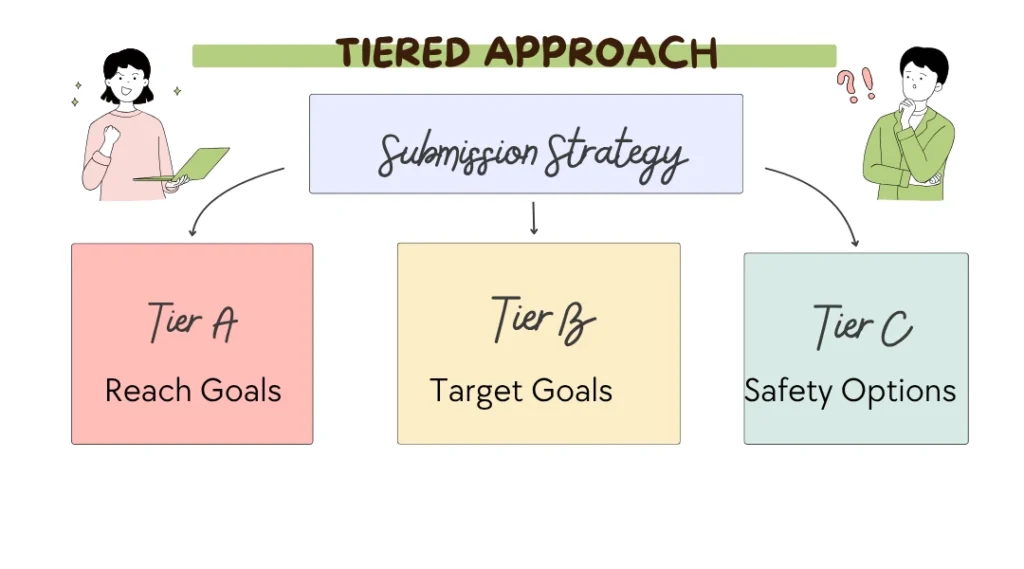
Here's the tiered approach:
Tier A (Reach Goal): One journal slightly above your estimated acceptance likelihood. You believe in your paper's contribution; it's worth the risk.
Tier B (Target Goals): Two to three journals at your realistic level. These should fit well methodologically, topically, and in terms of audience.
Tier C (Safety Options): Two to three journals where acceptance is highly probable. These are legitimate, indexed venues where your work clearly belongs.
When Tier A rejects you (assume it will), immediately submit to Tier B. This isn't pessimism; it's statistics. Even excellent papers face rejection.
The Right Academic Journal Decision Matrix
Here's a practical table to help you compare journals systematically:
| Evaluation Criteria | Ideal Characteristics for Your Paper | How to Verify | Weight |
| Journal Scope Match | 80%+ of recent articles align with your topic | Review last 12 months of table of contents | HIGH |
| Peer Review Quality | Transparent process, 2–4 reviewers, clear timeline | Journal website / Editor info section | HIGH |
| Indexing Status | PubMed, Scopus, Web of Science, JSTOR | Check journal site or Ulrichsweb | HIGH |
| Impact Factor (if applicable) | Aligned with or slightly above field median | JCR or Scimago | MEDIUM |
| Editor Alignment | Editor's research interests overlap with yours | Search editor name + recent publications | MEDIUM |
| Predatory Risk Assessment | Journal passes all legitimacy checks | Beall's List history, author testimonials | HIGH |
| Publication Timeline | 4–8 months typical; matches your timeline needs | Journal website or recent author interviews | MEDIUM |
| Open Access Option | Available if visibility is your priority | Journal homepage policy section | MEDIUM |
| Audience Reach | Practitioners/policymakers if applied focus | Journal website mission statement | LOW-MEDIUM |
Common Mistakes to Avoid When Choosing
Mistake 1: Chasing Impact Factor Over Fit
A prestigious journal rejecting your paper wastes months. A moderate-impact journal accepting and widely reading it advances your career faster.
Mistake 2: Ignoring Methodological Alignment
If a journal publishes exclusively qualitative research and you've done quantitative work, rejection is almost certain—regardless of quality.
Mistake 3: Underestimating Predatory Red Flags
Accepting a publication in a predatory journal damages your reputation permanently. Verify before you commit.
Mistake 4: Submitting Without Reading Recent Issues
You're essentially submitting blind. Five minutes reviewing recent content prevents major mismatches.
Mistake 5: Forgetting Author Guidelines Until the Submission Deadline
Some journals have unusual formatting, reference, or disclosure requirements. Reading these early prevents last-minute panic reformatting.
Field-Specific Journal Selection Insights
Different disciplines have different journal cultures. Understanding yours accelerates your decision.
Academic Medicine Journal Impact Factor research:
Medicine values large studies with clear clinical implications. Journals emphasize statistical rigor and ethical compliance. Timeline: 4–6 months average.
Social Work Academic Journals research: These value practice-informed, community-engaged research. Journals prioritize applicability and population impact alongside rigor. Open access is increasingly expected.
Management Academic Journals research: Theory and novelty matter. Journals want original frameworks or empirical evidence of theoretical mechanisms. Timelines vary widely (4–12 months).
History Academic Journals research: Scholars value archival depth, historiographical awareness, and narrative clarity. Journals vary from specialized (medieval history) to broad (general history). Timeline: 6–12 months typical.
Each discipline has its unwritten rules. Ask your advisor. Read your field's top journals. Absorb the culture. For further clarity, refer to these guides:
- How Editorial Standards in Academic Journals Differ Across Journals
- How to Analyze Previously Published Papers to Pick Your Journal
The Final Checklist: Before You Hit Submit
Go through this before submitting:
- Your paper's methodology follows the requirements established by the journals maintaining the journals have published standards.
- Your topic falls within the "scope" of the journals (confirmed through reviewing the last few issues published).
- You have confirmed that this journal is non-predatory.
- You have an understanding of how long it typically takes to publish, and you are willing to wait that long.
- You have read, understood, and followed the author's guidelines exactly as stated by the journal.
- Your reference list includes citations to that specific journal (meaning you are demonstrating respect for this publication).
- You have identified the editor and appropriate associate editor(s) (i.e., likely) for your area of study.
- You have completed all required journal metadata, and you have the conflict-of-interest declarations when submitting your article to this journal, and you included a cover letter with your submission packet.
- You have a "backup" of other journals in case this journal rejects you.
The decision of which journal to publish in can make or break your publishing experience. Not selecting an appropriate journal can lead to you being rejected by a journal, therefore, your chances of being accepted are lessened. Ultimately, if you select the right journal, it will ensure your work is reaching the right people and has a lasting academic impact on your field of study.
Reference Books for Deeper Learning
- "How to Write and Publish a Scientific Paper" by Barbara Gastel and Robert A. Day – The comprehensive guide to academic publishing, covering journal selection, manuscript preparation, and navigating the review process with practical wisdom from decades of editorial experience.
- "The Craft of Scientific Communication" by Joseph E. Harmon and Alan G. Gross – An essential resource exploring how to effectively communicate research findings, including detailed guidance on selecting journals and understanding audience expectations across different academic disciplines.