

Academic writing doesn’t fail loudly—it fails quietly. A manuscript gets rejected. A reviewer flags “lack of clarity.” A thesis comes back with vague but damaging comments.
In many cases, the issue isn’t the research—it’s the editing.
And that’s where things get uncomfortable.
A low-quality editing service doesn’t just miss errors. It weakens arguments, distorts meaning, and signals to reviewers that the work isn’t ready—even when the science is solid.
Explore how weak arguments cost you with: Weak Arguments in Academic Papers (And How to Fix Them).
This isn’t about perfectionism. It’s about credibility. If your editing layer is weak, everything built on top of it collapses faster.
Let’s break down exactly how to identify a low-quality editing service before it costs you time, money, and academic momentum.
Why Editing Quality Matters More Than You Think
Editing is often treated as a final polish—a cosmetic step after the “real work” is done. That mindset is flawed.
In academic publishing, clarity is part of the argument. If your writing is unclear, your research becomes harder to evaluate, easier to reject, and less likely to be cited.
According to Copy editing standards, editing involves structural coherence, consistency, and precision—not just grammar fixes. A weak edit leaves logical gaps untouched.
This is why serious researchers invest in professional academic editing services rather than treating editing as an afterthought.
If your editing service doesn’t elevate the clarity of your work, it’s not doing its job.
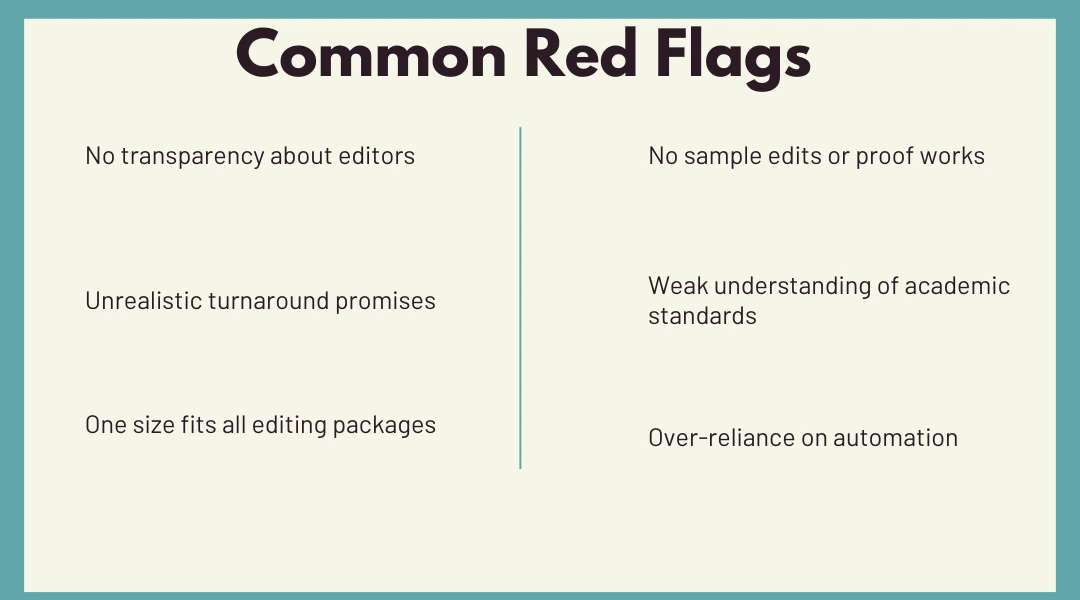
Red Flag #1: No Transparency About Editors
If you can’t verify who is editing your work, you’re already in trouble.
A credible edit service will clearly state:
- Editor qualifications (PhD, MSc, subject expertise)
- Areas of specialization
- Experience with journals or academic writing
Low-quality providers avoid this entirely. They hide behind generic phrases like “expert team” or “professional editors” without proof.
Why? Because many rely on:
- Generalist freelancers
- Non-native subject specialists
- AI-assisted editing without human oversight
When dealing with complex documents like theses, this lack of expertise becomes dangerous. Professional services, as offered by PaperEdit, emphasize subject-specific editors for a reason—technical accuracy matters as much as language.
If the service cannot prove who is editing your work, assume they’re not qualified to do it.
Red Flag #2: Unrealistic Turnaround Promises
Speed is one of the biggest marketing traps in editing.
A 15,000-word dissertation cannot be meaningfully edited in 6–12 hours. That’s not editing—it’s surface scanning.
Low-quality dissertation editing services often promise:
- “Same-day delivery”
- “Instant proofreading”
- “Express editing within hours.”
These offers typically mean:
- Automated tools are doing most of the work
- Editors are rushing without context
- Structural issues are ignored entirely
Institutions like the Centers for Disease Control and Prevention emphasize layered review processes for accuracy—because rushed outputs lead to flawed communication.
Serious academic editing services take time to:
- Understand the research context
- Align terminology with discipline norms
- Ensure logical consistency
If a service prioritizes speed over depth, quality is already compromised.
Red Flag #3: One-Size-Fits-All Editing Packages
Editing is not a single process—it’s a hierarchy.
A credible service distinguishes between:
- Developmental editing services → structure, argument flow, clarity
- Line editing → tone, readability, sentence flow
- Copy editing service → grammar, punctuation, consistency
Low-quality providers flatten all of this into one vague “editing package.”
That’s a problem.
Editing a research paper is not the same as editing a novel. Even within academia, editing a medical paper differs from editing a social sciences thesis.
For example, book novel editing services focus heavily on narrative structure, while dissertation editing service providers must handle citations, methodology clarity, and academic tone.
If a service cannot explain what type of editing they offer, they likely lack the depth to do any of it properly.
Red Flag #4: No Sample Edits or Proof of Work
A serious editing service shows results—not promises.
Low-quality providers avoid sample edits because:
- Their changes are minimal
- Their edits may introduce inconsistencies
- They lack a consistent editing standard
A reliable best essay editing service should be able to demonstrate:
- Before/after comparisons
- Sentence restructuring
- Logical improvement in arguments
Without this, you’re trusting blindly.
High-quality platforms like PaperEdit often provide trial edits or clear examples because they understand that editing quality must be visible—not assumed.
If a service cannot show proof of improvement, it’s not worth your manuscript.
Red Flag #5: Weak Understanding of Academic Standards
Academic writing is governed by strict conventions.
A low-quality academic editing services provider often ignores:
- Citation styles (APA, MLA, Vancouver)
- Journal formatting guidelines
- Ethical writing practices
According to Academic publishing frameworks, compliance is not optional—it’s a baseline requirement.
Poor editing can:
- Misformat references
- Alter intended meaning
- Introduce inconsistencies in terminology
For dissertations, this is even more critical. Weak dissertation editing services can lead to rejection or revision delays simply because formatting and clarity aren’t aligned with institutional expectations.
Editing without academic awareness is not just ineffective—it’s risky.
Red Flag #6: Over-Reliance on Automation
AI tools are everywhere—but they’re not editors.
Low-quality services rely heavily on automation, leading to:
- Generic phrasing
- Loss of author voice
- Mechanical sentence corrections
Even discussions in Nature highlight the limitations of automated editing in scholarly communication.
A credible edit service uses tools as support—not as a replacement for human judgment.
If your document feels flattened or stripped of nuance after editing, it’s a sign that automation replaced expertise.
Red Flag #7: No Revision Policy or Accountability
Editing is iterative. One pass is rarely enough.
Low-quality services:
- Charge extra for revisions
- Limit feedback cycles
- Avoid post-delivery support
This signals low confidence in their own edits.
If a service disappears after delivery, you’re left fixing their mistakes.
Red Flag #8: Suspiciously Low Pricing
Editing is skilled, intellectual labor. It requires:
- Subject expertise
- Language mastery
- Analytical thinking
If pricing seems unusually low, something is being cut:
- Editor qualifications
- Time spent on your document
- Depth of review
Cheap editing often results in:
- Missed errors
- Inconsistent terminology
- Weak structural clarity
A professional copy editing service invests real effort into each manuscript. That effort has a cost.
Low pricing is not a deal—it’s a warning.
Comparison Table: Low vs High-Quality Editing Services
| Feature | Low-Quality Editing Service | High-Quality Editing Service |
| Editor Transparency | No clear qualifications | Verified academic credentials |
| Turnaround Time | Unrealistically fast | Realistic, structured timelines |
| Editing Scope | One-size-fits-all | Layered (developmental, copy, line) |
| Sample Edits | Not available | Provided or offered |
| Academic Standards | Weak or inconsistent | Strict adherence to guidelines |
| Use of AI | Over-reliance | Balanced with human expertise |
| Revision Policy | Limited or paid | Included revisions |
| Pricing | Suspiciously low | Reflects expertise and effort |
| Subject Expertise | Generalist editors | Discipline-specific specialists |
| Output Quality | Surface-level corrections | Deep clarity and coherence |
The Real Cost of Choosing the Wrong Service
A low-quality editing service doesn’t just waste money—it creates setbacks.
You risk:
- Journal rejection
- Misinterpretation of your research
- Delays in publication timelines
- Loss of academic credibility
In academic publishing, clarity signals authority. Weak editing sends the opposite message.
This is why investing in credible academic editing services is not optional—it’s strategic.
What High-Quality Editing Actually Looks Like
To make the contrast clear, here’s what you should expect from a professional service:
- Editors with proven academic backgrounds
- Subject-specific expertise
- Multi-layered editing approach
- Transparent communication
- Realistic deadlines
- Revision support
Therefore, formatting and proofreading services by PaperEdit emphasize these fundamentals because they directly impact publication success.
Editing is not just about fixing language—it’s about strengthening your argument.
Final Take: Be Critical Before You Commit
The editing industry is crowded—and inconsistent.
A low-quality editing service doesn’t just fail to improve your work—it actively weakens it.
And the damage is subtle. You won’t always notice it immediately—but reviewers will:
- Be selective.
- Ask for proof.
- Demand transparency
Because in academic writing, precision isn’t optional—and neither is the quality of the editor you choose.
Never hesitate to invest in high-quality editing. It really matters.
You can refer to this analysis for better insight: Should Medical Students Invest in Editing Services?