


The academic world runs on numbers. Your promotion depends on them. While, your funding hinges on them. Your reputation is literally quantified by them. But here's the uncomfortable truth: nobody agrees on which numbers actually mean something.
You've probably heard both terms. The h-index vs impact factor debate has divided researchers for nearly two decades. One measures your personal influence. The other measures your journal's prestige. They sound complementary, but they're measuring entirely different dimensions of academic success—and confusing them could derail your career strategy.
This isn't academic theory. This matters because tenure committees, grant reviewers, and hiring panels use these metrics to evaluate you. Get them wrong, and you're playing the credibility game with incomplete information.
Get to know about research portfolio's publication from How to Create a Research Portfolio to Boost Your Career?
The Rise of Metrics in Academia: Why We Quantify Everything
School administration wanted to gather data about your program's progress (e.g., number of students enrolled). They also believed that using Quantitative Metrics provided an easy way to show objective progress, even though the field of education is primarily subjective. Quantitative Metrics are now being used to guide researchers’ careers (i.e., who gets better job offers), journals (i.e, more submissions due to the Journal's Impact Factor), the direction of funding, promotion of researchers, and the closing or expansion of laboratories. As reported in the Nature Report on Research Assessment Practices, this process created opportunities and many challenges for Faculty of Arts & Sciences (FAS) academics. The important thing to note about these two concepts, the H-Index and the Journal's Impact Factor, is that they were both created for a particular purpose at a particular time, and they were not created as an ideal measure of an individual or a journal. Despite this, we have come together to pretend they are an ideal measure of an individual or journal. Administrators wanted data they could report to stakeholders. Metrics provided an appealing illusion of objectivity in a fundamentally subjective field.
The problem?
Both h index and impact factor were invented to solve specific problems at specific moments in time. Neither was designed to be the ultimate measure of academic worth. Yet we've collectively pretended they represent something universal.
Learn more aboutt research metrics with: What is a ResearchGate Score, and Does It Matter for Academics?
Understanding h-Index: What It Really Measures
Jorge Hirsch, a physicist, introduced the h-index in 2005 and it is a very straightforward metric. The h-index essentially represents the largest number, h, for which there are at least h papers with h or more citations. According to the comprehensive definition of the h-index given on Wikipedia, the h-index is a revolutionary way for researchers to measure their individual impact on the academic community.
In other words, if you have an h-index of 25, then you have 25 papers that were cited at least 25 times. This simple metric has profound meaning; how did it become so widely accepted?
The primary reason is that it is simple to understand and relatively fair. It reflects both productivity (number of papers) as well as impact (citation numbers). Thus, an individual researcher with one highly-cited publication will have a lower h-index than an individual researcher with 200 low-citations publications.You need both output and impact.
When calculating your highest h index, the formula becomes your competitive advantage. Your first highly-cited papers boost it quickly. The plateau comes later—adding papers with fewer citations barely moves the needle. This creates an interesting career dynamic: early success matters enormously, but you can't coast forever.
Several platforms now calculate your h-index: Google Scholar, Scopus, Web of Science, and specialized h index calculator tools. These platforms sometimes give different results because they index different journals and count citations differently. Your h-index on Google Scholar might be 28. On Scopus, it might be 24. This inconsistency matters more than academics admit.
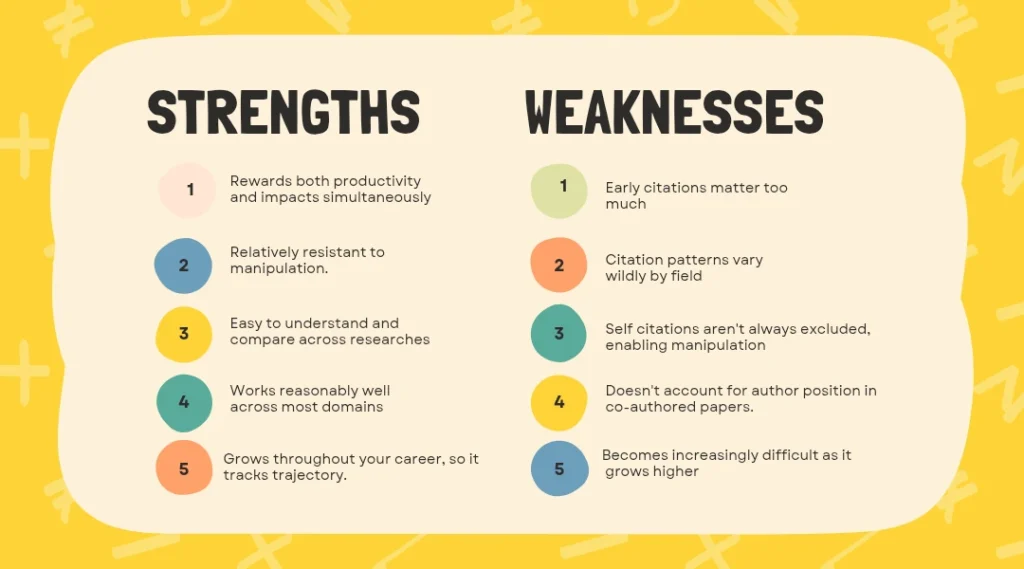
The Strengths of h-Index:
- Rewards both productivity and impact simultaneously
- Relatively resistant to manipulation (one massively-cited paper won't inflate it dramatically)
- Easy to understand and compare across researchers
- Works reasonably well across most disciplines
- Grows throughout your career, so it tracks trajectory
The Critical Weaknesses:
- Early citations matter too much (your first papers significantly boost it)
- Citation patterns vary wildly by field (theoretical physics gets cited differently than molecular biology)
- Self-citations aren't always excluded, enabling manipulation
- Doesn't account for author position in co-authored papers
- Becomes increasingly difficult to improve as it grows higher
Understanding Impact Factor: Journal Performance Explained
Impact factor is fundamentally different—it measures journals, not researchers. Published since 1975 by Clarivate Analytics, it's the average citation count of papers published in a specific journal over a two-year window.
Here's how it works: If Nature published 1,000 papers in 2023-2024, and those papers collectively received 50,000 citations in 2025, the impact factor would be 50. Higher impact factor means readers cite that journal's papers more frequently.
The logic seems sound. A journal with higher impact factor publishes more influential work. Publishing there signals quality. It's become shorthand for prestige, and that shorthand has metastasized into career assessment.
The specific impact factors many researchers care about include nature journal impact factor, plos one impact factor, and iscience impact factor. Nature typically hovers around 50+. PLOS ONE, being an open-access mega-journal publishing thousands of papers annually, sits much lower despite enormous reach. iScience, Elsevier's newer multidisciplinary journal, targets the 5-10 range.
Where the confusion starts: publishing in Nature doesn't automatically make your work influential. It makes your work published somewhere others read frequently. That's different.
The Strengths of Impact Factor:
- Objective, standardized measurement across journals
- Reflects the journal's overall readership and citation patterns
- Relatively stable year-to-year (less volatile than h-index)
- Easy for administrators to understand and compare
- Useful for identifying high-visibility publication venues
The Fatal Weaknesses:
- Penalizes niche journals regardless of importance within their field
- Doesn't measure individual paper impact (one blockbuster can inflate the whole journal's average)
- Susceptible to manipulation (journals often encourage self-citations)
- Review articles get cited more than original research, skewing averages
- Completely ignores the author's position or contribution to the paper
h-Index vs Impact Factor: The Key Differences You Must Understand
These metrics measure fundamentally different things, yet people conflate them constantly. Let's be crystal clear about what each does:
| Dimension | h-Index | Impact Factor |
| Measures | Individual researcher impact | Journal prestige & citation patterns |
| Time Frame | Entire career (cumulative) | Specific 2-year window (annually updated) |
| Unit of Analysis | Your body of work | The journal itself |
| Affected by | Your total citations + paper count | All papers published in that journal |
| Growth Pattern | Monotonically increases or plateaus | Fluctuates annually |
| Discipline Variance | High (fields cite differently) | High (fields have different norms) |
| Manipulation Risk | Moderate (self-citation possible) | High (journal policy dependent) |
| Career Relevance | Direct (measures your influence) | Indirect (reflects venue prestige) |
The practical implication is this: your h-index tells a grant reviewer what your track record looks like. The impact factor of your publication tells them where your work appeared. These are supplementary pieces of evidence, not interchangeable metrics.
A researcher publishing in high-impact journals will eventually build a higher h-index, assuming those papers get cited. But the path isn't automatic. You could publish in Science and have a paper that doesn't resonate with the field. Meanwhile, someone publishing in a specialized journal might get 100+ citations because they hit on something the field desperately needed.
Which Metric Should You Actually Care About?
Here's where professional honesty matters: it depends on your career stage and your field.
Early Career (PhD through postdoc): Your h-index doesn't matter yet because it's too low to be meaningful. What matters is where you're publishing. Journal impact factor is your proxy for quality and visibility. Publishing in higher-impact journals early creates two advantages: greater visibility and citation potential for future h-index building.
Mid-Career (Assistant Professor to Associate): Your h-index now matters. Tenure and promotion committees explicitly evaluate it. They're asking: have you established independent research productivity? Do your papers get cited? An h-index of 8-15 for mid-career is reasonable depending on field. This is where your publication strategy compounds. Every paper published now could contribute to your h-index for decades.
Late Career (Full Professor and beyond): Your h-index is already established. Committees care less about new growth and more about whether you maintain relevance. Your newest papers matter more than ever because they signal whether you're keeping up with your field.
Field-Specific Considerations: If you're in high-energy physics or most influential artificial intelligence scientists h-index database rankings, your field is citation-heavy. Citation counts happen faster and go higher. You're competing on h-index across a well-cited field. If you're in humanities or certain social sciences, citations are slower and lower. Your h-index will never match physics colleagues, and that's not a problem—it's field-specific reality.
The smart strategy? Optimize for h-index growth by publishing in journals where your papers will be read and cited. That means some higher-impact journals, but not exclusively. Sometimes the most relevant journal for your specific contribution will have lower impact factor. That's fine. Citation impact matters more than impact factor.
The Limitations of Both Metrics: Why Numbers Lie
Here's where we get brutally honest: both metrics have structural flaws that no amount of refinement will fix.
h-Index Doesn't Measure Importance: A highly-cited review article author can build a massive h-index without conducting original research.A researcher that addresses a major issue, and only ever publishes their work one time will have an h-index of just one. They did change their discipline with this innovative piece of research however the h-index still only takes into account number of articles rather than the quality of the original work itself. The sub-specialty researcher will always get a lower h-index score than someone who researches a more commonly studied field such as cancer research; however, this is not a measure of the quality of their work but a measure of how many people read about the sub-specialty and therefore why the research in that area is not being read as much as the other fields have.
How Many Times You Are Cited is Not How Good You Are: Although published in a moderate journal like PLOS ONE which publishes circa 30,000 articles a year; the citation counts will likely not match that of similar articles published in a higher impact factor journal.
Both Metrics Ignore Context: Neither metric acknowledges when you're a co-author versus first author versus corresponding author. On tenure committees, this distinction matters enormously, but the numbers treat all authorships equally.
Citation Gaming Is Real: Researchers can self-cite, edit Wikipedia to promote their work, or encourage citation cartels.Journals can manipulate what they count as "citable items." The metrics depend on honest behavior they can't enforce.
Disciplinary Differences Are Ignored: A higher h index in biology is completely incomparable to a higher h index in mathematics. The citation patterns, publishing speeds, and audience sizes are completely different.
Building Your Academic Profile Beyond Numbers
The smartest researchers stopped obsessing about metrics a few years ago. They're building academic profiles instead—multidimensional evidence of impact that numbers alone can't capture.
This means:
Publishing strategically, not just frequently. Our resource on:
Best Platforms to Showcase Your Research Portfolio
helps you balance prestige with relevance. Choose journals where your paper will reach the right audience, not necessarily the highest-impact journal that will accept it.
Tracking h index calculator tools and understanding your specific platform results, because different databases give different numbers. Know where your h-index stands on Google Scholar versus Scopus. This matters when you write grant proposals.
Establishing yourself as an accessible expert. Write blog posts, give talks, mentor students, engage with social media. These don't boost your h-index directly, but they increase the likelihood that researchers read your papers and cite them.
Contributing to your field's infrastructure. Review manuscripts for journals. Serve on committees. Contribute to open-source research tools. These don't show up on metrics, but they signal that you're a respected community member.
Publishing replication studies and negative results. These rarely get cited heavily, so they hurt your h-index. But they're essential to science, and increasingly, funders and institutions recognize this. Quality matters more than citation count.
Collaborating deliberately. Co-authorship spreads impact across more researchers, potentially increasing everyone's h-index. Choose collaborators who work in well-cited fields if you want faster h-index growth, but choose collaborators who strengthen your research first.
The Field-Specific Reality: What Matters in Your Discipline
Different academic communities have entirely different relationships with metrics. Understanding your field's culture is essential.
In computer science and related fields: The h-index is treated seriously. Researchers openly compare h-indices. Publishing in premier conferences matters as much as journal publications. Your field moves fast—citations accumulate quickly.
In biology: Impact factor still carries surprising weight, but this is shifting. High-impact journals serve as a proxy for research quality, but the field acknowledges this is imperfect. Grant reviewers increasingly look at the papers themselves, not just where they were published.
In physics: The h-index is fundamental to career assessment. Citation counts run high because researchers routinely cite all foundational work. Your h-index will be higher than equivalent researchers in other fields, and that's expected.
In chemistry: Both metrics matter substantially. Publishing in high-impact journals early is crucial for career trajectory. The field has strong prestige hierarchies tied to specific journals.
In mathematics: The h-index matters less than many fields. Single papers can sustain a career. Citation counts are slower, impact is measured differently, and prestige often depends on solving specific important problems rather than citation volume.
In humanities: Both metrics are increasingly used by administrators, but the research community often resists them. Quality is assessed more by peer recognition, book publications, and intellectual contribution than by numbers.
If you don't know your field's norms, ask your senior colleagues explicitly: "On a tenure case in our department, what weight would hiring committees give to h-index versus journal impact factor versus other factors?" The answer will reveal what actually matters.
The Future of Academic Metrics: Where We're Headed
Academia is slowly recognizing that single metrics cannot capture research quality. The Declaration on Research Assessment has 19,000+ institutional signatories pledging to move beyond journal impact factor as the primary evaluation tool. Yet most tenure committees still use these metrics. The change is slow.
Emerging alternatives include:
Citation impact normalized by field: Comparing h-indices within your discipline only, accounting for different citation speeds and patterns.
Article-level metrics: Evaluating individual papers rather than journal averages. Some high-impact journals publish low-impact papers; some low-impact journals publish high-impact papers.
Altmetrics: Tracking online attention, policy influence, news coverage, and real-world application. A paper might not be heavily cited but could influence policy or technology.
Open peer review: Moving away from metrics entirely and toward transparent evaluation where reviewers can see and evaluate papers directly.
Research evaluation profiles: Comprehensive assessments showing diversity of work—original research, reviews, teaching, service, public engagement—rather than single numbers.
The academic community hasn't settled on alternatives yet. For your career right now, you need to work with the metrics that exist while positioning yourself for whatever comes next.
Learn more with:
How Universities Evaluate Research Portfolios?
Final Thoughts: Mastering the Metric Game While Staying Sane
Track both metrics, but understand what each measures. Your h-index tracks your personal influence. Journal impact factor tracks where you're publishing.
Publish in appropriate venues, not just prestigious ones. Publishing in the most relevant journal for your work—even if it has lower impact factor—often leads to more citations over time.
Invest in quality over quantity. A few solid papers with strong citation potential will build your h-index. That's why working with professional editors often pays dividends in higher citation rates and better journal acceptance.
How Professional Editing Improves Your Chances of Journal Acceptance?
Collaborate strategically. Working with established, well-cited researchers accelerates your h-index growth.
Monitor your progress without obsessing. Check your h-index once a year. Know where it stands relative to your career stage and field. But don't let it dictate every decision.
Communicate your impact clearly. When you're evaluated, provide context. Explain why your papers matter. Highlight their applications and influence beyond citation count.
Your academic career is determined by the quality of your thinking, the rigor of your work, and your commitment to advancing knowledge. The metrics follow from that foundation. Build the foundation first, and the numbers will take care of themselves.
Refer to Paperedit's blog section.
Reference Books
- "The Metric Tide: Reshaping Research Assessment and Evaluation" by Paul Wouters et al. (SAGE Publications) — A comprehensive examination of how metrics are reshaping academic evaluation and the unintended consequences of quantification in research assessment.
- "Planned Obsolescence: Publishing, Technology, and the Future of the Academy" by Kathleen Fitzpatrick (NYU Press) — Explores how academic publishing systems work, why we measure what we measure, and how technology might reshape evaluation beyond traditional metrics.