


Accidental plagiarism can undermine an otherwise rigorous research paper, even when authors have no intention of claiming someone else's work. Inconsistent note-taking, overly close paraphrasing, missing citations, and incorrect attribution of secondary sources can introduce scholarly integrity problems into dissertations, journal articles, and research proposals.
Avoiding accidental plagiarism in research papers requires more than running a similarity checker before submission. Researchers must understand how to paraphrase technical material, distinguish their own analysis from published findings, attribute ideas accurately, and maintain traceable references throughout the writing process.
This guide explains how to prevent unintentional plagiarism, recognize patchwriting, cite secondary sources correctly, use plagiarism detection tools responsibly, and conduct a final citation-integrity audit before submitting academic work.
💡 Ready to polish your research paper for publication?
Strengthen your manuscript's clarity, citation consistency, and academic presentation with PaperEdit's professional editing and proofreading services.
1. Understand Accidental Plagiarism and Scholarly Misattribution
What is accidental plagiarism?
Accidental plagiarism occurs when a writer uses another person's words, ideas, data, or intellectual contributions without adequate acknowledgment, despite having no deliberate intention to deceive. It can arise from incomplete citations, faulty paraphrasing, inadequate research notes, or confusion about attribution conventions.
Intent does not determine whether a passage is properly attributed. Editors and academic institutions assess the work itself, including its citations, textual similarities, context, and compliance with applicable research-integrity policies.
Common examples include:
- Reproducing a sentence from a journal article without quotation marks or an appropriate citation.
- Paraphrasing a published argument while retaining its distinctive wording and structure.
- Reporting a numerical finding without identifying its original source.
- Citing a review article as though the author had consulted the original study.
- Reusing previously published material without the disclosure or permission required by the applicable policy.
- Incorporating another researcher's conceptual framework without acknowledging its intellectual origin.
Why does citation integrity matter?
Accurate attribution allows readers to distinguish established knowledge, previous findings, and the author's original contribution. It also enables other researchers to verify evidence, trace scientific claims, and reproduce analytical decisions where appropriate.
Academic standard: Follow the research-integrity, citation, and authorship policies of your institution and target journal. Requirements differ across disciplines, publishers, and types of scholarly material.
Common pitfall: Assuming that accidental plagiarism is automatically exempt from consequences because the omission was unintentional. Good-faith mistakes should be corrected, but they can still require formal clarification or revision.
2. Identify Patchwriting Before It Reaches a Journal
What is patchwriting, and why is it considered accidental plagiarism?
Patchwriting occurs when an author reproduces much of a source's sentence structure and wording while substituting synonyms, changing grammatical forms, or rearranging a few phrases. The result may look different on the surface while remaining too dependent on the original expression.
Consider this illustrative example.
Original source sentence:
"Chronic exposure to air pollution is associated with an increased risk of respiratory morbidity among vulnerable populations."
Problematic patchwriting:
"Long-term exposure to polluted air is linked to a higher risk of respiratory illness in susceptible groups."
Although several words have changed, the sentence retains nearly the same structure and sequence of ideas.
A stronger paraphrase:
"Evidence linking sustained air-pollution exposure with respiratory health outcomes highlights the need to assess risks in populations with greater clinical vulnerability (Author, Year)."
This version reorganizes the emphasis and expresses the finding in a different analytical structure. The citation remains essential because the underlying evidence originated with another researcher.
The example is illustrative, not a substitute for checking an actual source. A proper paraphrase must accurately represent the original study's methods, population, findings, and limitations.
How to distinguish patchwriting from acceptable paraphrasing
| Feature | Patchwriting | Acceptable paraphrasing |
| Sentence structure | Closely follows the source | Independently constructed |
| Word choice | Primarily substitutes synonyms | Uses wording appropriate to the writer's explanation |
| Understanding | May reflect superficial processing | Demonstrates comprehension of the source |
| Attribution | May be missing or inadequate | Cites the source when required |
| Scientific meaning | May distort or oversimplify details | Preserves the original claim and its limitations |
Industry-standard practice: Read the source, identify its central meaning, draft the explanation independently, and compare the result with the original to verify accuracy. Retain a citation even when the wording is entirely your own.
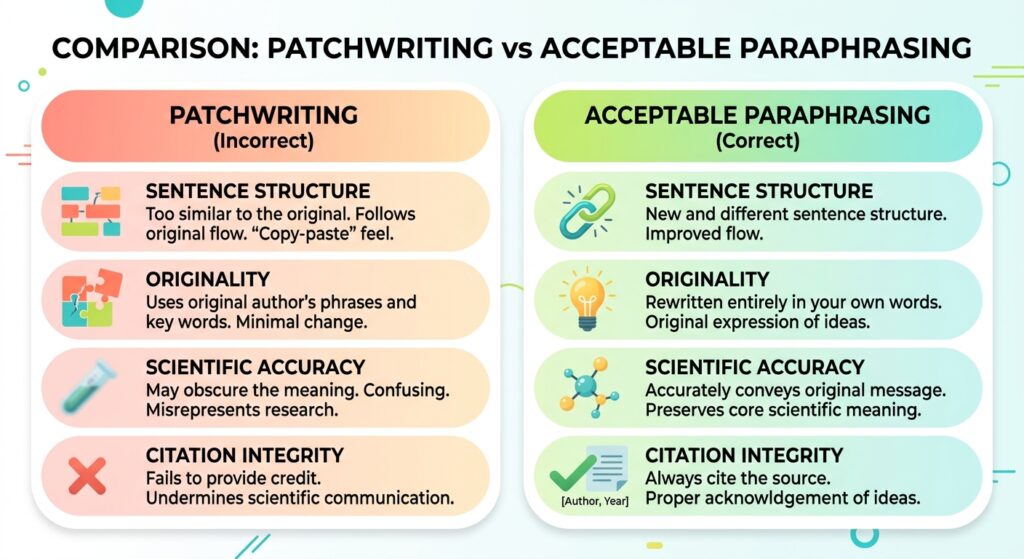
Common pitfall: Believing that changing a specified percentage of words makes a paraphrase acceptable. There is no universal percentage of rewritten text that guarantees ethical attribution.
3. Develop a Reliable Paraphrasing Method for Academic Writing
Proper paraphrasing requires both linguistic independence and scientific accuracy. This is particularly important for ESL authors and researchers working with dense theoretical or technical literature.
Follow a five-step paraphrasing workflow
- Read for meaning. Identify the author's main argument, evidence, and limitations before attempting to rewrite the passage.
- Record the key idea. Write a brief note in your own words, separating the finding from the author's supporting details.
- Draft independently. Close or minimize the original text while writing a new sentence structure that suits your argument.
- Restore essential precision. Check technical terms, numerical results, population characteristics, and qualifiers against the source.
- Cite and verify. Add the citation, compare the paraphrase with the original, and correct wording that remains unnecessarily close.
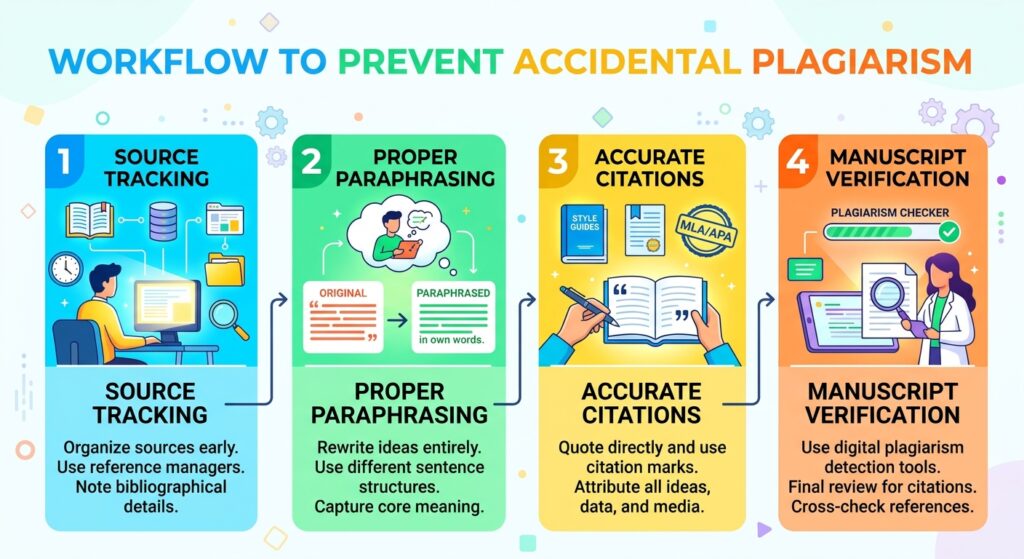
Do not remove important qualifiers simply to make a sentence shorter. For example, a study reporting an association should not be paraphrased as proving causation. Similarly, a result from a small, selected sample should not be generalized to an entire population without supporting evidence.
How do you rewrite technical descriptions without altering meaning or plagiarizing?
Technical writing introduces an additional challenge: established terminology often cannot be replaced safely. Researchers may need to retain standardized definitions, instrument names, equations, diagnostic criteria, or methodological labels.
Preserve necessary technical terms while changing the explanatory structure around them. Cite the original source for borrowed methods, definitions, theoretical models, or distinctive procedures. Use quotation marks when exact wording is necessary and quotation is appropriate under the applicable style guide.
For instance, when describing a published laboratory protocol, distinguish between a standardized method name and the source's original explanatory prose. Do not rewrite a validated procedure so extensively that the scientific steps become ambiguous.
Common pitfalls: Replacing precise technical language with inaccurate synonyms, deleting qualifiers, combining findings from different studies into one unsupported claim, and paraphrasing from memory without rechecking the evidence.
Also read: How to Conduct and Write a Rigorous Systematic Literature Review
4. Prevent Secondary Source Misattribution
What is secondary source misattribution?
Secondary source misattribution occurs when a writer cites an original study without consulting it, relying instead on a review, textbook, or another author's discussion of that study. It can also occur when a claim attributed to one source is actually supported by a different reference.
This error is especially common in literature reviews and dissertations, where multiple sources summarize the same evidence.
How can researchers prevent misattributing secondary source citations?
Use the following procedure:
- Locate the original article through a DOI, journal website, institutional repository, or academic database.
- Confirm that the original source actually supports the claim you intend to make.
- Check the study population, design, results, and limitations rather than relying only on the secondary author's summary.
- If the original work cannot be accessed, consult your required citation style for the appropriate secondary-citation format.
- Avoid implying that you independently verified a source that you have not read.
In APA 7th edition, for example, secondary citations generally identify the original author and the secondary source actually consulted. Only the work consulted is normally included in the reference list. Other styles may use different conventions, so follow the specified manual.
Why this matters for data and scientific findings
A review article may summarize an original study selectively, discuss its results in a different context, or report a corrected estimate. Returning to the primary source helps prevent the transmission of numerical errors and misinterpreted conclusions.
Industry-standard practice: Verify primary sources for important claims whenever feasible, particularly for clinical recommendations, quantitative findings, landmark theories, and disputed evidence.
Common pitfall: Copying a citation from another article's reference list and assuming that the cited source supports the same statement in your own manuscript.
5. Maintain Citation Integrity Throughout a Dissertation or Long Research Paper
Long dissertations, systematic reviews, and multi-author manuscripts create more opportunities for attribution errors. Researchers may collect hundreds of references, revise chapters over several months, and move paragraphs between documents without retaining the original citation context.
Build a source-tracking system
Use a reference manager such as Zotero, EndNote, or Mendeley to organize bibliographic information and insert citations consistently. These tools reduce formatting errors, but they cannot determine whether a source genuinely supports a claim.
Maintain research notes that record:
- Full bibliographic details and DOI or stable URL.
- The specific claim, result, or idea drawn from the source.
- Page numbers for direct quotations, where available and appropriate.
- Whether you consulted the primary source or a secondary discussion.
- Any limitations or contextual qualifications relevant to your interpretation.
- The intended location of the evidence in your manuscript.
Clearly distinguish direct quotations from paraphrased notes. A simple system of quotation marks, source labels, and separate fields for personal commentary can prevent copied text from being mistaken for original prose during later drafting.
Avoid accidental plagiarism in collaborative writing
In multi-author projects, establish a shared citation workflow and require contributors to preserve source references when transferring text. Assign responsibility for verifying citations in each section, then conduct a manuscript-wide audit before submission.
Common pitfalls: Leaving temporary citation placeholders unresolved, deleting citations while editing for concision, duplicating references under slightly different metadata, and transferring notes into the manuscript without checking whether they contain verbatim source language.
Also read: Addressing Desk Rejection: How to Rewrite Your Abstract in 2026
6. Use Plagiarism Checkers Correctly
What does a similarity score actually measure?
Plagiarism detection software identifies text that matches or resembles material in the databases and sources available to the tool. A similarity report is an indicator for review, not a definitive judgment of plagiarism.
A high similarity score may result from correctly quoted passages, standard methodological descriptions, reference lists, institutional wording, or previously submitted versions of the same work. Conversely, a low score does not establish that every idea is properly attributed.
How should researchers interpret a similarity report?
| Report finding | Possible explanation | Recommended action |
| Long matching passage without quotation marks | Potentially copied text or patchwriting | Compare with the source, rewrite appropriately, and cite |
| Matching text in a reference list | Standard bibliographic overlap | Verify reference formatting |
| Similarity in a methods section | Standardized terminology or reused wording | Review source dependence and applicable reuse policies |
| Match to the author's previous publication | Potential text recycling | Check disclosure, copyright, and journal policies |
| Unattributed claim with little textual overlap | Possible idea or data misattribution | Verify the underlying source and add attribution |
There is no universal acceptable similarity percentage for every journal. Editorial decisions depend on the nature, location, extent, and context of the matches.
Protect unpublished research and sensitive data
Before uploading a manuscript to a third-party similarity checker, review its privacy policy, retention practices, database-sharing arrangements, and institutional requirements. This is particularly important for confidential peer-review material, unpublished findings, patent-sensitive work, and manuscripts containing sensitive data.
Common pitfall: Rewriting every highlighted sentence solely to lower a similarity score. The goal is accurate attribution and original scholarly expression—not cosmetic manipulation of a report.
Also read: Mastering Academic Style Guides: APA 7th, MLA 9th, and Chicago: 2026 Author Guide
7. Apply the Correct Citation Style and Attribution Rules
Citation formatting and attribution are related but distinct tasks. A perfectly formatted reference can still be incorrect if it does not support the associated claim.
| Style or framework | Common context | Key consideration |
| APA 7th | Psychology, education, social sciences | Author–date citations; careful handling of secondary sources |
| Vancouver | Medicine and biomedical research | Numbered citations linked consistently to the reference list |
| IEEE | Engineering and technical disciplines | Numbered references and consistent citation order |
| MLA | Humanities and language studies | Author–page conventions where applicable |
| Chicago | History and several humanities disciplines | Notes-bibliography or author–date system, depending on requirements |
| Harvard | Various academic disciplines | Author–date conventions vary by institutional guide |
Before finalizing citations, consult the official or institutionally required style guide. For example, the APA Style website provides guidance on APA citation and reference conventions, while the Purdue Online Writing Lab offers practical academic writing and citation resources.
For biomedical manuscripts, also review the ICMJE Recommendations and the target journal's instructions for authors.
Common pitfalls: Mixing author–date and numbered citation systems, failing to update numbering after deleting a reference, omitting citations from figure legends, and assuming that reference-manager output is error-free.
8. Pre-Submission Citation Integrity Checklist
Before submitting a journal article, dissertation, or thesis, complete the following checks:
- Every borrowed idea, finding, dataset, figure, and adapted table is appropriately attributed.
- Direct quotations are clearly marked and cited according to the relevant style guide.
- Paraphrased passages use independent wording and structure while preserving the source's meaning.
- Technical descriptions retain essential scientific terminology and methodological accuracy.
- Primary sources have been checked for important claims wherever feasible.
- Secondary citations follow the required style and do not imply that an unread source was consulted.
- All in-text citations correspond to reference-list entries, and all listed references are used appropriately.
- Author names, publication years, titles, DOIs, and other bibliographic details are accurate.
- Figures, tables, adapted materials, and reused text comply with citation, permission, and disclosure requirements.
- Any reuse of the author's previously published work complies with copyright and journal policies.
- Similarity reports have been interpreted contextually rather than judged solely by percentage.
- Reference-management software has been used consistently, followed by manual verification.
- The manuscript meets the target journal's formatting, ethics, and submission requirements.
Conclusion: Make Citation Integrity Part of Your Writing Process
Avoiding accidental plagiarism is a continuous research practice, not a last-minute similarity-checking exercise. Accurate source tracking, independent paraphrasing, transparent secondary citations, and careful verification help researchers protect the integrity of their arguments and demonstrate respect for other scholars' contributions.
Build attribution checks into literature review, drafting, revision, and final proofreading. When a manuscript contains complex technical descriptions, extensive references, or language that needs refinement, an independent editorial review can help identify inconsistencies before submission.
Ready to strengthen your manuscript? Visit PaperEdit to explore professional academic editing and proofreading support for clearer, more consistent, submission-ready research.