


Expressing disagreement in academic writing requires more than choosing formal vocabulary. Researchers must challenge interpretations, contrast conflicting studies, and identify methodological limitations without sounding dismissive or overstating the available evidence. The goal is to communicate critical judgment while maintaining scholarly neutrality.
Academic disagreement phrases are expressions that allow researchers to question claims, qualify interpretations, evaluate evidence, and acknowledge alternative perspectives in a measured, evidence-based manner. When used effectively, these phrases strengthen literature reviews, dissertations, research articles, and peer-reviewed manuscripts by distinguishing established findings from interpretations that remain uncertain or contested.
For researchers, doctoral candidates, and ESL authors, mastering this language is essential for developing a credible academic voice. This guide explains how to express disagreement respectfully, contrast conflicting research findings, critique methodology, and use hedging phrases to communicate uncertainty without weakening an argument.
💡 Ready to polish your research paper for publication?
Transform your manuscript with PaperEdit's professional editing and proofreading services
1. Why Academic Disagreement Requires Scholarly Neutrality
Academic writing is not simply a presentation of facts. It involves evaluating evidence, examining competing explanations, and determining how confidently a conclusion can be supported. Disagreement is therefore a necessary component of scholarly inquiry.
However, the language used to challenge another researcher can influence how readers interpret the argument. Statements such as “This study is wrong” or “The authors clearly failed to understand the issue” sound subjective because they judge the researchers rather than explain the limitations of their evidence.
A more effective approach identifies the specific issue and supports the evaluation with evidence.
Instead of writing:
“This study is completely unreliable and its conclusions are incorrect.”
Write:
“Although the study provides useful preliminary evidence, its conclusions should be interpreted cautiously given the limited sample size and the absence of a longitudinal assessment.”
The revised statement identifies a limitation, explains its relevance, and avoids making a stronger claim than the evidence supports.
What makes academic disagreement effective?
Four principles guide a scholarly critique:
- Evidence-based evaluation: Connect criticism to data, methods, assumptions, or documented findings.
- Precision: Identify the specific claim or methodological decision being challenged.
- Proportionality: Match the strength of the language to the strength of the evidence.
- Professional respect: Critique the argument, not the competence, intentions, or character of the researcher.
These principles apply across disciplines, although the conventions of critique differ between experimental sciences, humanities, social sciences, and clinical research.
2. Academic Disagreement Phrases for Different Writing Situations
The most appropriate phrase depends on the purpose of the sentence. A literature review may require a neutral comparison, whereas a discussion section may need a more direct evaluation of an interpretation.
A. Phrases for respectfully challenging an argument
Use these expressions when a previous study makes a claim that your evidence, analysis, or theoretical framework does not fully support.
| Academic phrase | Best use | Example |
| “This interpretation may overlook…” | Identifying an omitted factor | “This interpretation may overlook the influence of institutional differences.” |
| “An alternative explanation is that…” | Introducing another plausible interpretation | “An alternative explanation is that the observed effect reflects selection bias.” |
| “This conclusion warrants further scrutiny because…” | Evaluating a conclusion cautiously | “This conclusion warrants further scrutiny because the analysis excludes relevant confounding variables.” |
| “The evidence does not fully support the claim that…” | Challenging an overgeneralization | “The evidence does not fully support the claim that the intervention is equally effective across populations.” |
| “A more qualified interpretation would suggest that…” | Narrowing an overly broad claim | “A more qualified interpretation would suggest that the intervention is beneficial under specific conditions.” |
| “This account may be incomplete insofar as…” | Identifying a gap in an explanation | “This account may be incomplete insofar as it does not consider regional variation.” |
These sentence frames are especially useful when writing a critical literature review or evaluating the theoretical assumptions underpinning a research question.
Submission pitfall: Avoid using “the evidence does not support” when the evidence is merely inconclusive. A lack of statistically significant evidence is not automatically proof that an effect does not exist.
B. Phrases for contrasting conflicting studies in a literature review
A strong literature review does more than summarize one paper after another. It synthesizes findings, identifies disagreements, and explains why results may differ.
When studies produce conflicting findings, distinguish between differences in outcomes, research designs, populations, measurement instruments, and analytical assumptions.
Useful phrases include:
- “In contrast to the findings reported by [Author], [Author] found that…”
- “Whereas previous studies have emphasized [factor], more recent evidence suggests…”
- “These findings differ from those of [Author], potentially because of differences in…”
- “The discrepancy between these studies may reflect variations in sample characteristics.”
- “Taken together, these studies suggest that the relationship may depend on…”
- “Although both studies examine [topic], they differ in their operationalization of…”
- “The available evidence remains mixed regarding…”
- “One possible explanation for these divergent findings is…”
Example:
“Smith et al. (2023) reported a positive association between remote work and employee productivity, whereas Ahmed et al. (2024) found no statistically significant relationship. This discrepancy may reflect differences in industry composition, productivity measures, and study duration.”
This formulation identifies the disagreement and proposes possible explanations without assuming that either study is necessarily flawed.
When synthesizing evidence, check whether the studies are genuinely comparable. Differences in effect estimates may arise from distinct populations, outcome definitions, confidence intervals, or study designs rather than direct contradictions.
Also read: PaperEdit Academic Proofreading Services to refine your manuscript's clarity, consistency, and scholarly tone.
C. Phrases for critiquing a study's methodology with scholarly neutrality
Methodological critique is strongest when it explains how a research decision affects the validity, reliability, generalizability, or interpretation of the results.
Consider these expressions:
- “The methodological approach may limit the generalizability of the findings.”
- “The reliance on self-reported data introduces the possibility of recall bias.”
- “The absence of a control group makes it difficult to attribute the observed changes to the intervention.”
- “The cross-sectional design limits the extent to which causal relationships can be inferred.”
- “The sampling strategy may have introduced selection bias.”
- “The study would have benefited from a more explicit justification of the chosen analytical method.”
- “The measurement instrument may not fully capture the complexity of the construct.”
- “These limitations should be considered when interpreting the reported effect.”
Example:
“Although the study offers valuable insights into student engagement, its reliance on a convenience sample from a single institution may limit the generalizability of the findings to other educational contexts.”
The sentence acknowledges the study's contribution while explaining a concrete limitation.
Industry-standard consideration: Use methodological terminology accurately. Internal validity concerns whether the study supports the proposed relationship within the research design; external validity concerns the extent to which findings apply beyond the studied conditions. Reliability concerns consistency of measurement, whereas validity concerns whether the intended construct or inference is adequately supported.
Do not automatically label a study “invalid” because it has a small sample or uses a nonexperimental design. The suitability of a method depends on the research question, design, and intended inference.
D. Phrases for identifying limitations in previous research
Researchers often need to establish a knowledge gap without dismissing earlier contributions. Use language that specifies what remains unresolved.
| Purpose | Recommended phrase |
| Identify an omission | “Previous research has paid limited attention to…” |
| Highlight a research gap | “Less is known about the extent to which…” |
| Qualify existing evidence | “The available evidence remains inconclusive regarding…” |
| Identify a narrow scope | “Earlier studies have primarily focused on…” |
| Identify a measurement limitation | “Existing measures may not adequately capture…” |
| Establish a need for further research | “Further investigation is needed to determine whether…” |
For example:
“Although previous studies have examined digital learning outcomes extensively, less is known about how these outcomes vary across institutions with different levels of technological infrastructure.”
This statement establishes a research gap without implying that previous researchers overlooked an obvious issue or conducted inadequate work.
3. Hedging Phrases in Academic Writing: How to Express Uncertainty
Hedging refers to linguistic strategies that qualify claims, indicate uncertainty, and communicate the limits of available evidence. Hedging is particularly important when interpreting observational data, discussing preliminary findings, proposing explanations, or generalizing beyond a sample.
It does not mean making every sentence vague. Instead, it helps researchers calibrate their claims to the evidence.
Common hedging words and expressions
Modal verbs: may, might, could, would.
Example: “These findings may indicate a relationship between sleep quality and academic performance.”
Qualifying adverbs: potentially, plausibly, relatively, partially.
Example: “The intervention was potentially beneficial in settings with adequate institutional support.”
Evidence-based qualifiers: the findings suggest, the results appear to indicate, the evidence is consistent with.
Example: “The findings suggest that targeted feedback may improve revision quality.”
Scope limitations: in this sample, under the conditions examined, within the limits of the present study.
Example: “Within the limits of the present study, the intervention was associated with improved task completion.”
Cautious interpretation: one possible explanation is, it remains unclear whether, this interpretation should be treated cautiously.
Example: “One possible explanation is that the observed differences reflect variation in participants' prior experience.”
How much hedging is appropriate?
The appropriate level of certainty depends on the evidence and the claim.
| Claim strength | Appropriate wording | Typical context |
| Strongly supported | “The results demonstrate…” | Robust evidence directly supports the specified finding |
| Supported but qualified | “The findings indicate…” | Results provide substantial support within the study's scope |
| Suggestive | “The findings suggest…” | Evidence supports a plausible interpretation |
| Tentative | “The results may indicate…” | Preliminary, limited, or uncertain evidence |
| Unresolved | “It remains unclear whether…” | Available evidence does not resolve the question |
These categories are practical editorial guidance, not universal statistical thresholds. Even a statistically significant result may require cautious interpretation if the design, measurement, or assumptions limit the inference.
Common pitfall: Over-hedging can obscure a well-supported conclusion. A sentence such as “It might perhaps be possible that the results could potentially suggest…” contains unnecessary qualifiers. Prefer “The results may suggest…” when that accurately reflects the evidence.
Also read: Synthesizing Sources: How to Move Beyond Summary to Critical Analysis in Academic Writing (2026 Guide)
4. Neutral Academic Vocabulary for Scholarly Debate
Word choice affects whether a sentence sounds analytical or confrontational. Replace emotionally charged evaluations with precise descriptions of evidence, assumptions, and reasoning.
| Avoid | Prefer | Why |
| “The authors are wrong.” | “The available evidence does not fully support this interpretation.” | Evaluates the claim rather than the researchers |
| “This study is useless.” | “The study's applicability may be limited by its design.” | Identifies a relevant constraint |
| “The researchers ignored…” | “The analysis does not explicitly account for…” | Describes an observable omission |
| “Obviously, this proves…” | “These findings provide evidence that…” | Avoids unwarranted certainty |
| “This argument is ridiculous.” | “This argument may be difficult to sustain given…” | Connects the critique to evidence |
| “The results are contradictory.” | “The results differ across the studies examined.” | Describes the discrepancy without assuming incompatibility |
| “The methodology is terrible.” | “Several methodological limitations warrant consideration.” | Creates space for specific evaluation |
Neutral language should not conceal substantive problems. If a study contains a demonstrable error, describe the error directly and explain its consequences. Scholarly neutrality requires accuracy, not excessive politeness.
5. How to Structure a Balanced Academic Critique
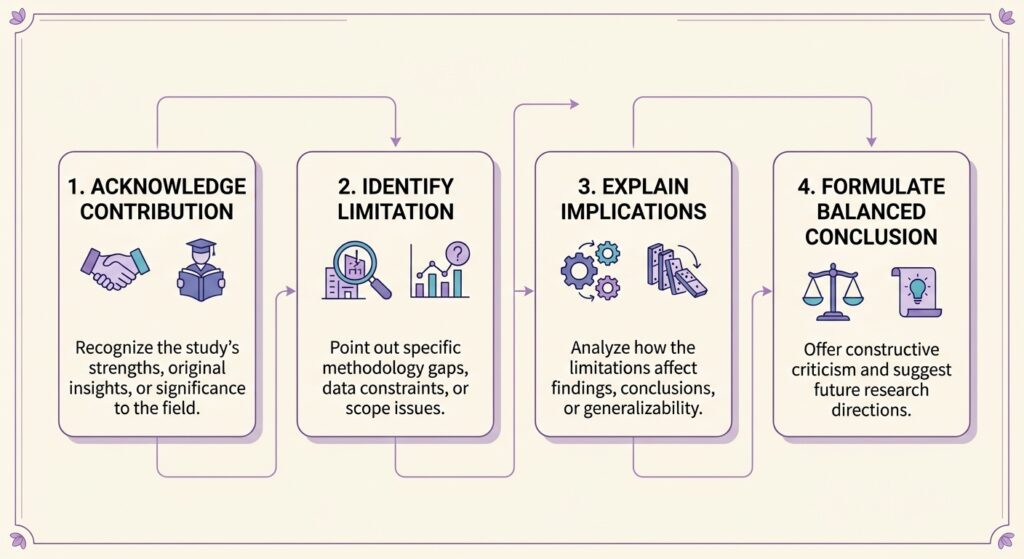
A useful critique follows a logical sequence: acknowledge the contribution, identify the limitation, explain its implications, and offer a proportionate conclusion.
Step 1: Acknowledge the study's contribution
Begin by identifying what the research establishes or contributes.
Example: “The study provides useful evidence concerning the relationship between instructional feedback and student performance.”
Step 2: Identify the specific limitation
Avoid broad judgments. Name the methodological or interpretive issue.
Example: “However, the absence of a comparison group limits the ability to isolate the effect of the feedback intervention.”
Step 3: Explain why the limitation matters
Connect the limitation to the research question or the conclusions.
Example: “Consequently, the observed improvement cannot be attributed exclusively to the intervention.”
Step 4: Qualify the overall conclusion
Explain what the study can still contribute and what remains uncertain.
Example: “Nevertheless, the findings provide a useful basis for further research using controlled or longitudinal designs.”
This four-part structure creates a balanced critique without weakening its analytical force.
6. Practical Sentence Frames for Literature Reviews and Dissertations
Researchers can adapt the following academic phrasebank to their discipline and the specific evidence under discussion.
To compare interpretations
- “Whereas [Author] interprets these findings as evidence of [X], [Author] attributes them to [Y].”
- “An alternative interpretation is that…”
- “This distinction is important because…”
To challenge assumptions
- “This assumption may not hold under conditions in which…”
- “The argument rests on the premise that…, which remains to be established.”
- “A further consideration is whether…”
To discuss contradictory findings
- “The findings are not entirely consistent with those reported in…”
- “The divergence in results may be attributable to…”
- “Further evidence is required to determine whether…”
To qualify a conclusion
- “The results should be interpreted within the context of…”
- “The findings provide preliminary support for…”
- “The evidence does not permit a definitive conclusion regarding…”
To propose future research
- “Future studies could examine whether…”
- “Further research using [design or method] may help clarify…”
- “A direct comparison of [X] and [Y] would help establish…”
Adapt these sentence frames rather than inserting them mechanically. A phrase is effective only when it accurately represents the evidence and fits the surrounding argument.
Also read: How to Create a Literature Review Synthesis Matrix: A Complete 2026 Guide for Researchers
7. Maintain Academic Tone During Manuscript Editing
Even a well-reasoned critique can lose impact if the manuscript contains inconsistent terminology, grammatical errors, or poorly structured sentences. A final editorial review should address both language and argumentation.
Apply these editorial checks
Argumentation: Verify that every disagreement identifies a specific claim and explains why it warrants qualification.
Evidence: Confirm that citations support the exact statement being made. Check original sources rather than relying solely on secondary summaries.
Hedging: Remove redundant qualifiers and strengthen statements when the evidence justifies greater certainty.
Terminology: Use terms such as bias, validity, reliability, significance, and generalizability according to their methodological meanings.
Consistency: Maintain consistent author names, tense, abbreviations, terminology, and citation formatting throughout the manuscript.
Sentence structure: Break up long sentences that combine several criticisms or competing interpretations.
Citation style: Follow the target journal's requirements for APA 7th edition, IEEE, Vancouver, Chicago, Harvard, or another prescribed style. Citation style governs presentation; it does not determine whether the underlying critique is scientifically justified.
For journal-specific requirements, consult the official APA Style website, the IEEE Author Center, or Purdue OWL's academic writing resources.
If your manuscript requires more than surface corrections, consider PaperEdit's academic editing services for support with language precision, sentence structure, and publication-ready presentation.
8. Pre-Submission Checklist: Academic Disagreement and Nuance
Before uploading your manuscript to a journal portal, review the following checklist.
- Each criticism addresses a specific claim, method, assumption, or interpretation.
- Conflicting studies are compared using relevant design and population characteristics.
- Explanations for divergent findings are presented as hypotheses unless directly established.
- Hedging reflects the strength and limitations of the available evidence.
- Statistical significance is not confused with practical importance or causal evidence.
- Methodological limitations are explained in terms of their consequences for interpretation.
- Critical statements are direct without being dismissive or personal.
- Citations support the claims they accompany and accurately represent the original studies.
- Terminology, abbreviations, and academic tone remain consistent throughout the manuscript.
- Grammar, punctuation, transitions, and sentence structure have been proofread.
- The manuscript follows the target journal's author instructions and required citation style.
- Reporting requirements relevant to the study design, such as CONSORT, STROBE, or PRISMA, have been checked where applicable.
Conclusion: Make Academic Disagreement Precise, Balanced, and Evidence-Based
Expressing disagreement in academic writing is an essential research skill. Effective scholarly critique combines precise terminology, evidence-based reasoning, appropriate hedging, and respect for alternative interpretations. Whether contrasting conflicting studies in a literature review, evaluating methodological limitations, or qualifying a dissertation's conclusions, researchers should ensure that the strength of their language matches the strength of their evidence.
Use academic phrasebanks as adaptable writing tools rather than fixed formulas. Then review each sentence for accuracy, clarity, and proportionality. Before submission, a professional editorial review can help identify overstatements, redundant hedging, inconsistent terminology, and language issues that obscure your argument.
Prepare your manuscript for publication with confidence. Visit PaperEdit to explore professional academic editing and proofreading support tailored to your research and publishing goals.