


Choosing between ibid. and a shortened footnote can seem like a minor citation decision, but using the wrong format can make an academic manuscript inconsistent and difficult to verify. For researchers, doctoral candidates, historians, and other scholars working with Chicago-style citations, understanding when to repeat a source, when to abbreviate its details, and which edition-specific rules apply is essential for accurate scholarly documentation.
In Chicago Notes and Bibliography style, ibid. is a Latin abbreviation meaning “in the same place,” traditionally used to refer to the source cited in the immediately preceding note. A shortened footnote identifies a previously cited work using the author’s surname, a shortened title, and, when relevant, a page number. Although both methods reduce repetition, they do not function identically and the distinction matters when preparing a manuscript for submission.
The Chicago Manual of Style, 17th and 18th editions, also differs in its treatment of ibid.. Chicago’s 17th edition discouraged the abbreviation in favor of shortened citations, while the 18th edition, published in 2024, continues the preference for clear, shortened notes. Authors should therefore check the edition specified by their institution, publisher, or journal rather than automatically applying older conventions.
This guide explains the difference between ibid. and shortened footnotes, provides practical examples, outlines the rules for consecutive citations, and offers a final checklist for producing a consistent Chicago-style manuscript in 2026.
💡 Ready to polish your research paper for publication?
Transform your manuscript with PaperEdit's professional editing and proofreading services!
1. What Is the Difference Between Ibid. and a Shortened Footnote?
Both citation methods refer readers to previously cited material, but they differ in how they identify the source and when they can be used.
What is ibid.?
Ibid. is short for the Latin ibidem, meaning “in the same place.” In traditional Chicago footnotes, it refers to the same source cited in the immediately preceding note. If the page number changes, the note can specify the new page.
For example:
- Jane Smith, The History of Scientific Publishing (Oxford University Press, 2022), 45.
- Ibid., 48.
The second note directs readers to page 48 of the same book cited in note 1. This convention depends on the immediately preceding note referring to that same source.
What is a shortened footnote?
A shortened footnote identifies a previously cited source through a reduced combination of bibliographic details, usually the author's surname, a shortened title, and the relevant page number.
For example:
- Jane Smith, The History of Scientific Publishing (Oxford University Press, 2022), 45.
- Smith, History of Scientific Publishing, 48.
Unlike ibid., a shortened footnote remains identifiable even when other sources appear between citations to the same work.
Key differences at a glance
| Feature | Ibid. | Shortened footnote |
| Identifies the source | Refers to the immediately preceding note | Names the author and a shortened title |
| Requires the preceding note to cite the same source | Yes, under traditional rules | No |
| Works after an intervening citation | No | Yes |
| Includes a page number when needed | Yes | Yes |
| Status in modern Chicago practice | Generally discouraged | Preferred |
| Best use | Legacy manuscripts or expressly permitted house styles | Standard choice for recurring citations |
Practical rule: For new manuscripts, use shortened footnotes unless your publisher, journal, or institutional guidelines explicitly require or permit ibid..
2. Is Ibid. Still Allowed in Chicago Style 17th and 18th Editions?
The distinction between the two editions is important because many online citation examples still reproduce older conventions.
Chicago 17th edition: Why ibid. was discouraged
The 17th edition of the Chicago Manual of Style moved away from ibid. in favor of shortened notes. The rationale was practical: abbreviated references that repeat enough identifying information are easier to follow when readers encounter notes out of sequence, navigate electronic documents, or consult citations independently.
A shortened note such as “Smith, History of Scientific Publishing, 48” immediately identifies the source. By contrast, “Ibid., 48” requires the reader to locate the preceding note and confirm that it cites the same work.
Chicago 18th edition: The current approach
The 18th edition, released in 2024, retains the preference for shortened citations over ibid. in Notes and Bibliography style. Authors should not interpret the publication of a new edition as a reason to revive ibid. as their default citation method.
For a 2026 submission, consult the journal's current author instructions and the edition it specifies. Some publishers and academic departments maintain house styles that differ from the manual's general recommendations.
Important distinction: A style may permit a convention without recommending it. Even when ibid. is acceptable under a particular house style, consistent application remains essential.
For the authoritative rules, consult the Chicago Manual of Style Online, especially its sections on notes and bibliographies and its guidance for the edition required by your publisher.
Also read: Challenges for Researchers in Developing Countries
3. How Do You Write a Shortened Footnote After the First Full Citation?
The first citation normally provides the complete publication information necessary to identify the source. Subsequent citations can use a shortened form, provided the reader can distinguish the work from other sources in the manuscript.
Step 1: Write the full citation at first mention
For a book, a standard Chicago Notes and Bibliography footnote generally includes the author's name, the title, publication information, and the relevant page number.
Example:
- Maria Chen, Research Ethics in the Digital Age (University of Chicago Press, 2023), 112.
Follow the format appropriate to the source type. A journal article, edited collection, website, archival document, or translated work will require different bibliographic details.
Step 2: Retain the author's surname
In subsequent notes, use the author's surname rather than repeating the full name.
Example:
- Chen, Research Ethics in the Digital Age, 118.
For a source with multiple authors, follow the applicable Chicago rules for author names. Do not assume that every source can be reduced to a single surname.
Step 3: Shorten the title carefully
Use a recognizable portion of the title, retaining enough information to distinguish it from other works by the same author.
Example:
- Chen, Research Ethics, 126.
The shortened title should remain unambiguous throughout the manuscript. If the author has cited two works by Chen, an overly generic title such as Research may confuse readers.
Step 4: Include the relevant page number
When the citation supports a specific passage, quotation, finding, or argument, provide the relevant page or page range.
Example:
- Chen, Research Ethics, 131–33.
Use an en dash for a page range, and follow the required style for page-number abbreviations. Do not omit locators simply because the source appeared earlier in the manuscript.
Step 5: Check the source type and note structure
Shortened references for journal articles, chapters, and online sources may retain different identifying elements. A shortened journal-article citation, for example, typically preserves the article's shortened title and enough information to identify the publication when needed.
The objective is not to remove as many words as possible. It is to make repeated citations concise while preserving traceability.
4. What Are the Rules for Consecutive Citations of the Same Work in Chicago?
Consecutive references are one of the most common sources of confusion when authors transition from older Chicago conventions to modern shortened notes.
Scenario A: The same source appears in consecutive notes
Suppose two adjacent notes refer to the same book but support different claims.
Traditional convention:
- Daniel Wright, Methods in Historical Research (Cambridge University Press, 2021), 76.
- Ibid., 79.
Preferred modern approach:
- Daniel Wright, Methods in Historical Research (Cambridge University Press, 2021), 76.
- Wright, Methods in Historical Research, 79.
The second example identifies the source without requiring the reader to interpret a Latin abbreviation.
Scenario B: The same source appears after a different citation
Consider this sequence:
- Daniel Wright, Methods in Historical Research (Cambridge University Press, 2021), 76.
- Priya Shah, Evidence and Interpretation (Routledge, 2020), 41.
- Wright, Methods in Historical Research, 83.
Note 3 should use a shortened citation. It cannot use ibid. to refer back to note 1 because note 2 cites a different work.
Scenario C: The same source appears repeatedly, but the page changes
When citing the same source across several notes, retain the identifying information and update the locator as required.
- Wright, Methods in Historical Research, 83.
- Wright, Methods in Historical Research, 87.
- Wright, Methods in Historical Research, 91–92.
Avoid copying a previous page number without checking whether it supports the current claim. Citation accuracy requires a source-to-claim audit, not merely mechanical formatting.
Scenario D: Multiple works by the same author appear
If the manuscript cites two works by the same author, include enough of each title to distinguish them.
For example:
- Daniel Wright, Methods in Historical Research (Cambridge University Press, 2021), 76.
- Daniel Wright, Archival Evidence and Public Memory (Routledge, 2023), 52.
- Wright, Methods in Historical Research, 83.
- Wright, Archival Evidence, 58.
This approach reduces ambiguity and makes it easier for reviewers and readers to trace each claim.
Also read: Addressing Desk Rejection: How to Rewrite Your Abstract in 2026
5. How Should You Abbreviate Author Names and Titles in Footnotes?
Abbreviation requires judgment. A shortened citation should reduce repetition without compromising identification.
Single-author works
Use the author's surname followed by a shortened title and the relevant locator.
Example:
Full note:
Elena Martinez, The Politics of Public Health Research (Oxford University Press, 2022), 64.
Shortened note:
Martinez, Politics of Public Health Research, 71.
Works with multiple authors
Apply the Chicago rules for the number of authors and the source type. For works with several contributors, the shortened note may use the first author's surname followed by et al., where appropriate.
Do not remove author names mechanically from every citation. Confirm whether the source's authorship, editorial responsibility, or institutional authorship affects the format.
Chapters and journal articles
Retain a shortened version of the chapter or article title, generally in quotation marks, rather than treating it like a standalone book title.
Example:
Full note:
Amira Patel, “Transparency in Clinical Research,” Journal of Research Ethics 19, no. 2 (2023): 144–45.
Shortened note:
Patel, “Transparency in Clinical Research,” 151.
The exact publication details and punctuation should follow the applicable Chicago rules for the source and edition.
Institutional and online authors
When an organization is responsible for a report or webpage, use a recognizable institutional name or other appropriate shortened identifier. For online material without stable page numbers, use an appropriate locator only when required and available; never invent pagination.
Common pitfall: Shortening a title so aggressively that two works become indistinguishable. Establish a consistent shortened form when a source first recurs, then apply it throughout the manuscript.
6. How Do Chicago Footnotes Differ from Other Citation Systems?
Chicago Notes and Bibliography uses numbered notes and a bibliography, making it particularly suitable for many humanities disciplines. Other styles use different systems and should not be combined with Chicago conventions.
| Citation system | Typical in-text method | Repeated-source approach | Common fields |
| Chicago Notes and Bibliography | Superscript note numbers | Shortened footnotes; ibid. generally discouraged | History, arts, humanities |
| APA 7th edition | Author–date citations | Repeat author and year as required | Psychology, education, social sciences |
| IEEE | Numbered bracket citations | Reuse the original reference number | Engineering, computing |
| Vancouver | Numbered citations | Reuse the assigned reference number | Medicine, biomedical sciences |
| MLA | Author and page in-text | Repeat parenthetical identification as needed | Literature, languages, humanities |
Do not substitute Chicago footnotes for APA author–date citations or reuse an IEEE reference number as though it were a Chicago note. Choose the system specified by the target journal and apply it consistently.
For authoritative guidance, consult the APA Style website, the IEEE Author Center, and the Purdue Online Writing Lab's Chicago formatting resources.
Also read: Chicago Manual of Style: Notes-Bibliography vs. Author-Date (2026 Guide)
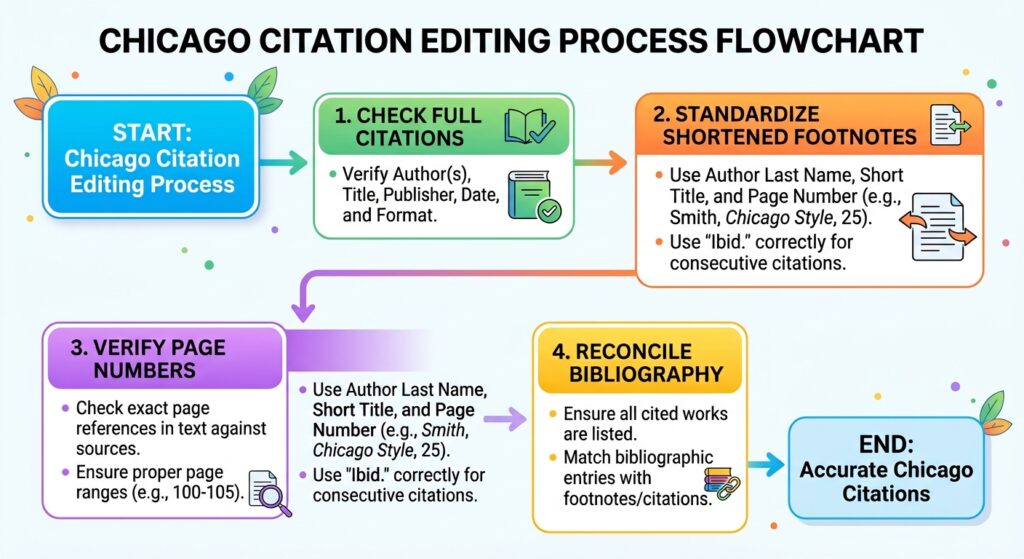
7. How to Audit Chicago Footnotes Before Journal Submission
Citation editing should be systematic. Correct individual notes first, then audit the manuscript as a complete referencing system.
Phase 1: Verify source identification
Check that every full citation contains the necessary bibliographic information. Confirm author names, publication titles, publication dates, edition details, journal volume and issue numbers, and DOI or URL information where required.
Phase 2: Standardize shortened notes
Search for recurring author names and titles. Confirm that every shortened citation identifies the intended work and follows a consistent pattern.
If ibid. appears in a manuscript prepared under a house style that permits it, verify every occurrence against the immediately preceding note. A citation to a different source breaks the traditional ibid. sequence.
Phase 3: Verify locators
Compare page numbers and other locators against the original source. Ensure that quotations, paraphrases, and specific claims point to the correct passage.
Phase 4: Reconcile notes and bibliography
Confirm that sources requiring bibliography entries appear there and that bibliographic details match the notes. Apply any source-specific exceptions required by Chicago and the journal.
Phase 5: Check document formatting
Review superscript note markers, footnote placement, numbering, punctuation, spacing, and the separation between note text and bibliography entries. Follow the target journal's manuscript template rather than assuming that one universal layout applies to every submission.
8. Common Chicago Footnote Mistakes That Can Weaken a Manuscript
Even when the research is strong, inconsistent referencing can reduce readability and signal insufficient attention to editorial requirements.
Mistake 1: Using ibid. after an intervening source.
Under traditional rules, ibid. refers to the immediately preceding note, not any earlier citation. Use a shortened note when another source intervenes.
Mistake 2: Mixing citation conventions.
Switching between ibid. and shortened notes without a clear, permitted style policy creates inconsistency. Adopt the required convention and apply it systematically.
Mistake 3: Omitting the shortened title.
An author's surname alone may not distinguish multiple works by that author. Retain enough title information to identify the source.
Mistake 4: Repeating incorrect page numbers.
A perfectly formatted footnote is still inaccurate if its locator does not support the claim. Verify every specific reference against the original text.
Mistake 5: Applying book rules to every source type.
Journal articles, chapters, edited volumes, archival sources, and online publications have different citation requirements. Confirm the correct model before shortening a citation.
Mistake 6: Ignoring journal-specific instructions.
A journal may require a particular Chicago edition or impose its own house-style preferences. Follow the target publication's explicit instructions when preparing the submission.
Also read: PaperEdit Academic Proofreading Services
9. Pre-Submission Checklist for Chicago-Style Footnotes
Before uploading your manuscript to a journal portal, complete the following checks:
- Confirm whether the target publication requires Chicago 17th or 18th edition, or a modified house style.
- Provide a complete first citation for each source where required.
- Use shortened footnotes consistently for recurring sources.
- Remove ibid. unless its use is expressly permitted by the applicable guidelines.
- If ibid. is permitted, verify that each occurrence refers to the immediately preceding note.
- Retain sufficient title information to distinguish works by the same author.
- Verify page numbers, page ranges, quotations, and paraphrases against the original sources.
- Apply the correct citation pattern to books, journal articles, chapters, reports, and online materials.
- Standardize punctuation, capitalization, italics, quotation marks, and note numbering.
- Reconcile footnotes with the bibliography and resolve missing or inconsistent entries.
- Check DOI and URL details where required.
- Confirm that the manuscript follows the journal's formatting and submission requirements.
- Run a final proofreading pass for typographical errors, duplicated words, and formatting inconsistencies.
Conclusion: Choose Clarity and Consistency Over Citation Shortcuts
The choice between ibid. and shortened footnotes in Chicago style depends on the applicable edition and the publisher's instructions. Although ibid. remains familiar from traditional citation practice, shortened footnotes are the preferred default in modern Chicago Notes and Bibliography manuscripts because they identify recurring sources more clearly. A full first citation, a recognizable shortened form, and an accurate page locator provide readers with a reliable path back to the evidence.
Before submission, verify the required Chicago edition, standardize recurring citations, and audit every locator against the source. For additional confidence, work with PaperEdit's professional editing and proofreading services to refine citation consistency, academic language, and manuscript presentation before journal submission.