


Citing a source you have not read directly or a work translated from another language requires careful attention to authorship, publication dates, attribution, and reference-list formatting. Under the APA 7th edition, secondary citations and translated works follow distinct rules, and confusing them can result in inaccurate attribution, incomplete references, and avoidable manuscript revisions.
Secondary referencing allows researchers to acknowledge an original author whose work they encountered through another source. Translated-work citations, by contrast, document a work published in a different language or made accessible through a translator. Understanding the distinction is essential for doctoral candidates, ESL researchers, and scholars preparing manuscripts for peer review.
This guide explains how to cite secondary sources and translated works in APA 7, when to include the primary source in the reference list, how to distinguish original authors from translators, and how to format books and journal articles accurately.
💡 Ready to polish your research paper for publication?
Transform your manuscript with PaperEdit's professional editing and proofreading services!
1. Understanding Secondary Sources in APA 7
A secondary source discusses, quotes, summarizes, or reproduces information from an original work. When you cannot access the original publication and rely on another author's account of it, you are using a secondary source.
For example, suppose you are writing about a psychological theory introduced by an author in 1985. You find a discussion of that theory in a 2022 review article, but you cannot obtain the original publication. Your citation must distinguish the original theorist from the author of the review article you actually consulted.
When should you use a secondary citation?
APA recommends using secondary sources sparingly. Whenever practical, locate and consult the primary source to verify the original argument, methodology, wording, and context.
Use a secondary citation when:
- The original work is unavailable despite reasonable efforts to locate it.
- The primary publication is out of print or inaccessible through available databases.
- You need to discuss a historical work that is difficult to obtain.
- An original finding is described in a reliable secondary publication that you can access.
Common pitfall: Citing an original study as though you read it when you only encountered its findings in a review article. This obscures the provenance of the evidence and can misrepresent the scope of your reading.
2. How to Cite Secondary Sources in APA 7
APA 7 uses the phrase as cited in to identify the secondary source through which you encountered the original work.
The basic formats are:
- Parenthetical citation: (Original Author, Original Year, as cited in Secondary Author, Secondary Year)
- Narrative citation: Original Author (Original Year, as cited in Secondary Author, Secondary Year)
Example: Parenthetical secondary citation
Suppose Smith published a theoretical framework in 1985, and you encountered it in a review by Jones published in 2022.
Parenthetical citation:
The framework emphasizes the relationship between social context and individual behavior (Smith, 1985, as cited in Jones, 2022).
Narrative citation:
Smith (1985, as cited in Jones, 2022) proposed a framework emphasizing the relationship between social context and individual behavior.
These examples are illustrative. Use the actual authors and dates of the publications you consulted.
How to cite a direct quotation from a secondary source
When you reproduce the exact wording of the original author as quoted in a secondary publication, use quotation marks and identify the page containing the quoted material in the source you actually read.
For example:
Smith (1985, as cited in Jones, 2022) argued that “the social environment shapes individual responses” (p. 47).
Here, page 47 refers to the location of the quotation in Jones's publication, not necessarily Smith's original work.
If the secondary source has no page numbers, provide another suitable locator when available, such as a paragraph number or section heading. Follow APA 7's guidance for locating direct quotations in unpaginated material.
Important distinction: A paraphrase does not require a page number under APA 7, although including one can help readers locate complex or lengthy material. A direct quotation ordinarily requires a page number or another appropriate locator.
3. Should the Primary Source Be Included in the APA Reference List?
One of the most common questions about secondary referencing is whether the original author belongs in the reference list.
The rule is straightforward: Include the source you actually read in the reference list, not the inaccessible primary source.
In the example above, if you read Jones's 2022 review but did not consult Smith's 1985 publication, list Jones's review in your references. Do not create a reference entry for Smith's work based solely on information reproduced by Jones.
This rule preserves an accurate record of the material you consulted and enables readers to locate the evidence supporting your discussion.
Example reference-list entry
Suppose the secondary source is a journal article with the following illustrative publication details:
Jones, A. B. (2022). Understanding social context in behavioral research. Journal of Behavioral Studies, 18(2), 100–115. https://doi.org/10.xxxx/xxxxx
In this example, the reference entry would appear in the reference list only if these details accurately describe the publication consulted. The DOI is a placeholder and must be replaced with a valid DOI where applicable.
What if you later obtain the primary source?
Read the original work and evaluate it directly. If your discussion relies on both the original publication and a separate secondary analysis, cite each work according to its actual contribution. Include both in the reference list when both have been cited as sources you consulted.
Common pitfall: Adding a primary source to the reference list simply because it appears in another author's bibliography. A reference list should document your cited sources, not reproduce the bibliography of a publication you consulted.
Also read: Journal Rejection Rate Explained (And How to Beat It)
4. Citing Translated Works in APA 7
A translated work is a publication rendered into another language by a translator. APA 7 requires authors to credit the original author and acknowledge the translator where the publication provides that information.
Translated works can include books, book chapters, journal articles, and other scholarly publications. Their citation structure depends on the type of work, the publication details available, and whether the original publication date differs from the translation's publication date.
How to cite a translated book
For a translated book, the reference-list structure is generally:
Author, A. A. (Year of translated edition). Title of book (T. T. Translator, Trans.). Publisher. (Original work published Year)
The precise formatting may vary depending on the work's publication details. Use the translator's initials and surname, followed by the role designation “Trans.”
For example:
Freud, S. (1961). The interpretation of dreams (J. Strachey, Trans.). Science Editions. (Original work published 1900)
This is an illustrative format based on a translated edition; verify the exact edition, publisher, and translator details against the copy consulted before using the entry in a manuscript.
The in-text citation typically identifies the author and both the translation and original publication years:
- Parenthetical: (Freud, 1900/1961)
- Narrative: Freud (1900/1961)
The first year identifies the original publication, while the second identifies the translated edition used. If the original work's publication date is unknown or the work has a different publication history, follow APA's guidance for the specific case rather than inventing a date.
Why acknowledge the translator?
Translation can affect terminology, conceptual nuance, and interpretation. Naming the translator allows readers to identify the edition on which your analysis depends and distinguish it from other translations of the same work.
Common pitfall: Treating the translator as the original author or omitting the translator from the reference entry when the translation credits one. The original author generally remains the author of the work; the translator is credited for the translation.
Also read: Formatting Block Quotes vs. Direct Quotes in APA 7
5. Original Author vs. Translator: APA 7 Citation Rules
Researchers working with translated literature, philosophical texts, historical documents, or international scholarship should distinguish authorship from translation responsibility.
| Element | APA 7 treatment |
| Original author | Appears in the author position in the reference entry. |
| Translator | Credited in parentheses after the title, with the role abbreviation “Trans.” |
| Original publication year | Included in the in-text citation when the original and translated publication dates are relevant. |
| Translation publication year | Identifies the edition actually consulted. |
| Reference-list entry | Describes the translated edition used, including its publication details. |
| In-text citation | Commonly uses the original year and translation year separated by a slash. |
What if the translated work has multiple translators?
List the translators in the order and format appropriate to the publication, preserving their credited names and roles. Follow APA 7's conventions for multiple contributors and verify the title page or publication metadata.
What if the translator is also the editor?
Credit each role as indicated by the publication. A translator-editor may need both roles identified in the reference entry. Do not assume that the person who edited a translated edition also translated it.
Common pitfall: Applying the same citation template to every translated publication without checking the source type. A translated book, a translated journal article, and an article published in a translated journal edition can have different reference structures.
6. How to Cite a Book That Was Translated Into English
The correct format depends on whether you read a published English translation or consulted a book in its original language.
Scenario A: You read an English translation of a previously published book
Use the translated edition's publication year in the reference entry and include the original publication year at the end. In the in-text citation, present the original year first and the translation year second.
Reference-list template:
Author, A. A. (Year of translation). Title of book (T. T. Translator, Trans.). Publisher. (Original work published Year)
In-text citation: (Author, Original Year/Translation Year)
For example, the University of Lincoln's APA 7 guidance provides this reference for a translated book:
Castro, F. (2008). My life (A. Hurley, Trans.). Dover. (Original work published 2006).
The corresponding in-text citation is (Castro, 2006/2008). The reference entry documents the 2008 edition, while the citation acknowledges the original publication in 2006.
Scenario B: You read a book published in a foreign language
If you consult the work in its original language rather than a separately published translation, cite the edition you actually read. Include an English translation of the title in square brackets after the original-language title when appropriate.
Reference-list template:
Author, A. A. (Year). Original-language title [English translation of title]. Publisher.
For example:
Piaget, J. (1957). Le jugement moral chez l'enfant [The moral judgment of the child]. Presses Universitaires de France.
This example illustrates the format; verify the exact title and publication details of the edition consulted.
The in-text citation uses the publication year of the edition you read: (Piaget, 1957).
Why the distinction matters: A title translated into English for explanatory purposes is not the same as a published English translation of the entire work. Do not automatically add a translator's name or an original/translation year pair when you have not consulted a translated edition.
7. Reference List Entry for Translated Journal Articles
Translated journal articles require additional care because the reference must identify the article, journal, volume, issue, page range, and DOI where applicable.
When an article has been republished in translation, identify the translator or translators after the article title and include the original publication year when required.
General format for a translated journal article
Author, A. A. (Year of translated publication). Title of article (T. T. Translator, Trans.). Title of Journal, volume number(issue number), page range. DOI (Original work published Year)
This is a general pattern, not a universal template for every translated article. Follow the publication history and APA guidance applicable to the version you used.
For example, an illustrative reference could look like this:
Author, A. A. (2022). Social development across the lifespan (B. B. Translator, Trans.). Journal of Developmental Research, 15(2), 100–112. https://doi.org/10.xxxx/xxxxx (Original work published 2018)
Do not publish this illustrative entry as a real reference. The author, journal, DOI, and publication details must be replaced with verified information.
For a translated and republished article, the in-text citation ordinarily uses the original year followed by the translation or republication year, such as (Author, 2018/2022).
What if you read an article in its original language?
If you consult an article in its original language and no translated edition is involved, use the standard APA 7 journal-article reference format. Retain the original title and add an English translation of that title in square brackets when appropriate.
A typical journal-article entry includes:
- Author names and publication year
- Article title
- Journal title and volume number
- Issue number, if available
- Page range or article number
- DOI formatted as an HTTPS URL, when available
APA 7 generally uses sentence case for article titles and italicizes the journal title and volume number. Do not italicize the issue number.
Common pitfall: Confusing an article translated and republished in another journal with an article that simply has a title in a different language. Check the publication record before selecting a reference format.
Also read: In-Depth Guide to APA 7th Edition In-Text & Reference Formatting
8. Citing Indirect Quotes in Academic Research
Citing indirect quotes in academic research requires a clear distinction between paraphrasing, direct quotation, and secondary attribution.
A paraphrase communicates an author's idea in your own words. A direct quotation reproduces the source's exact wording. A secondary citation identifies an original work encountered through another publication.
These are related but different citation tasks.
How to paraphrase a secondary source
Suppose a review article reports that an earlier study identified a relationship between sleep quality and academic performance. If you have not read the earlier study, attribute the finding to the original authors using the secondary-citation format.
For example:
Lee's findings on sleep quality and academic performance were discussed in a later review (Lee, 2014, as cited in Morgan, 2023).
This construction indicates that Morgan's 2023 publication is the source you consulted.
Do not copy the original author's wording from the review and present it as your own paraphrase. Read the secondary author's explanation, verify the context available, and rewrite the idea accurately without changing its meaning.
How to quote a source cited by another author
If Morgan reproduces Lee's exact words, and you want to use those words, acknowledge both the original author and the secondary source.
For example:
Lee (2014, as cited in Morgan, 2023) described the relationship as “a persistent predictor of academic outcomes” (p. 84).
The page number in this illustrative example refers to Morgan's publication, assuming that is where the quoted wording appears.
When the exact original wording is central to your argument, locating the primary publication is preferable. A secondary author may have shortened, translated, or selectively quoted the original passage.
How to avoid citation overreach
Before citing a secondary source, ask:
- Did I read the primary publication?
- Does the secondary source accurately identify the original author and date?
- Am I reproducing exact wording or paraphrasing an idea?
- Have I included a page number or another locator for a direct quotation?
- Does the reference list include the source I actually consulted?
If you cannot verify the original publication, avoid making claims about its full methodology, limitations, or conclusions beyond what the secondary source supports.
9. Secondary Sources vs. Translated Works: Key Differences
Although both citation types can involve an author's original work and another publication, they serve different purposes.
| Feature | Secondary source | Translated work |
| Main purpose | Acknowledge an original work encountered through another source | Identify a work consulted in translation |
| In-text format | (Original Author, Year, as cited in Secondary Author, Year) | (Author, Original Year/Translation Year), when applicable |
| Reference list | Include the secondary source actually consulted | Include the translated edition actually consulted |
| Translator credit | Not required merely because a secondary source discusses another work | Credit the translator when applicable |
| Direct quotations | Cite the source containing the quoted passage and its locator | Cite the translated edition and the appropriate locator |
| Primary-source access | Not required, but direct consultation is preferred | The translation itself is the edition consulted |
The central principle is accurate source attribution. Secondary citations document how you encountered an idea; translated-work references identify the edition through which you accessed it.
Also read: PaperEdit Academic Proofreading Services
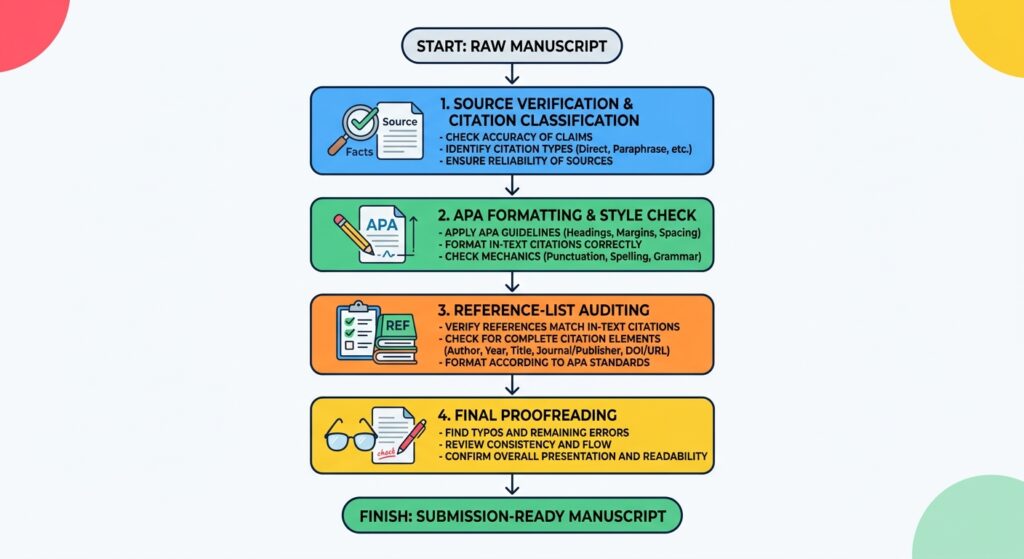
10. A Practical Workflow for APA 7 Citation Accuracy
An effective citation audit should occur after substantive revisions but before the manuscript is submitted. Checking citations only at the end can leave inconsistencies embedded in the text, tables, figure notes, and reference list.
Step 1: Verify the source type
Determine whether each citation refers to a primary publication, a secondary discussion, a translated edition, or an original-language publication.
Step 2: Confirm bibliographic details
Check author names, dates, titles, journal details, publisher information, page ranges, and DOI links against the actual publication.
Step 3: Standardize in-text citations
Apply APA 7 rules consistently. Use as cited in for secondary citations and the original-year/translation-year format for republished translated works when applicable.
Step 4: Audit the reference list
Ensure that each reference corresponds to a work actually cited in the manuscript and that each entry contains the information required for its source type. Confirm that translated editions identify their translators where applicable.
Step 5: Proofread the complete manuscript
Review punctuation, capitalization, italics, quotation marks, spacing, and reference-list alphabetization. Use reference-management software to support consistency, but verify generated entries manually.
11. Official APA and Academic Referencing Resources
Consult authoritative guidance when you encounter an unusual publication history or a source type that does not fit a standard example.
- APA Style — Official guidance on APA writing, citations, and references.
- Purdue OWL: APA 7 Reference List—Books — Examples of book references, including translated works.
- Purdue OWL: APA 7 Reference List—Other Print Sources — Guidance on citing works discussed in secondary sources.
- University of Lincoln: APA 7 Translated Works — Examples of translated editions and original-language publications.
These resources are especially useful when preparing manuscripts for journals that require strict adherence to APA 7 conventions.
12. APA 7 Pre-Submission Checklist
Before uploading your manuscript to a journal portal, complete a final citation and formatting audit.
- Source verification: Confirm that each cited work was consulted directly or is clearly identified as a secondary source.
- Secondary citations: Use as cited in when the original work was not consulted.
- Reference-list accuracy: Include the secondary publication you actually read, not an unconsulted primary source.
- Translated books: Identify the original author, translator, translated edition's publication year, publisher, and original publication year when applicable.
- Translated journal articles: Verify the journal title, volume, issue, pages or article number, DOI, and translator details where relevant.
- Original-language titles: Retain the original title and add an English translation in square brackets when appropriate.
- Direct quotations: Check quotation marks, wording, page numbers, and other appropriate locators.
- Paraphrasing: Ensure that borrowed ideas are accurately attributed and expressed in your own words.
- DOIs and URLs: Verify that links resolve correctly and follow APA 7 formatting.
- Reference consistency: Confirm alphabetical ordering, hanging indents, capitalization, italics, and punctuation.
- Journal compliance: Check the target journal's author instructions for additional requirements beyond APA 7.
- Final proofreading: Review tracked changes, spelling, grammar, academic tone, and consistency across the entire manuscript.
Conclusion: Strengthen Your Manuscript With Accurate APA 7 Citations
Citing secondary sources and translated works correctly is fundamental to scholarly transparency. Use as cited in when you rely on an original work through another publication, include the source you actually consulted in the reference list, and distinguish the original author from the translator when documenting translated editions. Verify every publication detail rather than relying exclusively on citation generators.
Accurate citations help readers trace evidence, assess the credibility of your argument, and understand the origins of the ideas you discuss. Before submission, combine a systematic reference audit with careful language editing and journal-specific formatting checks.
Prepare your manuscript for its next stage of publication. Explore PaperEdit's professional academic editing and proofreading services for support with citation consistency, reference formatting, academic language, and final manuscript readiness.