


Academic publishing isn't just about having something to say — it's about saying it so well that others feel compelled to reference you. The connection between writing quality and citation impact is one of the most underappreciated dynamics in scholarly communication. While researchers obsess over methodology and journal prestige, the actual prose quality of their papers quietly determines whether those papers sink or swim in the citation landscape.
This isn't speculation. It's a pattern backed by bibliometric research, editorial experience, and the cold mathematics of how knowledge spreads.
Why Citation Impact Starts Long Before Submission
Most academics think citation impact is determined after publication — by journal rank, by network effects, by luck. That framing is wrong, or at least dangerously incomplete.
Citation potential is shaped at the manuscript stage. Papers with vague abstracts, tortured syntax, and disorganized arguments get desk-rejected more often, land in lower-tier journals, and even when published, fail to communicate their value clearly enough to be cited. Readers can't cite what they can't fully understand — and they won't recommend what they couldn't follow.
According to the American Psychological Association's Publication Manual, clarity, precision, and economy of expression are foundational standards — not stylistic preferences. These aren't cosmetic goals. They're functional requirements for scientific communication.
The chain looks like this: Better writing → clearer contribution → more citations → higher impact. Simple. But most researchers break it at the first link.
What "Writing Quality" Actually Means in Academic Context
This term gets thrown around without precision, which is ironic. Writing quality in scholarly publishing isn't about being eloquent or literary.
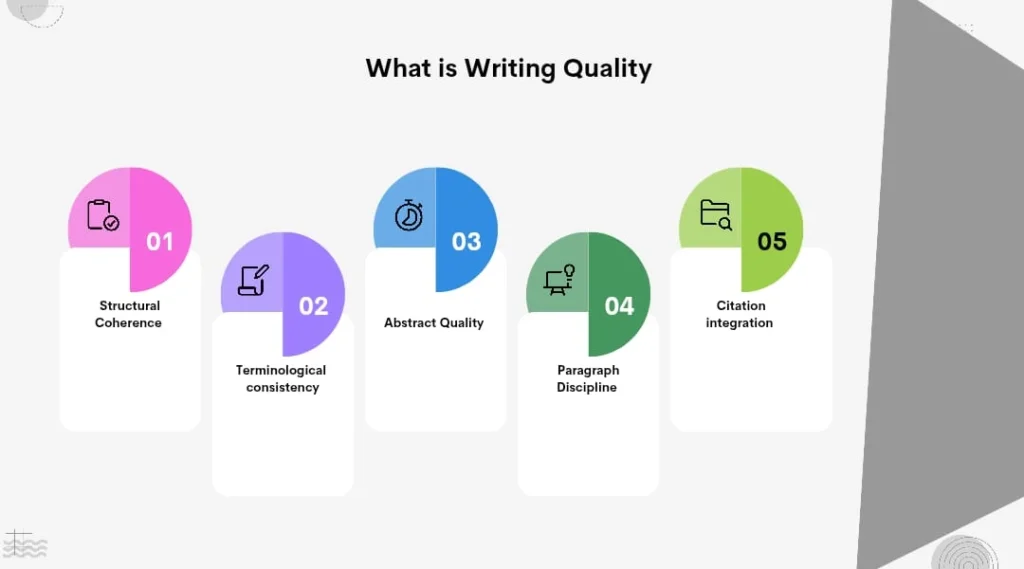
It means:
- Structural coherence: Does the argument flow logically from problem to conclusion?
- Terminological consistency: Are key concepts defined and used uniformly throughout?
- Abstract quality: Does it front-load the contribution, methodology, and implication in under 250 words?
- Paragraph discipline: Is each paragraph built around one claim?
- Citation integration: Are sources woven in contextually, not just appended?
When researchers invest in high quality article writing practices — or partner with quality content writing services — they're not just polishing grammar. They're reengineering the paper's communication architecture to maximize comprehension and, by extension, citability.
The Field Weighted Citation Impact Metric: A Signal You Can't Ignore
Not all citations are created equal. A paper cited 20 times in a niche subfield may have a higher real-world influence than one cited 50 times across irrelevant disciplines. This is why field weighted citation impact (FWCI) was developed — to normalize citation counts against what's typical for that field, document type, and publication year.
An FWCI of 1.0 means you're at the global average. Above 1.0 means you're outperforming the field average. Below 1.0 — you're underperforming.
Here's what's rarely discussed: writing quality is a silent variable in FWCI performance. Papers with clear, well-structured writing are:
- More likely to be read in full
- More likely to be cited by researchers outside the core subfield, boosting cross-disciplinary reach
- More likely to be recommended through informal academic channels like ResearchGate, Twitter/X threads, and lab group chats
If you're tracking citation reports impact factor for your department or personal academic portfolio, FWCI is the metric that actually reflects whether your writing is resonating — not just existing.
You can explore FWCI benchmarking through Elsevier's SciVal platform, which institutions worldwide use to evaluate research performance against global standards.
The Table: How Writing Quality Affects Citation Outcomes
| Writing Quality Dimension | Low Quality Impact | High Quality Impact |
| Abstract clarity | High desk-rejection rate; low discoverability | Stronger indexing signals; more reader click-throughs |
| Argument structure | Reviewers demand major revisions; longer time to publish | Faster peer review; cleaner revision cycles |
| Terminology consistency | Confusion in citing authors; misattribution risk | Accurate citation context; higher cross-field reach |
| Citation integration | Appears derivative or ungrounded | Positioned as authoritative contributor to discourse |
| Language precision | Findings misunderstood or undervalued | Core claims cited with confidence and accuracy |
| Abstract keyword alignment | Lower SEO and database discoverability | Better indexing in Google Scholar, Scopus, PubMed |
| Overall readability | Low FWCI; limited citation lifespan | Above-average FWCI; long-tail citation accumulation |
This table isn't theoretical. Every dimension here maps to an observable pattern in how high-impact papers versus low-impact papers behave across their citation lifecycles.
AI Citations Impact on Google SEO Rankings: The New Frontier
The academic world is being forced to reckon with a new variable: AI-generated citations and their downstream effect on visibility. Search engines — particularly Google — are refining how they evaluate authority, and the AI citations impact on Google SEO rankings is becoming an active area of concern for researchers who publish open-access content.
When AI tools summarize research papers for general audiences, they preferentially cite papers that:
- Have well-structured, scannable formats
- Use clear, human-readable language — not impenetrable jargon
- Are published in indexed, authoritative outlets
- Have strong inbound citation signals from other credible sources
This creates a recursive dynamic: high-quality writing generates more citations; more citations improve SEO authority signals; stronger SEO authority makes papers more visible to AI systems; AI visibility generates more citations. The loop rewards quality at every stage.
According to Google's Search Quality Evaluator Guidelines, expertise, authoritativeness, and trustworthiness (E-E-A-T) are the core standards for ranking. Academic papers that communicate expertise clearly — through precise language and well-integrated citations — align naturally with these signals.
Also read: The Role of Google Scholar Citations in Academic Reputation.
SEO Impact of Citations and Source Links in Articles
Here's something most academic writers don't realize: publishing isn't just about peer-reviewed databases anymore. Open-access articles and preprints live on the public web, which means the SEO impact of citations and source links in articles is a genuine strategic consideration.
A well-cited academic article functions like a high-authority webpage. Inbound citation links from other papers — especially in indexed journals — are analogous to backlinks in web SEO. The more credible the citing source, the stronger the signal.
This is why investing in a high quality writing paper isn't just about academic pride — it's about building a citation network that compounds over time. Papers that communicate clearly get cited accurately. Papers cited accurately accumulate cleaner link equity, both in academic databases and on the open web.
When researchers work with academic editing professionals who understand both scholarly standards and digital discoverability, they're not just fixing commas — they're optimizing for a multi-channel citation ecosystem.
What Peer Reviewers Don't Tell You (But Citation Data Does)
Peer review feedback is notoriously inconsistent. One reviewer praises your structure; another calls it convoluted. But citation data doesn't lie — it aggregates the preferences of every researcher who read your paper and decided it was worth referencing.
Bibliometric studies have consistently shown that papers with higher readability scores receive more citations, particularly in applied fields like medicine, psychology, and environmental science. The National Institutes of Health's research on health communication frames clear writing as a functional requirement for knowledge dissemination — not an aesthetic bonus.
What peer reviewers won't write in their comments:
- "Your abstract was confusing, so I skim-cited you instead of reading deeply"
- "I would have cited your findings in three sections, but I couldn't tell where your argument ended and your discussion began"
- "I forwarded this to a colleague but they said the methods section was too dense to parse"
These invisible losses are real. They happen constantly. And they're entirely preventable with stronger writing discipline or professional editing support.
The Role of Professional Editing in Closing the Citation Gap
Here's a myth worth dismantling: academic editing is for people who can't write. That's backwards. The researchers who take editing most seriously are often the most productive publishers — because they understand that the gap between a good paper and a cited paper is frequently a communication gap, not a content gap.
Quality content writing services and academic editors are not ghostwriters. They don't change your ideas. They restructure your sentences so your ideas land with the force they deserve. They tighten your abstract. They ensure your contribution statement is unmissable. They make your paper's argument digestible for reviewers who have 48 hours to assess 40 manuscripts.
The investment pays off in citation velocity — how quickly a paper starts accumulating citations after publication. Papers that communicate clearly tend to get cited within the first 12 months, establishing early citation momentum that compounds over their academic lifespan.
For a detailed understanding, read the article "Editing Costs Explained".
At PaperEdit, the editorial workflow is built around citation readiness — not just grammatical correctness. If you're preparing a manuscript for submission, the difference between a functional edit and a strategic one is often what separates a 5-citation paper from a 50-citation one.
Practical Steps to Strengthen Writing Quality for Citation Impact
You don't need to overhaul your entire writing process. Targeted interventions yield measurable results.
Before writing:
- Define your contribution in one sentence before drafting a word
- Map your argument structure in outline form — sections, not just topics
- Identify the three key papers you expect to be cited alongside
During drafting:
- Write your abstract last, not first
- Keep paragraphs to one claim + evidence + implication
- Use active voice for findings; passive is acceptable for methods
Before submission:
- Run a readability check using Flesch-Kincaid or an equivalent tool
- Ensure every citation in your reference list is contextually integrated in the text
- Have a non-specialist read your abstract and explain it back to you
Post-submission strategy:
- Share preprints on domain-appropriate platforms
- Engage with citing authors when your paper goes live
- Update your researcher profile and publication record regularly to maintain discoverability
The Long Game: Building a Citation Legacy Through Writing Standards
Citation impact isn't a single-paper outcome — it's a cumulative reputation built paper by paper. Researchers who consistently produce clear, well-structured work develop a citation brand: colleagues begin pre-emptively citing them because their papers reliably deliver on what they promise.
This is the long game. And it begins with treating every paper not as a reporting exercise but as a communication act — designed to be found, read, understood, and referenced.
Journals indexed in Scopus and Web of Science use citation data to determine impact factors. That data is downstream of writing quality. If your field's citation reports impact factor matters to your institution, department, or funding body, that pressure is ultimately a pressure to write better — not just publish more.
If you're serious about building this foundation and want structural feedback before your next submission, explore the manuscript review services at PaperEdit — professional Proofreading and formatting services. These are designed specifically for researchers who understand that quality writing and citation impact aren't separate goals. They're the same goal.
Conclusion: The Citation You Never Got Was the One That Couldn't Find You
Every year, thousands of genuinely valuable research contributions go under-cited — not because the science was weak, but because the paper didn't communicate with enough clarity to compete in a crowded field. The relationship between writing quality and citation impact is direct, quantifiable, and largely within your control.
You can't control who reviews your paper. You can't control which journals are trending. But you can control whether your abstract makes your contribution unmistakably clear. You can control whether your argument is structured for maximum comprehension. You can control whether you invest in the kind of editorial rigor that turns a published paper into a cited one.
That's the hidden link. It was never that hidden. It just required honesty about what academic success actually demands.
In order to help you make the best decision, read this blog " PaperEdit vs Other Editing Services — Honest Comparison"
Reference Books:
- Cargill, M., & O'Connor, P. (2013). Writing Scientific Research Articles: Strategy and Steps (2nd ed.). Wiley-Blackwell. A rigorous guide to structuring arguments and maximizing the clarity and impact of scientific manuscripts across disciplines.
- Belcher, W. L. (2019). Writing Your Journal Article in Twelve Weeks: A Guide to Academic Publishing Success (2nd ed.). University of Chicago Press. An indispensable roadmap for academic writers committed to producing high-quality, publishable work with long-term citation longevity.