


A significant aspect of failure will not be reflected in your grades. It may appear apparently similar because it is a combination of several individual instances of lack of authenticity. The result is that your credibility erodes incrementally through written work that appears 'acceptable' but has poor content, weak reasoning, and sends a signal to any serious reviewer that, as a writer, you have not yet 'arrived.'
These are the academic writing mistakes no one puts on a rubric. They're the ones that make a thesis committee wince, a journal editor desk-reject your paper, or a professor wonder whether your brilliance is really there — or just hiding behind complexity.
This isn't about grammar. This is about the deeper craft of academic writing, and why getting it wrong quietly undermines everything else you're building.
What Is Academic Writing — And Why Most People Misunderstand It
Before diagnosing the mistakes, let's be clear about the medium. Academic writing is a highly formal, evidence-based form of written communication utilized in many environments, including (but not limited to) research papers, dissertations, literature reviews, and peer-reviewed journals. Its purpose is not to impress. Its purpose is to advance knowledge through precise, structured, and substantiated argument.
Most students walk into graduate programs thinking academic writing is about sounding smart. It's not. It's about being precise. When you confuse these two objectives, the mistakes start.Academic writing is defined by writing that follows the principles of logic, provides evidence-based statements, is objective in tone, follows a set of conventions for the discipline, etc. Therefore, there is no room for lack of clarity, inconsistency of tone, or a lack of clear structure in academic writing (these three common mistakes are made even by experienced academic writers).
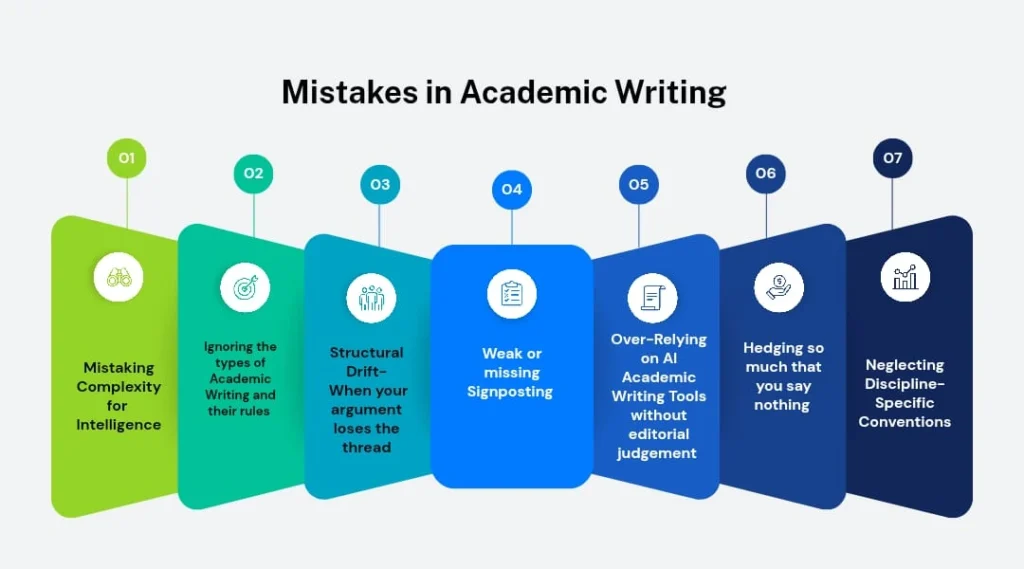
Mistake #1: Mistaking Complexity for Intelligence
This is mistake number one among graduate students and it's the hardest one to unlearn.
Sentences that sprawl across five lines. Passive constructions stacked inside subordinate clauses. Vocabulary chosen for its impressiveness rather than its precision. The result? Readers have to work harder than they should, and the actual argument gets buried.
Academic writing readability improvement techniques are not optional polish — they are central to scholarly authority. When a reviewer or professor has to re-read a sentence three times to understand it, your credibility drops, not theirs.
Larn more from guides like:
- How to Balance Technical Accuracy with Readability in Research Writing (Paperedit)
- Strategies on Reducing Wordiness to Enhance Readability in Academic Writing (PubMed)
The fix is not to "dumb it down." It's to cut the noise. Strong academic writing is dense with meaning, not with words. Every sentence should carry a precise, irreplaceable idea. If you can remove it without losing content, remove it.
Practical tools like the Hemingway Editor or readability scoring (Flesch-Kincaid) are useful diagnostic checks. But the real discipline is developing an editorial eye during revision — which is exactly the kind of skill that professional academic editing services train you toward.
Try Paperedit proofreading services.
Mistake #2: Ignoring the Types of Academic Writing and Their Rules
One of the biggest sources of errors in writing is when you write an academic type that isn't suitable for the context of your work (for example, an analytical paper that doesn't support its arguments). In addition, one of the ways that people confuse this type of composition with other types is by mixing them, in that when they attempt to accomplish two things (to write a paper specifically to analyse a topic and also to argue something) they ultimately fail at accomplishing either one of those tasks correctly. Each type of academic writing has its own inherent rhetorical logic that defines what constitutes "good writing."
For example
- Analytical and argumentative writing require a clearly delineated and defendable thesis
- Literature review requires an analysis of existing literature to arrive at insights about what has been written, as opposed to simply summarising each piece of literature that is being analysed,
- Research reports should be transparent in terms of how the investigations were carried out and what findings were made.
Combining or "blending" different styles of academic writing together (for example, writing a literature review that is essentially just an opinion paper) creates basic errors in your writing that demonstrate a lack of experience to most senior faculty and academic researchers. Since doctoral students are required to complete a PhD, courses such as GS 732 Advanced Academic Writing for Ph.D. Students have been developed for the purpose of helping doctoral-level writers to learn how to distinguish between types of academic writing and to employ the appropriate conventions associated with each style when they write at the doctoral level. The requirement to know the type of academic writing being used and to apply the correct conventions associated with that type of writing is an absolute requirement for doctoral-level writing.
Mistake #3: Structural Drift — When Your Argument Loses the Thread
You've experienced this in your own writing: you begin with a powerful thesis, but by the end of your paper, you are summarizing unrelated information that does not support your original thesis. This is an example of structural drift, and it can be fatal to your academic credibility.
In order for your academic writing to have academic credibility, you must maintain a golden thread — a continuous, single line of logic that can be traced through each section and ultimately connects the introduction and conclusion. Each paragraph, section, and citation must clearly support the central argument. If it does not support the central argument, it must be removed, regardless of its inherent interest.
The solution to structural drift is to reverse outline your first draft. After you have completed the first draft, take a piece of paper and write a one-sentence summary of each paragraph. After you have written down all the summaries in sequential order, read them in the order you wrote them. If the summaries do not collectively create a logical argument, you have a broken outline, and you need to fix the outline before you fix the prose.
This process is discussed at length in the fifth edition of From Inquiry to Academic Writing: A Practical Guide, a great practical academic writing book for those who are moving from undergraduate to graduate writing. It teaches you how to critically read sources and structure arguments to support your thesis.
Mistake #4: Weak or Missing Signposting
Academic readers are not detectives. Readers should have a clear idea of how your argument advances from one section to the next; therefore, it is important to use signposts (transitions, topic sentences, and linking words and phrases) to provide that direction. Although many writers do not frequently use signposts, experienced readers can instantly identify sections that lack signposts — and while they may not be able to define exactly what has gone amiss, it still does not feel right.
Examples of effective signposting:
- Each new section opens with a topic sentence that provides a logical connection back to the thesis statement.
- Transitional phrases are used that explain the logical progression of your argument (e.g., "This finding haftens the previous assumption that...," as opposed to simply saying, "Furthermore....")
- Each new section closes with either a summary of the information covered or a direct transition to the next section of the thesis statement.
Signposting is not the same as simply adding extra words or sentences; instead, it is a way to make the researcher’s thought process visible. When the author’s thought process is visible, the research is better-supported, the reader finds it easier to read and understand what is being presented, and overall, this increases the writer's authority.
Mistake #5: Over-Relying on AI Academic Writing Tools Without Editorial Judgment
This is the conversation the academic world is currently having — and it's more nuanced than the headlines suggest.
AI academic writing tools have real utility. They can surface relevant literature, suggest structural improvements, and flag readability issues. Used correctly, they're productivity tools that support a skilled writer. Used incorrectly, they become a crutch that produces fluent, confident-sounding writing that is structurally weak, intellectually hollow, and tonally inconsistent with the writer's own voice.
The credibility risk here is real. AI-generated text often:
- Hedges where confidence is needed
- Summarizes where synthesis is required
- Produces plausible-sounding citations that don't exist
- Flattens disciplinary voice into generic academic-ese
The UNESCO framework on AI in education is explicit that AI tools must support — not replace — critical thinking. The same principle applies to writing. AI can assist your process; it cannot substitute your scholarly judgment.
The ethical and practical rule: use AI tools for drafting, organizing, and checking. Use human editorial judgment — your own, or a qualified editor's — for everything that determines the quality of your argument. This is exactly the distinction that professional proofreading services are built around.
Mistake #6: Hedging So Much That You Say Nothing
Academic writing is appropriately cautious. You qualify findings. Also, you get to acknowledge limitations. You don't overclaim. That's intellectually honest.
But there's a difference between appropriate epistemic humility and writing that is so hedged it communicates nothing at all.
Sentences like "It could perhaps be suggested that there may be some relationship between…" are not cautious. They are evasions. They tell the reader that the writer doesn't believe in their own argument.
According to The Guardian's academic writing series, overuse of hedging language is one of the clearest markers of inexperienced academic writing — and one of the first things reviewers and examiners notice.
The fix: make your claims as strong as your evidence allows. If the evidence is strong, say so directly. If it's preliminary, qualify it once — then commit. Hedging once is scholarly. Hedging every sentence is avoidance.
Mistake #7: Neglecting Discipline-Specific Conventions
Academic writing is not a monolith. What counts as credible writing in sociology looks different from what's expected in biochemistry, law, or literary criticism. Citation styles differ (APA, MLA, Chicago, Vancouver). Structural norms differ. Even the role of the first person differs — permitted in some fields, prohibited in others.
Graduate students who don't master their discipline's conventions signal immediately that they haven't fully entered their scholarly community. This matters enormously at the level of journal submission, grant writing, and dissertation defense.
If you're writing in a specific field and unsure about its conventions, the best resource is always published work in your target journal or by your target committee members. Read what gets published. Model your structure and register accordingly.
The Most Common Academic Writing Mistakes at a Glance
Here's a consolidated reference table of the mistakes covered in this article, along with their credibility impact and the fastest fix:
| Mistake | Impact on Credibility | Quick Fix |
| Complexity mistaken for intelligence | High — obscures argument | Revise for clarity; cut redundant clauses |
| Wrong type of academic writing for context | High — signals inexperience | Identify the genre; follow its conventions |
| Structural drift | Very High — loses the reader | Reverse outline after first draft |
| Missing or weak signposting | Medium-High — confuses logic | Add topic sentences and logical transitions |
| Over-reliance on AI tools | Medium-High — produces shallow work | Use AI to assist, not replace, judgment |
| Excessive hedging | Medium — undermines authority | Qualify once; then commit to the claim |
| Ignoring discipline-specific conventions | High — excludes from scholarly community | Study published work in your field |
| Inconsistent citation and formatting | Medium — signals carelessness | Use reference managers (Zotero, Mendeley) |
What Academic Writing Focuses On — And What It Doesn't
There are many misconceptions about the purpose of academic writing that we must put to rest. Academic writing will focus on some very important aspects like: In short, the focus of academic writing is storytelling, emotions, persuasion, or entertainment.
In addition to understanding what is included in academic writing, it is also important to understand what is not included in it. As an example: If you insert personal experiences, emotions or creative experimentation into work in a context that has no place for that inclusion (such as research papers, dissertations, and policy briefs), that would indicate an inability to understand proper use of that type of writing.
However, this does not mean academic writing must be boring. The best academic writing can both be precise, as well as engaging. But engagement comes from clarity of thought and confidence of argument — not from stylistic performance.
For further insights, read Weak Arguments in Academic Papers (And How to Fix Them).
Academic Writing for Graduate Students: The Stakes Are Higher
If you're at the doctoral or master's level, the stakes of these mistakes are exponentially higher. At the undergraduate level, writing errors affect a grade. At the graduate level, they affect your professional reputation, your publication record, and your career trajectory.
Academic writing for graduate students must function at a level where it can withstand peer review, committee scrutiny, and — eventually — public scholarly discourse. That's a different standard than undergraduate work. It requires not just competence but mastery.
The American Psychological Association's Publication Manual — the standard reference for much of social and behavioral science — dedicates significant attention to the distinction between writing that meets the bar and writing that advances the field. Knowing that distinction, and closing the gap, is the central project of graduate-level academic development.
If you're working at this level and want your writing reviewed against professional standards, thesis and dissertation editing from qualified subject-matter editors is one of the highest-leverage investments you can make before submission.
Try out Paperedit for these services, Now!
Academic Writing Jobs and the Overlooked Professional Dimension
Here's something that doesn't get discussed enough: academic writing mistakes don't just hurt your scholarly credibility — they hurt your employability.
Academic writing jobs — including research analyst positions, policy writing roles, grant writing careers, academic editing, and university communications — all require demonstrated command of scholarly communication. Employers in these fields evaluate writing samples. A portfolio that shows weakness in structure, does not flow well and has excessive inconsistencies will prevent you from having interviews that are unsuccessful.
If you are pursuing a career in any field that requires either research or writing, you need to think about your writing as a professional skill (not simply a task you completed in school) so that you have a very different process for making revisions, editing and receiving feedback.
Final Word: The Quiet Ones Are the Ones That Stick
Some of the mistakes that negatively affect your credibility in academic settings are not the most obvious. For example, mistakes such as missing citations, formatting errors, spelling/grammar issues can all be quickly identified and fixed. Conversely, there are many 'silent' types of mistakes that can become cumulative and will ultimately contribute to how serious readers will perceive your overall scholarly ability. Examples of these 'silent' types of mistakes include: structural drift, overuse of hedge phrases, inappropriate register, and over-dependence on AI tools.
The good news?
Every one of these mistakes is diagnosable and correctable. Not with a grammar checker. Not with an AI rewriter. With intentional revision, disciplinary study, and — when the stakes are high — qualified editorial feedback.
Your writing is your scholarly identity. Treat it accordingly.
Reference Books
- Greene, S., & Lidinsky, A. — From Inquiry to Academic Writing: A Practical Guide, Fifth Edition (Bedford/St. Martin's). The most practical guide available for developing argumentation and critical reading at the undergraduate-to-graduate transition.
- Swales, J. M., & Feak, C. B. — Academic Writing for Graduate Students: Essential Tasks and Skills, Third Edition (University of Michigan Press). A field-standard resource for both native and non-native English speakers navigating the demands of graduate-level scholarly writing.