


Academic writing is supposed to communicate ideas clearly. Yet many researchers submit manuscripts that technically contain valuable findings but still feel exhausting to read. Editors notice it. Peer reviewers notice it. Readers definitely notice it.
The problem is not always the science. Sometimes the real issue is readability.
A paper can be statistically strong, ethically sound, and clinically important — but if the writing feels dense, awkward, or confusing, the message collapses before it reaches the audience.
This is precisely why professional proofreading has become a crucial component of modern academic publishing.
According to the National Institutes of Health, scientific communication should prioritize clarity and accessibility, as poorly communicated research can limit knowledge transfer. Even leading journals increasingly expect manuscripts to be polished before peer review.
If your paper feels hard to read, this article explains why — and how professional proofreading can completely transform the way your research is perceived.
The Real Reason Your Paper Feels Hard to Read
Most researchers assume readability problems come from grammar mistakes alone. That is rarely true.
In reality, readability issues usually emerge from structural friction inside the writing itself.
Common examples include:
- Sentences overloaded with technical qualifiers
- Excessive passive voice
- Unclear transitions
- Repetitive wording
- Overuse of jargon
- Long paragraphs with weak flow
- Hard passages to read caused by translation-style writing
A manuscript may sound “academic” while still being painful to process.
This becomes especially obvious when authors try to make it hard to read in a way that sounds sophisticated. Many researchers mistakenly believe complexity equals intelligence. Editors do not agree.
Professional editors are trained to recognize when writing is hiding the message instead of delivering it.
Why Reviewers Reject Papers That Are Difficult to Read
Peer reviewers are not language tutors.
Their job is to evaluate scientific value efficiently. If your manuscript creates unnecessary reading resistance, reviewers often associate that friction with weak scholarship — even when the data is solid.
A study discussed by PubMed highlights how readability influences reviewer interpretation and publication outcomes across biomedical journals.
Here is what usually happens:
| Readability Problem | Reviewer Reaction | Possible Outcome |
| Hard sentences to read | Reviewer loses focus | Critical comments |
| Repetitive wording | Writing feels unprofessional | Request for revision |
| Confusing methodology flow | Trust decreases | Major revision |
| Dense academic jargon | Low accessibility | Rejection risk |
| Poor proofreading | Weak first impression | Editorial decline |
The reality is brutal but simple:
A reviewer struggling to understand your paper is less likely to advocate for it.
That does not mean your research lacks quality. It means your communication strategy failed.
What Makes Academic Writing Feel Unnecessarily Complex
Some writing problems are invisible to the author because familiarity creates blindness.
You already know your research. Readers do not.
This disconnect creates several major readability traps.
1. Overcomplicated Sentences
Researchers often chain multiple ideas into one sentence to sound formal.
Example:
“The intervention demonstrated statistically significant outcomes despite limitations associated with participant heterogeneity and implementation inconsistency observed across regional cohorts.”
Technically correct. Practically exhausting.
Professional proofreading breaks these structures into digestible ideas without damaging scientific accuracy.
2. Translation-Influenced Writing
Many international researchers think directly in one language while writing in another.
This creates unnatural sentence construction and hard passages to read.
According to the World Health Organization, global scientific collaboration depends heavily on accessible multilingual communication. Language clarity directly affects knowledge dissemination.
This is why proofreading is not merely “grammar correction.” It is communication optimization.
3. Trying Too Hard to Sound Academic
This is one of the biggest hidden problems.
Authors intentionally make hard-to-read sections because they associate simplicity with weakness.
In reality, elite journals prioritize precision and clarity.
Readable writing signals confidence.
Overwritten writing often signals insecurity.
Professional Proofreading Is More Than Grammar Correction
Many authors misunderstand what professional proofreading actually does.
A high-level proofreader does not simply fix commas.
They improve readability mechanics across the entire manuscript.
That includes:
- Sentence rhythm
- Logical transitions
- Word economy
- Tone consistency
- Structural coherence
- Reader comprehension
- Academic fluency
This distinction matters.
Basic grammar tools can detect surface-level issues. They cannot fully understand scientific context, narrative flow, or discipline-specific communication standards.
That is where human proofreading becomes essential.
At PaperEdit, proofreading focuses not only on language accuracy but also on how the manuscript feels to read from an editor’s perspective.
That difference changes outcomes.
For further clarity, read this: The Last Step to Journal Acceptance is Editing and Proofreading.
The Psychology of Readability in Academic Publishing
Readable papers create cognitive momentum.
Unreadable papers create mental fatigue.
This matters because scientific publishing is deeply psychological.
Editors and reviewers process dozens of manuscripts under time pressure. If your paper feels smooth and organized, readers subconsciously assume:
- The research process was rigorous
- The methodology is reliable
- The author understands the field
- The findings deserve attention
Meanwhile, hard sentences to read create doubt.
Even minor confusion interrupts trust.
According to Wikipedia’s overview of readability, readability directly affects comprehension efficiency and reader retention across professional texts.
Academic communication is not only about correctness.
It is about reducing friction.
Signs Your Manuscript Needs Professional Proofreading
Many authors wait until journal rejection before seeking editing support.
That delay costs time, publication momentum, and confidence.
Here are strong indicators that your manuscript needs professional proofreading immediately.
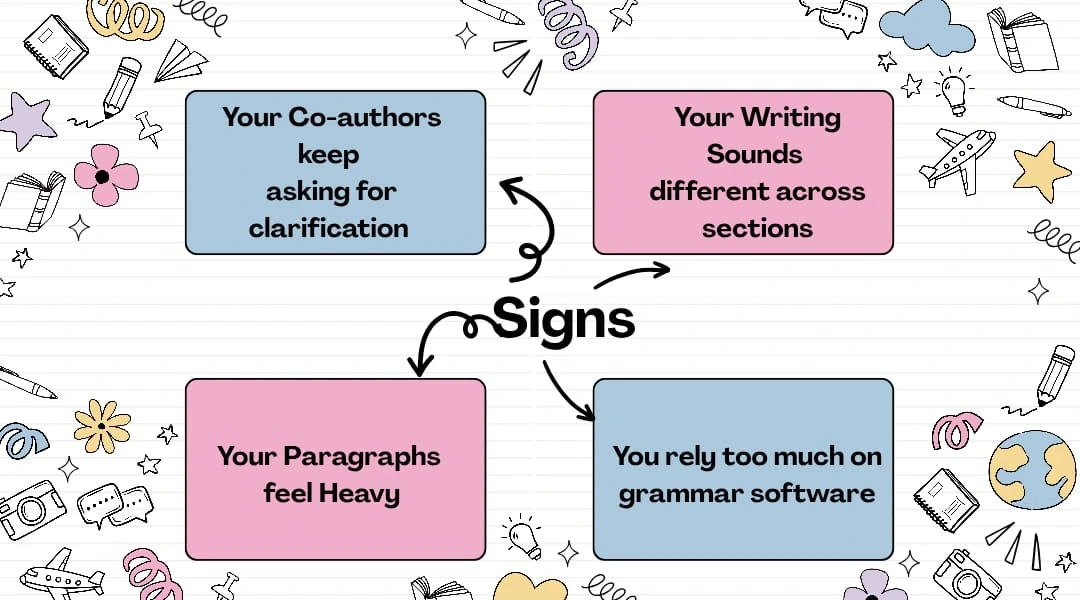
Your Co-Authors Keep Asking for Clarification
If collaborators repeatedly ask:
- “What does this sentence mean?”
- “Can you simplify this?”
- “This section feels confusing.”
Then the paper likely has readability issues.
Your Paragraphs Feel Heavy
Dense blocks of text overwhelm reviewers.
Professional proofreaders restructure flow without reducing academic depth.
Your Writing Sounds Different Across Sections
This often happens in multi-author manuscripts.
The introduction may sound polished, while the discussion feels fragmented.
Proofreading creates stylistic consistency.
You Rely Too Much on Grammar Software
AI grammar tools help with surface corrections, but frequently miss:
- Scientific nuance
- Logical coherence
- Discipline-specific tone
- Human readability
A machine can detect grammar.
A professional proofreader detects confusion.
The Difference Between Editing and Proofreading
Researchers often confuse these services.
Here is the distinction.
| Service Type | Main Purpose | Focus Area |
| Proofreading | Final readability refinement | Grammar, fluency, clarity |
| Copyediting | Structural language improvement | Style, consistency, flow |
| Developmental Editing | Major content restructuring | Argument, organization |
| Technical Editing | Discipline-specific accuracy | Scientific precision |
A professional proofreading checklist usually includes:
- Grammar review
- Punctuation consistency
- Sentence clarity
- Transition flow
- Formatting checks
- Citation consistency
- Readability optimization
Without this process, even strong research can appear unfinished.
Why Journals Care About Language Quality More Than Ever
Scientific publishing has become globally competitive.
Editors now receive submissions from thousands of international researchers competing for limited publication space.
That means language quality increasingly functions as a filtering mechanism.
A paper that feels hard to read creates extra editorial workload.
Many journals openly recommend professional editing before submission.
For example, ICMJE guidelines emphasize clarity, transparency, and accurate reporting standards in biomedical research.
This trend is accelerating because:
- Journals publish faster
- Reviewer time is shrinking
- Competition is increasing
- Reader attention spans are shorter
Readable writing is no longer optional.
It is strategic.
What Professional Proofreaders Actually Fix
Many improvements happen at the micro-level.
Here is what experienced proofreaders often correct.
Sentence Compression
Original:
“The results that were obtained during the study demonstrated findings that were statistically significant.”
Improved:
“The study produced statistically significant findings.”
Same meaning. Half the friction.
Transition Weakness
Poor transitions make papers feel disconnected.
Professional proofreaders strengthen narrative movement between:
- hypotheses
- methodology
- findings
- interpretation
This improves reading continuity dramatically.
Academic Tone Balance
Some papers sound too casual.
Others sound robotic.
Professional proofreading balances:
- authority
- precision
- readability
That balance matters in peer review.
Why Readability Affects Citations and Research Impact
Researchers often focus only on publication.
But readability also affects long-term visibility.
A paper that is easier to understand is more likely to:
- be shared
- be cited
- influence practice
- appear in literature reviews
- attract collaborations
Unreadable papers disappear faster.
Scientific communication is competitive attention economics.
If readers struggle, they move on.
This is especially important for early-career researchers building publication credibility.
The Rise of Remote Proofreading Services
The academic editing industry has evolved rapidly.
Today, researchers commonly use:
- proofread anywhere platforms
- remote proofread jobs marketplaces
- specialized scientific editing services
However, not all proofreading is equal.
Generic proofreading services may fix grammar while completely missing scientific readability.
That is why subject-aware proofreading matters.
A biomedical manuscript requires different editorial judgment than a humanities paper.
Choosing specialized academic editors improves manuscript integrity significantly.
How to Choose a Reliable Proofreading Service
Before hiring any editor, evaluate these factors carefully.
Academic Expertise
Does the editor understand research publishing?
General proofreading is not enough for scholarly manuscripts.
Transparency
Professional services clearly explain:
- editing scope
- turnaround time
- revision policy
- confidentiality standards
Human Editing
Avoid services relying entirely on automation.
AI tools cannot fully interpret scientific nuance.
Also, review Can AI Replace Academic Editors Yet?
Readability Focus
The best proofreaders optimize reader experience — not just grammar.
That distinction separates average editing from publication-level refinement.
At PaperEdit proofreading services, readability enhancement is treated as part of the publication strategy, not merely language correction.
Why Strong Research Deserves Strong Writing
Researchers spend:
- months collecting data
- years of developing expertise
- enormous effort securing ethical approval and funding
Yet many manuscripts fail because the communication layer remains weak.
That is preventable.
Professional proofreading does not change your science.
It helps your science survive the publishing process.
Clear writing is not a simplification of intelligence.
It is an amplification of impact.
The strongest academic papers are not the ones trying hardest to sound complicated.
They are the ones readers understand without struggle.
And in modern publishing, readability is power.
Final Thoughts
If your paper feels hard to read, the issue is rarely just grammar.
Usually, the manuscript suffers from hidden readability friction:
- dense structure
- overloaded sentences
- weak flow
- inconsistent tone
- excessive complexity
Professional proofreading addresses those problems systematically.
In a publishing environment where editors make decisions quickly and reviewers operate under pressure, readability directly affects perception.
Your research may already be valuable.
The question is whether your writing allows others to recognize that value fast enough.
Because in academic publishing, clarity is not cosmetic.
It is a competitive advantage.
Explore more about the importance of proofreading from the guide: Why Academic Proofreading Services Are a Requirement, Not a Bonus?
For more guidance, navigate through our blog section.
Recommended Reference Books
- Writing Science in Plain English — strongly aligned with your blog’s emphasis on reducing dense, hard-to-read scientific writing.
- Effective Scientific Communication: The Other Half of Science — discusses readability, communication psychology, and scientific writing clarity.