

There's a cruel irony at the heart of academic writing: the more time you spend with your manuscript, the less you're able to see what's wrong with it. Researchers pour months — sometimes years — into their work, then submit drafts riddled with logical gaps, unclear arguments, and structural problems they genuinely could not see. This isn't carelessness. It's neuroscience.
Self editing problems in academic writing are so common and so deeply rooted in how the brain processes familiar information that even experienced scholars and published authors fall into the same traps repeatedly. Understanding why this happens is the first step toward actually fixing it.
The Brain Is Lying to You — And It's Not Malicious
When you read your own writing, your brain doesn't process what's actually on the page. It processes what it knows you meant to write. Cognitive psychologists call this predictive processing — your mind autocorrects errors before they even reach conscious awareness.
This is the same reason proofreaders are paid to exist. It's why law firms, medical journals, and major publications don't let authors self-approve their final drafts. The problem isn't intelligence or diligence. It's that familiarity with your own content creates a perceptual blind spot that no amount of re-reading will fully fix.
For academic authors, this effect is amplified. You've read your argument fifty times. Your brain has essentially memorized the intended meaning — and it serves that memorized version back to you, not the words on screen.
Can You Spot the Problem? Most Authors Can't
Here's a test most writers fail: Can you spot the problem in your own abstract after writing it for three hours straight? Probably not. But hand it to a peer? They'll find the ambiguous pronoun reference in thirty seconds.
This isn't hypothetical. Studies in cognitive science consistently show that authors are far less accurate at detecting their own errors than external readers. The gap is especially pronounced in academic writing, where dense vocabulary and complex sentence structures make error-detection even harder.
When editors ask "can you spot the problem with these headlines" or these topic sentences, authors often insist the writing is clear. To them, it genuinely is. Their mental model fills in every gap seamlessly. The reader has no such model — and they get lost.
This is exactly why editing services for self publishing and academic editing platforms like PaperEdit exist. The intervention isn't about being a bad writer. It's about removing the author's cognitive bias from the quality check.
For better analysis, read this article: PaperEdit vs Other Editing Services — Honest Comparison
The Author's Purpose Problem: You Know Too Much
One of the most underappreciated self editing problems in academic writing is what researchers call the "curse of knowledge." Once you understand something deeply, it becomes nearly impossible to imagine not understanding it.
The author's purpose is crystal clear in their own head. The methodology makes complete sense because you designed it. The theoretical framework feels obvious because you've lived inside it for a year. But your reader — whether a journal reviewer, a dissertation committee member, or a peer in a related field — doesn't share that context.
In scholarly writing, this results from:
- Readers expect certain levels of familiarity with ideas they will not necessarily possess
- You have made assumptions about certain things that your reader will find difficult to relate to or connect with on an intellectual basis
- Unexplained use of technical terms
- Conclusions drawn by the writer as being obvious but without any actual written evidence to back up those conclusions
The fix isn't just re-reading. It's deliberately adopting the perspective of someone encountering your work for the first time — something most authors find genuinely difficult to do without structured prompting.
Education Achievement Authority: The Overconfidence Trap
Here's something nobody in academia talks about enough: education achievement authority — the assumption that because you hold an advanced degree, your writing must be clear and rigorous. This overconfidence is one of the leading causes of self-editing failure in scholarly writing.
PhD candidates and senior researchers are often more vulnerable to this trap, not less. The more authority you hold in your field, the more you trust your own instincts — including the instinct that your writing is polished when it isn't.
The American Psychological Association's Publication Manual explicitly acknowledges that expert authors struggle disproportionately with clarity because expertise creates linguistic habits that exclude non-expert readers. High-achieving academics often write for an imagined audience that is exactly as expert as themselves — and that audience almost never exists in full when peer reviewers or editors open your manuscript.
Overconfidence in self-editing doesn't just affect style. It affects structure, argument coherence, and citation quality. Authors who assume their work is strong often skip the systematic review stage entirely — and that's where serious problems get embedded permanently.
A Complete Self-Editing Checklist for Academic Writers
Before you send any manuscript to an editor, journal, or committee, run through this evidence-based self-editing checklist. It won't replace professional review, but it will eliminate the most common surface-level problems that cost authors credibility:
| Editing Stage | What to Check | Common Mistake |
| Argument Structure | Does each paragraph make one clear claim? | Multiple ideas crammed into one paragraph |
| Thesis Clarity | Can you state your thesis in one sentence? | Vague or multi-part thesis buried in section 3 |
| Evidence Alignment | Does every claim have supporting evidence? | Assertions made without citation or data |
| Transition Quality | Do sections connect logically? | Abrupt topic shifts without signposting |
| Passive Voice Audit | Is active voice used where possible? | Excessive passive voice obscuring agency |
| Abstract Accuracy | Does the abstract reflect the actual content? | Abstract written before conclusions were finalized |
| Citation Consistency | Are all in-text citations in the reference list? | Orphaned citations or uncited references |
| Sentence Length Variance | Are sentence lengths varied? | Wall-to-wall long sentences causing reader fatigue |
| Jargon Audit | Is every technical term defined on first use? | Unexplained acronyms or discipline-specific terms |
| Conclusion Check | Does the conclusion answer the research question? | Conclusion that summarizes without synthesizing |
Print this out. Use it every single time. The majority of self editing problems in academic writing that slip past authors are caught by a systematic checklist — not by a sixth re-read of the same draft.
Why Self Publishing Makes This Worse
For academic authors navigating the self-publishing route — researchers releasing monographs, practitioners publishing handbooks, or scholars producing independent reports — the absence of a traditional editorial gatekeeper creates serious risk.
Self publishing editing services fill a critical gap that most independent authors underestimate until it's too late. Without a peer review system or in-house editorial board, every quality check falls on the author — who, as we've established, is neurologically compromised when it comes to evaluating their own work.
According to The Chicago Manual of Style, self-published academic authors should budget for at least three separate editing passes: a developmental edit for structure and argument, a line edit for clarity and style, and a proofreading pass for surface errors. Most self-publishing academics attempt one read-through and call it done.
The UNESCO guidelines on open access publishing note that the credibility of self-published academic work is directly tied to editorial rigor — meaning that cutting corners on editing doesn't just hurt readability, it undermines the work's scholarly authority in the eyes of the academic community.
Platforms like PaperEdit.org's academic editing services exist precisely for this reason: to give self-publishing academics the editorial scaffolding that institutional publishing would otherwise provide.
Can You Spot the Problem With These Headlines? Structure as a Warning Sign
One of the fastest ways to diagnose self-editing failure in an academic paper is to look at its headings in isolation. Pull out every H2 and H3 and read them as a list. Do they tell a coherent story? Do they escalate logically? Or do they feel random, disconnected, or repetitive?
Can you spot the problem with these headlines?
- "Background"
- "Some Notes on Methodology"
- "Results and Some Discussion"
- "Further Thoughts"
Every one of these is vague, inconsistent in tone, and structurally useless. A reader skimming your manuscript — which is what most reviewers do on a first pass — cannot determine what the paper argues, what it found, or why it matters. Headings are your paper's skeleton. If the skeleton is weak, the whole body collapses.
Good academic headings are specific, informative, and parallel in construction. They function as a roadmap. Authors who struggle to write strong headings are usually struggling with argument structure — and no amount of sentence-level polishing will fix a paper with a broken backbone.
If you're uncertain about your structure, PaperEdit.org's manuscript proofread service offers structural feedback before full editing begins — a step most authors skip but almost all need.
The Temporal Distance Problem: Why Waiting Isn't Enough
A common piece of writing advice is to "let it sit" before editing. Step away. Come back fresh. And while temporal distance does help, it doesn't solve the fundamental problem. Even after two weeks away from a manuscript, authors still approach their own text with the pre-loaded understanding of what they meant to write.
The brain's predictive model doesn't fully reset. What does shift is your memory of specific word choices — which is why returning to a draft after a break helps with catching typos and awkward phrasing, but rarely helps with identifying structural failures, logical gaps, or clarity problems.
Temporal distance is a useful tool. It is not a substitute for external review.
The National Institutes of Health's writing resources for researchers explicitly recommend peer feedback as a core component of any grant writing or research writing process — not because NIH writers are incompetent, but because the NIH understands what cognitive science has proven: authors need outside eyes.
The Real Fix: Building an Editing Ecosystem
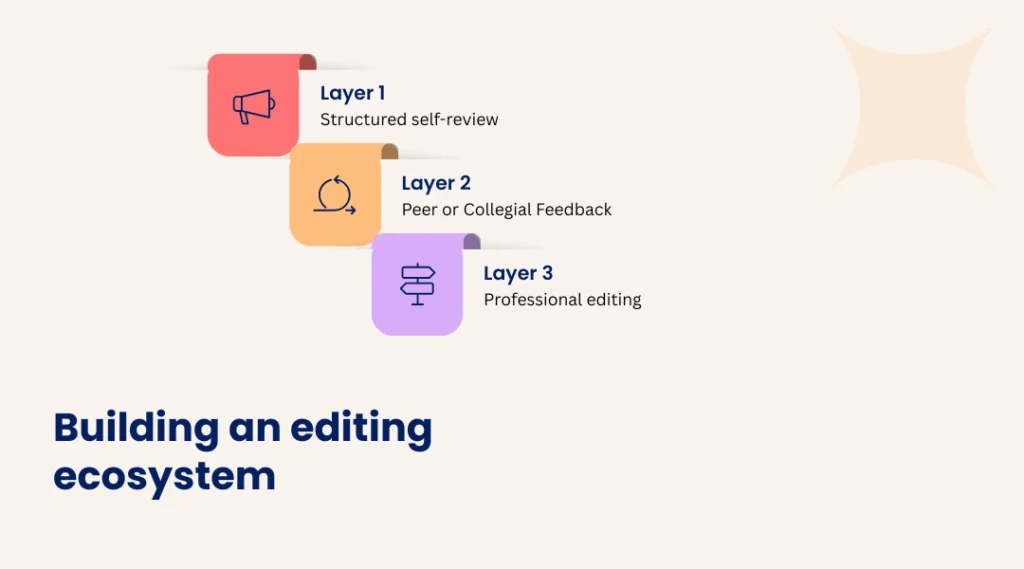
Solving self editing problems in academic writing isn't about trying harder or reading more carefully. It's about building a system that compensates for the author's inherent blind spots. That system has three layers:
Layer 1 — Structured Self-Review: Use a formal self-editing checklist (like the one above). Don't rely on intuition. Work through categories systematically. Read your paper aloud — hearing your words activates different neural pathways and catches errors your visual cortex misses.
Layer 2 — Peer or Collegial Feedback: Find someone in your field — or adjacent to it — to read the work. Give them specific prompts: "Tell me where you got confused" or "Tell me what you think my main argument is." Their confusion is data. Their confusion is not their problem — it's yours.
Layer 3 — Professional Editing: For manuscripts heading to high-stakes submission — journals, dissertations, grant proposals, or self-published academic books — professional editing is not a luxury. It's quality assurance. PaperEdit's full editing services cover everything from language correction to argument alignment and formatting, tailored specifically for academic authors.
Try their professional formatting services!
The authors who consistently publish in top-tier journals aren't better writers than their peers in a raw talent sense. They're better systems thinkers. They've built workflows that catch what they can't see — and they use those systems every single time.
Self-Editing and the Ethics of Academic Submission
There's an ethical dimension here that doesn't get enough airtime. Submitting work riddled with preventable errors wastes peer reviewers' time, burdens editorial boards, and — if the errors are substantive — risks publishing work that misrepresents findings or misleads readers.
Academic integrity isn't only about avoiding plagiarism. It's about presenting your work honestly, clearly, and rigorously. Knowing that self-editing has cognitive limits and doing nothing about it is a form of neglect — however unintentional. According to the Committee on Publication Ethics (COPE), authors have a responsibility to ensure the accuracy, clarity, and integrity of their submissions before peer review begins.
That responsibility extends to the editing process. Using self publishing editing services or professional academic editors isn't cheating — it's diligence. It's doing the job properly.
Final Word: The Author's Blind Spot Is Real, But Fixable
The inability to accurately self-edit your own academic writing is not a character flaw. It's not a sign of poor scholarship. It is a documented, predictable cognitive phenomenon — and it affects everyone from first-year doctoral students to tenured professors.
What separates strong academic writers from weak ones isn't the absence of blind spots. It's the presence of a system that catches what the author cannot see.
Use a self-editing checklist. Build in peer feedback. Invest in professional editing for high-stakes work. And approach every draft with the humility to acknowledge that no matter how well you know your subject — the author's purpose is always clearest to the author, and almost never as clear to everyone else.
The goal of academic writing isn't to impress yourself with your own argument. It's to make that argument unmistakably clear to someone who hasn't lived inside it for a year.
Explore more from the guide: Weak Arguments in Academic Papers (And How to Fix Them).
Your readers deserve that clarity. So does your research.
For further help, explore our blogs section.
Reference Books
- Sword, H. (2012). Stylish Academic Writing. Harvard University Press. — A landmark guide that diagnoses the habits making academic writing needlessly opaque, with direct, evidence-based strategies for writing with clarity and authority.
- Mack, C. A. (2018). How to Write a Good Scientific Paper. SPIE Press. — Practical, rigorous, and written specifically for researchers, this book walks through every stage of the academic writing and editing process with discipline-level precision.