


You've submitted your manuscript. And, you've obsessed over every word, citation, and figure. You've waited for the editor's response with the kind of anxiety that only researchers understand. Then silence. Days turn into weeks. Your emails disappear into some digital void where journal editors apparently live. Should you follow up? Can you even do that without looking desperate or unprofessional?
The answer is yes—and you probably should.
Following up with a journal editor isn't a sign of weakness. It's a sign of professional diligence. But here's where most academics stumble: they either never follow up (leaving their manuscripts forgotten in the slush pile) or they follow up so aggressively that editors start dreading their emails. This guide cuts through the confusion and shows you exactly when, how, and why to follow up with journal editors—without torching your reputation in the process.
Read: How to get a paper published without being at a university?
Why Journal Editors Expect Professional Follow-ups
Let's be clear about it too: editors in journals are overwhelmed. They have to deal with numerous papers every year while managing their own research projects, teaching, and trying not to think about their 47,000 unread emails. Your follow up is not disturbing them; it is a reminder of the fact that you are there.
Editors appreciate persistence. There are various studies that show that manuscripts that have been followed up on are remembered much better than those that have been forgotten. This is not an issue of favoritism. The above happens just because following up shows that you have been serious about your paper.
The thing that editors would never tell you is that they lose track of things. Manuscripts are piled under tons of responsibilities. A reviewer drops out at some point. A deadline changes. Your follow up is the only thing that will move your paper to the "in progress" pile from the "deal with it later" pile. To find this out, you may refer to the Committee on Publication Ethics, which is responsible for establishing a set of rules about the way editors should behave and handle the manuscripts.
And in this case, you can apply the words "professional persistence".
The Psychology Behind Your Silence: What Editors Actually Think
When you don't follow up, what's the editor thinking? Likely one of these narratives:
- "They found a better venue." The author might be pursuing publication elsewhere, which is fine—that's how academia works.
- "They withdrew it." Many authors silently pull manuscripts without formal notice, assuming the journal "got the idea."
- "They're not checking their email." The editor genuinely might assume you've moved on or changed your mind.
- "I should probably get back to them eventually." Buried under the backlog, your manuscript shifts further down the priority queue with each passing day.
None of these scenarios is ideal. But here's what a professional follow up email after application accomplishes: it interrupts these narratives. It says, clearly and politely, that you're still here, still interested, and still expecting communication.
Research by the National Institutes of Health (NIH) on grant application timelines shows that manuscripts and applications that receive structured follow-ups have significantly higher success rates—not because of the content of the follow-up, but because they stay visible and relevant in decision-makers' minds.
The psychology cuts both ways too. When you follow up professionally, you reinforce your own commitment. You're not in a state of anxious waiting; you're actively managing your submission process. That psychological shift—from passive to active—often translates into better overall research outcomes because you're staying engaged with your work.
How Long Should You Wait Before Following Up?
This is where most academics get stuck. "Is two weeks too soon? Should I wait three months?" The answer depends on the journal's explicit guidelines—and on the stage of the review process.
Understanding the Timeline
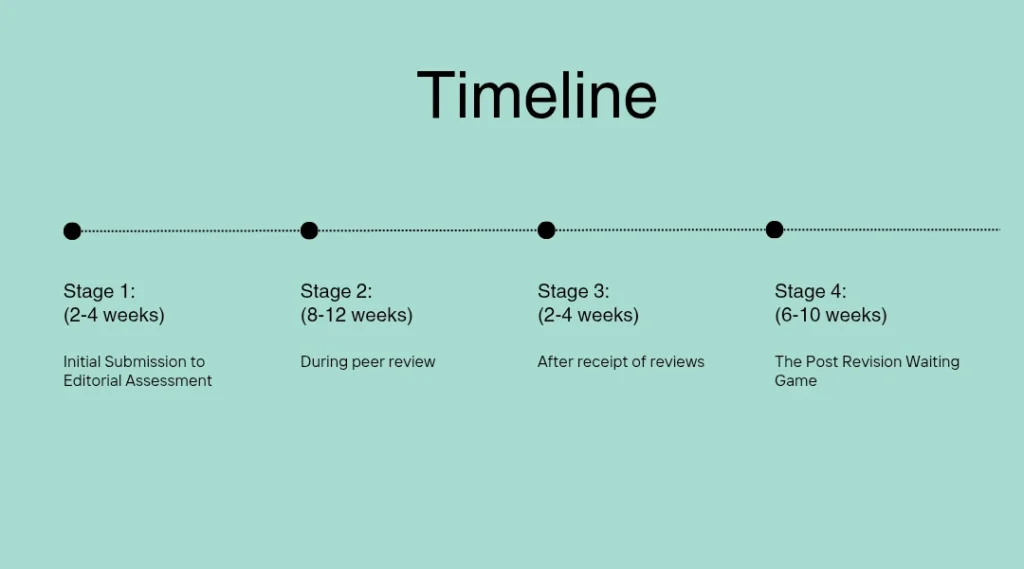
Initial Submission to Editorial Assessment (2-4 weeks):
Following the submission, you should not follow up for at least two weeks. The editor will consider whether or not to send your paper for peer-review, which takes time and there will be a logical process of reading submissions, checking them for compliance with the journal's requirements and allocating reviewers' responsibilities. The International Committee of Medical Journal Editors (ICMJE) has established the average time period for journal decisions; it amounts to 4-8 weeks.
Peer-Review Process (8-12 weeks):
When the editorial board makes a decision to review a certain paper, it usually takes reviewers 6-12 weeks to provide their comments on the manuscript. However, you may expect to have the prolongation of this period.
Understanding the Peer Review Process: How It Works and How to Respond
Post-Revisions (2-4 weeks):
When you get comments from the reviewers as well as respond to them and submit your corrections, you should do this within the fixed time limits. If the editor's comment indicates a deadline for you in 3 months, you will have to remind them about yourself if you have already waited for 10 weeks without receiving any news.Wait at least 6 weeks before following up, then every 4 weeks thereafter if you still haven't heard.
| Stage | Expected Timeline | When to Follow Up | Tone |
| Initial submission review | 2–4 weeks | After 4 weeks if silent | Neutral, brief check-in |
| Peer review stage | 8–12 weeks | After 12 weeks; then every 4 weeks | Professional, reference submission ID |
| Revisions requested | As specified (typically 2–3 months) | One week before deadline if no progress; then weekly | Respectful, factual |
| Post-revision review | 6–10 weeks | After 8 weeks; then every 3–4 weeks | Persistent but patient |
| Final decision pending | Varies widely | After 2 weeks of specified timeline | Direct but courteous |
The table above gives you a roadmap. But remember: these are guidelines, not laws. Some journals are faster. Some are glacially slow. Your job is to follow what that specific journal says while also maintaining reasonable expectations.
The Directory of Open Access Journals (DOAJ) maintains standards for journal operations that you can consult if a journal seems to be dragging its feet unreasonably.
Crafting the Perfect Follow-up Email After No Response
This is where most academics fail. They either write something that sounds desperate ("Did you get my email? I'm so sorry to bother you...") or something that sounds aggressive ("It's been 6 months; why hasn't this been reviewed?"). Neither works.
Here's a template for a professional follow up email after no response that actually gets results:
Subject Line: Manuscript Inquiry: [Manuscript ID] - [Your Last Name]
Body:
Dear Dr. [Editor Name],
I hope this message finds you well. I'm writing to check on the status of my manuscript, "[Manuscript Title]," which I submitted on [submission date]. The manuscript ID is [XXXXX].
According to your journal's guidelines, I expected an initial editorial decision within [specify timeframe]. As it has been [actual time passed] since submission, I wanted to ensure the manuscript was received and is progressing through review.
I remain very interested in publishing with [Journal Name] and am happy to provide any additional information you might need.
Thank you for your time and attention.
Best regards, [Your Name] [Your Institution] [Your ORCID if applicable]
Why this works:
- It's factual, not emotional. You're stating what should have happened versus what did. No apologies for existing.
- It includes specifics. Manuscript ID, submission date, and the journal's own timeline. This shows you've done your homework.
- It's brief. Editors are busy. You're asking a simple question that deserves a simple answer.
- It ends positively. You're reaffirming your interest, not threatening to withdraw.
For a sending a follow-up email after no response sample in the revision stage (when you've already received feedback), modify it slightly:
Dear Dr. [Editor Name],
I submitted my revised manuscript and response to reviewer comments on [date] (Manuscript ID: [XXXXX]). I wanted to check on the status of the re-review process.
I'm happy to address any additional concerns or clarifications needed.
Thank you for considering my work.
Best regards, [Your Name]
This version acknowledges that you've already done work—you've revised, you've responded—and you're just checking in on next steps. That's not pestering; that's professional project management.
Alternative Ways to Reach Out: Beyond Email
Not all follow-ups need to be emails. Sometimes, different channels work better—depending on the journal's structure and your professional relationship with the editor.
- Xtwitter/X or Academic Social Media: There are some editors who keep an eye on what is happening on social media. You can sometimes give things a slight push by mentioning your submission in a polite and kind way in public (but not in any aggressive way). You must be careful, however—what you don’t want to do is bring out the journal into public disrepute. For example, “I really appreciate the efforts of [@journal_name] in considering my submission on [topic]” or “How long does it take? I submitted my manuscript to @journal_name 6 months ago but got no news” are two very different messages.
- Institutional relationships: In case you belong to the same institution or are part of the same conference network with the editor, you can ask them directly about the status of your submission in an informal setting. A sentence like, “If I’m not mistaken, my paper is currently with you for review” will suffice in this case.
- Linkedin message: Depending on the field of the editor and the preference of the editor, contacting them through LinkedIn may result in a successful result.
- Journal's Online System: Most journals have submission tracking systems where you can check status. Use these before sending an email. If the system shows your manuscript in "under review," you have your answer—be patient.
The safest approach?
Stick with email. It's documented, professional, and leaves a paper trail (important if you need to escalate later).
What NOT to Do: Common Follow-up Mistakes
Smart researchers learn from others' failures. Here are the cardinal sins of manuscript follow-ups:
1. Don't Follow Up Too Soon
Emailing after 10 days screams "I don't understand how publishing works." You'll be flagged as a problem author. Wait the appropriate time. The wait is agonizing, but it's part of the process.
2. Don't Make It Personal
"I've been waiting so long, and this is stressing me out" or "I need this for my tenure case" are personal problems, not editorial ones. Editors care about the manuscript's quality and fit, not your timeline.
3. Don't Follow Up Multiple Times Without Spacing
Sending three emails in two weeks makes you look unhinged. Space follow-ups appropriately—typically every 4 weeks once you're in the deep waiting period.
4. Don't Threaten or Complain
"I'm withdrawing this if I don't hear back in a week" or "Other journals are faster" might feel cathartic, but they burn bridges permanently. Academic communities are small. Editors talk.
5. Don't Send the Same Email Twice
If you followed up two weeks ago and got no response, your next email should acknowledge that. "Following up on my previous message from [date]..." shows you understand time has passed and you're not just resending.
6. Don't Ask Vague Questions
"What's the status?" is weaker than "I'm checking on the status of manuscript [ID], submitted on [date], which should have received an editorial decision by [date]." Specificity makes it easier for them to help you.
7. Don't Use Passive-Aggressive Language
"I'm sure you're very busy" is a subtle jab. "I understand the review process takes time" is better—it shows maturity and realistic expectations.
You can also explore about use of active passive voice in your manuscript with the guide 'Active vs. Passive Voice: Which Is Best for Scientific Writing?'
Managing Multiple Submissions Simultaneously
Here's something they don't teach in grad school: most serious researchers have multiple manuscripts at different journals simultaneously. This creates a management challenge. You need to track where each manuscript is, when it's appropriate to follow up, and ensure you're not accidentally sending the same follow-up email to the wrong editor (yes, this happens, and it's mortifying).
Create a Submission Tracker:
Use a simple spreadsheet with:
- Manuscript title
- Journal name
- Editor name
- Submission date
- Expected decision date
- Last communication date
- Current status
- Next follow-up date
This removes emotion from the equation. When the calendar hits your "follow-up date," you follow up. No agonizing, no overthinking.
Never Mention Other Submissions in Your Follow-up
Don't say, "I've submitted this to five other journals as backup." That's implied in academic publishing, but stating it explicitly sounds desperate. Your follow-up should assume this is the editor's top priority (even though it isn't).
Prioritize by Timeline
If you have manuscripts at five journals and four are due for follow-up this week, prioritize by which one is oldest and which has the closest impact factor or prestige. Follow up strategically, not randomly.
After Rejection: When and How to Follow Up
It is not uncommon to feel the need to know more about the rejection you have received—to want to know the reasons for the rejection or even the possibility of discussing about it.
Journal Rejection Rate Explained (And How to Beat It)
Understanding Rejection with Feedback: If you receive feedback with a rejection from the editor, make sure to read the feedback carefully. If you receive a desk rejection from the editor, then following up the rejection is futile unless you want an angle that would be entirely different. If the rejection has come after peer review, the editor must have put his/her time in reviewing the paper, so a follow-up to discuss the comments from reviewer will only be useful if you have sincere intentions of learning and not just to have the decision upturned since there wouldn't be any point in the follow-up otherwise.
The "Request Reconsideration" Email:
Only send this if:
- You have genuinely new data or analysis that addresses a major criticism
- A reviewer clearly misunderstood your work
- The journal made a procedural error
Don't send it because you're disappointed.
Sample:
Dear Dr. [Editor Name],
Thank you for the feedback on manuscript [ID]. While I respect the decision, I wanted to bring [specific new finding/clarification] to your attention, which directly addresses the primary concern raised by Reviewer 2.
I've attached [new data/revised analysis]. If you feel this warrants reconsideration, I'd be happy to submit a revised manuscript.
Thank you.
Keep it short.
Don't argue.
Provide new information or leave it alone.
Active Voice and Professional Authority in Your Follow-ups
Here's a subtle but important point: the way you write your follow-up emails affects how editors perceive you.
Weak (Passive): "It is hoped that an update on the manuscript status might be provided."
Strong (Active): "I'm writing to check on the status of my manuscript."
Weak (Passive): "The timeline outlined in the journal's guidelines was expected to be followed."
Strong (Active): "Your journal's guidelines indicate I should receive a decision by [date]."
Editors make snap judgments about professionalism based on writing quality. Your follow-up email is your chance to demonstrate that you're a serious researcher with strong communication skills. Use active voice. Be direct. Sound confident without sounding demanding.
You can explore more guidance on academic writing standards through the Purdue OWL (Online Writing Lab), which provides detailed resources on professional academic communication.
The Ethical Dimension: Why Integrity Matters in Every Follow-up
This bears saying directly: never embellish your follow-up. Don't claim you have a job offer deadline if you don't loop. Also, don't say another journal accepted your work if they haven't. Don't threaten to take your work elsewhere unless you genuinely mean it.
These tactics backfire. Editors maintain informal networks. Word spreads about authors who play games. Your reputation—which matters far more than any single publication—is at stake.
A professional follow-up is honest. It states facts and respects the editor's time. It assumes good faith on both sides. That integrity is what separates authors who build successful publishing careers from those who burn out trying to game the system.
The Office of Research Integrity (ORI) provides comprehensive guidance on research ethics, including standards for honest academic communication.
Want to know about publication ethics? Explore: Ethical Challenges in Multi-Center Research.
Key Takeaways: Your Follow-Up Framework
- Follow up. Silence benefits no one. A professional follow-up keeps your work visible and maintains momentum.
- Time it right. Understand your journal's expected timelines and wait appropriately before your first contact.
- Keep it professional. Your follow-up email should be brief, factual, and free of emotional language.
- Space subsequent follow-ups. Every 4 weeks is a reasonable interval once you're in deep waiting.
- Use specifics. Include manuscript IDs, submission dates, and expected decision dates. This shows you're organized and serious.
- Recognize editor limitations. They're overwhelmed. Your follow-up should make their job easier, not harder.
- Never burn bridges. Your reputation across academic publishing communities matters more than any single journal decision.
Following up with journal editors isn't something to be anxious about. It's something to be strategic about. You're not pestering—you're professionally managing your publication timeline. When done right, editors will respect you for it.
Explore more about the changes in Academic Publishing with the changing era in 'The Future of Academic Publishing in the AI Era'.
Reference Books
- Belcher, W. L. (2019). Writing Your Journal Article in 12 Weeks: A Guide to Academic Publishing Success (2nd ed.). University of Chicago Press. A comprehensive guide covering the entire publication process, including strategic communication with editors.
- Murray, R. (2013). Writing for Academic Journals: Strategies for Getting Published (3rd ed.). McGraw-Hill Education. Detailed exploration of academic publishing conventions and professional communication standards with editors.