


Academic publishing is already a high-friction process. When your supervisor becomes the bottleneck, it shifts from a normal research challenge into a structural barrier. If you’re dealing with a supervisor not supporting publication, the solution isn’t confrontation—it’s strategy.
This guide breaks down exactly what to do, step by step, grounded in academic ethics, institutional frameworks, and real-world publishing dynamics. No shortcuts. No risky moves. Just a clear path forward.
Why Supervisors Block Publication (And Why It’s a Serious Issue)
Not all supervisors act in your best interest when it comes to publication.
Some are genuinely protecting research quality.
Others are protecting control.
Common reasons include:
- Concerns about methodological flaws
- Fear of rejection damages their reputation
- Disagreements over authorship order
- Delays due to competing priorities
- Internal politics within departments
- Intellectual ownership conflicts
According to policies outlined by the International Committee of Medical Journal Editors (ICMJE), authorship and publication decisions must be transparent and contribution-based—not hierarchical.
You can review authorship criteria directly via the ICMJE recommendations.
This matters because if your work meets academic standards, suppression without a valid reason becomes an ethical issue—not just a personal disagreement.
Step 1: Audit Your Manuscript Without Bias
Before assuming your supervisor is blocking you unfairly, you need to validate one thing:
Is your paper actually ready?
Brutal honesty here saves you from unnecessary conflict.
Evaluate:
- Study design robustness
- Statistical validity
- Clarity of the research question
- Strength of discussion and conclusions
- Alignment with the target journal scope
Many supervisors reject manuscripts not because they’re against publishing, but because the manuscript is weak.
If you’re unsure, get an independent review.
Resources like 'Can you publish without a supervisor' can help you understand what “publication-ready” actually means.
This step gives you leverage.
If your work is solid, you move forward with confidence.
Step 2: Understand the Supervisor vs Manager Divide
A key mistake researchers make is misunderstanding the supervisor vs manager dynamic.
A manager controls output.
A supervisor guides intellectual development.
But here’s the reality:
- Supervisors influence publication—but don’t own it
- Authorship is based on contribution, not position
- Academic work is collaborative, not hierarchical
According to the authorship guidelines explained on Wikipedia.
Your right to publish is tied to what you contributed—not your supervisor’s approval alone.
If your supervisor is acting purely as a gatekeeper without making intellectual contributions, the relationship is misaligned.
Recognizing this distinction changes how you approach the situation.
Step 3: Replace Emotional Requests with Structured Questions
Most researchers approach this incorrectly.
They say:
“Why are you not supporting my publication?”
That question invites vague answers and defensive behavior.
Instead, shift to structured, outcome-driven questions:
- “What specific revisions are required before submission?”
- “Can we define a clear timeline for submission readiness?”
- “Are there concerns related to methodology, ethics, or journal selection?”
- “What would make this manuscript acceptable for submission?”
This forces clarity.
If your supervisor provides actionable feedback, you now have a roadmap.
If they don’t, you’ve identified the real issue: lack of accountability.
Step 4: Document Everything (This Is Non-Negotiable)
If things start stalling, documentation becomes your strongest asset.
Keep records of:
- Feedback emails
- Suggested revisions
- Meeting summaries
- Agreed timelines
- Any refusal to proceed
This isn’t about building a case against your supervisor—it’s about protecting your work.
If escalation becomes necessary, undocumented claims don’t hold weight. Documented patterns do.
Step 5: Use Institutional Support Systems Strategically
Every academic institution has internal mechanisms to handle disputes.
These include:
- Graduate committees
- Research offices
- Ethics boards
- Professional support units
According to the Committee on Publication Ethics (COPE), publication disputes should be resolved through formal channels, rather than informal conflict.
This is where the professional support unit becomes critical.
Their role includes:
- Mediating conflicts
- Clarifying authorship rights
- Ensuring ethical compliance
- Protecting researcher interests
Approaching them doesn’t make you “difficult.”
It makes you professional.
Step 6: Build a Parallel Mentorship Network
If your supervisor is limiting your progress, relying solely on them is a mistake.
You need additional academic input.
Options include:
- Co-supervisors
- Senior faculty members
- External collaborators
- A field supervisor (especially in clinical or applied research)
A field supervisor can validate:
- Data collection integrity
- Practical relevance
- Methodological accuracy
This external validation strengthens your position significantly.
Learn more about these with the guides:
- Most Common Mistakes in Research Methodology Sections (And How to Avoid Them)
- Data Storytelling in Research Papers
- How to Handle Conflicting Data in Your Findings Chapter
It also reduces dependency on a single authority figure—a common failure point in academic careers.
Step 7: Know Your Legal and Ethical Rights to Publish
Here’s where most researchers hesitate unnecessarily.
You may have the right to publish independently if:
- You meet authorship criteria
- Your work is not contractually restricted
- Ethical approvals are properly documented
However, this does not mean:
- Ignoring your supervisor
- Submitting secretly
- Misrepresenting contributions
It means you proceed with awareness, documentation, and institutional alignment.
Step 8: Evaluate Your Options Using a Strategic Table
When facing a supervisor not supporting publication, your decision-making should be structured—not reactive.
Here’s a clear breakdown:
| Situation | Risk Level | Recommended Action | Outcome Potential |
| The supervisor refuses without reason | Medium | Request structured feedback | Clarifies expectations |
| Supervisor delays repeatedly | Medium-High | Set written deadlines | Forces accountability |
| An authorship dispute exists | High | Document and escalate | Enables institutional support |
| Involve the ethics committee | High | Use a professional support unit | Protects your contribution |
| Manuscript needs improvement | Low | Revise and resubmit internally | Builds supervisor confidence |
| Supervisor unavailable | Medium | Seek co-supervisor input | Maintains progress |
| Supervisor blocks submission entirely | Very High | Use a professional support unit | Formal resolution pathway |
| Strong independent work | Medium | Prepare for independent submission | Enables publication |
This table isn’t theoretical—it reflects real academic conflict patterns.
Use it to decide your next move based on facts, not frustration.
Step 9: Prepare for Ethical Independent Submission
If all structured attempts fail, independent submission becomes a viable option—but only under strict conditions.
Before submitting:
- Confirm authorship contributions clearly
- Acknowledge your supervisor if required
- Ensure no data ownership conflicts
- Align with institutional policies
Also consider:
- Submitting as corresponding author
- Using journals with flexible authorship policies
- Being fully transparent in disclosures
Independent submission is not rebellion—it’s a controlled, last-resort decision.
Step 10: Strengthen Your Manuscript Until Resistance Becomes Irrelevant
One of the most effective strategies is simple:
Make your manuscript impossible to reject.
Focus on:
- Clear research contribution
- Strong statistical backing
- Journal-specific formatting
- Professional editing
Use strategies like those discussed in How to Write and Publish Your Paper in High-Impact Journals?
Also study common rejection triggers in the article: Fear of Rejection in Academic Publishing.
When your paper meets reviewer-level standards, internal resistance often fades.
Step 11: Build a Future-Proof Publishing Workflow
Don’t repeat this situation.
Create a system where:
- Publication timelines are defined early
- Authorship is agreed upon upfront
- Feedback cycles are scheduled
- Multiple mentors are involved
This eliminates:
- Delays
- Miscommunication
- Power imbalances
Publishing becomes predictable—not political.
Step 12: Protect Your Academic Reputation at All Costs
This situation tests more than your patience—it tests your professionalism.
Avoid:
- Emotional emails
- Public complaints
- Social media discussions
- Unapproved submissions
Instead:
- Stay evidence-driven
- Communicate formally
- Follow institutional pathways
Your reputation determines long-term opportunities—not just one paper.
Expanded Summary for Supervisor Assist Situations
If you’re in a situation where you need a “give me a summary for supervisor assist”, here’s the full breakdown:
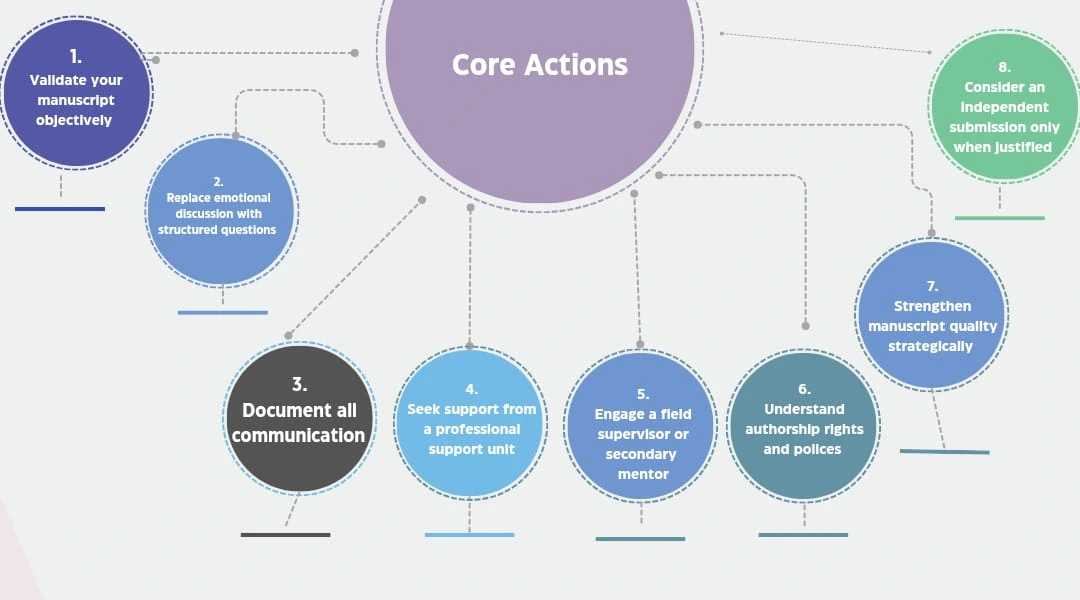
Key Insight:
This is not about conflict—it’s about control over your research trajectory.
Final Perspective: Publishing Is a System, Not a Permission
A supervisor not supporting publication feels personal—but it’s actually systemic.
Academic publishing operates on:
- Contribution
- Transparency
- Ethical compliance
Not approval from a single individual.
Once you understand this, your approach changes:
You stop asking for permission.
You start managing the process.
And that’s the difference between researchers who stay stuck—and those who publish consistently.